
2026 U.S Open: Pat Mayo’s Golf Picks, Rankings, Stats, Course Preview | Fantasy Golf Picks

Pat Mayo

3 months ago

2026 U.S OPEN RESEARCH
Mayo takes a deep dive into tournament and player stats with the Rabbit Hole Tool from Betsperts Golf, making his early 2026 US Open Golf Picks, highlighting stats that matter inside the model, and previewing the course at Shinnecock Hills with Golf Channel’s Gary Williams.
2026 U.S OPEN Field
- Field: 156 Players
- Cut: Top 60 and Ties after 36 Holes
- First Tee: June 18, 2026
- Defending Champion: J.J. Spaun
The golf world of June 2018 was a different place. Dustin Johnson was still the world’s top-ranked player while Jordan Spieth, Jason Day, and Rickie Fowler were still Top 10. Justin Rose, Rory McIlroy, Tommy Fleetwood, Justin Thomas, and Jon Rahm found themselves Top 10 as well. So, I suppose that part is kind of the same as now. Maybe not that much has changed at all, actually. Oh, Brooks Koepka was solidifying his Hall of Fame career.
SUB TO FREE PME NEWSLETTER TO GET ALL ARTICLES AND CHEATSHEETS EARLY + EXTRA INFO & BREAKING NEWS
The last time the U.S. Open rolled into Shinnecock Hills, Brooks claimed his second straight National Open. The first to hoist the cleverly named US Open Trophy two times in a row since Curtis Strange in 1989.
Brooks’ victory wasn’t the lasting image of the week, though. No, the star of the week was the USGA setup. Saturday afternoon, balls were skipping off greens, players were looking at officials like they’d been personally betrayed, and social media had collectively decided the course was one gust away from becoming pure concrete. If you’d like to mimic those conditions, head on down to a Walmart parking lot at 3 a.m. and hit off that.
From what they’ve publicly stated, and the reviews of some top players, things appear fair this time around. It was never about easy vs hard; despite many claims to that point, Major championships need to be fair inasmuch as they reward excellent shots and punish bad ones. Shinnecock doesn’t need to be gimmicked up to do that.
One misconception about Shinnecock Hills is that it’s this narrow U.S. Open torture chamber where every fairway is the width of a balance beam. It’s actually pretty wide. In 2018, the USGA narrowed the fairways; that is not going to happen in 2026. So, the fairways are there. You can find them. Whether you choose to is another matter entirely.
Directly off the fairway is the punishing thick grass. The US Open conditions you’re used to. There doesn’t appear to be any sort of graduated rough. It’s fairway, straight into the shit. Beyond that cut of rough is the prevalent fescue. Having a lot of fescue experience, I’d rather take my chances in that and pray to draw a good lie rather than the rough, which will yield none.
We’ve seen it at some U.S. Opens, where it’s often better to miss the fairway by 30 yards than three. Miss big and you may have a better chance to advance the ball into a par-saving position. Miss small and suddenly you’re in the golf equivalent of quicksand, standing over a half-wedge from an awkward angle wondering how a shot that missed the fairway by six feet turned into a double bogey.
And that’s what makes Shinnecock so fascinating. Unlike the majority of US Open venues, which basically beat everyone over the head with the same frying pan (distance), Shinnecock doesn’t have one obvious answer: Bombers can contend. Plotters can contend. Elite iron players can contend. Great putters can contend. If you look at past leaderboards here, they often resemble an Open Championship more than a U.S. Open. Everyone arrives with a different recipe, and somehow they’re all cooking with the same ingredients by Sunday.
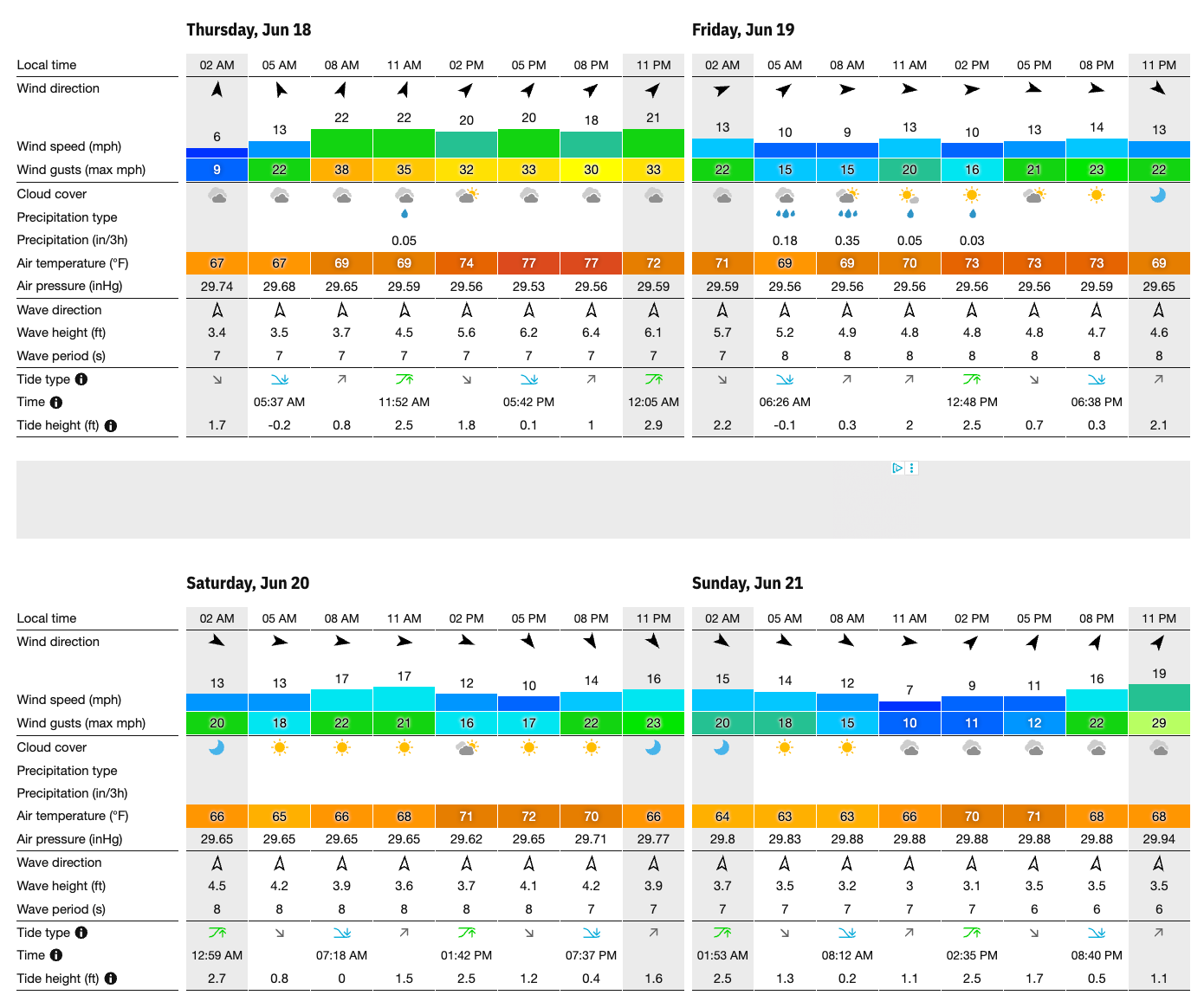
The course can be set up as easy or as difficult as they want, but the wind is going to have the ultimate say.
The weather is the real superintendent at Shinnecock. If it’s calm, you’ll hear players tell everyone how fair the course is and how much they enjoy the challenge. If it’s blowing 25 miles per hour, you’ll hear grown men who have made $400 million playing golf start discussing whether the ball they personally designed is actually any good.
A slight forecast change can completely alter the championship. Ten-mile-per-hour winds? We might get a winning score around par. Twenty-five? Suddenly the leaderboard starts looking like someone forgot to carry the one.
Then there are the greens.
Many have compared them to Augusta National, which is pretty fair. Miss in the wrong section and you’re essentially putting from a different zip code. The difference is that Augusta tends to give players options. Shinnecock gives you consequences. The contours are severe, the surrounds are tight, and once the ball starts moving away from the hole, you probably wish you’d given a hug beforehand because it’s gonna be a while before you see it again.
Obviously, the manicured bentgrass from Augusta National will interact with the ball differently than the coastal Bent/Poa blend the field will take this week, but the firmness of the greens should be similar. As will the chipping. Beyond the conditions, part of the reason past leaderboards have resembled Open Championships is the creativity that can be used from greenside. Where a lot of US Opens give you the ability to hack the ball from deep rough, Shinnecock’s run-off areas will allow players to choose their own adventure from greenside. We may even get to see a few 3-wood bumps from off the green this week. Always exciting.
This is why Shinnecock remains one of the best Major championship venues in the world. It doesn’t reward one style of golfer. It rewards the player who can adapt, survive, and avoid losing his mind for four straight days. Which, admittedly, eliminates about 90% of the field before they even tee off.
Player Updates: Brooks Koepka withdrew from the final round of the RBC Canadian Open on Sunday morning with a hand injury. Jake Knapp has been sidelined with a wrist injury since the RBC Heritage in April. He was listed in the field for the Memorial Tournament two weeks ago but ultimately withdrew. There have been no updates on either player’s status as of yet. Expect Brooks to play, while Knapp remains closer to a 50/50 proposition to tee it up.
2026 U.S Open Key Stats
- Strokes Gained: Approach
- Par 4 Scoring
- Strokes Gained: Open Championships & Links Courses
- Strokes Gained: Difficult Courses
MAKE YOUR OWN RANKINGS & GET ACCESS TO ALL TOOLS AT RABBIT HOLE FOR $1 THIS WEEK WITH CODE “USOPEN”!!!!!!
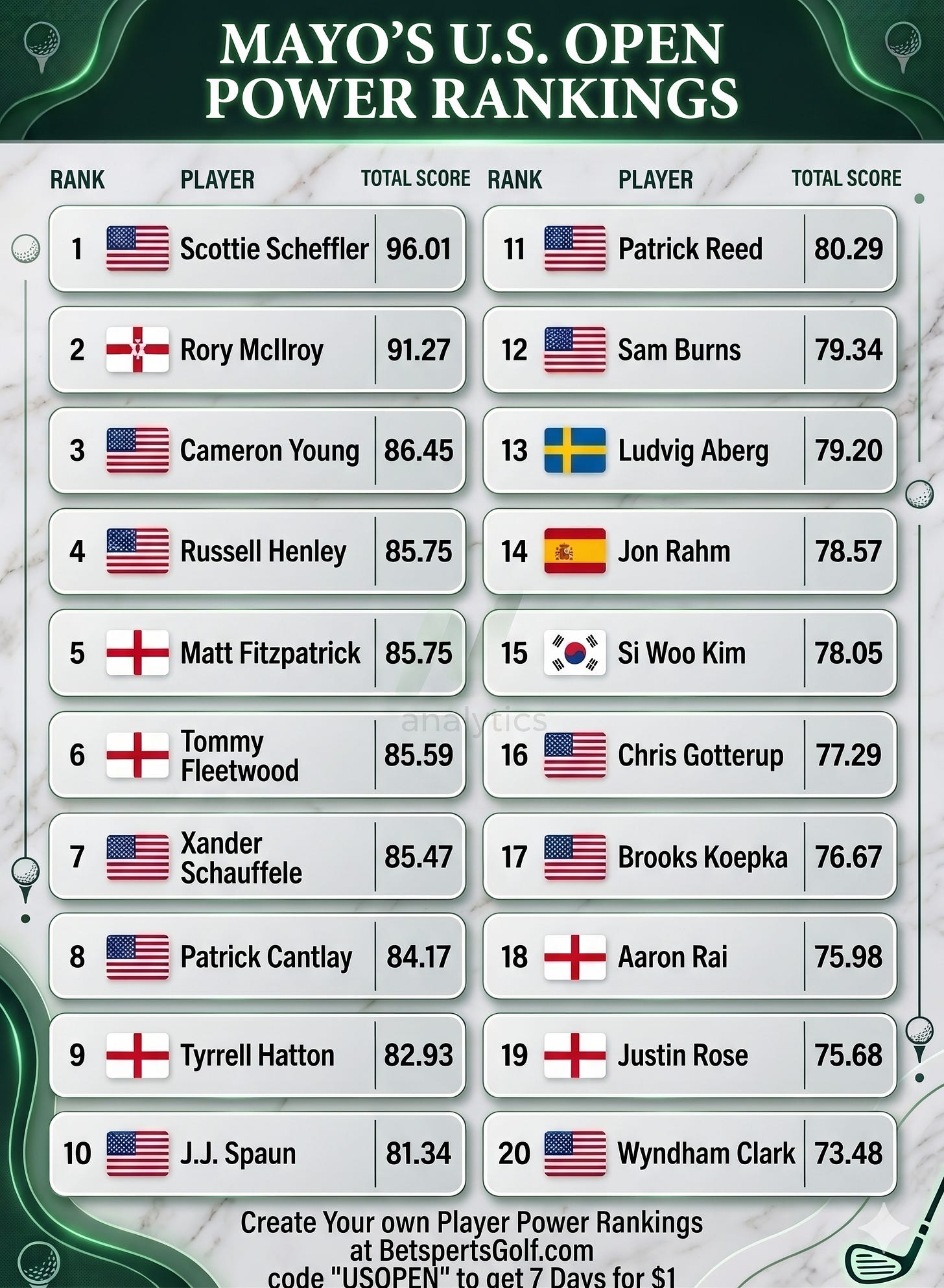
2026 U.S Open Course
- Shinnecock Hills
- Par: 70
- Yardage: 7,440
- Greens: Bentgrass/Poa Mix
- Average Green Size: 7,500 sq. ft.
- Bunkers: 151
- Water Hazards: 1
Hole 1: 394 yards (Par 4)
Hole 2: 252 yards (Par 3)
Hole 3: 501 yards (Par 4)
Hole 4: 476 yards (Par 4)
Hole 5: 592 yards (Par 5)
Hole 6: 495 yards (Par 4)
Hole 7: 187 yards (Par 3)
Hole 8: 440 yards (Par 4)
Hole 9: 482 yards (Par 4)
Hole 10: 415 yards (Par 4)
Hole 11: 157 yards (Par 3)
Hole 12: 469 yards (Par 4)
Hole 13: 371 yards (Par 4)
Hole 14: 520 yards (Par 4)
Hole 15: 409 yards (Par 4)
Hole 16: 614 yards (Par 5)
Hole 17: 176 yards (Par 3)
Hole 18: 490 yards (Par 4)
Par 3’s (4): Average Distance – 194 yards
-> Hole #2 measures 252 while the other 3 are under 190
- 2018 Koepka: -2 on #3, even on the other Par 3’s for the week
- 3rd best SG:TOT on Par 70’s in 2018
Par 4’s (12): Average Distance – 455 yards
-> 2 under 400, 2 of 500+, plurality come in the 465-495 bucket
- 2018 Koepka: 2 double bogeys in Round 1 and both came on Par 4’s
- 8th on APP that season on courses with large greens
Par 5’s (2): Average Distance – 603 yards
- 2018 Koepka: Birdied both on Sunday after having just one Par 5 birdie up to that point
- 3rd best Ball Striker for the 2018 season on long/very long courses
Past Events at Shinnecock Hills
- 1896 U.S. Open (James Foulis)
- 1896 U.S. Amateur (H.J. Whigham)
- 1900 U.S. Women’s Amateur (Frances Griscom)
- 1967 U.S. Senior Amateur (Ray Palmer)
- 1977 Walker Cup (USA)
- 1986 U.S. Open (Raymond Floyd)
- 1995 U.S. Open (Corey Pavin)
- 2004 U.S. Open (Retief Goosen)
- 2018 U.S. Open (Brooks Koepka)
2026 U.S Open Past Winners & Form
2025: JJ Spaun -1 (at Oakmont)
T-6th at Charles Schwab, cut at Memorial, gained OTT in 6 straight prior to the win
2024: Bryson DeChambeau -6 (at Pinehurst No. 2)
T-6th at The Masters, 2nd at the PGA Championship, gained over a stroke OTT in every major that season
2023: Wyndham Clark -10 (at LA Country Club)
Cut at the PGA Championship, T-12th at Memorial, gained APP in 6 straight measured events prior to his win
2022: Matt Fitzpatrick -6 (at The Country Club)
Cut at Memorial, T-10th at RBC Canadian Open, over +1.25 T2G in his four lead-in events
2021: Jon Rahm -6 (at Torrey Pines)
T-8th at PGA Championship, W/D at Memorial (was spiking: +3.06 in APP prior to W)
2018: Brooks Koepka +1 (HERE)
2nd at Fort Worth, T-30th at St. Jude, gained over 0.4 P in each of his four lead-in events
PAST WINNER DETAIL
2025: JJ Spaun -1 (+15000) beat Robert MacIntyre by 2
2024: Bryson DeChambeau -6 (+2000, T-5th on the odds board) beat Rory McIlory by 1
2023: Wyndham Clark -10 ( +10000) beat Rory McIlroy by 1
2022: Matt Fitzpatrick -6 (+3000, T-10th on the betting board) beat Scottie Scheffler and Will Zalatoris by 1
2021: Jon Rahm -6 (+1000, betting favorite) beat Louis Oosthuizen by 1
2018: Brooks Koepka +1 (Shinnecock) (+2500, T-10th on the betting board) beat Tommy Fleetwood by 1
- Brooks was 1st for the week in APP, negating the 115th ranking in ARG
- Top 4 finishers (in order) in SG:BS for the week: 1st-2nd-18th-3rd
- Of the top 9 finishers, 4 ranked outside the top 90 OTT
GET THE RABBIT HOLE FOR $1 THIS WEEK WITH CODE “USOPEN”!!!!!!
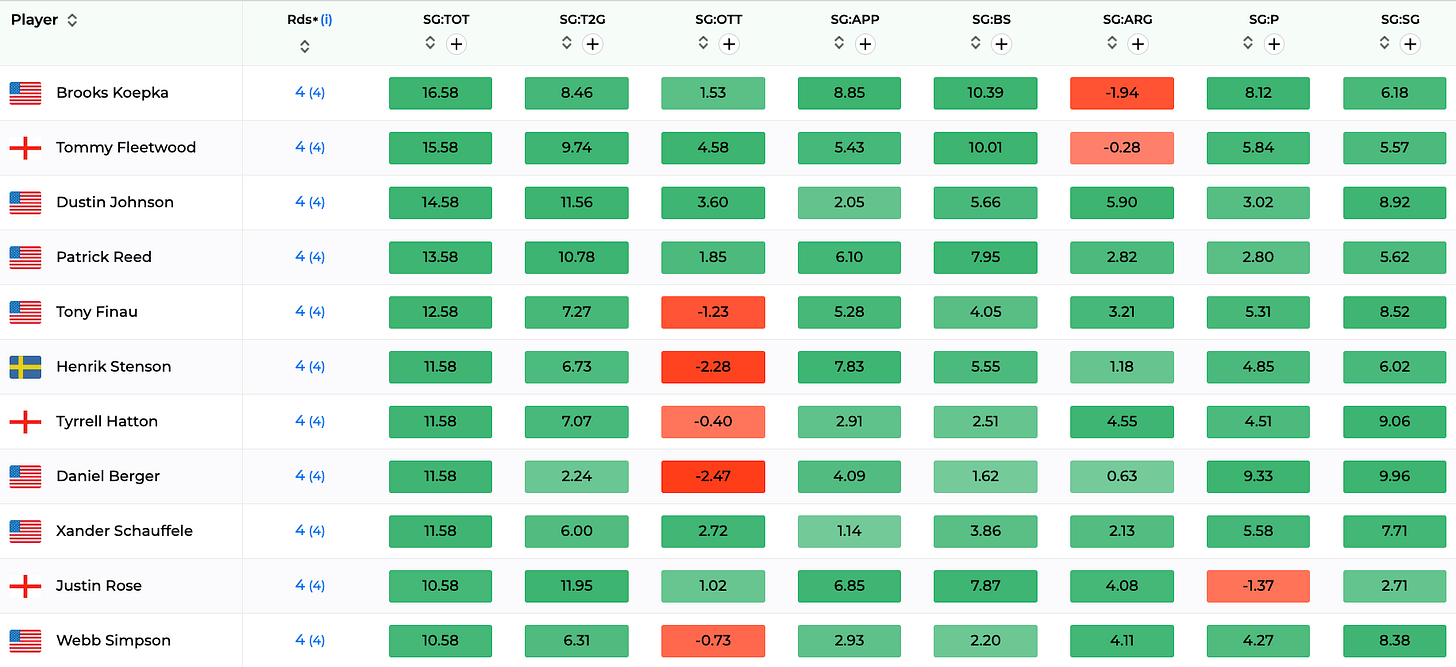
US OPEN FIRST ROUND LEADERS
2025
66 – JJ Spaun (AM)
2024
65 – Rory McIlroy (PM) and Patrick Cantlay (AM), played together on Sunday
2023
62 – Xander Schauffele (AM) and Rickie Fowler (AM) … neither shot better than 68 for the rest of the week, Fowler went 62-68-70-75
2022
66 – Adam Hadwin (PM)
2021
67 – Louis Oosthuizen (PM) and Russell Henley (AM)
2018 (Shinnecock)
69 – Dustin Johnson (PM), Russell Henley (PM), Ian Poulter (AM), and Scott Piercy (AM, first group)
2026 U.S. Open Quick Notes
2026 will be the first U.S. Open played at Shinnecock without modifications to William Flynn’s original 1931 design. That’s a stark contrast to 2018, when the setup became the story by Sunday. The USGA got roasted for 2018. This time, they’re essentially saying, “The course is already hard enough.”
Shinnecock will play at 7,440 yards. Long, yes, but nowhere near the monsters we’ve seen recently.
For comparison:
- Erin Hills stretched to 7,845 yards
- Chambers Bay reached 7,695 yards
- Torrey Pines exceeded 7,670 yards
This isn’t a bomb-and-gouge setup. It’s far more positional than raw distance. Hence why the leaderboards at past U.S. Opens have more closely resembled Open Championships rather than a typical bomb-and-gouge U.S. Open.
Shinnecock is the only course to host U.S. Opens in three centuries. Founded in 1891, it’s the oldest incorporated golf club in America and one of the five founding USGA clubs.
Robert MacIntyre finished runner-up at Oakmont and became only the third left-hander to finish second in U.S. Open history. The championship still has never produced a left-handed winner. Bad news for Brian Harman, Bobby Mac, Akshay Bhatia, Sudarshan Yellamaraju, and others.
Flynn designed the routing specifically to expose players to different wind directions. The redesign completed in 1931 created “a trio of routing triangles,” exposing players to a variety of wind directions. Unlike links golf, where everyone knows weather matters, Shinnecock is America’s closest thing to a weather-dependent U.S. Open. Same course, totally different championship depending on whether it’s blowing 5 mph or 25 mph.
Here is the current forecast for Rounds 1-4:
WIND TOWER: Tuckahoe / Southampton
Mayo’s 2026 U.S. Open Golf Picks
Chris Gotterup — Two wins this year, four over the past 12 months, and now we get a course that can showcase the best of his abilities. The fairways are wide enough to accommodate his prodigious driver (6th in Driving Distance; 12th in SG: OTT), and he enters having gained on approach in 12 of his past 13 starts.
His chipping can always be an issue, yet he was able to use his creativity from just off the green in his first go-round at Augusta National (T24) this year, as well as at last year’s Scottish Open (Win) and Open Championship (T3). And, with expected gusty conditions this week, this Jersey boy has proven he can win when the winds start to rise. You see, my theory is he plays so well in the wind because his gold chain works as an anchor to keep him steady.
Matt Fitzpatrick — Already a U.S. Open champion, Fitzpatrick has worked his way up to No. 4 in the world rankings with three victories over the past few months. His ball striking has been immaculate, his ability to navigate wind and firm conditions is among the world’s best, a lot of which has to do with his now elite chipping. Fitz ranks only behind Andrew Putnam and Scottie Scheffler in SG: ATG this season. And he remains weirdly undervalued compared to his peers on the odds board.