
2025 Butterfield Bermuda Championship at Port Royal Golf Course – Preview

Ron Klos

a year ago

With only two events remaining in the “FedExCup Fall”, the Tour heads to the island of Bermuda for the seventh edition of the Bermuda Championship. Located on high ground overlooking the Atlantic Ocean on the western shore of Southampton Parish, Port Royal Golf Course is one of the world’s most scenic island courses. Known as one of Jack Nicklaus‘ all-time favorites, it is a government-run municipal course designed by Robert Trent Jones in 1970.
One of the shortest courses played in the PGA Tour’s annual rotation, it is characterized by its hilly terrain, challenging par-3s, and the seemingly ever-present threat of windy conditions on much of the course. It features one of the most dramatic holes on the PGA Tour, the 16th, a 230-yard par 3 perched on a clifftop ledge overlooking the Atlantic.
While any type of player can win here, past winners have included some of the best putters on the Tour, including the likes of Seamus Power, Lucas Herbert, Brendon Todd, and Brian Gay. Fairways are narrow, and wedge opportunities are plentiful. This leads to numerous short to mid-range birdie putts that players must consistently make to remain in contention.
Scoring has been as low as -24 both when Todd won in 2019 and in 2023 when Camilo Villegas emerged victorious. But the prevailing conditions of Bermuda often add volatility, making for an unpredictable week. This was the case in both 2020 and 2021 when Gay and Herbert won at only -15.
The Field
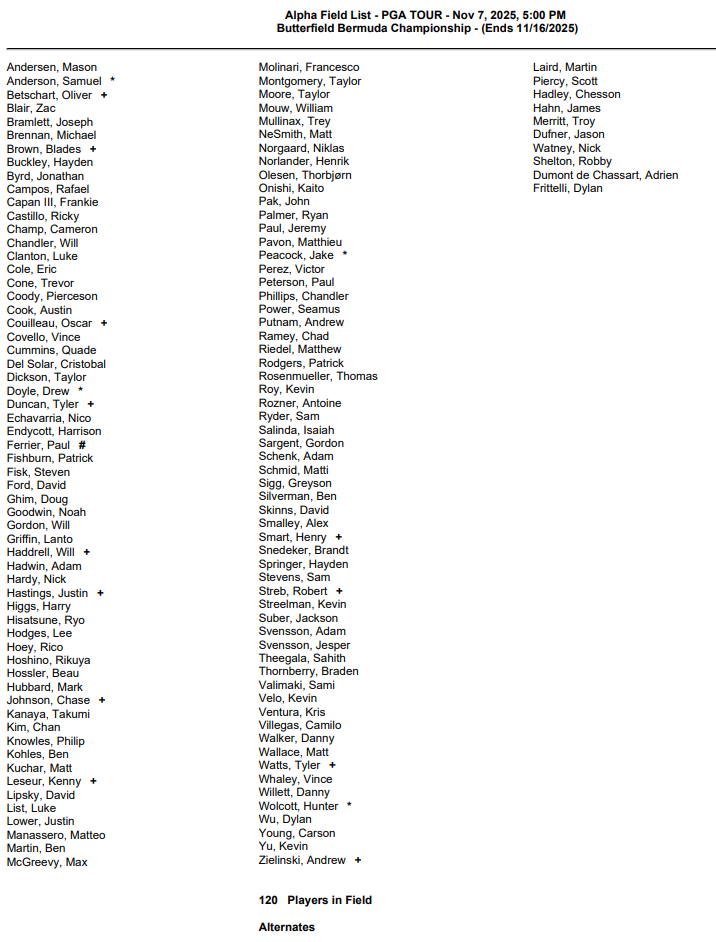
This week’s Bermuda Championship is critical for players hovering around the top 100 bubble, with those finishing inside that number securing PGA Tour cards for 2026. Golfers like Beau Hossler, Max McGreevy, David Lipsky, and Victor Perez are right on the bubble of that magic number in the standings. They, along with numerous other golfers in the field, will be hoping for a big performance this week.
In what is most likely the weakest field this year on the PGA Tour, Bank of Utah Championship winner Michael Brennan and Sam Stevens are the only two players in the field ranked among the top 50 in the world. Other notables include Sahith Theegala, Nico Echavarria, Thorbjorn Olesen, Matt Wallace, Luke Clanton, and Eric Cole. Past champions in the field include last year’s winner, Rafael Campos, Camilo Villegas, and Seamus Power.
Port Royal GC – Course History
Originally known as Southampton Golf Club, the property was purchased in 1965, with construction led by famed architect Robert Trent Jones beginning in 1967. Though the design had to be changed numerous times due to land agreements, the course was finally completed and opened in 1970. In 2008, an original member of the design team, Roger Rulewich, was in charge of the $14.5 million renovation that also made Port Royal the longest golf course in Bermuda.
Originally used by the PGA Tour in 2019 as an alternate-field event played opposite the WGC-HSBC Championship, thanks to the COVID-19 pandemic, the tournament was elevated in 2020 to a standalone event. Taylor Pendrith holds the course record with a 61 in 2021.
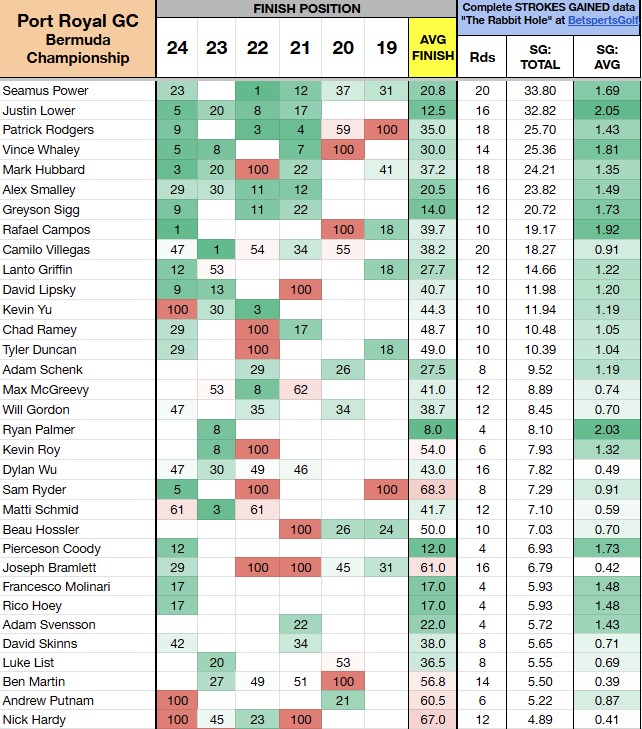
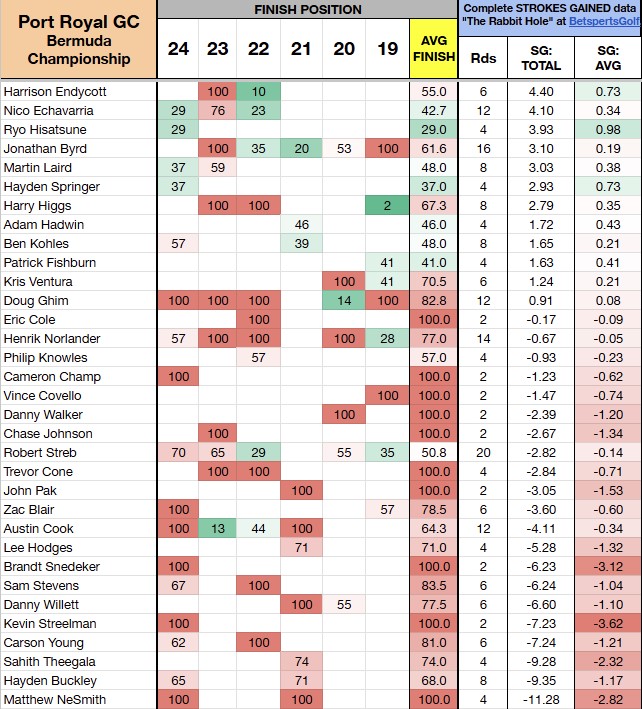
Finish Position and Strokes Gained History at Port Royal GC (2019-2024)
This includes the average finish position and Strokes Gained per round since 2016 for each of the categories. Players are sorted by SG: Total. Port Royal is the 14th most predictive annual course on Tour.
Course Features
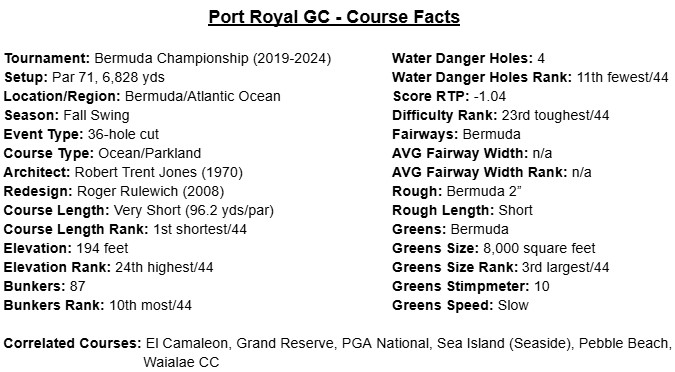
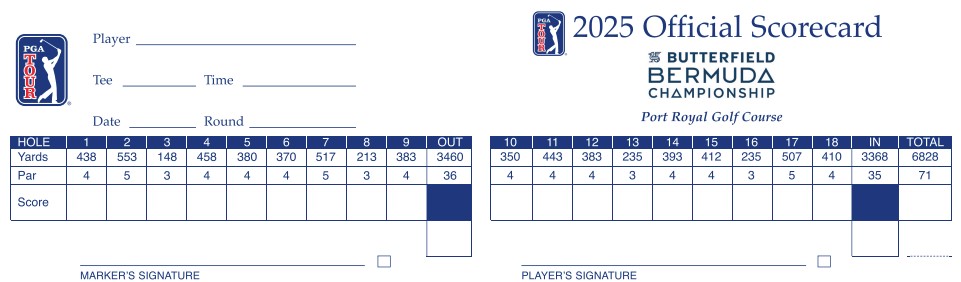
At 6,828 yards long, Port Royal is the shortest course played in the annual PGA rotation. Designed by legendary architect Robert Trent Jones Sr., the par-71 resort course takes full advantage of Bermuda’s natural terrain—clifftop tees, wind‑swept fairways, and greens with ocean glimpses from nearly everywhere. The main factor that determines the scoring conditions each year is the strength of the wind. Blustery conditions have, at least partially, influenced every tournament here, and anyone attempting to predict player outcomes should have past performance in windy conditions built into their model.
As Patrick Reed once said about Port Royal, “It’s one of those golf courses that if they didn’t have wind around here, you’d go out and you’d destroy it. So I almost feel like they need the wind here to be kind of a defense mechanism for the golf course.” And it is not just the wind, but also how often it changes direction mid-round. Said Aaron Wise about the course, “It’s definitely not a bomber’s golf course. The crazy part is how much it changes because the wind’s blowing 30 miles an hour. Then all of a sudden, if the wind switches to the dead opposite way, a ball goes 50 yards shorter or longer than it did the day before.”
Winning scores have ranged from 15-under (twice) to 24-under (twice) – with the tougher scoring years resulting from windy conditions. From shorter hitters like Brendon Todd, Seamus Power, and Camilo Villegas to longer hitters like Taylor Pendrith, Patrick Rodgers, and Lucas Herbert, all types of players have been in contention. The enormous average green size of 8,000 square feet contributes to the scoring ease, especially in the wind.
When the winds increased and certain holes stretched longer, the scoreboard made it clear that the big hitters off the tee held a definite advantage. Still, Port Royal’s short layout ensures that it can’t be completely overpowered in any conditions.
Port Royal also features consistent elevation changes, similar to those of the Plantation Course at Kapalua. As should be expected from a Robert Trent Jones design, heavy fairway bunkering is another part of the challenge. For agronomy this week, the course is 100% bermudagrass.
As for the holes themselves, the course is an interesting mix of seaside and parkland holes. The first hole tee box is perched high, with players hitting downhill as they head away from the ocean. In fact, the first seven holes are somewhat protected by trees that appear like a tropical parkland course. It is not until you reach the 7th green that you get full panoramas of the Atlantic Ocean and the crystal blue waters of Bermuda’s south shore. This is also where the wind typically intensifies as players must deal with ocean breezes for the remaining holes, except for holes 11-13.
Including the effects of the wind, the par-3s at Port Royal are among the most difficult set on Tour. Three of the four measure over 213 yards and are the most difficult holes on the course. The par 3 16th is Port Royal’s signature hole. Widely considered one of the toughest par-3s in all of golf, it is a 235-yard crescent-shaped beauty with a carry directly over the Atlantic Ocean.
Eight of the 11 par-4s are less than 415 yards, with the longest playing at 458 yards. Overall, Port Royal has the shortest group of par-4s on Tour that can also play as the easiest if the winds are low. Historically, however, seven of the 11 par’4s have averaged over par. The three par-5s measure at only 507, 517, and 553 yards and have a birdie or better rate of 45%. Even in strong winds, players will need to take advantage of these scoring holes.
Strokes Gained Analysis
Port Royal does not have ShotLink data. The analysis is based on limited course data.
Off the Tee
With generous fairways but enough hazards to keep players honest, Port Royal demands thoughtful decision-making off the tee. The compact layout allows golfers to club down when necessary, yet nearly every par 4 and par 5 features staggered fairway bunkers that force careful consideration of both club selection and landing zones.
Driving accuracy at Port Royal averages just 55%, well below the PGA Tour mark of 61%. While the fairways are on the narrower side, the lower rate is more likely a product of the island’s swirling winds that push tee shots offline, combined with the relatively forgiving 2-inch rough that doesn’t discourage players from pulling driver. As Brendon Todd noted, the presence of cross bunkers near common landing zones often forces everyone to hit similar clubs off the tee in order to carry the hazards safely.
Approach
While it is somewhat easier to flight your ball down off the tee, hitting approach shots into the wind, and especially higher lofted wedges from inside 150 yards, will be a test for players. Close to 60% of all approach shots are estimated to be hit from that distance. There will also be an above-average rate of approaches from over 200 yards when considering the long par-3 holes and each of the par-5s. With relatively straightforward green complexes and an average GIR rate of 66%, success at Port Royal often comes down to how well players can judge the wind and position approach shots close enough to create consistent birdie opportunities.
Around the Green and Putting
With both scrambling and sand save rates near the PGA Tour average, performance around the greens should have an average impact. The numerous greenside bunkers and unpredictable Bermuda rough can present challenges, but unless the wind is actively pushing shots off target, the main objective is to capitalize on scoring opportunities by converting putts.
As is typical on coastal tracks, green speeds are much slower than normal because of how exposed the surfaces are to the wind. Depending on the gusts, speeds at Port Royal have been as slow as a 9 on the stimpmeter but typically run around 10.
While scoring isn’t typically low enough to call it a putting contest, both lag putting and putting from inside 15 feet are vital this week. Past winners and high finishers have included a number of putting specialists. With the third-largest greens on Tour at an average of 8,000 square feet, the 3-putt rate last year was well above average at 3.22%. Golfers who are especially competent on bermuda greens and in windy conditions should be targeted this week.
Most Important Stats For Success at Port Royal GC
*In order of importance
- SG: APP
- SG: Coastal Courses/Windy Conditions
- SG: Putting (Bermuda)
- Driving Accuracy (DFEF)
- Scrambling
- Birdie or Better %
- Bogeys Avoided
- 3-Putt AVD
- SG: Weak Fields/Short Courses
- Proximity 50-150 yds
Key Rabbit Hole Filters
- Course Type: Coastal/Resort/Island
- Scoring Conditions: Easy
- Course Length: Very Short
- Field Strength: Very Weak
- Event Season: Fall
- Water Danger: Low
- Greens Surface: Bermuda
- Greens Speed: Slow
- Greens Size: Large
- Rough Surface: Bermuda
- Rough Length: Short
- OTT Club Type: Less than Driver
- Gain OTT: Difficult
- Gain APP: Easy
- 3-Putt AVD: Difficult
- Par 3 Scoring: Difficult