2024 U.S. Open at Pinehurst No. 2 – Preview

Ron Klos

2 years ago

To play well, a man must have a wide variety of shots. More and more he will be forced to use his head as well as his hands and arms. More and more the golfer will have to have control over the club to insure direction or meet certain trouble.
– Donald Ross
The 124th edition of the U.S. Open will be held at one of the historic courses for golf in America, Pinehurst No. 2. Home of Donald Ross’s masterpiece, it will host its fourth U.S. Open championship in the last 25 years. “Some say it’s our St. Andrews – it’s certainly something special, and that’s why we’re going back there for the 2024 U.S. Open”, said Thomas J. O’Toole Jr., the former president of the USGA.
Pinehurst Resort and Country Club consists of nine 18-hole golf courses, each named simply by a number, and a 9-hole short course. Pinehurst No. 2 has consistently been ranked as one of the top courses in North Carolina and among the best in the United States.
With its classic Donald Ross design, it was restored by the team of Bill Coore and Ben Crenshaw in 2010 to reinvigorate the historic course with Ross’ original 1930s playing conditions. First opened in 1907, it is considered to be Ross’ best work and he called it “the fairest test of championship golf I have ever designed.” He continued to perfect it until his death in 1948.
Lush green grass. Five inches of club-tangling penal rough. Narrow fairways. Those are the typical characteristics of a standard U.S. Open course. But not here. The land itself is far from dramatic. There are no sweeping vistas, no chiseled bunkers, and no breathtaking water hazards. With each of these features absent, Pinehurst will present an unfamiliar test. The brilliance of the design resides not in the spectacle but in the subtle nuances in which mere inches can result in extremely different shot outcomes. Simply being on the wrong side of a slope can mean the difference between a par and a double bogey. Said 2006 U.S. Open champion, Geoff Ogilvy, “When I think about Pinehurst No. 2, I think brilliant golf course but scary to play.”
Compared to conventional U.S. Open layouts, the fairways are expansive and lined with towering pines. There is no rough on the property. Fairways instead bleed into sandy waste areas full of wire grass, pineweed, and other native vegetation. With expected firm and fast conditions, distance control, precision, and humility in approaching greens will be paramount for climbing the leaderboard. While there are different options to play each hole, players with accuracy off the tee, quality long-iron skills, and short-game acumen will have the best chance to contend.
Pinehurst is a course where the closer you get to the hole the more it gets in your head. It’s famous for its diabolically crowned green complexes where they sit like upturned saucers and repel balls in every direction. Johnny Miller once famously compared trying to land a shot on a Pinehurst green as “like trying to hit a ball on top of a VW Beetle.” Where you end up and how you mentally respond are part of the experience and make for a unique examination.
The 2024 U.S. Open will be the 13th USGA championship to be hosted by Pinehurst and the 12th Pinehurst USGA event in the last 35 years, which is more than any other site in the United States. Other significant championships played on Pinehurst No. 2 include the 1936 PGA Championship (won by Denny Shute), the 1951 Ryder Cup Match (won by the USA), the 2005 U.S. Open (won by Michael Campbell), and the 2014 U.S. Open (won by Martin Kaymer). It will also mark the 25th anniversary of the moment Payne Stewart won the 1999 U.S. Open here with a dramatic par putt to win by a stroke over Phil Mickelson. Indelibly linked to Pinehurst, it was just four months later that Stewart would tragically die in a plane crash.
The Field
The U.S. Open is a four-round, 72-hole stroke-play championship, with a cut after 36 holes. The top 60 players and ties make the cut. After 10,052 golfers attempted to qualify for this year’s national championship, along with the conclusion of the Memorial tournament, the 156-player field is officially set. It consists of 82 exempt players and 68 qualifiers, 15 of which are amateurs.
The USGA conducted 100+ 18-hole Local Qualifiers. All players advancing then competed in 36-hole Final Qualifiers that were held at 13 sites, 10 in the U.S., one in England, one in Canada and one in Japan. Those wrapped up June 3, dubbed by some as “Golf’s Longest Day,” with some dramatic stories of young amateurs, first-time qualifiers and even a past U.S. Open champion (Webb Simpson) earning their way to start at Pinehurst.
Anyone in the top 60 of the OWGR automatically earned a spot in the field. Overall, 76 of the top 80 players in the world rankings will be in attendance at Pinehurst. Headlining the field is the unquestioned No. 1 player in the world, coming off his fifth win of the year at the Memorial, Scottie Scheffler. Just a month removed from his arrest at Valhalla which sidetracked his chances at the PGA Championship, the sky is the limit for Scheffler on a course like Pinehurst that perfectly fits his game.
There are numerous other contenders including the winner of the PGA Championship, Xander Schauffele who has the all-around game to compete with Scheffler. The No. 3-ranked player, Rory McIlroy has done everything but win a major in the past decade. Plenty of other big names exist in the next tier of favorites, though each enters with almost as many questions as answers. This includes Viktor Hovland, Collin Morikawa, Ludvig Aberg, Justin Thomas, Max Homa, Patrick Cantlay, Hideki Matsuyama, Brian Harman, Tommy Fleetwood, and last year’s winner, Wyndham Clark.
Included in the field are 13 players from LIV Golf led by Jon Rahm, Bryson DeChambeau, Brooks Koepka, Dustin Johnson, Cameron Smith, Tyrrell Hatton, and the 2014 U.S. Open winner here, Martin Kaymer. This major will feature the lowest intake of LIV players since the breakaway circuit was formed – that is despite 35 of its roster opting to try and make it through sectional qualifying in the weeks leading up to the championship. Players such as Joaquin Niemann, Patrick Reed, and Talor Gooch each failed to qualify.
Pinehurst No. 2 – History
While Pinehurst Resort and Country Club had its origins in 1895, its most famous course, Pinehurst No. 2 was completed in 1907 by Donald Ross who became associated with the property for nearly half a century. The Scottish-born Ross settled in the United States and lived on the third fairway of the course, and from 1907 to the mid-1930s, he tweaked the golf course extensively.
Pinehurst No. 2 started as a nine-hole course to alleviate the crowds that began to develop from playing Number 1. The crowd continued to grow and in 1907, Donald Ross expanded and re-designed Number 2 to eighteen holes. His routing used high points of the land, especially for the greens.
Ross continued to adjust and refine the course as he saw fit. He began to implement strategic options instead of the penal features that dominated the early version of the layout. Ross widened landing areas on the fairways to add strategy with alternative lines of play into the greens.
Ross also experimented with different types of grass, eventually shifting the sandy fairways and greens to strains of Bermuda. Remarkably, for almost 30 years until 1936, Pinehurst No. 2 featured sand greens. That same year, the course hosted the PGA Championship, its first major. The introduction of grass enabled Ross to incorporate swales and ridges on and around the green complexes that are now synonymous with the course. It was also at this time that he began to invert the greens to their domed shape that many mischaracterize as his trademark feature on most of his courses.
After Ross died in 1948, Robert Trent Jones modified the course in various ways throughout the 1950s. More “modernization” changes ensued in the 1960s and 1970s as the course started drifting away from Ross’ well-planned strategic layout. New owners of the resort lengthened various holes, removed the wire grass and other vegetation, and installed Bermuda rough throughout the course. This essentially converted Pinehurst No. 2 into an aerial challenge while eliminating the ground game’s creativity. Additionally, greens were rebuilt, and to attract tournament play, the pine trees were allowed to crowd the playing corridors removing many of the strategic options.
Pinehurst had become every part of a modern tournament course that could be found anywhere else. Thick lush rough. Narrow fairways. Small greens. Strategic options and highlighting unique terrain features were not design priorities during this period in golf, especially if a course wanted to host a major.
This finally happened again when it was selected to host the 1999 U.S. Open. The initial restorative work at Pinehurst began in preparation for this event. Greens were rebuilt to the size and slope that Ross had created and hundreds of trees were removed to solve the overcrowding along the fairways and greens. Even with these hopeful changes, more narrowing, lengthening, and added irrigation for the rough continued into the preparation for the 2005 U.S. Open.
Finally, Pinehurst’s leadership realized that transformative changes needed to happen. Said Pinehurst’s former executive vice president Don Sweeting, “We felt we had moved away from the Donald Ross era. Pinehurst is known for its history, and you don’t want to go away from your history; you want to preserve it. We’ve normally done an excellent job of that, but we got away from it in the 1970s and 1980s. The golf world was going to the pristine and perfect look then, but that wasn’t what Donald Ross was all about.’’
Starting in 2010 and completed in 2011, a team led by Bill Coore and Ben Crenshaw began a $2.5 million restoration. They used aerial photographs from 1943 to remove over 35 acres of turf along with 650 irrigation heads. They eliminated the rough, replacing it with nearly 250,000 wire grass plants and other native vegetation. Overseeding was discontinued to create fast and firm conditions year-round. They also widened fairways, restoring some of the strategic angles that had been forgotten with the move towards narrow corridors.
“It was a huge departure from the set-up of No.2 in 2005, but to be perfectly candid, I didn’t recognize the course that I played growing up,” says Coore. “In 2005, the tournament was dictated by four-inch deep Bermuda rough that lined the side of all the fairways. Now, it is almost the exact opposite. There is no rough. It just goes from fairway to hardpan sand and pine straw.”
The renovated Pinehurst No.2 staged the 2014 US Open and it proved to be a formidable test for all but one player. Martin Kaymer was lights-out around the greens and coasted to an eight-shot victory after shooting a pair of 65s in the opening two rounds. Only three players finished the tournament under par.
Over the past decade, the architecture of the course has remained quite stable. Along with planting more wire grass plants in the sand along the driving zones, the most significant change was switching the greens from bentgrass to ultradwarf bermudagrass immediately following the 2014 U.S. Open. The greens now play much firmer as Ross intended. As a warm-season turf, they also provide better playing conditions throughout the year. “I think the bermudagrass greens play firmer than bentgrass if all other things are equal,” said course Superintendent John Jeffreys. “I also think that they stay more consistent throughout the day.”
We have partnered with Underdog to bring you an easy way to claim a FREE, no-strings-attached 90 days of Premium Access to Betsperts Golf, plus up to $250 in bonuses when you deposit! Click here to learn more!
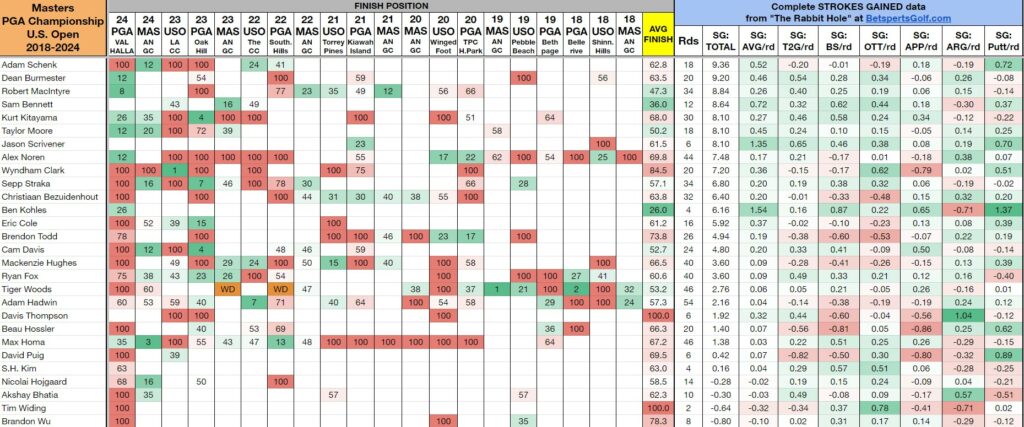
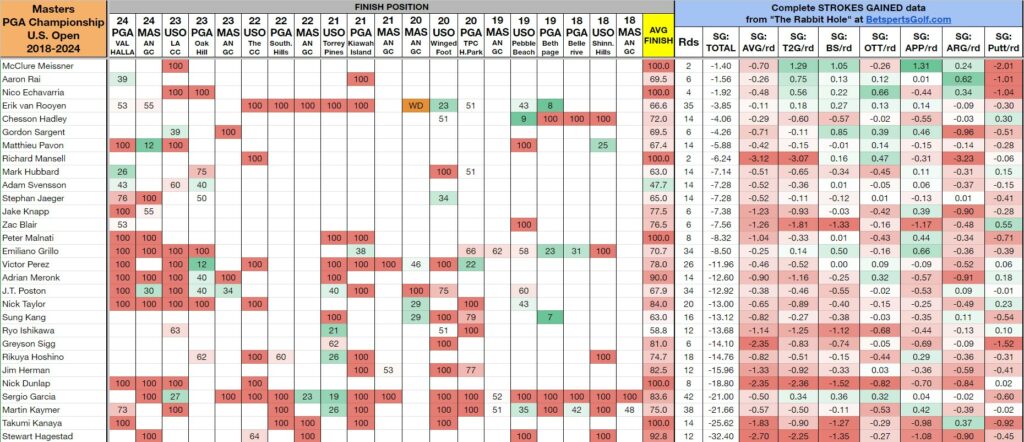
Finish Position and Strokes Gained Course History (2018-2024)
Combined Masters/PGA Championship/U.S. Open course history going back to 2018. Includes average finish position and Strokes Gained per round in each category. Players are sorted by SG: Total.


Course Features
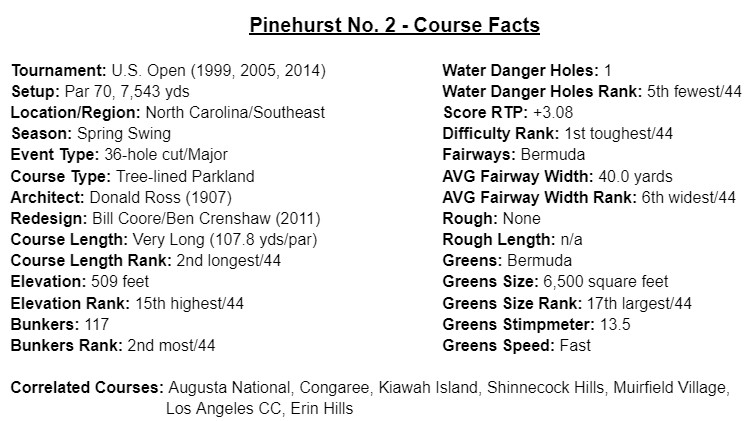
Measuring 7,543 yards, the par 70 “Carolina Sandhills” course located 92 miles east of Charlotte is a beast of a track. With only two par5s, Pinehurst No. 2 ranks as the fifth-longest course (yards per par) on the PGA Tour since 2015. Scoring can be brutal. In the most recent U.S. Open hosted here in 2014, the average round played at +3.08. It is the fourth toughest course on Tour in that same period with only Shinnecock Hills, Winged Foot, and Oakmont playing more difficult.
Martin Kaymer was probably being honest when he predicted that the winning score in 2014 would be eight-over-par, a full 17 shots fewer than he managed as the runaway champion. “You don’t hear many roars at Pinehurst,” admits Tiger Woods. “But that’s the nature of the course. At Augusta, you hear eagle roars and you hear big putts being made. But who is going to hole out from off the side of one of these greens? Guys are just trying to make par.”
Looking on the bright side, it’s tough to lose a ball at Pinehurst with just one water hazard on the entire course and out-of-bounds rarely coming into play. The 2011 restoration also made it much more forgiving off-the-tee with wider fairways and the elimination of rough. That being said, there is still a huge “Missed Fairway Penalty” with the trouble contained inside the sandy native areas.
The changes made by Coore and Crenshaw have revitalized the layout by adding strategy and shot-making back to the course. The beauty of Pinehurst is that it doesn’t dictate any particular style of golf. It instead allows you to play your own game with multiple choices on almost every single hole. Golfers have the option to play an aerial game and bomb it down the fairway followed by a lofted iron into the treacherous greens. Likewise, shorter hitters can club down and play longer iron shots and use the firm fairways to run them up onto the greens.
The natural terrain combined with its design features accentuates the penalty for mediocre shots. Whether it’s the sandy waste areas that are chock-full of vegetation or the swales and slopes and tight lies of the diabolical green complexes, at Pinehurst, it truly is a game of inches. A fractional miss can result in a massive number on the scorecard. A lucky bounce can lead to a birdie chance. This randomness and increased range of outcomes on every hole only adds to the excitement of the tournament.
Famous for its crowned greens, to make birdies, players must take on difficult hole locations with distance control and precision. For those wanting to play more conservatively, keeping the ball on the ground (including using putter around the green like Kaymer did in 2014) and hitting toward the middle of each green is another strategy.
Sand and Wiregrass and Pineweed, Oh My
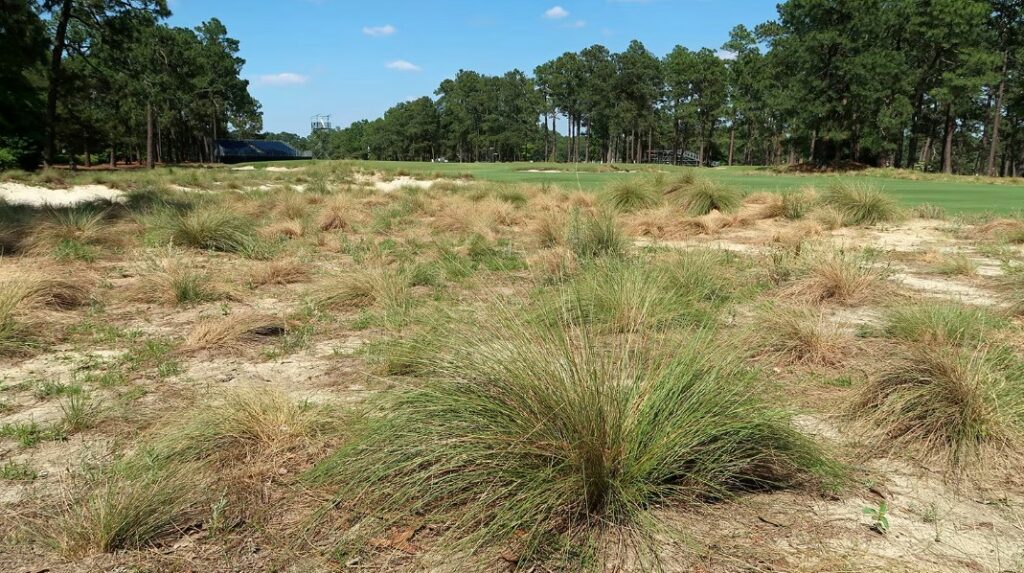
Pinehurst contains 40 native sandscapes along with 117 bunkers. There are also 250,000 wiregrass plants and counting. That is the minimum number that were planted at Pinehurst No. 2 in the sandy waste areas, of which more were added this year. Wiregrass is a warm-season grass that dominates vegetation in sandhills coastal plain ecosystems in the Carolinas region. Wiregrass doesn’t look pretty, but that’s what Donald Ross worked with in creating his layout. According to Sweeting, wiregrass is “a clump of grass that grows to four-six inches tall and has plumes on it and is very wispy. And while it provides an obstacle to golfers to play through, it’s very easy to find your ball.’’
An underappreciated aspect of the sand and wire grass at Pinehurst is the randomness it injects into the competition. This includes how the wiregrass can affect shots in a variety of ways. It’s not just that you are behind a tuft of wire grass and are screwed or you are in a sandy lie and are okay. Often you will find yourself directly up against a profusion of wiregrass and will have to manufacture some sort of creative recovery shot. It’s not just hacking away from thick rough. It takes a certain level of skill and requires flexibility and a variety of techniques which allows players to better separate from the field.
“The wire grass that lies alongside our fairways introduces an unknown that a lot of the players are not going to like,” says Bob Farren, Pinehurst’s Director of Golf Course Management. “At most US Opens, they know that if they miss the fairway, they are going to be hacking out of three or four-inch rough. Here, when their ball runs off the fairway, they could get a perfect lie or they could find themselves nestled in a footprint or against some wire grass.”
“I can’t imagine people playing 72 holes and not having to take a drop or chop out sideways at least once or twice. So, I think the players who will rise to the top of the leaderboard will be the ones who can stay patient, take their medicine, and appreciate that bad lies are going to happen to everybody.”
In addition to wiregrass, the native areas also have some extra challenges because of plants that have emerged naturally. One example is “pineweed,” a native plant that began popping up in the sandscapes over the past several years. It has wiry stems that make it hard to make solid contact with a ball lying below its canopy. Warm weather this spring has given the pineweed a head start on its annual growth and the maintenance team won’t be doing anything to thin it out before the U.S. Open.
A Mental Challenge
From a mental aspect, Pinehurst will present a challenge unlike any other that most players have faced. Out of all the majors, the U.S. Open is supposed to be the sternest examination. Standing on each tee box, not a single hole appears visually intimidating. But in trying to avoid the wiregrass, followed by hitting approaches into these firm turtleback greens, and then attempting to scramble for par (or bogey), anxiety levels should be high. While almost every player will experience some type of extreme variance this week, planning and plotting one’s way around the course can offer a level of stability amidst the chaos.
Pinehurst is also a course where you must be fully committed to your shots. Modern golf has become infatuated with “bailing out”. The problem is that, at Pinehurst, there are very few places to bail. If you aren’t committed to your target, that’s when the struggles tend to begin. And when you bail out and miss, you are typically left with a difficult uphill chip where you have to go up and over the edge of the green and back downhill to the lower middle section toward the hole location. Having a competent short game, especially from tight-lie short-grass areas is paramount for survival.
The native area is somewhat luck-dependent because the course is so unpredictable. Good shots can produce very bad lies. This forces players to be mentally tough to overcome the bad breaks that every single golfer will face at some point during their round. The 14th green complex is an example of a hole where there will be all kinds of crazy bounces and breaks around and behind that green.
“It provides a mental challenge as much as a physical one,” said Scott Langley, the USGA’s Senior Director of Player Relations who finished 54th here at the 2014 U.S. Open. “No matter what club you end up choosing or what shot you decide to play, you always have a little bit of doubt in your mind if it’s the right one because of the presence of so many options.”
An anonymous golfer writing about his round at Pinehurst summed up the intricacies of the course quite well.
“I came away amazed at how strategic the course was. It required a deep knowledge of the greens in how they move and the manner in which they repel shots, and to where. It requires knowing the lines into the greens and how hard to hit into them. It requires decisions, sometimes between choosing the lesser of two evils. It requires and occasionally rewards ingenuity. I stopped caring if my shots were perfect or even as intended. What really mattered was what my next shot looked like and how to best coax it closer to the hole. I was forced to ponder where I’d prefer a recovery; from the short grass or the bunker. I started to think about golf in the right way and as I submerged myself into the round, I realized what mattered out here most was your interplay with the terrain.”
Hole Preview

While most agree that Pinehurst doesn’t have a specific signature hole, there is not a weak hole on the entire 18. It’s a course where the argument can be made that the sum is greater than its parts, and the sum is magnificent. The routing favors no specific type of player or shot shape. The variety from tee to green in terms of length and direction is outstanding. Holes snake between sandy areas and pine trees.
Said course architect writer, Chris Mavros, “There are no natural wonders to gaze upon, no heroic shots or carries, really not too many places to even lose a ball. It’s simply how the course is laid upon the land amongst sand and greenery. The strategy and character reveals itself over time through angles and placement. The order of the holes, their variety and versatility.”
Perhaps the best stretch on the course (and maybe anywhere) is holes No. 3-6. The third is a short par 4 that is one of the few scoreable holes and was the only non-par 5 hole that has historically played under par. It is followed by the mammoth 528-yard par 4 fourth with its sloping fairway and 31% bogey-or-worse rate. Players get another quick breather with the easiest hole on the course, the par 5 fifth before facing the toughest hole on the course with the 228-yard par 3 sixth.
There are so many iconic holes at Pinehurst,” said former USGA CEO Mike Davis. “Take the fifth hole – a great risk-reward hole where we saw players laying up in two and having a tricky third shot. But we also saw players go for it, and saw some eagles there – but we saw a lot of ‘others’ too. It’s a great course that requires fine shotmaking and good thinking.”
Overall, the majority of the 12 par 4s are monstrous and unrelenting. Seven play at 470+ yards with three of them over 500 yards. Only having two par 5s on which to score only adds to the proliferation of pars and bogeys. Meanwhile, players like Jason Day believe it’s the par 3s that should be feared. On a lot of courses, the shorter holes offer the most respite. Not so at Pinehurst No.2. “Some of the par 3s are very difficult,” concedes Day. “You’re coming into a green where the slope is very severe at the front, but you’re trying to land it just on the front edge. Then, if you land it short, it’s going to roll back down. Land it too far, it’s going over the back of the green. Distance control is huge.”
Strokes Gained Analysis
Off-the-Tee
The 2011 restoration was crucial in recapturing the width of the fairways and the strategic angles that had been lost over the years. “The fairways had narrowed to the point that there was hardly any decision-making off the tee,” said Coore. “As a player, it was being dictated where you were going to be. From all we had read from Mr. Ross, and what we had seen in the diagrams and old photos, that was not the intent. The intent was to give you freedom to play, but the angle to the greens – their axis to the line of play – would either help you or hurt you. Oftentimes the direct route that you saw from tee to green was not the ideal angle to take.
“The wider fairways have changed the strategy of the course quite a lot”, says Farren. “In 2005, the fairways were all 27 yards wide and players had no choice but to try and hit the center. Now, they are up to 51 yards wide (in spots), so players need to choose which side of the fairway will give them the best angle to attack that day’s hole location.”
As with most great courses, the middle of the fairway generally isn’t the best spot to drive the ball. Many of the best locations for angles into the greens are actually getting close to the edges of the sandy waste areas.
“The 2nd hole is a brilliant example,” says Jeff Hall, Managing Director of Rules and Open Championships at the USGA. “It’s a 500-yard, par 4, and in some places the fairway is 40 yards wide, but you really need to be on the left side of that fairway – which is where the fairway bunkers are – to leave the best angle to the green. I’ve described it in a few instances as a very anxious 300-yard walk, because you can’t afford to be out of position on it. Donald Ross wrote that Pinehurst No. 2 is wide, but it is strategically wide. That’s the difference.”
While skilled approach and around-the-green play take precedence over driving this week, don’t assume that wider fairways (40 yards on average) and lack of rough make off-the-tee performance at Pinehurst unimportant. Unlike most U.S. Opens where power and distance are emphasized, Pinehurst favors accuracy, positioning, and patience. Fairways tend to bottleneck and narrow around the 300-yard mark limiting aggressiveness with driver.
Accuracy and planning also matter because setting up good approach angles is vital if you want to have the option of using the ground game. Blasting away with driver will often leave you in the worst position on the hole. That being said, because of the challenge around the greens, distance is still beneficial in allowing for higher-lofted irons to fall softer on these bouncy surfaces.
The topography around the landing zones also presents a challenge for tee shots. There are all sorts of uneven lies in the fairway that often run at an awkward angle to the line of play or swerve around a sandy hazard. The 11th hole is a great example of this. The fairway runs on a left-to-right diagonal in relation to the tee. There is also a left-to-right tilt. You have to pick an aiming point and you have to execute it well.
With wider fairways and expected dry and firm conditions, drives will tend to roll out until they reach these wiregrass-filled hazards which places a greater demand on shot control. With the amount of variance that comes into play with the vegetation in these areas, golfers who are precise off the tee and who rank highly in “Distance From Edge of Fairway” should be heavily targeted this week.
Approach
There have been many descriptions of the greens at Pinehurst No. 2 – crowned, turtle-shell, volcanoes, domed. The shape of the greens demand extremely precise approach play, and many shots that initially hit the putting surfaces only do so temporarily before trickling off an edge. They make you tentative and unsure of your aim point because it feels like any shot is going to be repelled from the target. Aiming for the middle of the green and not being overly aggressive is an essential discipline this week.
“In general, the greens are fairly large,” said Coore, “but they play extraordinarily small with those fall-offs on the edges. That is what makes them so demanding for approach shots. You could take a player who is an absolute magician with their irons, drop them at whatever their ideal distance might be, and see what percentage of greens they hit and hold. I guarantee it won’t be a very high number. “It’s a little bit like Augusta in that sense, in that you’re playing to zones, rather than just going at the pins or trying to hit greens”, said Justin Rose.
“There’s an old saying around Pinehurst that you don’t really count the number of greens you hit, you count the number of greens you visited,” says Coore, laughing. “Even if a green is, say, 6,000 sq ft, the actual useable part of it is not much more than half that. And seldom is there ever a contour that kicks the ball back toward the green.”
With approximately 55% of approach shots coming from 175+ yards, elite long-iron play presents a huge advantage and a path to separate from the field. Not only are all the greens crowned, but they also play firm and fast. Said Ogilvy, “You could put someone’s ball at a perfect drive on every hole and they still would miss five or six greens. They are that challenging. There are just disasters everywhere, even with wedges in hand.”
After reading much of the analysis on the best way to play Pinehurst, keeping one’s ball on the ground as much as possible seems the preferred method. Said Langley, “Playing an aerial game makes distance control such an absolutely critical factor. Playing from tough angles, even from the fairway, is often going to catch up with you at Pinehurst No. 2.” If you want to take an aerial approach, you need to hit a high shot with ample spin. The danger in this approach is that being a few yards short will send the ball rolling off the front edge of the green.
Yet while low-running shots are an option on most holes, they aren’t necessarily easier. With each green being elevated, they might not make it up to the playing surface or might run through the green and down the back. Whatever option players take, whether high or low, precision is key
Around the Greens and Putting
“The big difference at Pinehurst, compared to other US Opens, is that you are not going to find the ball two inches off the green in five inches of rough,” says Langley. “Anything that misses the putting surface is going to keep running away because of the closely mown turf. And once it comes to rest, there are a variety of options that the player is going to have. All of a sudden, it creates choices and creates indecision.” There are interesting mounds and slopes everywhere, and they extend far beyond the typical 5-10 yards from the fringe. The bunkers appear to eat into the greens and present their own troubles.
Short-siding the hole when chipping at Pinehurst typically leads to treacherous downhill putts while going long means completely off the green and who knows where it stops. It could end up in sand or under trees or in pine straw or simply a long way off in the short grass. Players will have to deal with upslopes and downslopes – full of apprehension wondering where this short pitch might end up.
With the greens being so difficult to hit, players will be faced with a variety of recovery shots. At Pinehurst, you can play any number of clubs to get up and down to save par. Texas wedge (putter) off the green. Bump-and-run with an iron. A perfectly nipped wedge through the air. A flop shot when short-sided. Perhaps a hybrid or 7-wood when going through the collar of the green. It allows for a certain level of creativity that most championship venues lack. It also introduces uncertainty for a large number of golfers who lack the touch and creativity of players like Scottie Scheffler, Cameron Smith, or Hideki Matsuyama.
“With all of these run-offs and the little swales and tight lies, you have got so many different ways to play,” says Rory McIlroy. “You can bump-and-run or you can putt it, or you can fly it on the putting surface. It brings into play imagination, creativity, hitting different shots out of different lies. Guys are going to have to maybe come up with shots that they’re not so comfortable playing and shots they really don’t play much week in and week out, but that’s the beauty of this golf course.”
For Ross, it wasn’t just a putting surface; it was an entire green complex of little humps and hollows and closely mown contours. He wanted to emulate some of the windblown dune contours he had experienced in Scotland because they were extraordinarily important for creating interest on those courses.
New for this year’s tournament is the introduction of ultradwarf Bermuda grass greens, a heat-tolerant grass that thrives in the Southeast with less water. The greens in the 2014 U.S. Open were bentgrass, a northern strain that could become stressed in a Southern summer. Because the USGA can better control the moisture, the new greens should be even firmer and bouncier in this year’s Open.
When you combine the slope and speed of these greens, putting will be its own adventure. The GIR putting average here in 2014 was 1.88, much higher than the Tour average of 1.77. The 3-putt rate was an astronomical 5.02%, almost double the Tour average. Putting will also be heavily affected by the direction of the Bermuda grain. The target greens speed for the week will be a lightning-fast 13.5 on the Stimpmeter.
Most Important Stats For Success at Pinehurst No. 2
*In order of importance
- Scrambling – Short Grass
- SG: Approach (Difficult APP Courses)
- Distance From Edge of Fairway (DFEF)
- SG: Total – Difficult Scoring/Majors
- Proximity 175+ yards
- Bogey Avoidance (Difficult Scoring)
- SG: ARG (Difficult ARG Courses)
- 3-putt Avoidance
- Good Drive % (Difficult APP Courses)
- Par 4 Scoring (Difficult Scoring)
Key Rabbit Hole Filters
- Course Region: Southeast
- Scoring Conditions: Very Difficult
- Course Length: Very Long
- Field Strength: Very Strong
- Event Type: Major
- Greens Surface: Bermuda
- Missed Fairway Penalty: High
- Gain APP: Very Difficult
- GIR Accuracy: Difficult
- Par 4 Scoring: Difficult
- Par 3 Scoring: Difficult
- Gain ARG: Very Difficult
- Scrambling – Short Grass: Difficult
- Gain Putting: Very Difficult
- 3-Putt AVD: Difficult
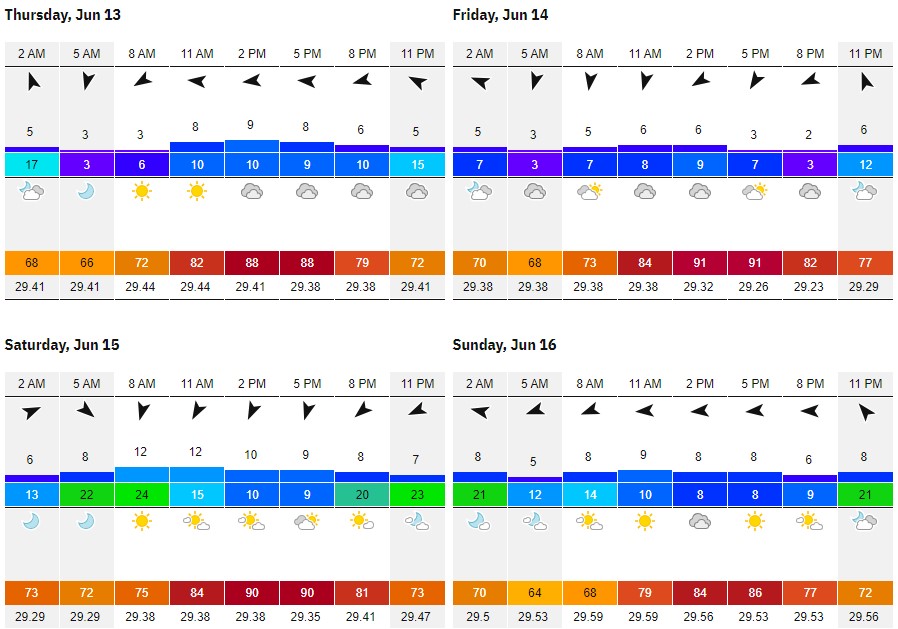
Weather Forecast – Pinehurst, North Carolina