
2024 Texas Children’s Houston Open Betting Card Picks and Preview

Ryan Noonan

3 years ago

With the conclusion of the Florida Swing and just two weeks remaining until the Masters, the PGA Tour now shifts its focus to the west for the Houston Open at Memorial Park Golf Course. This renowned public and municipal course, dating back to 1912, spans 7,412 yards with a par of 70. Six of the OWGR’s top 30 are in the field, including course record holder Scottie Scheffler. It’s once again a “to Scottie, or not to Scottie” week.
Noteworthy for its five par 3s and three par 5s, the course features a modest 21 bunkers and only four water hazards, all changes made during the 2019 Brooks Koepka-led redesign. Its defense lies in the distinctive green complexes characterized by undulating surfaces and short-grass runoffs with false fronts. According to course superintendent Parker Henry, while everything is visible, the green complexes can be challenging if not approached accurately.
The course has historically played over par, emphasizing the need for a well-rounded game. This year, the tournament’s move from fall to spring has significantly changed the course’s agronomy. The once bermudagrass-covered course now showcases Poa trivialis on the greens. Additionally, the rough has transitioned from penal 2.5″ Bermuda to a more manageable 1.25″ ryegrass. This shift in turf is crucial, as it is expected to make tee shots much more forgiving compared to previous years. With the reduced likelihood of “fliers” or difficult lies from Bermuda rough, players can adopt a more aggressive approach. Consequently, it is anticipated that this year’s average score will be approximately a full stroke easier than the previous three events, which averaged a score of +0.80 per round. This is a grip-it-and-rip-it course off the tee, and the penalty for missing the fairway should be severely reduced.
For more course details, check out Ron’s course preview. It’s the best in the business, bar none. Here’s an important tidbit about Memorial Park:
Memorial Park Golf Course is a long Par 70 that sits at 7,412 yards. Not only is it the fourth-longest course in the annual Tour rotation, but it has also played as the sixth-toughest annual course, with golfers averaging 0.80 strokes over par over the past two years. It initially appears like a bomber’s paradise, but the past two years have shown that it is a course that also demands accuracy, touch around the greens, and patience.
Along with a good mix of doglegs and straight holes, Memorial Park features a variety of holes with varying distances. Lengthy holes, however, are a common theme. Three of the five par 3s are over 200 yards, with eight par 4s playing over 440 yards. The course shows its teeth, with five of those playing over 490 yards and averaging a bogey or worse rate of 28.9%. Even the par 5s are challenging, which includes the 576-yard 16th hole, which only has a Birdie or Better rate of 22%.
Every single approach stat at Memorial Park is more difficult than the Tour average. The biggest challenge is getting your second shot to settle on the correct quadrant of these large greens. The firm undulations that slope off near the edges make it very difficult to get makeable birdie putts if you hit the wrong sector of the green. In some cases, missing the green on the correct side might be better than hitting the green but having to putt from 40 feet across multiple breaks and slopes.
We have partnered with Vivid Picks to bring you an easy way to claim a FREE, no-strings-attached 2024 season at Betsperts Golf, plus a 100% deposit match up to $250! Click here to learn more!
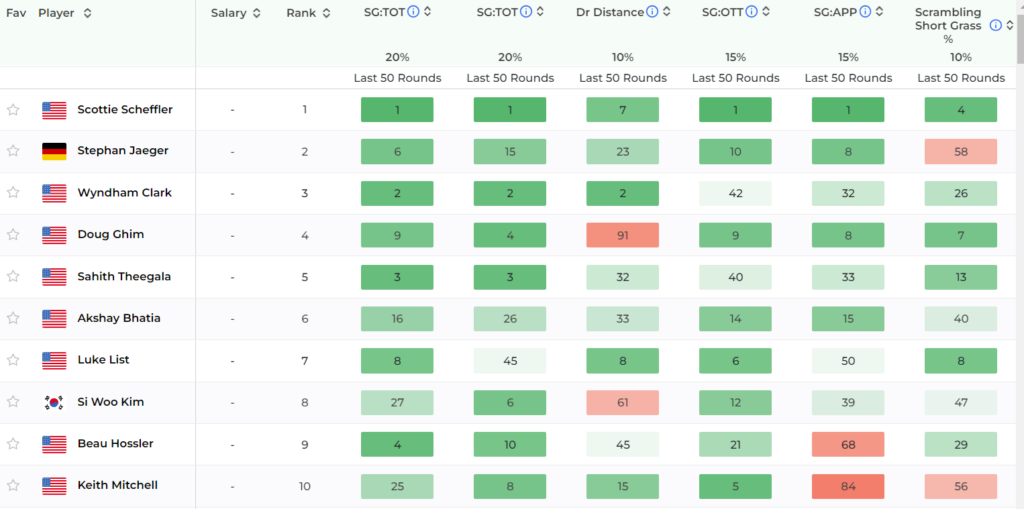
There are millions of ways to bet on this beautiful game, and my goal with this piece is to touch on the golfers I’m targeting this week. Remember to check out the Rabbit Hole, our customizable stat database that can help you pair down your player pool each week.
Please take advantage of the Discord feature and community. It’s the best way to get up-to-the-minute lines and advice, and if you need help getting started, please reach out. That’s where my full card will be posted, along with any live in-tournament bets. Betting markets are fluid, but I’ll note the best number available at the time of this writing.