2024 Rocket Mortgage Classic at Detroit Golf Club – Preview

Ron Klos

2 years ago
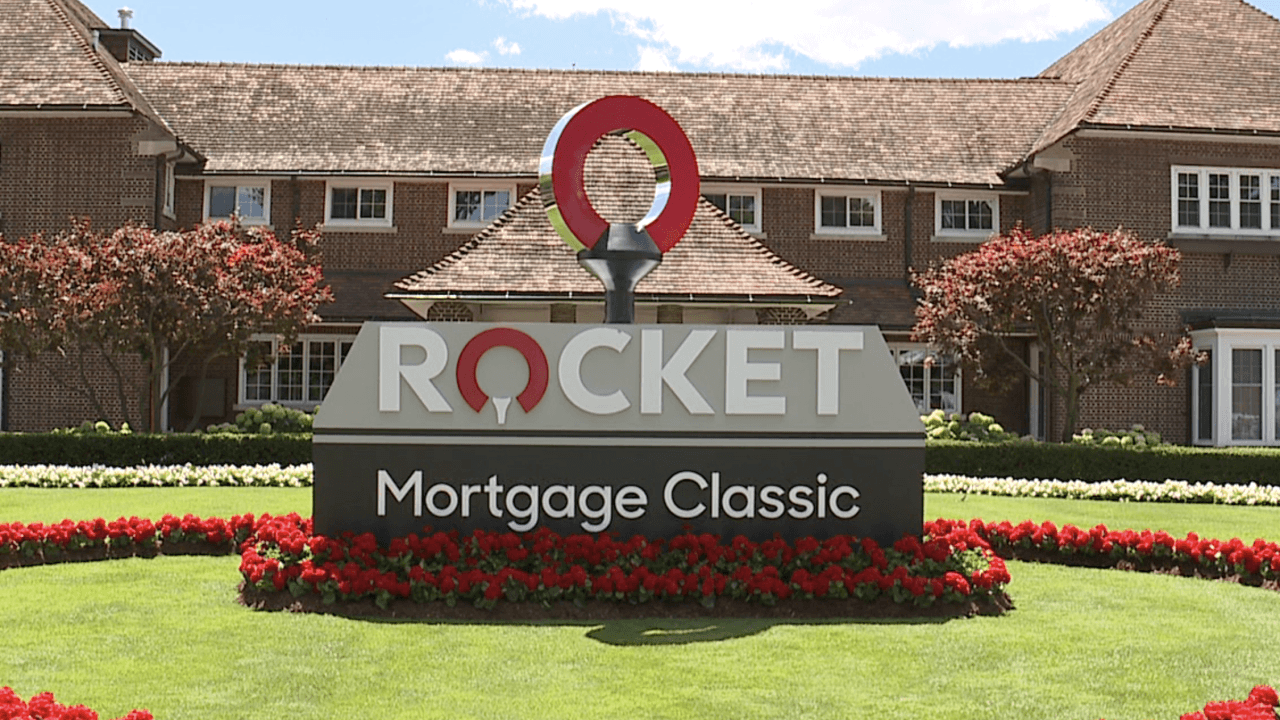
The PGA Tour rolls on to the Motor City and Rocket Mortgage Classic as we head down the stretch toward the year’s final major and the FedExCup Playoffs that follow. Coming off two “Signature” events sandwiched around the U.S. Open, it’s a much weaker field than typical as most upper-tier golfers will be taking a much-deserved breather from the recent gauntlet of tournaments.
The Detroit Golf Club is a beautifully manicured classical, tree-lined, Donald Ross-designed course that has been one of the most prolific birdie-making courses on the PGA Tour. Established in 1899, the club has a long history, with the North Course (1916) being the oldest annual course in the Tour rotation. This year’s tournament is the sixth edition with past champions including Tony Finau, Bryson DeChambeau, Cameron Davis, and last year’s winner, one of Detroit’s adopted sons, Rickie Fowler.
While longer hitters (DeChambeau, Davis, Finau, Taylor Pendrith) have flourished here due to the lack of hazards off the tee, all playing styles have had success with many shorter hitters (Nate Lashley, J.J. Spaun, Troy Merritt, Chris Kirk) finishing high on past leaderboards. Skilled putters who are strong with their wedges and are proven par-5 scorers are the best players to target at Detroit Golf Club.
The Field
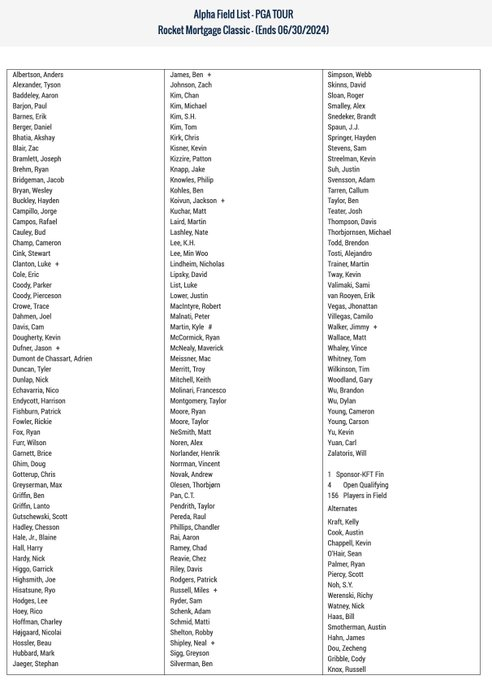
Due to an unfortunate spot on the PGA Tour schedule, the golf-crazed fans of metro Detroit will see one of the weaker fields of the year. There is not a single player ranked in the top 20 in this field. Contenders from last week’s Travelers Championship – Cam Young, Tom Kim, and Akshay Bhatia – along with Chris Kirk, Min Woo Lee, Will Zalatoris, Stephan Jaeger, Nicolai Hojgaard, Robert Macintyre, and Fowler are the only players in the top 50 of the world rankings expected to tee it up this week.
With dozens of players shut out from playing in the small-field “Signature” events, there is a relatively deep group of second-tier players in attendance including Daniel Berger, 2021 winner Cam Davis, Taylor Moore, Keith Mitchell, Alex Noren, Aaron Rai, Maverick McNealy, Adam Svensson, and Eric Cole. Along with Kirk, Jaeger, and Macintyre, several other players have PGA Tour wins this year that are in the field like Pendrith, Nick Dunlap, Jake Knapp, Peter Malnati, Davis Riley, and Chris Gotterup.
Detroit Golf Club – History
The Detroit Golf Club was founded in 1899 by local businessman William R. Farrand and his partners. The course was originally a six-hole layout on a rented 45-acre plot of farmland just a few miles north of the city center. Originally limited to 100 members, the course added three holes a year later, making it a nine-hole course. With membership increased to 200 in 1902, an additional 35 acres of land were purchased, and the course expanded to a full 18 holes. In 1913, more property was acquired, and one of the most iconic golf course designers of all time, Donald Ross, was brought in to survey the land. He determined that two 18-hole courses could be built on the property.
In 1916, Ross completed the two 18-hole tracts, which were simply named the North and South courses. The property’s heritage goes even further back in history, as between the seventh and eighth holes on the North Course, an oak tree was bent by Native Americans to mark the trail that extended from the area of Pontiac to the Detroit River.
Ross preferred to let the natural environment determine the design of his courses. This classic approach is quite evident at the Detroit Golf Club, especially concerning the topography of the course. There is very little elevation change, with only 10 feet between the highest and lowest spots. It is also this classical approach that, over a century ago, did not take into account players bombing the ball 320 yards off the tee. The course was chosen to host the 1941 Ryder Cup, but the outbreak of World War II scuttled that.
Based on the ShotLink data, minor adjustments to the course continue to happen. For example, on the par-4 12th hole, players were bombing it over 300 yards past the fairway bunker. This caused tournament officials to add 40 yards to the hole which has kept the bunker in play.
One revision of the North Course has been more controversial. Typically, the complexity of the greens is what makes it a “Donald Ross” course. With the passing of time, the greens have weakened, with some of the slopes becoming flatter. Said Golfweek’s course evaluator, Nick Ficorelli, “I’m a little worried about the North greens being too easy. They used to be really, really good. When I watch PGA Tour players playing, say, a 1916 golf course, it’s disappointing if those greens have been weakened. There’s nothing more boring than watching guys make 30-footers that don’t break.” While Ficorelli is accurate regarding the greens being less undulating than a century ago, they are still tricky in many spots and contribute to putting being the toughest area of the course in which to gain strokes.
There is a current plan to completely renovate the entire North Course after the conclusion of next year’s tournament. This includes remodeling each of the greens back to how Ross had them at the course’s origin.
We have partnered with Underdog to bring you an easy way to claim a FREE, no-strings-attached 90 days of Premium Access to Betsperts Golf, plus up to $250 in bonuses when you deposit! Click here to learn more!
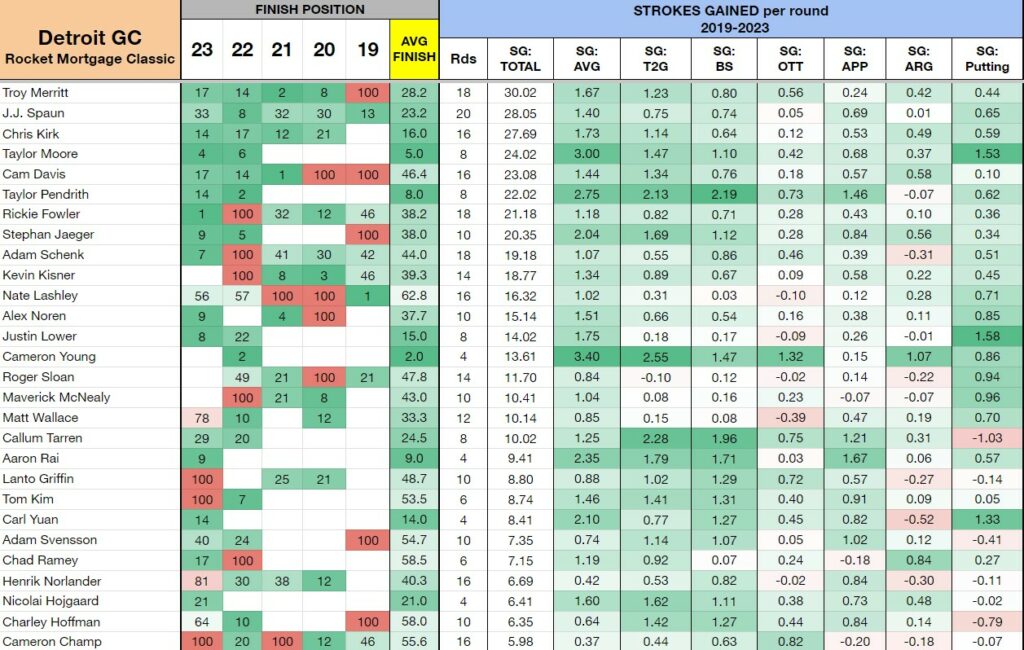
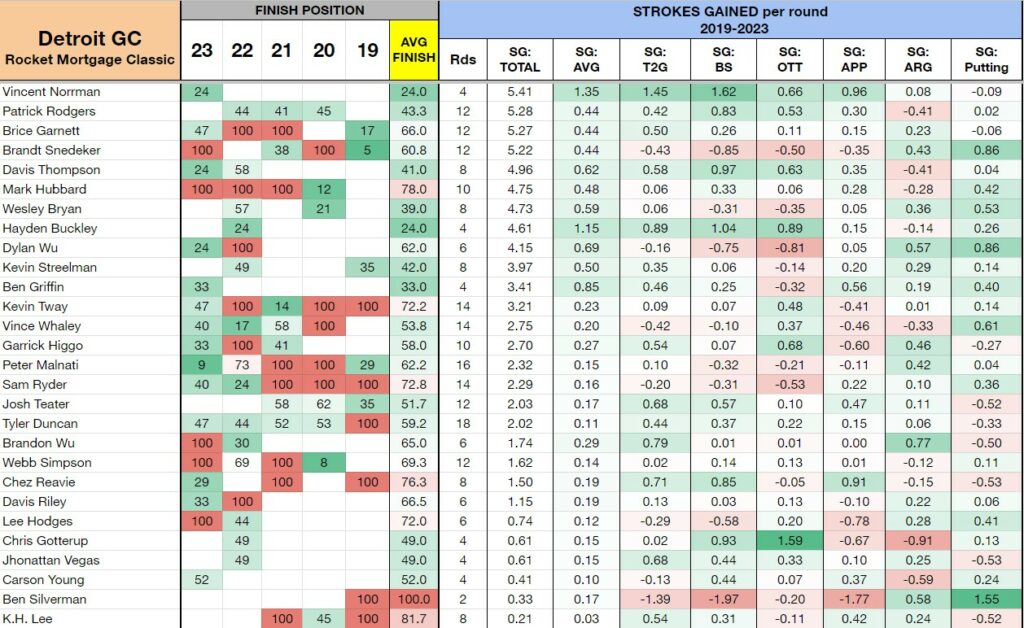
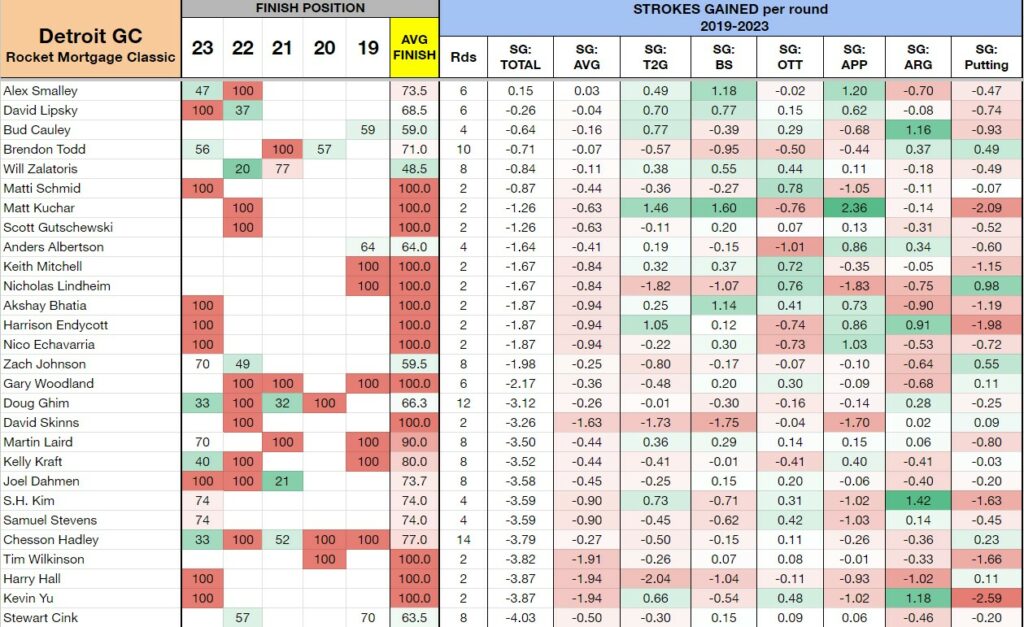
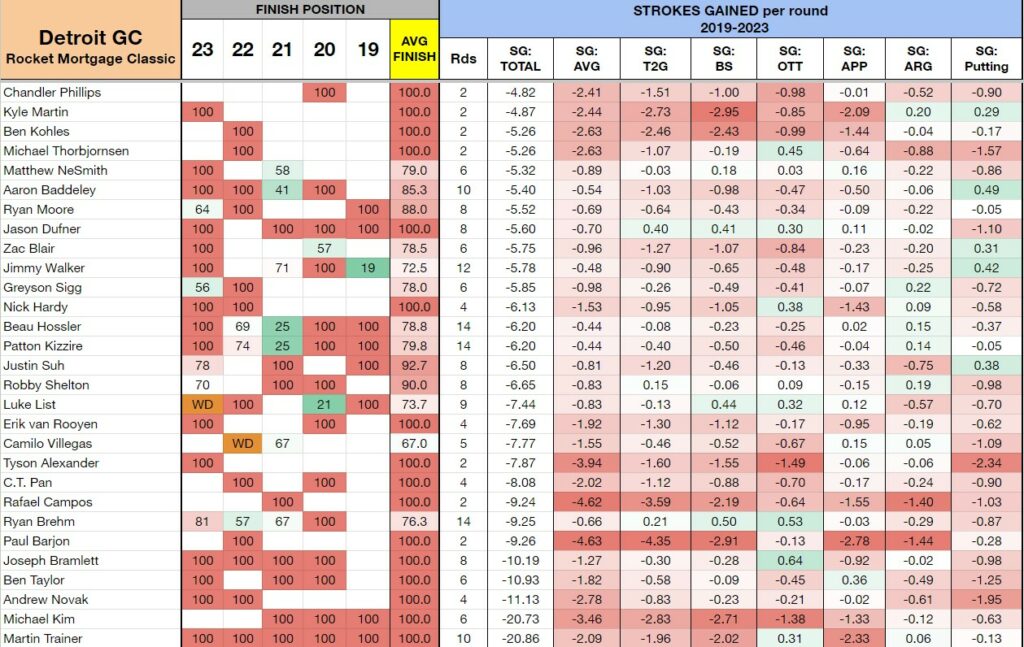
Finish Position and Strokes Gained Course History (2019-2023)
This includes the average finish position and Strokes Gained per round since 2019 for each of the categories. Players are sorted by SG: Total. Detroit Golf Club is the 12th least predictive annual course on Tour.
Course Features
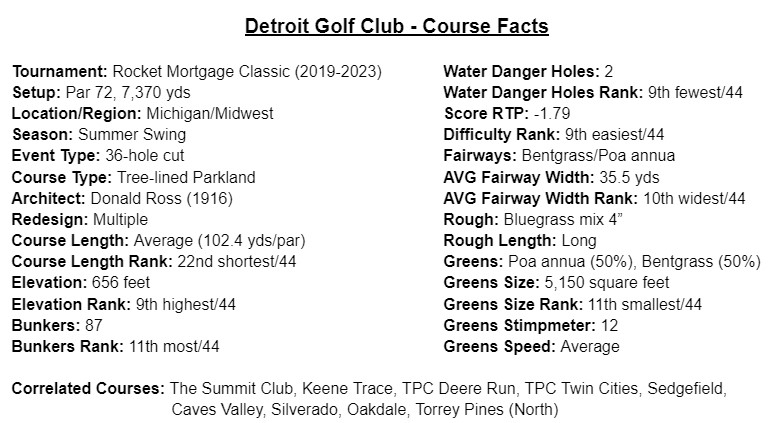
The North Course at Detroit Golf Club is a Par 72 course that measures 7,370 yards. It features the standard breakdown of four par-3s, 10 par-4s, and four par-5s. Let’s cut right to the chase here. It is one of the easiest courses on the PGA Tour rotation. Through the event’s four years of existence, it has played as the ninth easiest course on Tour at -1.79. Players will need to shoot low rounds each day to be in contention. Winning scores in the first five years of this tournament have ranged between 18-under to 26-under.
It is a traditional parkland venue with tree-lined fairways and flat topography. When the course entered the Tour rotation in 2019, its standard deviation of terrain change stood at 2.18 feet, edging TPC Louisiana (2.23) as the flattest course on Tour. Other than a few holes, not many stand out because there is not much variation from tee to green throughout the round. Most of the holes are north to south or south to north with a few doglegs mixed in.
With a course that lacks length and any real penal areas off the tee, birdies will be dropping left and right. In such an easy-scoring environment, more golfers will be able to contend on the leaderboard. Because the course does not penalize poor shots, there is not much separation between great and below-average tee-to-green play. This, in essence, boils the tournament down to a putting contest. Recent rainfall and typically soft conditions lead to receptive greens and only add to the scoring potential.
Unlike a course such as TPC Twin Cities, there are no “blow-up” holes here where players are threatened with double-bogey or worse. There are only two holes with any threat of water danger. In fact, there are only two holes on the course with a bogey or worse rate above 20%. The course has the second-fewest number of penalty strokes on Tour, which speaks for the lack of danger off the tee and on approaching the green.
While not as penal as one would think, the Bluegrass rough at Detroit Golf Club is one of the longest in non-major events that golfers will see all year at four inches. Even with many of the greens being diminished in nature from Ross’s original design, the main defense of Detroit Golf Club is the green complexes. Greens are a mix of Poa annua and bentgrass and run around 12 on the stimpmeter. They contain just enough slope and undulation to cause players to take some precautions with the flat stick. The greens are also smaller than average at only 5,150 square feet.
Hole Preview
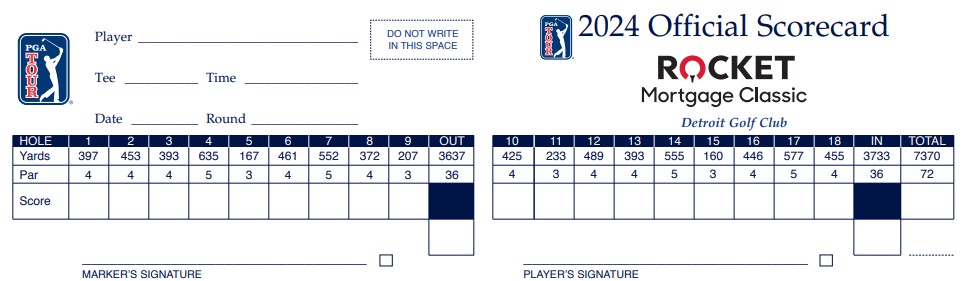
The holes used for the Rocket Mortgage Classic is a composite routing with 17 coming from the North Course and one from the South Course. The layout begins with holes 8 and 9 serving as Nos. 1 and 2, followed by hole 1 from the South Course serving as No. 3. The course then plays holes 2-7 of the North Course as Nos. 4-9 before the regular back nine on the North Course makes up the final nine holes for the championship.
Overall, the front nine plays easier than the back nine. Hole Nos. 6-8 are one of the trademark stretches on the course. Each demands tee shots into some of the most narrow fairways on the course with some sloping that angles drives toward the rough. Each of these holes also has two-tiered greens with multiple tricky pin positions.
The fourth hole is one of two par-5s on the front nine and is the course’s longest extending to 635 yards. While tough to reach in two shots, it still has a birdie or better rate of 28%. On the back nine, holes 14-16 combine to form what organizers have called the “Area 313” challenge. The 14th hole is a 555-yard risk-reward par-5 with a 41% birdie or better rate. The 15th hole is an uphill par-3 that typically plays longer than its 160-yard scorecard number, while the 446-yard par-4 16th hole has one of the most demanding greens on the course and rates as the 6th toughest hole overall.
The four par 5s are among the easiest on Tour with a 43.4% BoB rate and hold one of the keys to unlocking enough birdies to maintain the scoring pace on the leaderboard. Four of the ten par-4s are under 400 yards and combine to produce a bogey-or-worse rate of only 10.4%. The par 3s combine as the eighth-shortest group on Tour with three of the four playing among the seven toughest holes on the course.
Strokes Gained Analysis
Off the Tee
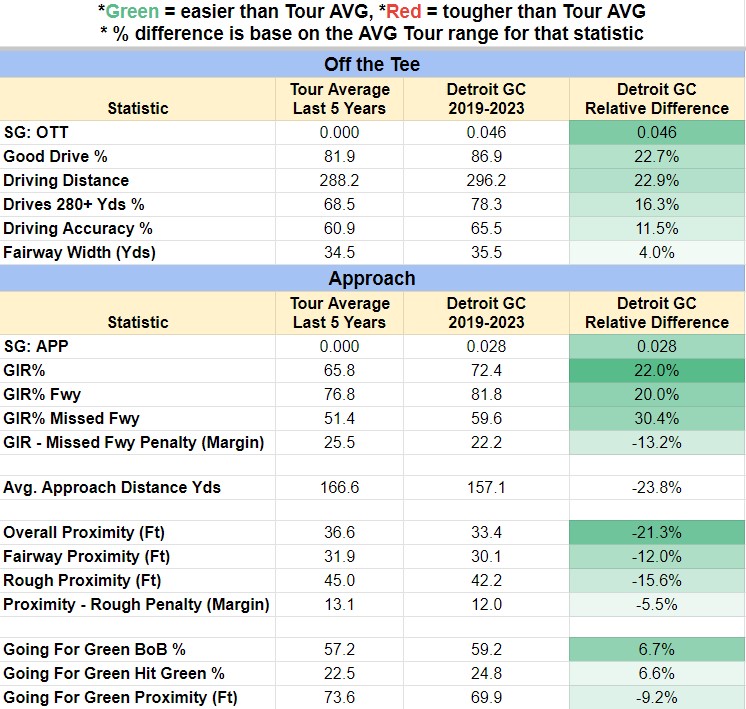
The top of leaderboards at Detroit Golf Club in its first five years as a Tour event has been a veritable group of bombers off the tee including DeChambeau, Finau, Pendrith, and Cameron Young who was runner-up in 2022. Fairways are generous and wider than average at over 35 yards, making them the 10th widest on Tour. With few hazards or penal fairway bunkers, there are no forced layups or “danger” areas off the tee. Players are free to blast away with driver which is evidenced by 78% of drives hit over 280 yards and a distance average of 296 yards. Those with extra length will have wedges and short irons into greens on every par 4.
During last year’s event, Tony Finau talked about length being an advantage. “If you hit it far, you have an advantage not only off the tee, but into the greens you’re hitting shorter shots. If you’re hitting it into the rough, you’re hitting more lofted clubs out of there, you’re able to create speed out of the rough. I always feel like guys that bomb it have the advantage and this golf course is no different.” During the 2020 tournament here that he won, DeChambeau commented on his strategy for the week. “There’s a lot of bunkers that are around 290 yards, so hopefully I’ll be able to clear those. Sorry Mr. Ross, but you know, it is what it is. Having a 9-iron into these par fives, it’s definitely nice to be able to attack par-five flags. There’s a couple holes where I can get it up close to the green and just chip it on there and make a putt.”
That being said, even though DeChambeau appeared to “bomb and gauge” Detroit Golf Club to death, the tree-lined fairways and thick rough, as unsuccessful as they were, are there to combat any similar attempts. It should also be remembered that DeChambeau gained eight strokes putting that week along with the six strokes he gained off the tee.
And while length can be an advantage, there have been plenty of shorter, more accurate hitters who have contended here as well. With it being very average length-wise, anyone who can keep the ball in the fairway will have the chance to contend. Along those same lines, former PGA player Brian Stuard had an interesting comment saying, “I think driving it straight here is very important because, with every fairway pretty much tree-lined, you would rather be 150 (yards) in the fairway rather than 100 in the trees.”
Approach
With golfers unable to separate themselves that much off the tee due to the lack of any penalty for wayward drives, Detroit Golf Club is a definite second-shot course. Over 46% of approach shots come from under 150 yards, which is one of the highest wedge/short-iron rates on Tour. Thanks to a full set of par 5s and two longer par 3s, 21% of approaches also come from over 225 yards which is 4% higher than the average course. Even with the 11th smallest greens on Tour, these greens have one of the highest GIR rates anywhere.
With an abundance of scoreable holes combined with a Greens in Regulation (GIR) rate from the fairway at well over 80%, proximity to the hole on these Donald Ross greens will be key this week. With the majority of approach shots coming from the short iron or wedge range, players that are strongest in that area will have a sizeable advantage. The greens have numerous quadrants, and finding the right area on approach to set up uphill putts will be another factor in golfers separating themselves from the field. Players will also need to control the spin on their wedge shots to get the ball as close to the hole as possible.
Around the Green and Putting
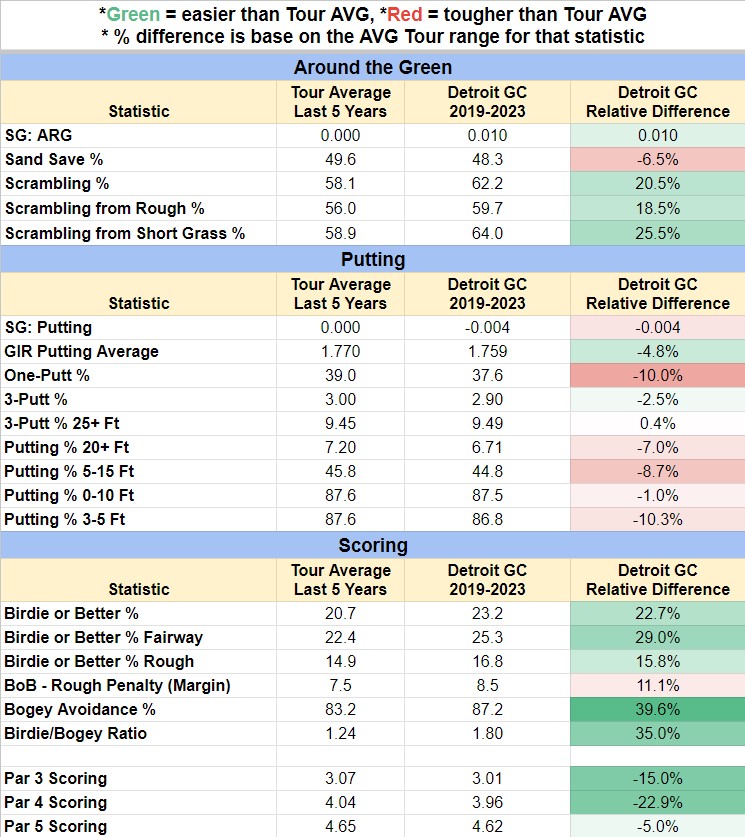
While there is thick rough and some tricky runoff and collection areas surrounding these green complexes, whenever the GIR rate is so high it is hard to give around-the-green play much weight. These green complexes have nowhere near the same runoff slopes as Ross created at Pinehurst No. 2 that were seen in the recent U.S. Open.
When looking at the numbers of past winners, however, this is one the most important putting courses on Tour. As previously mentioned, putting on these surfaces is not easy. While these Donald Ross greens have lost some of their natural movement over the decades, many still feature back-to-front sloping which is typical of his designs. They rate as the 10th most difficult greens on which to gain strokes putting. And yet, close to 40% of all strokes gained on this course come with the flat stick. That is well above the typical average of 35%. The undulated areas around some of the pin placements make putting even tougher from inside five feet averaging as the 6th toughest.
2019 winner Nate Lashley confirmed that certain hole locations on the greens can be tricky, saying, “The greens do have quite a bit of slope, some of them around the holes that have a lot of undulation. If you get it on the right spot, though, and get it in the right tier, you can make a lot of birdies.”
Just to further emphasize the importance of putting, 2019’s winner, Nate Lashley gained over 10 strokes on the greens that week. In 2020, every single player in the top 12 gained at least one stroke putting. In 2021, each of the top five in the standings gained over three strokes, and 23 of the top 25 were positive on the greens. 2022 saw more of the same as each of the top five on the leaderboard gained at least 3.5 strokes putting. Last year, the top 13 gained an incredible 5.2 total strokes putting on average. Though there is a blend of Poa annua mixed in, similar to TPC River Highlands, these greens do not play like “West Coast” Poa. They are very smooth and play more like bentgrass greens. Green speeds have been increased since the tournament’s inception, moving from 11 on the stimpmeter in 2019 to upwards of 12 and beyond this year.
Most Important Stats For Success at Detroit Golf Club
-
- Birdie or Better %
- SG: Approach
- SG: Putting (Bent/Poa)
- Par 5 BoB%
- Par 4 BoB%
- Driving Distance
- SG: Easy Scoring Courses
- Proximity: 50-125 yds
- Putting 5-15 feet
- SG: ARG
Key Rabbit Hole Filters
- Course Region: Midwest
- Scoring Conditions: Very Easy
- Field Strength: Weak
- Field Size: Full Field
- Greens Surface: Bent/Poa
- Green Size: Small
- Rough Surface: Bluegrass
- Architect: Donald Ross
- Gain OTT: Easy
- OTT Club Type: Driver Heavy
- Fairway Accuracy: Easy
- GIR Accuracy: Easy
- Missed Fairway Penalty: Low
- Gain Putting: Difficult
Weather Forecast – Detroit, Michigan