
Waste Management Phoenix Open at TPC Scottsdale – 2026 Preview

Ron Klos

8 months ago
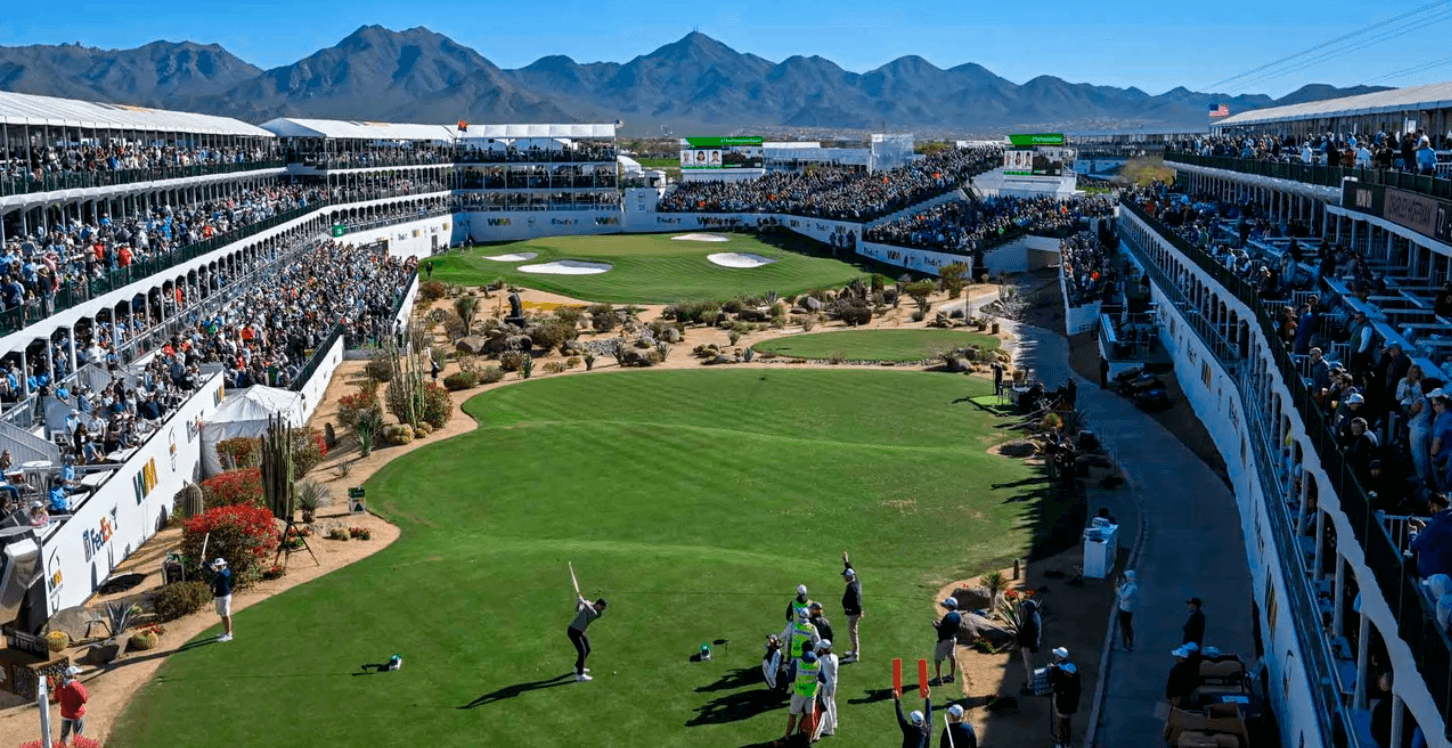
Set against the Sonoran Desert and framed by the rugged McDowell Mountains, the PGA Tour arrives at TPC Scottsdale for this week’s Waste Management Phoenix Open. Designed by Tom Weiskopf and Jay Morrish and completed in 1986, the course has hosted the event for 38 consecutive years, becoming one of the most recognizable stops on the schedule.
Dubbed “The People’s Open,” the tournament draws nearly 750,000 spectators annually and is renowned for its electric atmosphere—none more famous than the raucous par-3 16th hole. With massive crowds, high energy, and a layout that invites drama, the Phoenix Open routinely delivers one of the most memorable and unpredictable finishes of the season. In 15 of the last 19 years, the scoring margin has been one stroke and has included eight playoffs.
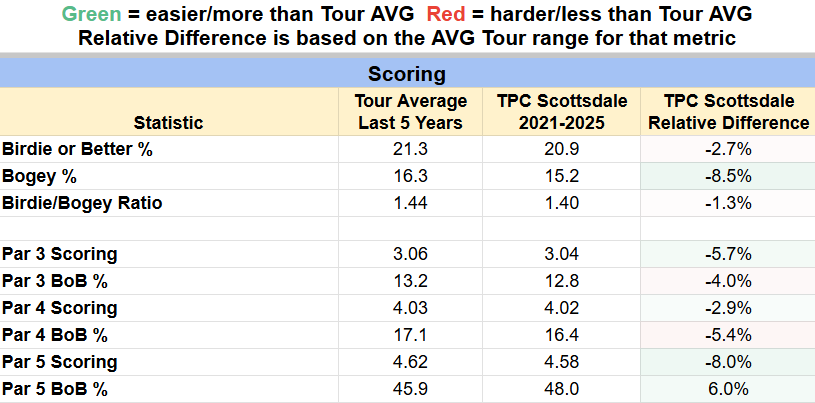
While TPC Scottsdale offers plenty of scoring opportunities, it has proven far from a pure birdie fest. The winning score has reached 20-under par only three times in the past 18 years, and over the last five editions scoring has averaged just -0.89 per round. Success here has consistently favored elite drivers and ball-strikers, with past champions including Scottie Scheffler (twice), Hideki Matsuyama (twice), Brooks Koepka, Jon Rahm, Rickie Fowler, and Justin Thomas.
Distance and precision off the tee are especially valuable in the thinner desert air, where all three par-5s are reachable and can be aggressively attacked for crucial eagle and birdie opportunities. Course history also carries significant weight, as TPC Scottsdale ranks as the fourth most predictive course on the PGA Tour based on past performance.
The Field
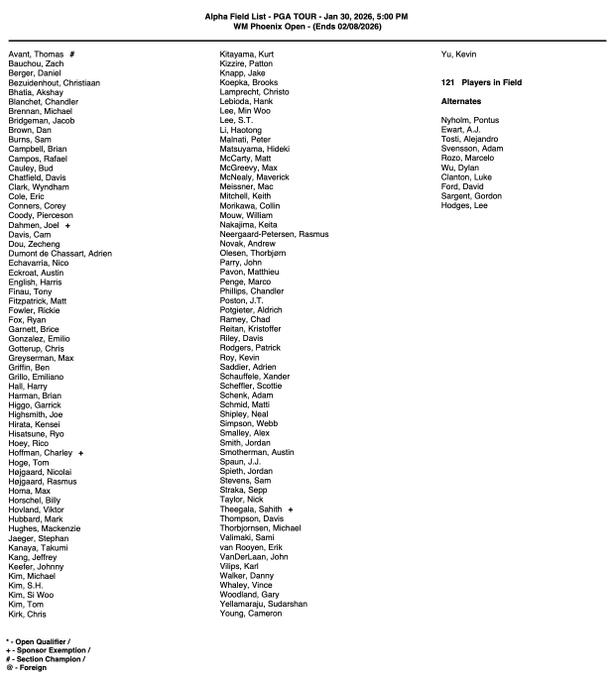
After consecutive weeks of course rotations, it’s back to one course with a 123-player field and a cut after 36 holes with the top 65 and ties advancing to the weekend. Two-time WM Phoenix Open champion and World No. 1 Scottie Scheffler will make his second start of the season after earning his 20th PGA TOUR victory at the 2026 American Express.
As is typical for this event, the field is absolutely loaded with talent, and features 11 of the top 20 players in the world, including Xander Schauffele, J.J. Spaun, Ben Griffin, Harris English, Viktor Hovland, Hideki Matsuyama, Collin Morikawa, Cameron Young, Matt Fitzpatrick, and Sam Burns. Another two-time winner here, Brooks Koepka, will be making his second straight start since rejoining the PGA Tour. The WM Phoenix Open is the final opportunity for players to earn FedExCup points towards the Aon Swing 5 with entry into the next Signature Events (AT&T Pebble Beach Pro-Am and The Genesis Invitational).

TPC Scottsdale Course History
Commissioned by the City of Scottsdale to create a municipal course capable of challenging the world’s best players, Tom Weiskopf and Jay Morrish more than delivered. Carved from the Sonoran Desert, TPC Scottsdale has grown into one of the most popular and recognizable annual stops on the PGA Tour since the Phoenix Open moved here in 1987. While the tournament has gone by several names since its inception in 1932, its modern identity is firmly tied to this desert layout.
Weiskopf, one of the most influential golf architects of his era before his passing in 2022, left a lasting imprint on the course and the game itself. A key pillar of his design philosophy was the revival of drivable par 4s, often positioned late in the round to inject strategy and drama. His most famous example is the short par-4 17th at TPC Scottsdale, a risk-reward hole that has helped define countless finishes—and famously produced the only par-4 hole-in-one in PGA Tour history, courtesy of Andrew Magee in 2001.
Another impact Weiskopf had on the game was his attempt to enhance the idea of “stadium golf”. Designed by Pete Dye, TPC Sawgrass was the first of the PGA Tour’s “stadium” courses. Weiskopf continued the tradition at TPC Scottsdale which has perhaps the most “stadium” feel of any course thanks to the 16th hole and the entire dramatic finishing stretch.
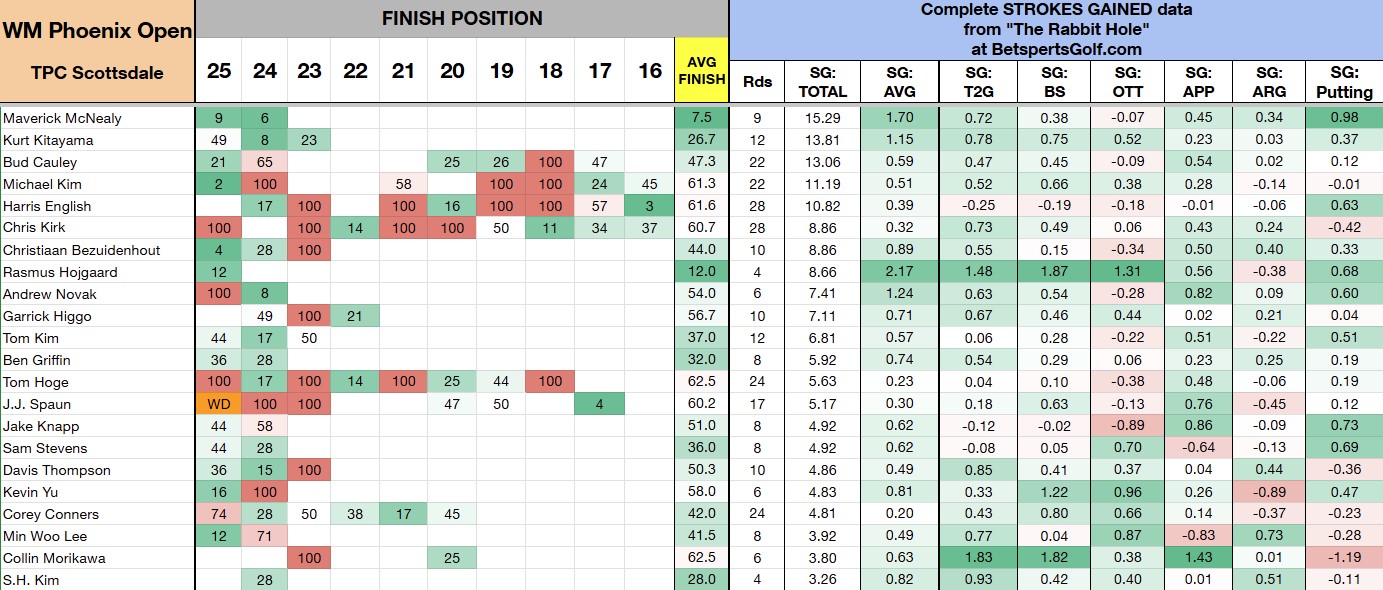
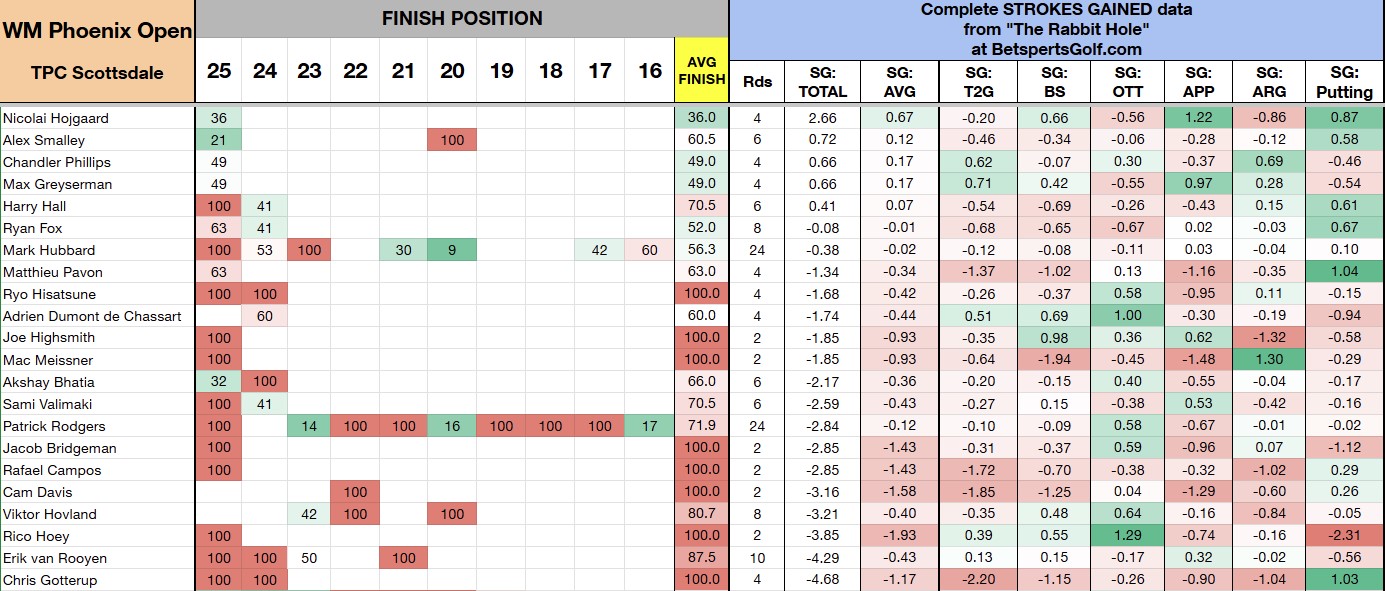
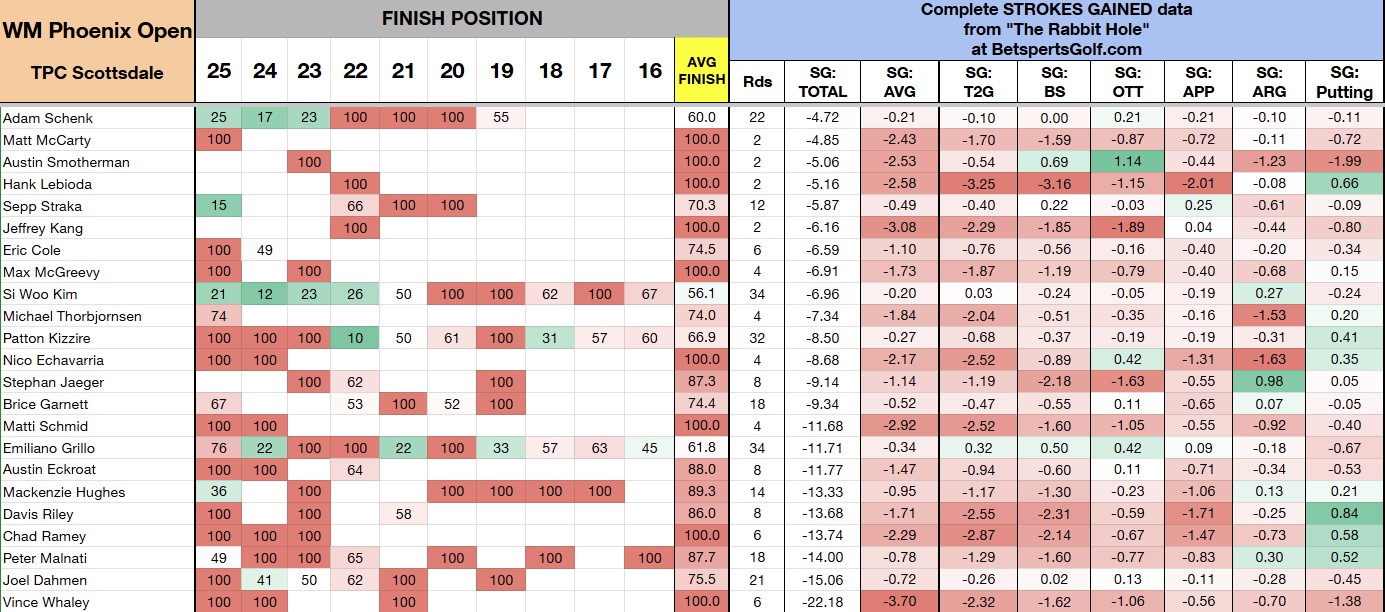
Finish Position and Strokes Gained History at TPC Scottsdale (2016-2025)
This includes the average finish position and Strokes Gained per round since 2016. Players are sorted by SG: Total. TPC Scottsdale is the 5th most predictive course on Tour. 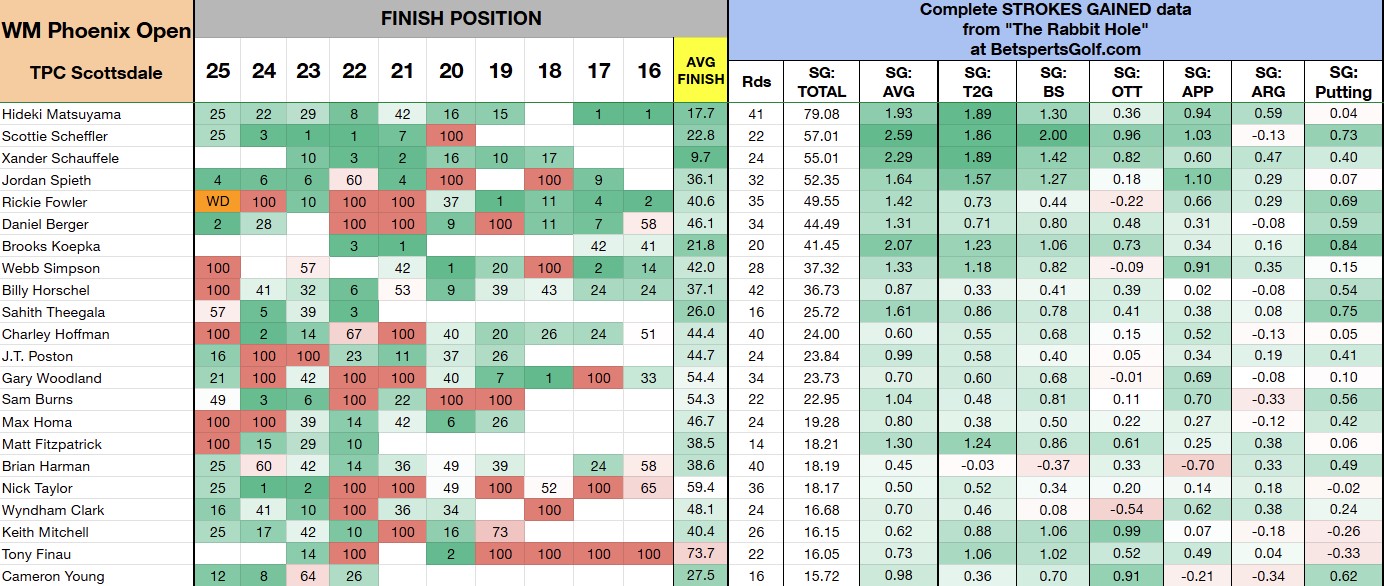
Course Features
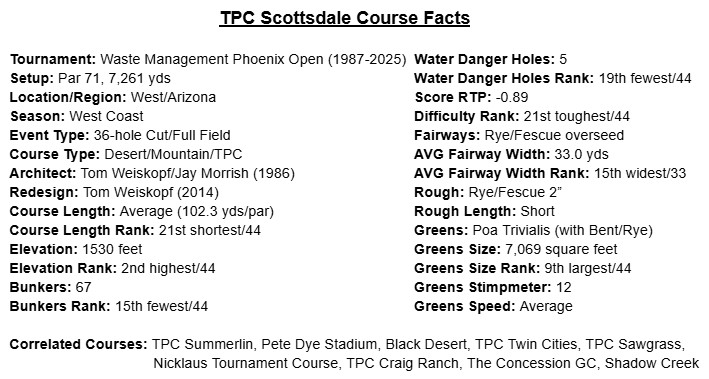
Measuring just over 7,200 yards, TPC Scottsdale is a par-71 layout that replaces a traditional par-5 with an extra par-4. While it ranks as average in length by PGA Tour standards, the course often plays significantly shorter due to its elevation of more than 1,500 feet above sea level. As the second-highest venue on Tour, the thinner air boosts carry distance off the tee, reinforcing the perception that TPC Scottsdale favors longer hitters.
Despite the elevation, the terrain itself is relatively flat, giving the course a distinct hybrid identity. With few trees, it does not fit the classic parkland mold, yet it also falls short of a true desert course, lacking the expansive waste areas and raw natural landscapes found at other Southwestern venues. Instead, TPC Scottsdale blends elements of both styles, creating a visually unique setting that challenges players in subtler, more strategic ways.
With bermudagrass still dormant this time of year, the fairways and rough at TPC Scottsdale are overseeded with rye and fescue, keeping the rough manageable at just two inches. The greens are predominantly Poa trivialis with a blend of ryegrass, a surface familiar to players from venues such as TPC Sawgrass, Innisbrook, TPC San Antonio, and Harbour Town. Averaging more than 7,000 square feet, they offer generous targets but still demand precision. Rolled to approximately 12 on the Stimpmeter, the putting surfaces reward confident strokes while placing a premium on solid approach play and distance control.
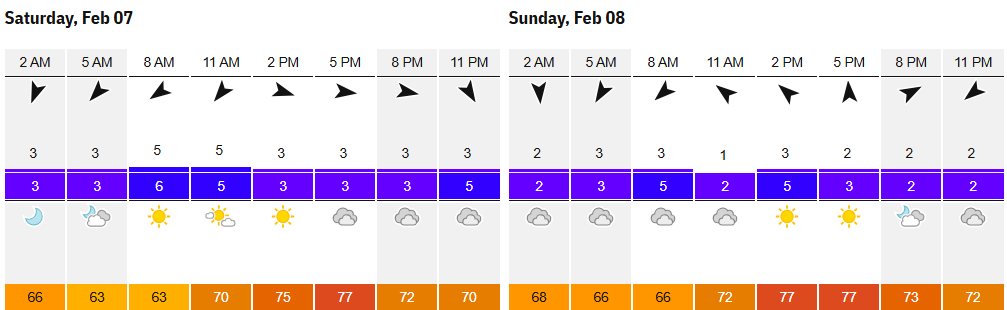
With non-penal rough, reachable par 5s, and expansive greens, TPC Scottsdale offers relatively few built-in hazards to consistently disrupt scoring. Much like PGA West, wind is rarely a significant factor, creating a dome-like scoring environment that allows players to be aggressive. However, the abundance of sunshine and minimal rainfall typical of the region cause the course to firm up and speed up as the week progresses, subtly increasing the challenge.
Those firmer conditions can work against players off the tee, where added rollout may push drives into trouble, and on approach shots that can bound through greens and into tightly mown collection areas. The primary danger zones remain on the tee, with water in play on five holes and scattered desert waste areas lurking on others, ready to penalize the most errant shots.
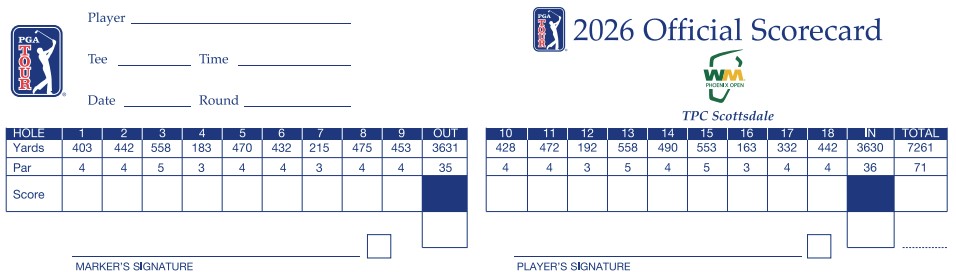
Hole Preview
The course features 10 par 4s measuring between 400 and 500 yards, placing a premium on consistent ball-striking off the tee. All three par 5s fall in the 550–600 yard range and are reachable in two shots for most of the field. These holes rank among the most scoreable par 5s on Tour, each carrying a birdie-or-better rate north of 41%. Players looking to climb the leaderboard must take advantage of these opportunities.
The opening 14 holes are relatively straightforward and lack significant strategic complexity. Success on this portion of the course is largely dictated by power and accuracy off the tee, rewarding players who can hit it long and straight. The character of the course changes dramatically late in the round, as the back nine introduces a series of risk-reward holes that bring water hazards and the surrounding desert into play.
The closing stretch is where tournaments are often decided. Danger is ever-present, but so are scoring chances, most notably on the drivable par-4 17th. Aggression is required to post a low number, as conservative play can quickly fall behind.
The momentum begins to build at the 15th hole, a 553-yard par 5 highlighted by an island green. With most players capable of reaching the green in two, anything worse than a birdie feels like a missed opportunity on what ranks as the 15th easiest hole on the course.
The par-3 16th, famously known as “The Coliseum,” delivers one of the most intimidating and raucous tee shots in all of golf. The stadium-style grandstands create a chaotic atmosphere that can rattle even seasoned veterans. Still, from a purely technical standpoint, the hole is relatively straightforward, playing between 120 and 160 yards into a two-tiered green. Execution—not distance—is the true challenge amid the noise.
As noted, the par-4 17th stands as the most stressful and electrifying hole on the course, often determining the outcome of the tournament. Countless events have been decided here, and the volatility of this hole is reflected in the numbers: since 2009, only three players holding a 54-hole lead have gone on to win on Sunday.
The closing hole is a demanding 442-yard par 4 that doglegs left, with water running the entire length of the left side. This hazard has ended many title hopes, ranking as one of the most punishing holes on the course. It carries the third-highest double-bogey-or-worse rate at 2.7% and consistently plays over par, ensuring that the pressure remains until the final putt drops.
Strokes Gained Analysis
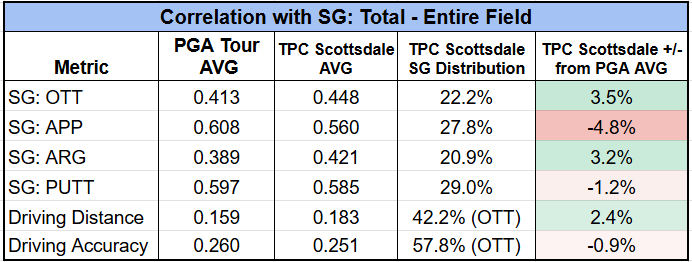
Off the Tee
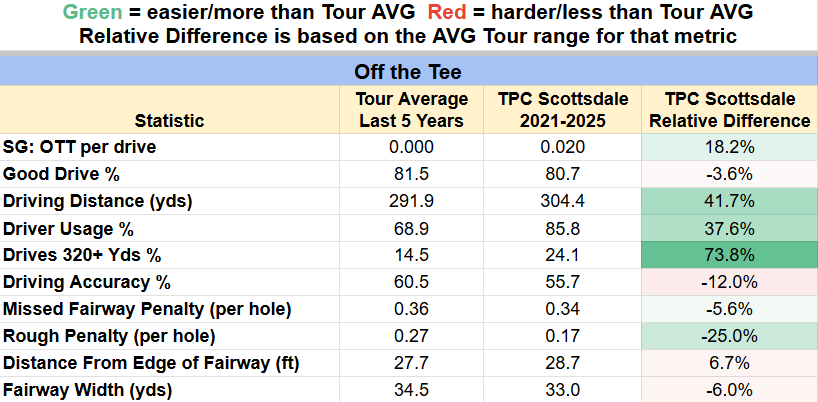
TPC Scottsdale consistently ranks as the longest course on Tour in terms of average driving distance. Thanks to the desert air, firm playing conditions, and a noticeable elevation boost, the driver-heavy layout produces average tee shots exceeding 304 yards. The elevation advantage alone adds roughly 7.5 yards of carry on a 300-yard drive, further rewarding players who are willing to lean on power off the tee.
Though the course is fairly spacious with fairways averaging 33 yards of width in the landing zones, widely errant drives will be penalized by the numerous water hazards and waste areas with native bushes that are littered along the sides of most of the driving holes. Wayward drives finding these trouble areas lead TPC Scottsdale to rank third among the Tour’s annual courses for the highest rate of tee shots finding the penalty areas.
While the 2″ over seeded rye rough is not penal, “Total Driving” is consistently one of the key stats this week as 15 of the last 16 winners here ranked inside the top 55 in Total Driving on the PGA Tour in the season of their victory (with an average rank of 33rd). When handicapping this week, it’s also important to remember that while many elite drivers of the ball have had great success here, shorter more accurate ball-strikers like Webb Simpson, J.T. Poston, and Matt Kuchar also have high finishes at TPC Scottsdale.
Approach
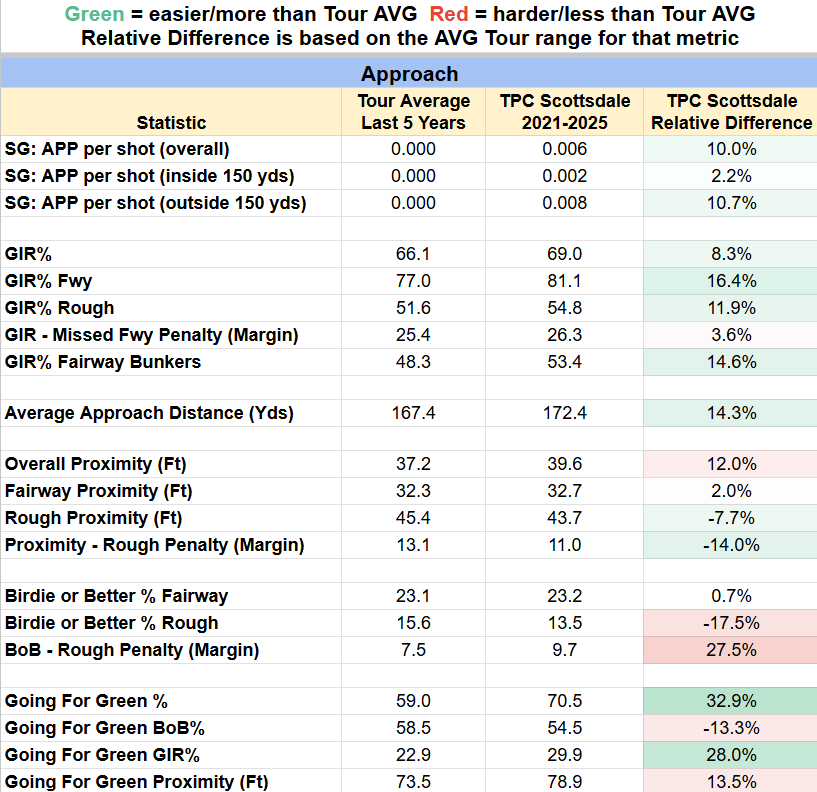
Firm greens are always a major factor this week, leading to a 12% relative increase in average proximity to the hole. As a result, the ability to hit high-quality approach shots close to the pin is critical for generating birdie opportunities. A higher ball flight is strongly preferred, further emphasizing the importance of distance off the tee, as it allows players to attack greens with shorter, more lofted irons.
Overall, TPC Scottsdale ranks near the middle of the pack in strokes gained approach difficulty. However, approach shot distribution reveals a more specific skill set is required. Last year, 43% of all approaches came from the 150–200 yard range—well above the Tour average—while every other distance bucket fell below the norm, with the lone exception of 225–250 yards.
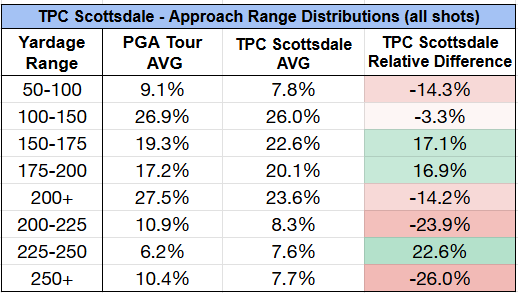
This underscores the importance of strong “second-shot” play. Supporting that trend, 14 of the last 17 winners ranked inside the top 40 in Ball Striking during the season of their victory. Scottie Scheffler exemplified this in his win two years ago, gaining 9.5 strokes on approach, while last year’s champion, Thomas Detry, gained more than seven strokes with his irons.
With three reachable par 5s and the drivable par-4 17th, players who are aggressive and efficient when “going for the green” hold a significant advantage. With winning scores approaching 20-under par and an eagle rate exceeding 2.5%, calculated risk-taking on these four holes is essential for players looking to separate themselves from the field.
Around the Greens and Putting
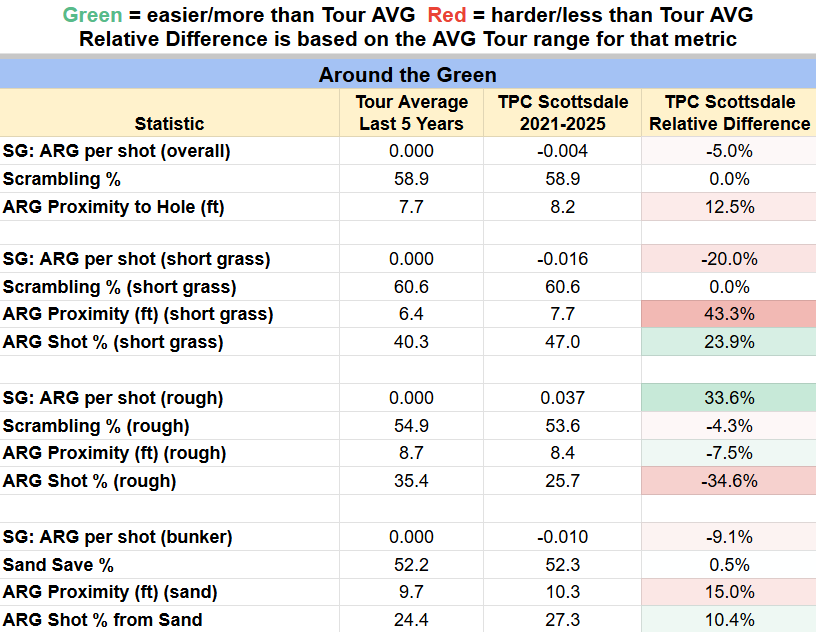
Over the last five years, “around the green” has been challenging as well. While playing from the rough is one of the easiest on Tour, only 25.7% of all ARG shots are from this area. With greens typically firm, most of the green complexes feature short-grass collection areas that funnel errant approaches. Scrambling and ARG Proximity from these tight-lie areas has proven difficult. What makes it more challenging is that 47% of all ARG shots come from these short grass areas.
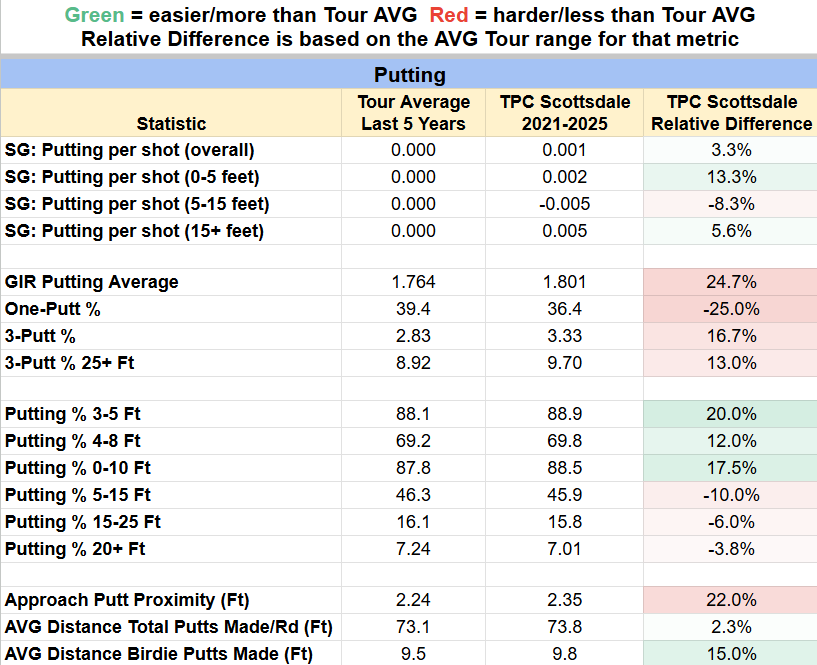
Over the past five years, the greens at TPC Scottsdale are have been slightly easier than average. They are relatively flat and lack undulations. With the likes of poor putters such as Hideki Matsuyama, Kevin Stadler, and even Kyle Stanley winning here, putting skill seems to matter much less overall than at other courses. The over seeded Poa trivialis greens roll fast and pure and are among the easiest on Tour from inside 10 feet.
Most Important Stats For Success at TPC Scottsdale
*In order of importance
- Course Region: West
- Course Type: Desert
- Scoring Conditions: Average
- Course Length: Average
- Field Strength: Strong
- Elevation: High
- Event Season: West Coast
- Greens Surface: Poa Trivialis
- Greens Size: Large
- OTT Club Type: Driver Heavy
- Rough Penalty: Low
- Gain OTT: Easy
- Scrambling Short Grass: Difficult
- Gain Putting: Easy
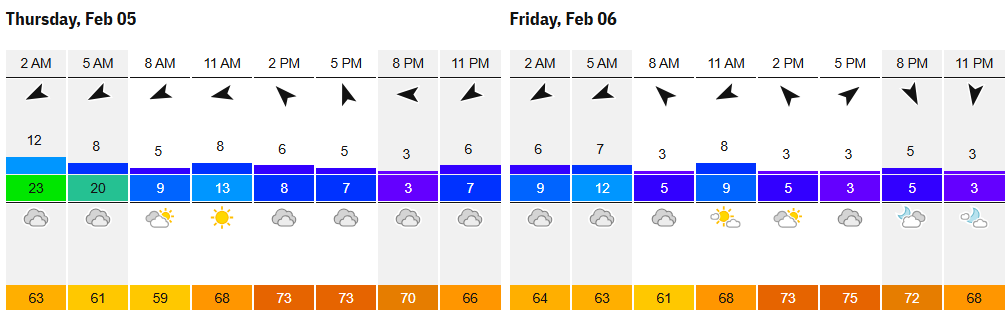
Weather Forecast – Scottsdale, Arizona
- SG: APP
- Total Driving
- Birdie or Better %
- Par 4 Scoring
- TPC Scottsdale Course History
- Bogey Avoidance
- SG: Putting (Poa Trivialis/Bent)
- SG: OTT
- Good Drive %
- Scrambling – Short Grass
Unique Rabbit Hole Filters
- Course Region: West
- Course Type: Desert
- Scoring Conditions: Average
- Course Length: Average
- Field Strength: Strong
- Elevation: High
- Event Season: West Coast
- Greens Surface: Poa Trivialis
- Greens Size: Large
- OTT Club Type: Driver Heavy
- Rough Penalty: Low
- Gain OTT: Easy
- Scrambling Short Grass: Difficult
- Gain Putting: Easy
Weather Forecast – Scottsdale, Arizona