
Valero Texas Open at TPC San Antonio – 2026 Preview

Ron Klos

6 months ago

With one week left before the Masters and the year’s first major, the PGA Tour gathers at the Oaks Course at TPC San Antonio for the 104th edition of the Valero Texas Open. This tournament was founded in 1922 and is the third longest-running event on the PGA Tour. It has been held in the San Antonio area since its origins and has relocated to numerous courses before finding its current home in 2010 when Adam Scott was victorious.
TPC San Antonio winds through the narrow corridors of the Cibolo Canyons, just north of Texas’s second most populous city, San Antonio. With fairways framed by dense brush and mature oak trees, the course demands precision off the tee. Elevated greens with tricky pin positions place a premium on approach play, while one of the most challenging sets of par 5s on Tour adds further scoring resistance. Combine that with the ever present gusty Texas winds and it consistently ranks as one of the tougher tests on the PGA Tour, playing as the 11th most demanding course with golfers averaging +0.26 strokes per round.
Off the tee, the Oaks Course presents a demanding mix of narrow, tree-lined corridors that punish inaccuracy while rewarding players who can position themselves strategically for optimal approach angles. One notable change this year is the rough being grown to three inches, up from its typical 2.25 inches, placing an even greater premium on accuracy. Keeping the ball in play off the tee, dialing in precise approaches to the proper green quadrants, and capitalizing on scoring opportunities on the par 5s are all essential ingredients for success here.
There has been a wide variety of past winners at the Valero Texas Open, ranging from heavy favorites like Jordan Spieth in 2021 to shocking underdogs. Corey Conners won as a qualifier in 2019, while Andrew Landry captured the title at 200 to 1 odds in 2018, and Steven Bowditch triumphed in 2014 at 350 to 1. Scoring has also varied significantly depending on the wind. Winning totals have ranged from Conners reaching 20 under par in 2019 to Brian Harman finishing at 9 under par last year.
The Field

In the final week of preparation before The Masters, many of the PGA Tour’s top players look to stay sharp with one last competitive start. The Valero Texas Open field features nine of the top-20 ranked players in the world rankings, headlined by Ludvig Aberg, Tommy Fleetwood, Collin Morikawa, Hideki Matsuyama, Russell Henley, J.J. Spaun, Sepp Straka, Robert MacIntyre, and Alex Noren.
Other contenders that are high on the odds board include Jordan Spieth, Maverick McNealy, Si Woo Kim, Daniel Berger, Nicolai Hojgaard, and Michael Thorbjornsen. Brian Harman returns to defend his title after winning by three shots over Ryan Gerard last year. The biggest prize at stake for the winner this week is a ticket into the Masters field if they are not already exempt.
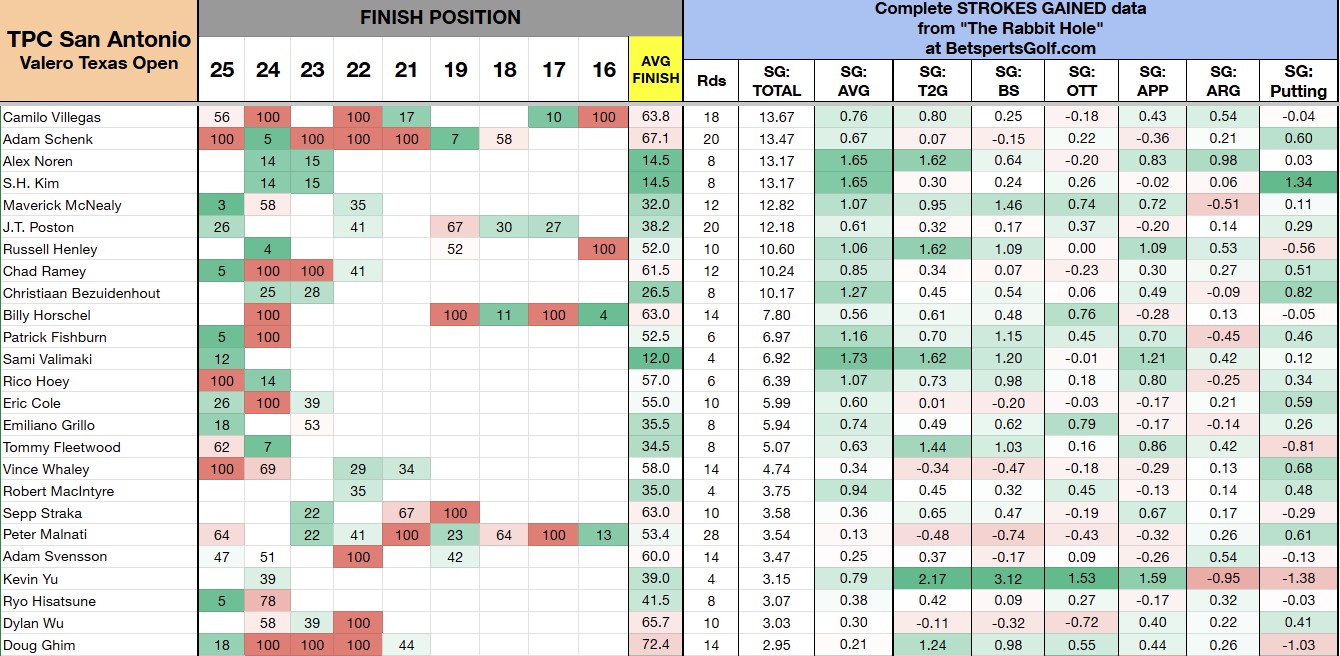
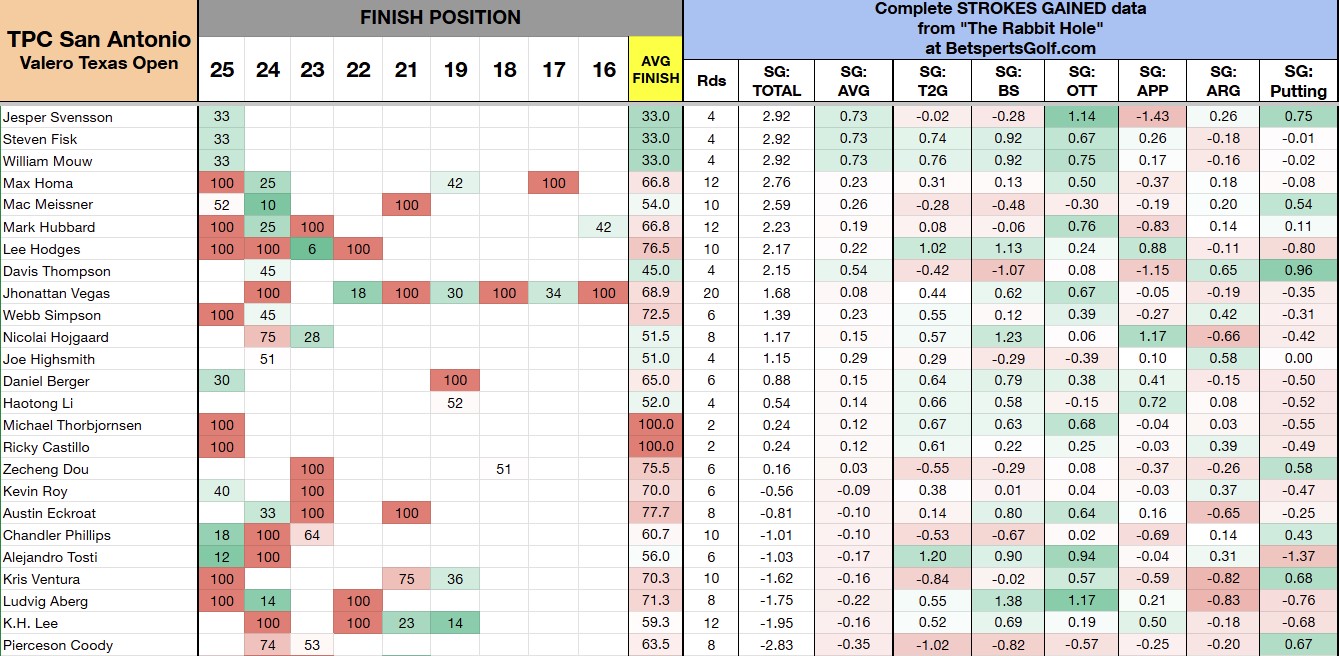
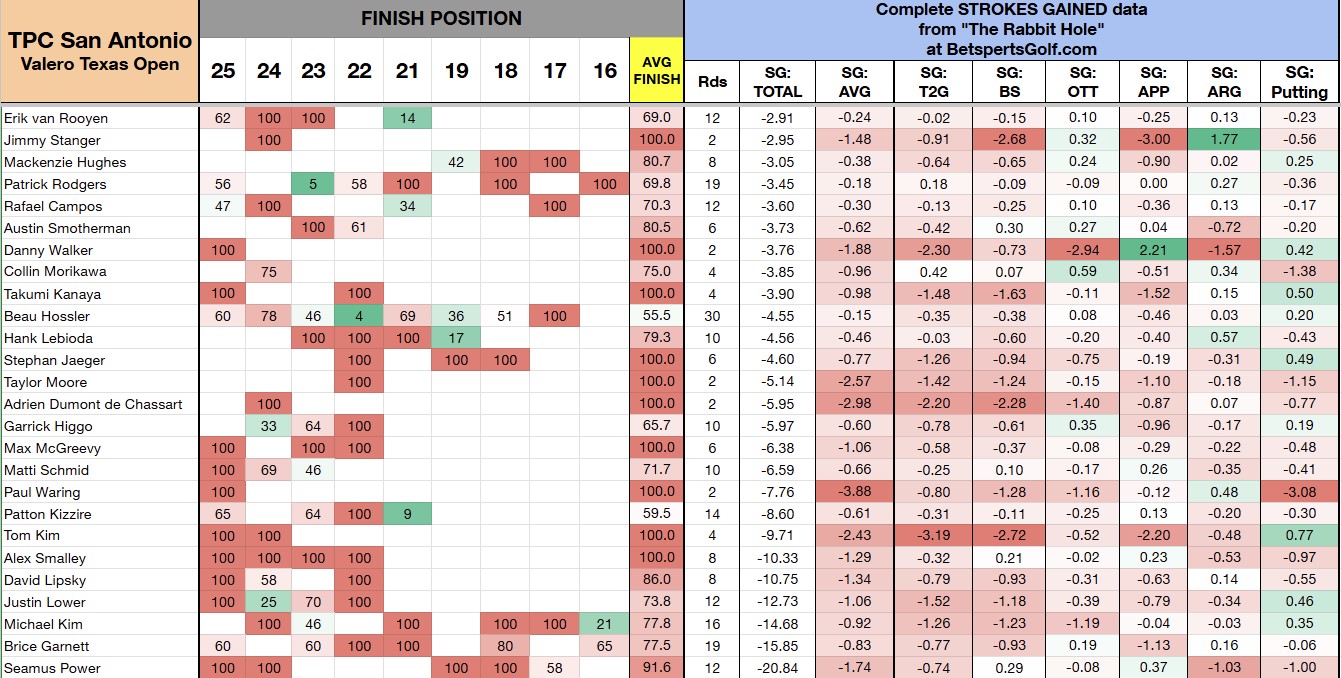
Finish Position and Strokes Gained History at TPC San Antonio (2016-2025)
This includes the average finish position and Strokes Gained per round. Players are sorted by SG: Total. TPC San Antonio is the 4th most predictive course on the PGA Tour. 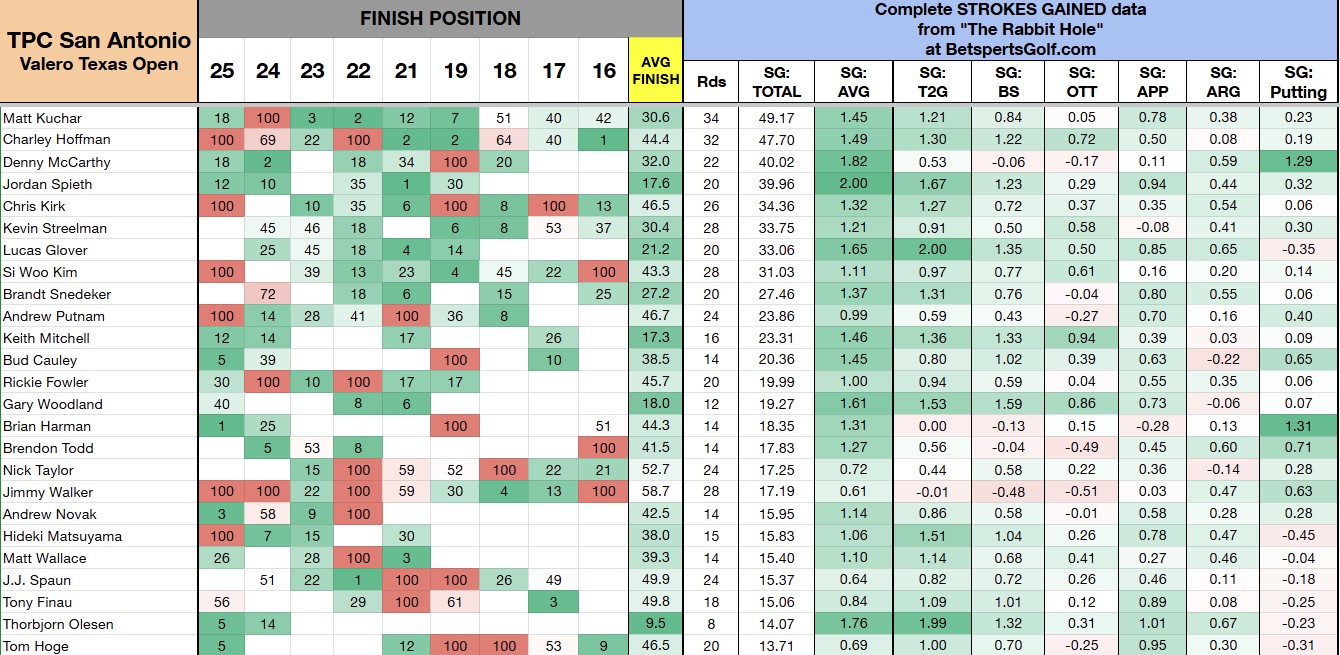
Course Features
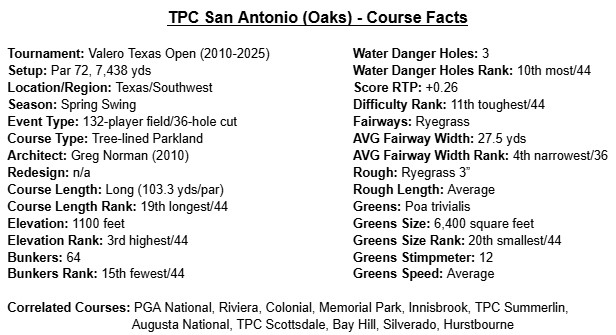
Located north of downtown San Antonio in the Texas Hill Country, TPC San Antonio is a par 72 that stretches to 7,438 yards. It plays slightly longer than average and ranks as the 19th longest course in the annual Tour rotation. The course was designed by Greg Norman, who was consulted during the build by current LIV player Sergio García.
In contrast to many of the more uniform TPC layouts, one of Norman’s goals was to highlight the rugged natural landscape of the property. Sitting at roughly 1,100 feet above sea level, the course is relatively flat, with only about 100 feet of elevation change from its highest to lowest points. It winds through oak trees and features rocky terrain alongside native grasses and vegetation, giving it a distinct and natural feel.
The agronomy team at TPC San Antonio overseeds both the fairways and rough with a mix of 80% Perennial Ryegrass and 20% Chewing Fescue. The rough is expected to play up to three inches this year, compared to roughly 2.25 inches in previous editions. Similar to many courses seen throughout the season, the greens are overseeded with Poa trivialis and typically run between 12 and 12.5 on the Stimpmeter.
With only three water hazards and relatively non penal rough, it may not appear overly difficult on paper, but TPC San Antonio consistently plays as a stern test due to its firm conditions and frequent winds. There are only two non par 5 holes that average under par, and historically the course has produced more double bogeys or worse than every venue except PGA National Resort and TPC Sawgrass.
Success here requires a combination of accuracy off the tee and high level iron play on approach. Even with four par 5s on the scorecard, they represent one of the most difficult sets on Tour. Still, the ability to score on these holes remains one of the few ways for players to separate from the field. Six of the past 11 winners have led the field in par 5 scoring for the week.
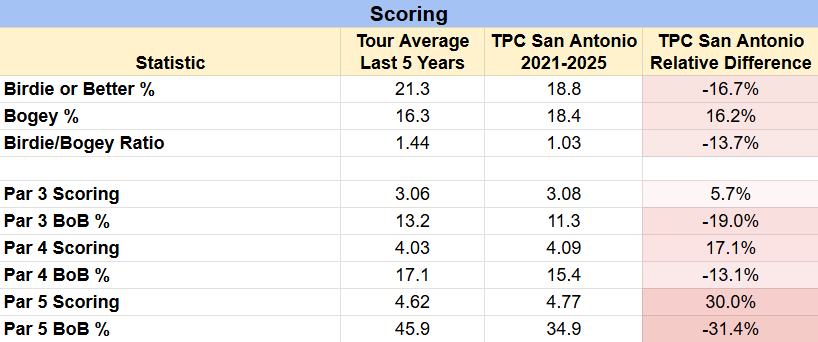
The primary variable that determines how difficult TPC San Antonio will play is the wind. As is the case with many Texas layouts, gusty conditions are often a constant factor. The course can become especially challenging when winds come from the north, the prevailing spring pattern in San Antonio. Last year, with moderate to gusty winds across all four rounds, the winning score was -9, and only 29 players in the field finished under par. Said 2016 winner, Charley Hoffman on the wind factor, “If the wind doesn’t blow, guys can shoot 5, 6, 7 under on this golf course. If the wind blows, it’s a totally different story.”
Players will also need to navigate strategically placed cavernous bunkers, heavily forested brush areas (see Kevin Na video below), and undulating green complexes at TPC San Antonio. While the total number of bunkers is relatively modest at 64, they are deep and often positioned around greens, where errant approach shots are most likely to find trouble. Wind plays an especially important role on approach shots into the course’s many elevated greens, which feature runoff areas designed to collect imprecise strikes.
Hole Preview
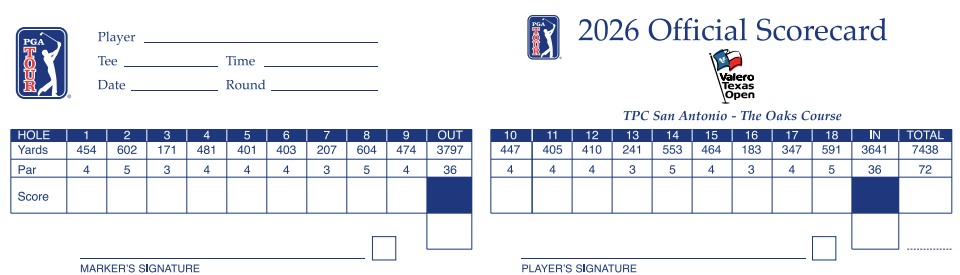
TPC San Antonio features the standard par 72 setup with ten par 4s, four par 5s, and four par 3s. Even though it sits in rugged Texas Hill Country terrain, there are few holes that stand out with a singular identity. The opening stretch, including the 602 yard second hole, is demanding from the start. The first four holes combine to measure 1,708 yards and average +0.45 strokes per round, making early execution critical.
Most of the front nine is defined by subtle doglegs and bunkering that guards both sides of greens. There are five par 4s under 410 yards, while the four par 5s are among the longest on Tour, averaging 588 yards. Three of the four par 5s are often unreachable in two shots and collectively rank among the most difficult par 5 scoring environments on Tour. Strong wedge play becomes essential for converting birdie opportunities when reaching scoring range.
A unique design feature of TPC San Antonio is how the routing interacts with the wind. Holes are shaped to play downhill when hitting into the prevailing wind and uphill when playing downwind. This design neutralizes pure distance advantages and reduces the benefit gained by longer hitters off the tee.
The 347 yard 17th hole is one of the most intriguing on the course. It can extend to 366 yards and becomes a potential driving hole when wind conditions are favorable. Greenside bunkers guard both sides and the front, creating a clear risk and reward decision late in the round.
The par 5 18th hole, measuring 591 yards, is a strong finishing test. It plays uphill and features a creek that cuts across the landing area, punishing errant drives. While it yields a birdie or better rate of 25 percent, it also produces a bogey or worse rate of 16 percent, making it one of the more volatile closing holes on Tour.
Strokes Gained Analysis
Off the Tee
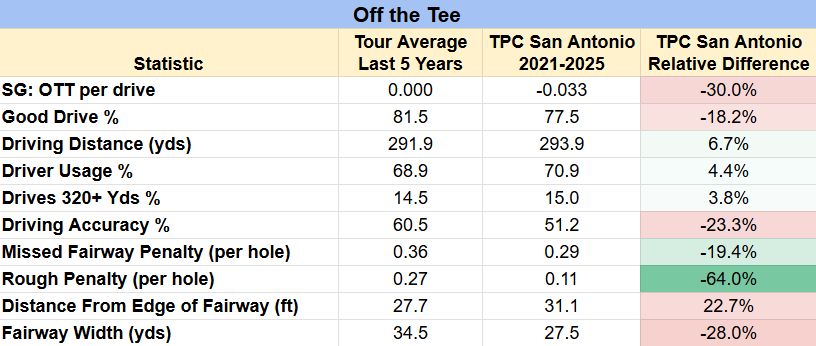
TPC San Antonio presents a unique challenge off the tee. While some driveable holes feature narrow, tree lined fairways, others open into significantly wider landing areas. Despite this mix, driving accuracy remains well below Tour average, sitting at just 51% compared to the PGA Tour baseline of 61%. Over the last two years, that number has dipped further to 49%, largely due to firmer turf conditions and persistent wind, which continue to make fairways more difficult to consistently hit. The data shows that general accuracy off the tee does not matter as much at TPC San Antonio because the rough has historically been among the least penal on Tour. In fact, the average proximity difference between approach shots from the rough compared to the fairway is only seven feet. Even more striking is that the Birdie or Better percentage over the last five years on second shots from the rough has actually been higher than from the fairway, highlighting how minimal the traditional penalty has been. That said, with the rough increasing to 3″ this year, the penalty from missed fairways is expected to be somewhat more pronounced than in previous editions.
While almost every driving hole at TPC San Antonio is flanked by either rocky terrain or native Texas brush, it will only truly penalize those who are wildly spraying the ball off the tee. As Jordan Spieth noted, “You can’t make many mistakes off the tee, you’ve got to be hitting fairways because it’s not just like bunkers on one side. A lot of holes you have rocks and brush off both sides of the fairway.”
“Distance From Edge of Fairway” becomes a key stat this week, as it helps identify which players are most inaccurate with their errant drives and therefore most likely to find those difficult recovery situations.
Fairway bunkers at TPC San Antonio are deeper and more troublesome than usual, but they are scattered throughout the layout and do not factor prominently into many tee shots. While shorter, more accurate players may have a better chance of avoiding trouble, longer hitters still gain value on holes that play into the wind, along with opportunities to hit shorter, higher lofted approaches into firm, “bouncy” greens.
Even so, driving distance has historically been nearly as inconsequential as driving accuracy in determining success here. Past leaderboards have included plenty of shorter hitters who have thrived, such as Brian Harman, Chris Kirk, Corey Conners, Matt Kuchar, and Lucas Glover.
In summary, neither elite distance nor pinpoint accuracy is essential off the tee at TPC San Antonio. The lack of a strong distance requirement is supported by the fact that the last eight winners have averaged 42nd in Driving Distance. The 2022 winner J.J. Spaun ranked 95th in Driving Distance, while the 2023 winner Corey Conners ranked 106th.
As for Driving Accuracy, the results have been equally inconsistent. In 2019, the top five finishers averaged ninth in the category, but in 2021 the winner Jordan Spieth ranked 109th in Driving Accuracy. More recently, the 2024 winner Akshay Bhatia finished 63rd in Driving Accuracy, reinforcing the idea that success off the tee is driven more by overall course management than any single driving metric.
Approach
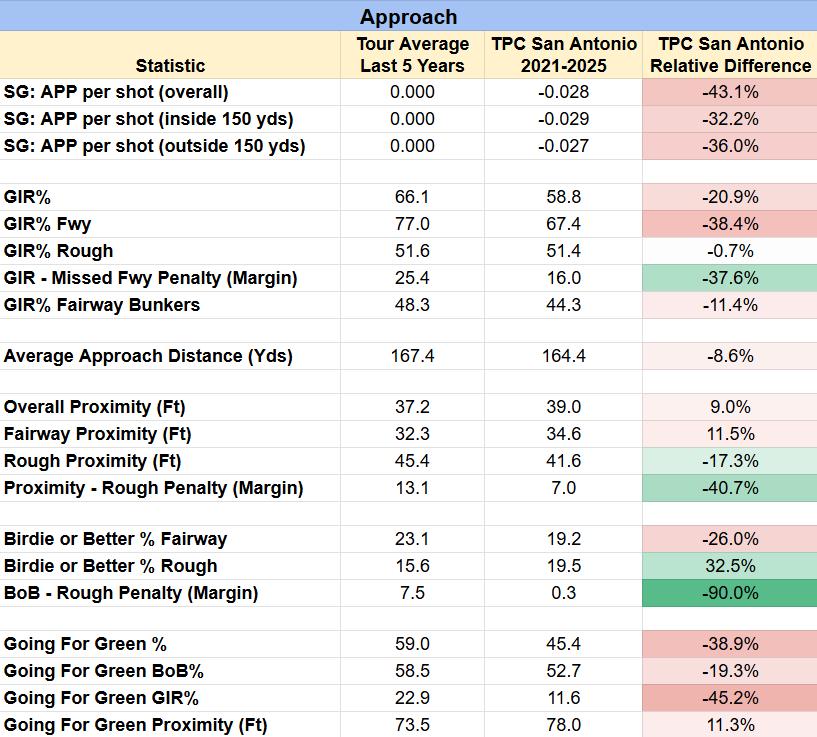
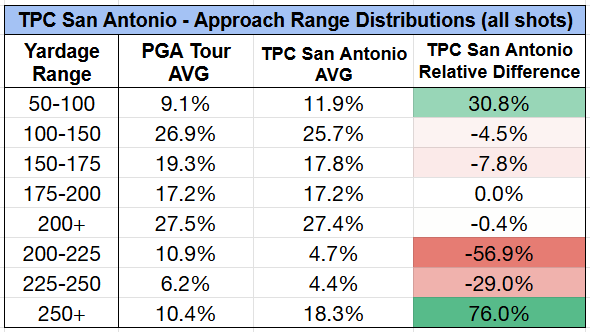
All the apparent variability and randomness off the tee is a key reason TPC San Antonio has become one of the premier second shot courses on the PGA Tour. Over the last two years, it has ranked as the eighth most difficult layout for gaining strokes on approach.
Not only are the greens heavily guarded by deep, challenging bunkers, but many are also elevated above the fairway with little to no bailout areas for missed approaches. Players must also control trajectory and land shots on the correct quadrants of the greens due to significant undulation, using slopes to help funnel the ball closer to hole locations.
- SG: APP
- Bogey Avoidance
- SG: Par 5
- Distance From Edge of Fairway
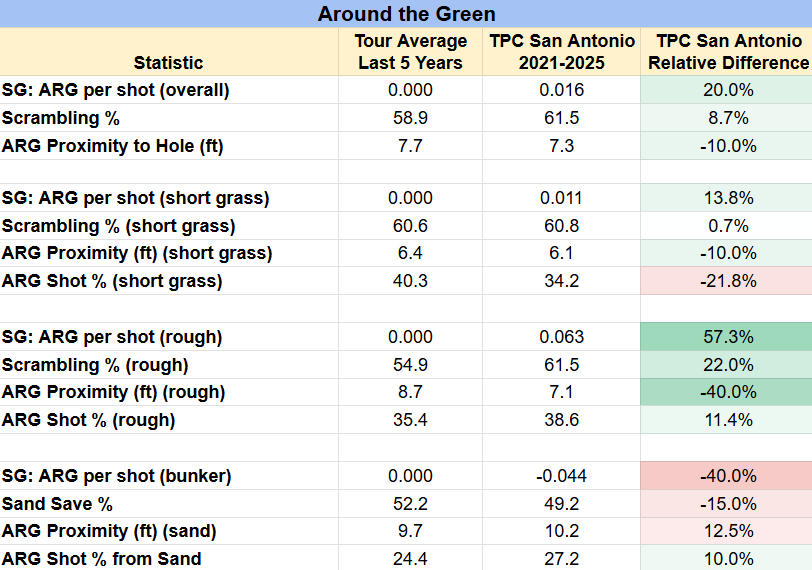
- Scrambling
- Good Drive %
- Birdie or Better %
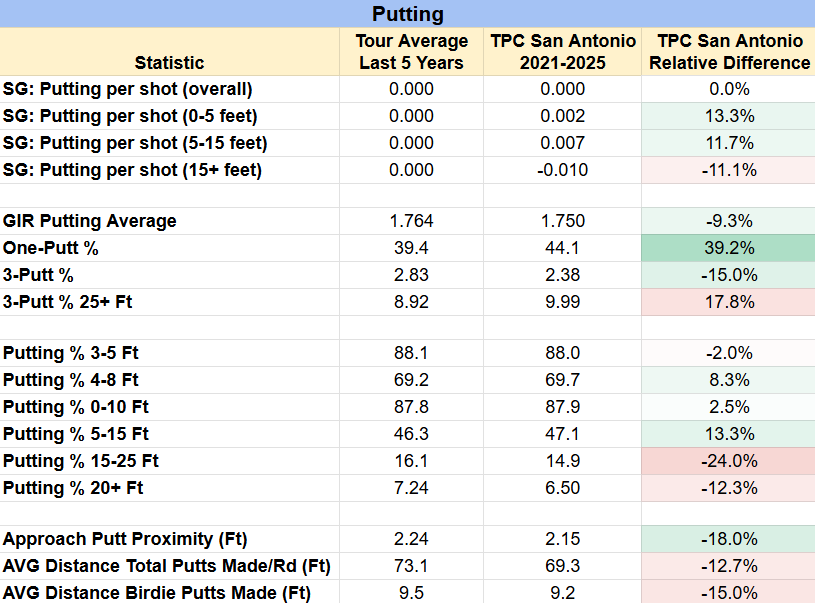
- SG: Putting (Poa Trivialis/Bent)
- Sand Save %
- Proximity 50-125 yds
Key Rabbit Hole Filters
- Course Region: Texas
- Course Length: Long
- Scoring Conditions: Difficult
- Greens Surface: Poa Trivialis
- OTT Gain: Difficult
- OTT Club: Mixed
- Fairway Accuracy: Difficult
- APP Gain: Very Difficult
- GIR Accuracy: Difficult
- Rough Penalty: Low
- Par 5 Scoring: Difficult
- Sand Saves: Difficult
- Gain Putting > 15′: Difficult
