The Truist Championship at The Philadelphia Cricket Club (Wissahickon Course) – 2025 Preview

Ron Klos

a year ago
The final tune-up for the 2025 PGA Championship sees the PGA Tour heading to Philadelphia for the first time since 2018 for the Truist Championship. It will be the year’s fifth Signature Event, where the 72-man field will compete without a cut for a $20 million purse.
The tournament is headlined by a new title sponsor and a course that has never hosted a regular Tour event. Formerly known as the Wells Fargo Championship, it’s normally played at Quail Hollow Club in Charlotte, North Carolina. However, because Quail Hollow is hosting the upcoming PGA Championship, the event will be hosted on the Wissahickon Course at the Philadelphia Cricket Club in Flourtown, Pennsylvania.
Wissahickon is a hidden gem that recently underwent a complete restoration in 2013 by Keith Foster to revive the course to its former glory under legendary architect A.W. Tillinghast. It was a perfect fit to be a temporary host because it’s tournament-ready and doesn’t need to make any major overhauls.
“We keep Wissahickon in championship conditions day in and day out. So when the tour needed a place to play and they only had nine months to decide where that was going to be played,” the Cricket Club was an option, said Dan Meersman, the Director of Grounds. “The fact that they decided to come here is fantastic.”
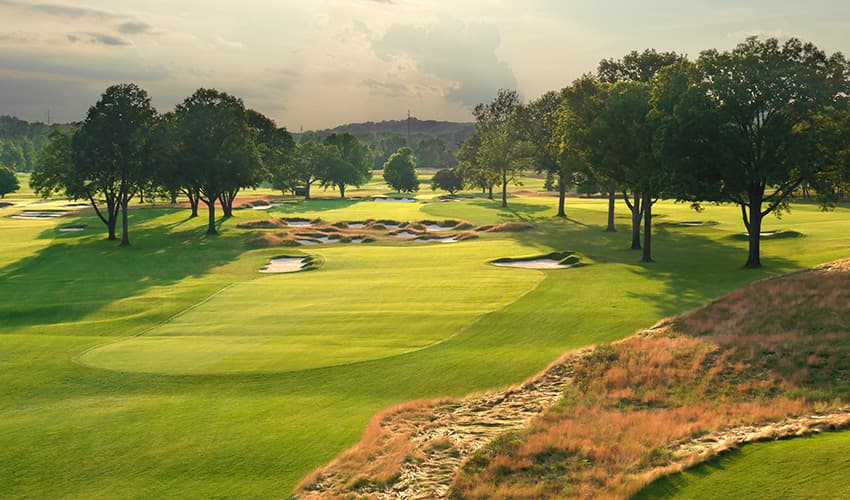
It’s a shorter classical strategic layout that features diverse undulating greens, clever bunkering, rolling terrain, and challenging approach shots. Tillinghast’s design forces players to hit every club and shot shape in their bag well to have success. The course is known for the par 5 15th, which features the “Great Hazard”, a large central bunker that bisects the fairway, and a challenging 18th hole that has a reputation as one of the best finishing holes on the East Coast.
The Field

The Truist Championship will feature 72 of the PGA TOUR’s best players, headlined by defending champion and World No. 2 Rory McIlroy. Other notable players set to compete at The Philadelphia Cricket Club include nine of the top 10 players in the Official World Golf Ranking: McIlroy (No. 2), Xander Schauffele (No. 3), Collin Morikawa (No. 4), Justin Thomas (No. 5), Ludvig Åberg (No. 6), Hideki Matsuyama (No. 7), Russell Henley (No. 8), Viktor Hovland (No. 9) and Maverick McNealy (No. 10). As he did last year, Scottie Scheffler will take the week off before the PGA Championship.
McIlroy won the 2024 Truist Championship (formerly known as the Wells Fargo Championship) for a record-setting fourth time in his career (2010, 2015, 2021, 2024). Since then, the 35-year-old has added three additional victories to his record including the 2025 AT&T Pebble Beach Pro-Am, PLAYERS Championship and Masters Tournament, where he completed the career grand slam.
In addition to McIlroy, the 22nd playing of the Truist Championship will feature six other past champions including Wyndham Clark (2023), Max Homa (2019, 2022), Jason Day (2018), Brian Harman (2017), Rickie Fowler (2012) and Lucas Glover (2011). Sponsor exemptions for the Truist Championship include Rickie Fowler, Keith Mitchell, Jordan Spieth and Gary Woodland.
Wissahickon Course – History
In 1920, the Philadelphia Cricket Club commissioned one of its members, the renowned A.W. Tillinghast, to create a golf course in Flourtown. Other Tillinghast courses played on the PGA Tour include Winged Foot, Bethpage Black, Baltusrol, and Ridgewood. Now known as Wissahickon, this Tillinghast course shows the work of a design genius at the height of his abilities. The course opened for play in 1922.
As the course aged toward the century mark, tree growth increased, greens shrank, and bunkers slowly eroded. In 2013, Keith Foster was hired to restore the course to its past glory to bring it back to Tillinghast’s original vision. The renovation led to the removal of over 2,500 trees and opened the sight lines and scenic beauty of the course. The tree removal highlighted the visual challenges that Tillinghast is known for. This is exemplified on the par 4 2nd where an uphill approach presents the illusion of a bunker behind the green, which is actually part of the 10th hole. The original greens and bunkers were also restored, as was the famed “Great Hazard”hole.
Course Features
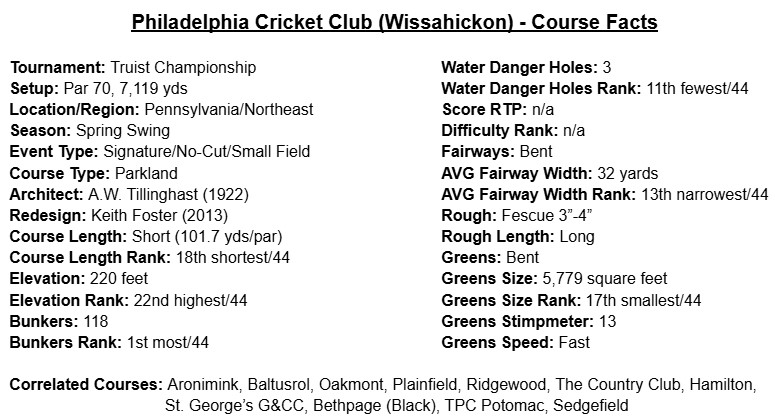
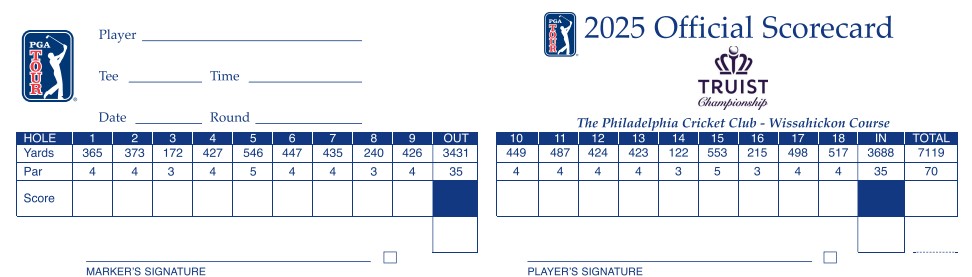
Wissahickon is a par-70 that will play to a modest 7,100 yards. One of the best layouts in the Philadelphia metro area, it’s a great example of classical golf course architecture. The routing, combined with the rolling terrain, creative bunkering, and the unique green complexes are some of the highlights of this Tillinghast masterpiece.
The property is bisected by an antiquated rail platform that separates the elevated section of the course. Most of the front nine is in the lower half and contains heavier tree growth. It was routed by Tillinghast to create an intimate feel. The back nine has a much more expansive feel, as it makes its way out to the far corner and then back to the grand finish at the clubhouse.
The biggest adjustment the PGA Tour is making for the Truist is the routing of the holes. Players will start on what is usually the 365-yard par-4 8th and move to another short par 4 on the 9th. Then they’ll play 10 through 18 before moving to 1 and 2. The picturesque par-3 3rd, measuring only 122 yards, will be their 14th hole. Then they’ll take on the “Great Hazard” for an exciting risk-reward par-5. The final three holes—the 5th, 6th, and 4th—will challenge anyone trying to cling to a lead.
One of the main descriptions of the course (including from members) is that it possesses an excellent blend of demand and opportunity to score. Even with difficult greens and challenging bunkers, because of the short course length, there will be plenty of birdies this week. Most of the holes contain an abundance of strategic options, including aerial or ground approaches. Numerous holes, including both second shots on the par 5s, offer risk-reward opportunities.
At an average width of 32 yards, the course is fairly wide open and forgiving off the tee. While an errant drive will rarely result in a penalty stroke, it will lead to a difficult approach due to having a bad angle into a heavily-bunkered green. Other than penal fairway bunkers, there are few hazards, and the fescue rough is between 3″-4″ and not as difficult as other Tillinghast courses like Winged Foot or Bethpage Black. Another challenge players will face off the tee is that the rolling topography leads to uneven lies and the possibility of drives bouncing sideways into the rough. This will force players to hit different shot shapes and favor those with the skills and experience to do so.
The course is littered with 118 cavernous bunkers, including numerous adjacent to fairway landing zones with high lips that will challenge players who are going for the green. At Wissahickon, accuracy trumps distance. “We play a lot of golf courses that are ‘bomb it and go find it.’ You can’t necessarily do that here,” says Stewart Moore, PGA Tour vice president of championship management.
Perhaps the biggest course defense is the green complexes, which should play firm and are subtle and nuanced with their undulations. Some greens are open across the front and entice a running shot, while others are elevated and heavily defended. The design reflects Tillinghast’s genius for varied green settings. The different tiers and quadrants will penalize players for being on the wrong side of the hole. Similar to Augusta National, this is a course where you need to understand where to miss and to sometimes simply aim for the middle of the green. Missing on the short side in one of the deep greenside bunkers will present a near-impossible up-and-down. There are also numerous options for tough pin placements due to the small plateaus on most greens.
With nine of the 12 par 4s under 450 yards, there will be a high amount of wedges and short iron approaches. Players who miss greens will find themselves with some tricky chips and sand saves from around the green. While the greens don’t have massive slopes, there are only three that are relatively flat and devoid of contours. Lag putting and avoiding three-putts will be crucial for success this week.
There is not a weak hole on the course along with an amazing variety of par 3s and par 4s, both long and short. The finishing stretch of holes (Nos. 15-18) will provide a measure of drama on Sunday no matter how big the lead is. The “Great Hazard” 15th is a diabolical risk-reward par-5 with 13 bunkers smack in the middle of the fairway. The 16th is a well-protected, 215-yard par-3, and both Nos. 17 and 18 are 500-yard par-4s. The 18th is one of the East Coast’s best finishers, a tough risk-reward hole with a creek that comes into play if you don’t hug the left side of the fairway off the tee.
“You’ve got a risk-reward par-5, and the last three holes have been three of the four hardest holes in all of the events we’ve held here,” said Jim Smith Jr., Cricket’s director of golf. “That will lead to what I hope will be an exciting finale.”
Most Important Stats For Success at Wissahickon
*In order of importance
- SG: APP (short courses)
- SG: Putting (Bent) 5-15 ft
- Proximity 50-150 yds
- SG: ARG
- Par 4 BoB%
- Bogey Avoidance
- DFEF
- 3-Putt Avoidance
- Sand Saves
- SG: Difficult “ARG/Putting” courses
Key Rabbit Hole Filters
- Region: Northeast
- Course Length: Short
- Field Strength: Very Strong
- Event Type: No Cut
- Field Size: Small
- Bunker #: High
- Greens Surface: Bent
- Green Speed: Fast
- Gain ARG: Difficult
- Gain Putting: Very Difficult
- 3-Putt AVD: Difficult
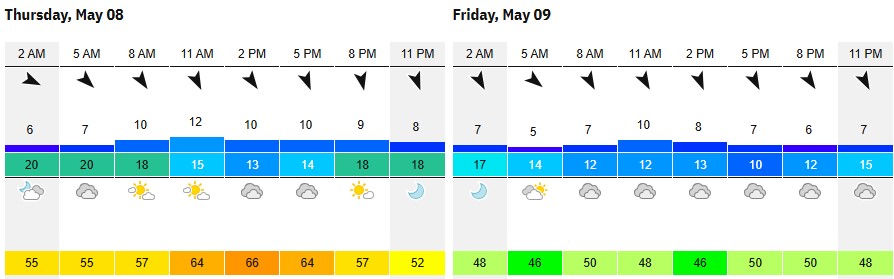
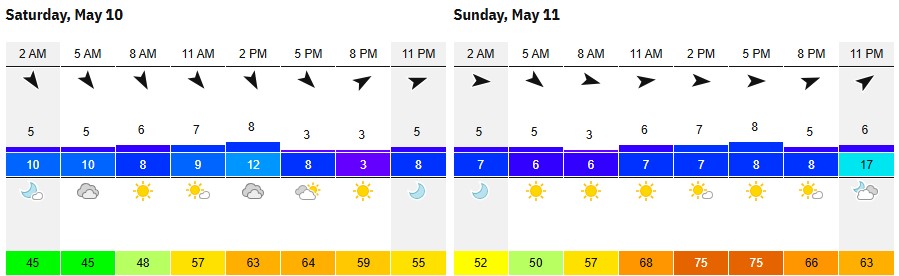
Weather Forecast – Flourtown, PA