
The Sony Open at Waialae Country Club – 2024 Preview

Ron Klos

3 years ago

In the first full-field event of 2024, the PGA Tour hops Hawaiian islands for the second event of the “Aloha Swing”, going from Maui to O’ahu for the Sony Open played at the classical Waialae Country Club in Honolulu. With legendary figures such as Jack Nicklaus, Tom Watson, Lee Trevino, and Ben Crenshaw having won championships here, the course carries on still today, withstanding the test of time. Having hosted the Sony Open since 1965, it is the third oldest annual course on Tour, only behind Colonial Country Club and Pebble Beach Golf Links.
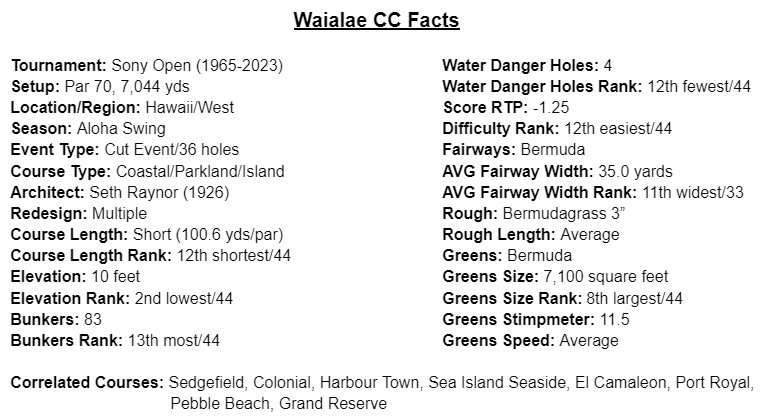
Waialae CC is known as a shot-makers golf course distinguished by its narrow corridors, sharp doglegs, unpredictable Bermuda rough, and firm greens. It is a positional track that has effectively neutralized any advantages held by bombers off the tee. In essence, this week is all about strategy, position, and shot-making on a tight and flat course. In the words of Kevin Kisner, “I like that it’s a shot-maker’s golf course. It’s a shorter, ball-striker’s paradise. You’ve got to play to certain spots. I think it’s Point A to Point B and make some putts.” This is why we typically see the same type of player (shorter-hitting ball-striker with a quality short game) have success here year after year.
Coming off four rounds at the Plantation Course at Kapalua, this week will present quite the contrast with the completely divergent Waialae CC. While Kapalua has enormous amounts of slope and is the toughest walk in golf, Waialae is one of the flattest courses on Tour and is perhaps the easiest walk. The sizes of both courses are also completely different. Whereas Kapalua has massively wide fairways, Waialae has tight tree-lined corridors. The greens are also dissimilar from each other. Kapalua’s are much bigger with more slope and grain while Waialae’s are smaller, flatter, and easier to make putts.
While not a complete birdie-fest, minus the wind-blown 2020 event, the average winning score over the past five tournaments has been 21-under par. It’s a course where if you hit good shots, you can make a birdie on almost every hole. But if you are in the rough or out of position, it will be a tough scramble for par.
The Field
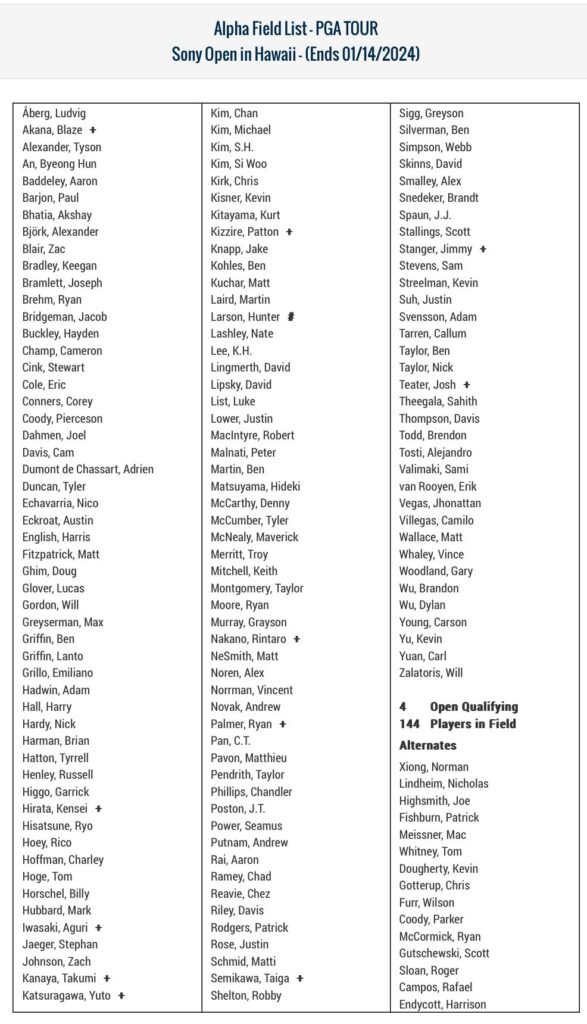
36 golfers who played in last week’s Sentry event are making the short trip to Honolulu this week. As the course trends show, those who did not play last week will need to shake off the competitive rust and will be at a slight disadvantage. Past performance at Waialae is of massive importance this week as it’s the second most predictive out of any course on Tour. Only Augusta National features a greater correlation with course history.
While not the star-studded event we saw at Kapalua, this will still be one of the strongest Sony Open fields ever with 15 of the top 40 and 33 of the top 65 in the Official World Golf Rankings in attendance. The main headliners include Matt Fitzpatrick, Brian Harman, Tyrrell Hatton, Keegan Bradley, Russell Henley, Ludvig Aberg, Hideki Matsuyama, and last week’s winner, Chris Kirk.
Will Zalatoris, who returned to competition at the Hero World Challenge in December, is scheduled to make his first official start since the 2023 WGC-Dell Technologies Match Play. Gary Woodland will also make his return to action after undergoing surgery in September to extract a brain lesion.
Being the first cut event of the year, the 144 golfers in the field will be “cut” to the top 65 players, including ties, by the end of Friday afternoon’s second round. Unlike The Sentry, the Sony Open is not a signature event and will have a prize purse of $7.9 million.
Course History
Completed in 1926 by legendary architect, Seth Raynor, the course, at what is now Waialae Country Club was first opened in 1927. Raynor was known for designing courses with exceptional routing that made players think their way around the property. It has many of the same characteristics as the classical “Golden Age” of golf courses. Almost every other hole is facing a different direction, forcing players to shape their shots and account for the wind at all times.
Raynor’s mentor and friend was the legendary course designer Charles Blair Macdonald. Many of the courses Raynor designed were influenced by Macdonald’s thoughts and ideas. He also incorporated elements from Scottish links-style courses that forced golfers to be creative shot-makers and to think their way around the property.
Unfortunately, Raynor passed away from pneumonia in 1926 just after completing Waialae. Originally named “The Royal Hawaiian Hotel and Waialae Golf Course”, it was built by the Territorial Hotel Company as part of a promotional program to develop luxury travel trade to Hawaii. And much like resort courses today, it was meant to be used by anyone staying at the hotel. Then in 1930, a collection of players at the course decided to designate it as an exclusive club and the name was changed to Waialae Country Club.
In the years after the Great Depression during the 1930s, business started to dramatically slow due to people not being able to afford to travel to vacation spots. When a fire destroyed portions of the clubhouse in 1941, it was decided that major renovations were needed. It was slow at first because parts of the course were used to aid the military during World War 2, but in the years after things started to progress. Amenities were added and certain holes were moved and redesigned in the early 1960s.
By 1965, Waialae Country Club was ready to host a PGA Tour event. The first Hawaiian Open on the PGA Tour was held at the course in November 1965. Since then, a PGA Tour event has been held here every year except for 1970. Over time there have been numerous minor renovations to the course led by numerous architects including Robert Trent Jones, Desmond Muirhead, Rick Smith, and Tom Doak.
Finish Position and Strokes Gained Event History (2015-2023)
This includes the average finish position and Strokes Gained per round in each category. Players are sorted by SG: Total. Waialae Country Club is the 2nd (out of 44) most predictive annual course on Tour.