
The Genesis Invitational at Riviera Country Club – 2026 Preview

Ron Klos

8 months ago

Coming off the heels of Collin Morikawa’s masterful performance at the AT&T Pebble Beach Pro-Am, the PGA Tour heads down the California coast for a second straight Signature Event, the Genesis Invitational, the final stop of the West Coast Swing.
After last year’s devastating wildfires forced a one year relocation to Torrey Pines Golf Course, the tournament returns to the Los Angeles area and the historic Riviera Country Club, which celebrates its 100th anniversary this year. Designed and built in 1926 by George C. Thomas Jr., it opened as the Los Angeles Athletic Club Golf Course and has been a fixture on the PGA Tour since 1973.
The routing is near-perfect, as Thomas masterfully utilized all the natural features of the terrain to create one of golf’s enduring architectural treasures. Not only is Riviera Country Club iconic, but it is consistently mentioned among the best designed courses in the country. Even as it approaches its 100 year anniversary, most experts believe it does not have a single weak hole. While the overall scope and size of the property may not overwhelm at first glance, Riviera demands precision and total commitment on every shot. It is a challenging layout that forces players to think strategically, shape shots both directions, and trust every club in the bag.
Riviera features tight driving corridors, unpredictable Kikuyu rough, and fast greens with subtle undulations. It tests every aspect of a golfer’s game and requires players to find precise areas on both fairways and greens to create quality scoring opportunities. Missing in the wrong spots places immediate pressure on a player’s ability to save par because the course does not offer many easy recoveries. Shot makers who can position themselves properly off the tee, shape the ball in both directions, and scramble effectively around the demanding greens are typically the ones who contend.
Two of the greatest golfers of all time, Jack Nicklaus and Tiger Woods, never managed to win at Riviera Country Club. The course holds universal admiration among Tour pros because it is demanding yet fair, asking players to execute without relying on gimmicks. Speaking about the challenge Riviera presents, Patrick Cantlay summed it up best: “The greens are not overly firm and it is not crazy long. The golf course always defends itself. There are no tricks. There is no water on the whole golf course. There is no real goofiness. I just think, all in all, it is the best test that we play.”
Rory McIlroy gave an insightful summary of the ball-striking test at Riviera: “You don’t have to really bomb it off the tee, but it’s real strategic. You’ve got to place your ball on the right sides of the fairways, you have to make sure you hit it to the right side of the greens. You can’t really short-side yourself here. You can’t really get it above the pin. It’s a real thinker’s golf course.”
The Field

Eighteen of the world’s top 20 are in the 72 player field along with 41 of the world’s top 50. And unlike last week’s Pebble Beach Pro-Am, there is a 36-hole cut with the top 50 and ties, plus any player within 10 shots of the lead, able to play the weekend.
Last year, Ludvig Aberg triumphed in the relocated event, defeating Maverick McNealy by one stroke, while Patrick Rodgers and Scottie Scheffler finished tied for third. In 2024, the last time it was played at Riviera, Hideki Matsuyama won by three strokes over Will Zalatoris and Luke List.
Riviera Country Club – History
Sitting inside a small canyon, and tucked away in a residential area just south of Sunset Boulevard lies one of golf’s monumental courses, Riviera Country Club. In the 1920s, golf was becoming more popular in Southern California, and the Los Angeles Athletic Club wanted to build a champion course that was located away from the congestion of the city. About 20 miles to the west of downtown Los Angeles, a tract of land in the Pacific Palisades area was settled upon as the best location.
Tasked with the course design, George Thomas was familiar with the area having just finished Bel-Air Country Club which was only five miles away. One of the most underrated architects of his time, up to that point, Thomas had only been an amateur designer and agreed to take on the project free of charge. He was joined in the project by his “construction man”, William P. Bell, and Alister MacKenzie who helped in the course’s creation. Thomas initially despised the property’s location in the Santa Monica Canyon. It was a small, dreary, treeless, mostly flat piece of land that seemed far from suitable for building a premier golf course.
It appeared that heaven and earth would need to be moved to construct a course from scratch in that canyon. But instead of moving tons of dirt and land, and because of financial constraints, Thomas took the naturalist approach and developed all sorts of holes that blended into the canyon and its surroundings. As renowned professional golfer, Hale Irwin attests, “The integrity of the course is influenced greatly by the fact that no two holes are alike and the course has been placed, rather than forced, into the land.”
The course was developed over an 18-month span as Thomas put together 15 different versions of the design over this time period. It finally opened to critical acclaim in 1927 and remains a crowned jewel to this day.
Since it opened, Riviera has been an institution in American tournament golf currently serving as the annual venue for the Genesis Invitational. This event was originally known as the Los Angeles Open and was first played here in 1929. Since 1973, The Los Angeles Open has been played here every year except in 1983 and 1988. Riviera was one of Ben Hogan’s favorite courses and it’s sometimes referred to as “Hogan’s Alley”.
It has also hosted a handful of majors including the 1948 U.S. Open, the 1983 and 1995 PGA Championships, the 1998 U.S. Senior Open Championship, and the 2017 U.S. Amateur. In 2028, Riviera will host the Summer Olympics.
The course itself has been relatively unaltered since its opening. It has held up magnificently over time as it has only undergone one major renovation back in 1992 when Ben Crenshaw and Bill Coore redesigned the bunkers to look as they did when the course first opened. In 2008, Tom Fazio completed a minor restoration of the 7th and 8th holes.
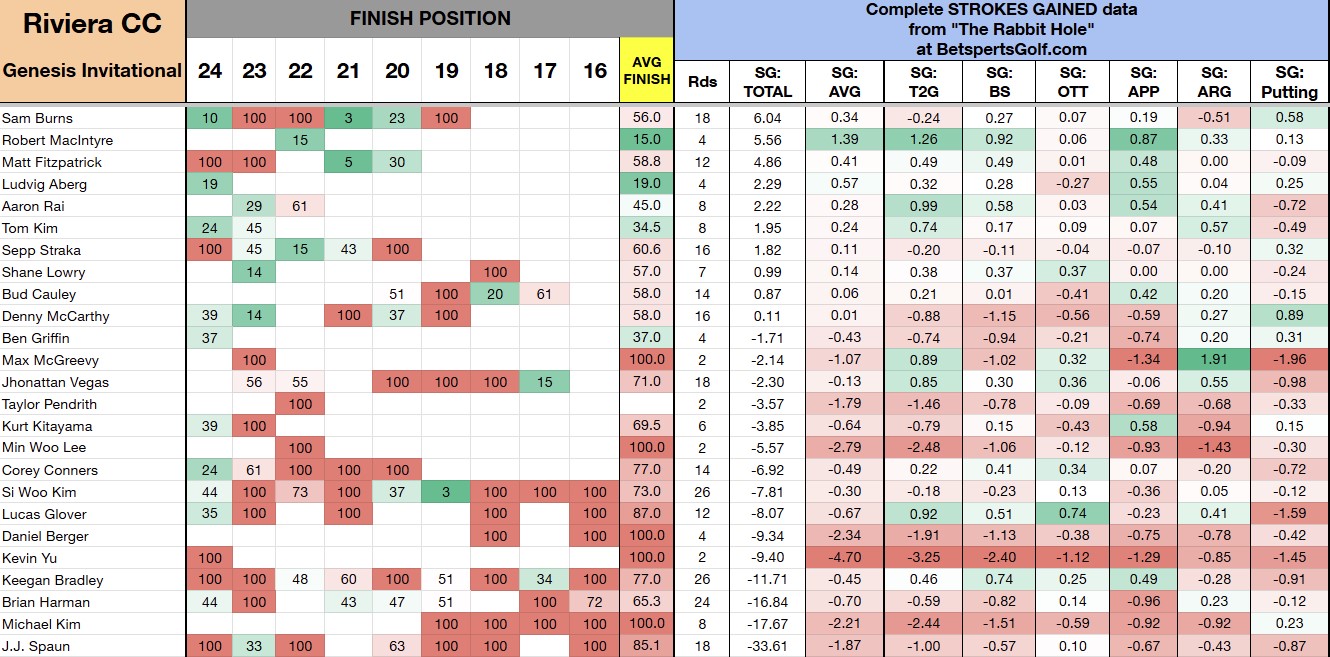
Finish Position and Strokes Gained History at Riviera CC (2016-2024)
This includes the average finish position and Strokes Gained per round. Players are sorted by SG: Total. Riviera CC is the3rd most predictive course on the PGA Tour. 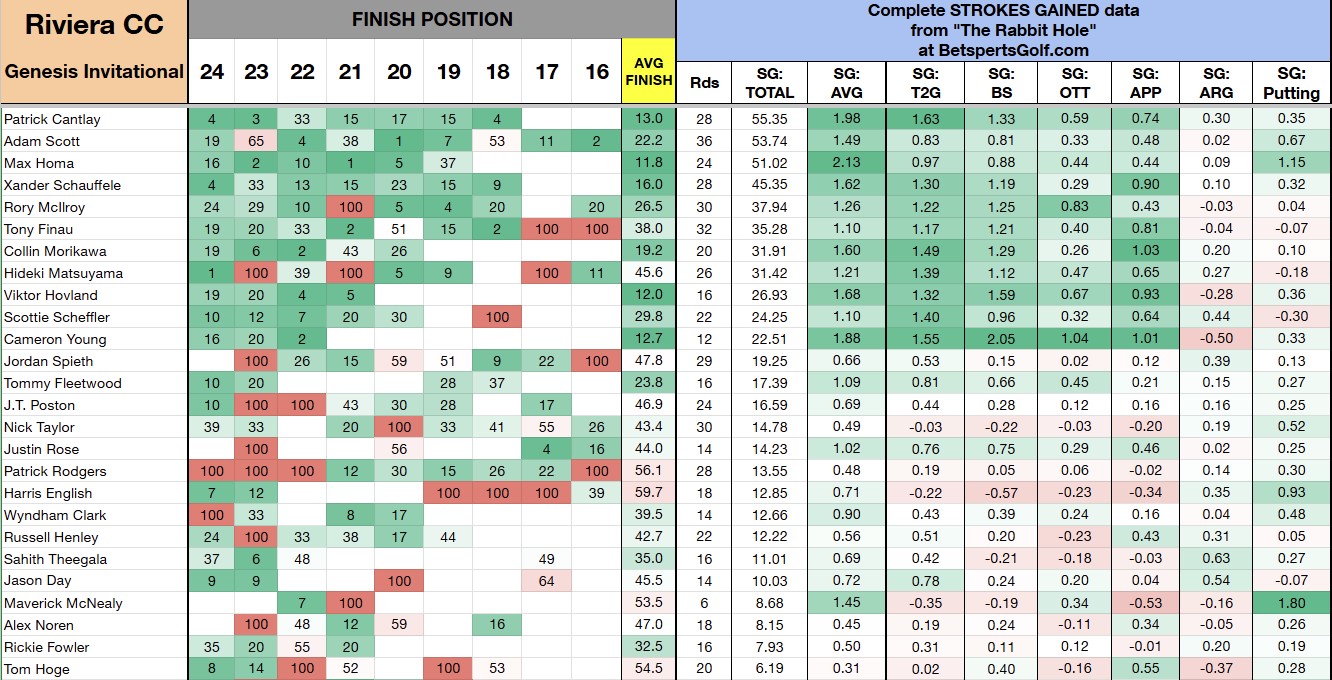
Course Features
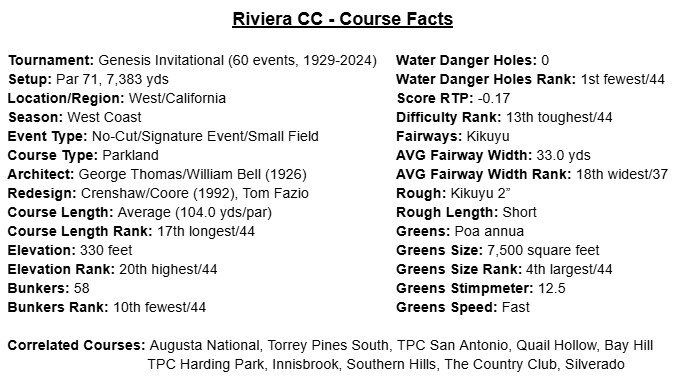
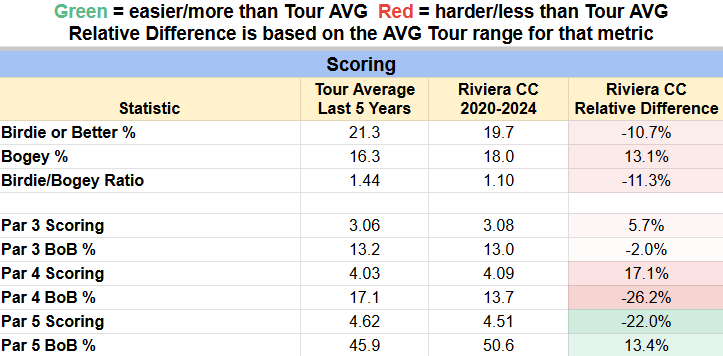
Located just a few miles from the Pacific coastline, Riviera Country Club is a Par 71 that stretches to 7,383 yards and consistently ranks as one of the most demanding non-major venues on the PGA Tour. It features bottlenecked, tree-lined, undulating fairways with fast Poa annua green complexes that average roughly 7,500 square feet. While it is a classical, old-school design, it still packs plenty of bite, averaging +0.17 strokes over par per round since 2019, which ranks it as the 13th toughest course in the annual rotation.
Very few statistical categories at Riviera play easier than the Tour average. With the second lowest Driving Accuracy/GIR percentage combination, it tests every part of a player’s game. One of the most striking contradictions is that Riviera has the second largest greens on Tour, yet also produces the lowest overall GIR rate at just 56.4%. The contouring, run-offs, false fronts, and firm Poa surfaces make simply holding greens a challenge.
Riviera also strongly rewards experience. It ranks third on Tour in course-history predictiveness, and 17 of the last 19 winners had already competed in at least four prior Genesis Invitationals before winning.
Strategically, Riviera forces constant decision-making. Nearly every hole presents a risk-reward choice between aggression and restraint. Architect George C. Thomas Jr. was a master of “angular” golf, and his influence is evident throughout the layout. On many holes, the optimal angle into the green comes from the most dangerous tee shot. Thomas also increased the number of trees near the greens on the back nine, further complicating approach play down the closing stretch and emphasizing precision, positioning, and patience.
While Riviera features no traditional water hazards, its 58 bunkers are among the deepest and most penal on TOUR. The absence of water and forced carries is a key reason the course’s penalty rate is nearly zero, yet Riviera still defends itself as well as any venue on the schedule. It does so without gimmicks, relying instead on brilliant hole design, narrow fairways, strategically placed bunkers, a barranca that comes into play on seven holes, and demanding pin locations on the fast Poa greens.
Barrancas are deep, natural gullies that are extremely difficult to escape once entered, and Riviera’s runs throughout the property, creating risk on both tee shots and approaches. This constant visual and strategic pressure forces players to shape shots and control trajectory rather than simply chase distance.
Wind is also a critical variable. When conditions pick up, gusts can swirl unpredictably through the canyon corridors, amplifying the challenge and causing Riviera to play significantly more difficult, as we have seen in multiple past editions.
Riviera is one of the few courses on the PGA Tour that features Kikuyu fairways and rough, a grass type that adds a unique layer of difficulty and unpredictability. Although the rough is only about two inches thick, Kikuyu lies can be extremely challenging. When the ball settles down into the dense, spongy strands, the grass can wrap around the clubhead and severely restrict contact, often forcing players to simply hack the ball back into play. From these lies, controlling distance and spin is nearly impossible, and reaching the green becomes unlikely.
At the same time, balls that sit cleanly on top of Kikuyu in the fairway can produce so-called “flyer lies.” Because the grass reduces friction between the ball and clubface, approach shots can come out hotter than expected, making distance control highly volatile. Kikuyu also has a sticky quality that can stop rolling balls abruptly, creating inconsistent bounces and lies throughout the round. As a result, players often describe the surface as unpredictable and one that requires significant experience to manage.
The greens at Riviera are Poa annua, and they are intentionally maintained to be firm and fast, typically measuring around 12.5 on the Stimpmeter. Combined with the challenges presented by Kikuyu, this contrast between unpredictable lies and fast, responsive putting surfaces places a premium on precision, trajectory control, and adaptability.
Hole Preview
Riviera is one of the rare courses that does not present a single, obvious weakness. The brilliance of George C. Thomas Jr.’s design lies in the way each hole introduces a different strategic problem. Former champion Johnny Miller once described Riviera as, “Definitely one of the greatest, no-nonsense golf courses in the world. It requires a player to play every club in his bag and every shot in his game,” a statement that reflects the course’s demand for complete versatility rather than specialization.
One of the defining strengths of Riviera is its routing. In laying out the holes, Thomas and Bell carefully considered the prevailing winds and natural terrain. The two nines stretch across the entire property, with the front nine moving counterclockwise and the back nine returning clockwise. This opposing flow exposes players to shifting wind angles throughout the round, preventing any single shot shape or strategy from becoming dominant.
The par 3s at Riviera are especially distinctive and widely regarded among the best sets in golf. Each presents a unique test rather than a repetitive demand. The par-3 4th, often cited by Ben Hogan as the greatest par 3 in America, is a 235-yard Redan-style hole featuring a massive bunker guarding the front and a green that slopes sharply from right to left. The par-3 6th, a Thomas original measuring around 200 yards, is equally unique, with severe contours and a narrow entrance that forces players to carefully control both trajectory and spin.
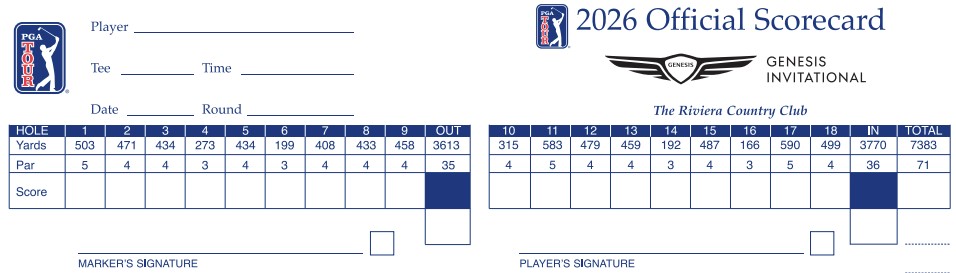
Riviera’s 11 par 4s rival the length and difficulty of any set on the PGA Tour, with seven measuring over 450 yards. Collectively, they rank as the fourth toughest group of par 4s on Tour, and they cannot simply be overpowered. Positioning, shot shape, and approach control are far more important than raw distance.
The most famous of these is the par-4 10th, a drivable hole that measures between 282 and 315 yards depending on tee placement. Despite its short yardage, it demands one of the most precise tee shots in golf, requiring players to shape the ball into a narrow target while avoiding deep bunkers that guard the green on three sides. The hole forces a decision between aggression and restraint and often produces wide scoring swings.
In contrast, Riviera’s three par 5s are highly scoreable, with a combined Birdie or Better rate of 44.5%, making them critical scoring opportunities. Performance on these holes has been a strong indicator of success. The most recent eight winners have combined to play the par 5s in 69 under par, and the last three champions, Joaquin Niemann, Jon Rahm, and Hideki Matsuyama, combined to go 29 under par on the par 5s for the week.
Strokes Gained Analysis
Off the Tee
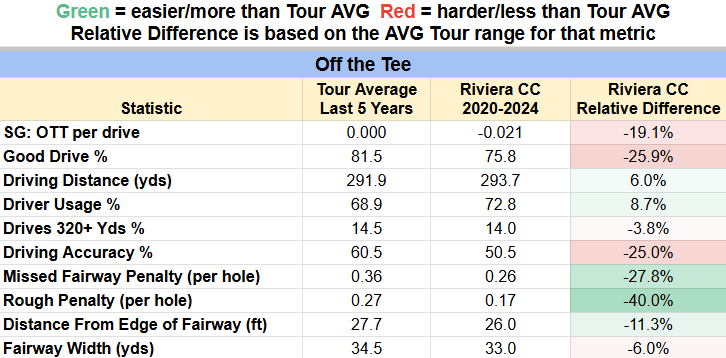
While Riviera’s fairways average 33 yards wide at the 300-yard landing zones, they narrow significantly beyond that point. This bottlenecking contributes to an extremely low 50.5% driving accuracy rate. With numerous doglegs and firm fairways that tighten near the 300-yard mark, players are constantly forced to choose between positioning and distance, making it difficult to consistently stay out of the Kikuyu rough.
Even though the rough is generally non-penal and there is no true hazard off the tee, a simple “bomb and gouge” approach is not fully viable. The hole shapes, tree-lined corridors, and angle-based green complexes demand proper positioning, not just length. As a result, Riviera routinely ranks among the top 10 most difficult courses on TOUR for strokes gained off the tee.
That said, recent champions such as Jon Rahm, Adam Scott, Bubba Watson, and Dustin Johnson illustrate that distance still matters. When much of the field is playing from the rough, longer hitters gain an advantage by approaching greens with higher-lofted clubs, making it easier to control spin and proximity on Riviera’s firm, “bouncy” putting surfaces.
In addition to distance, Good Drive Percentage is a key indicator of success, as it highlights players who can still find greens when missing fairways. With up to four inches of rain forecast leading into the tournament, softer conditions would further emphasize the value of length off the tee.
Nearly every drivable hole at Riviera features a dogleg or curvature, and sloping fairways ensure that flat lies are rare. Many holes bend around fairway bunkers, forcing players to shape tee shots both directions. Much like Augusta National, Riviera is a true shot-maker’s course that rewards creativity, trajectory control, and ball flight manipulation. This is a major reason Bubba Watson has thrived here, winning three times.
Approach
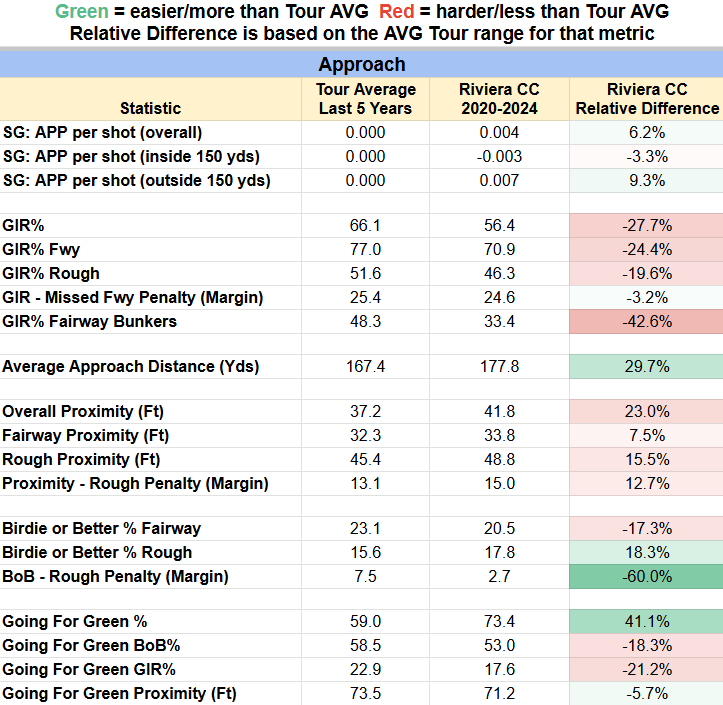
With Riviera’s greens kept firm and fast, pinpoint precision is required to create realistic birdie opportunities. Players must be able to shape shots both directions in the air to access the proper tiers and keep the ball below the hole, setting up far more makeable uphill putts. Controlling trajectory, spin, and landing angle is critical because shots that land on the wrong section of the green can easily release into difficult positions.
This demand for elite iron control has been echoed by Tiger Woods, who noted, “You’ve got to hit the ball high into these greens and really control your spin and put the ball in the right spots.” His comment reflects how Riviera rewards players who can flight the ball properly and manage distance under pressure.
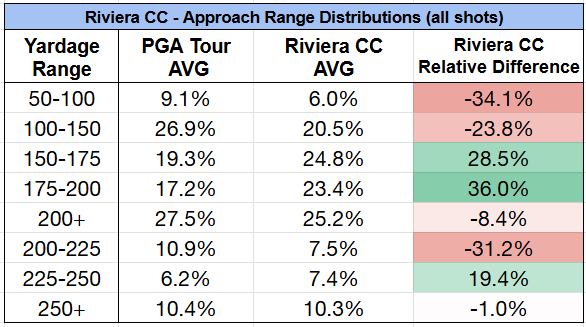
From a statistical perspective, Riviera also stands out for the length of its approach shots. Approximately 74% of approaches come from 150 yards or more, with 48% falling in the 150 to 200-yard range, both among the highest percentages on the PGA Tour. This reinforces the premium on mid and long iron proficiency and highlights why approach play is one of the most predictive skills at this venue.
Along with firm greens that actively repel marginal shots, missed fairways often force players to hit approaches from fairway bunkers or from angles partially obstructed by the eucalyptus trees that line the corridors. These compromised positions make controlling launch, spin, and distance even more difficult.
The greens themselves feature sharp edges and severe contours, which funnel overly aggressive approaches into tightly mown run-off areas. As a result, chasing tucked pin locations frequently brings double-sided trouble into play. Strategically, the optimal approach is often conservative, favoring the correct tier or the center of the green to minimize short-sided misses and avoid the difficult recoveries that define Riviera.
Around the Greens and Putting
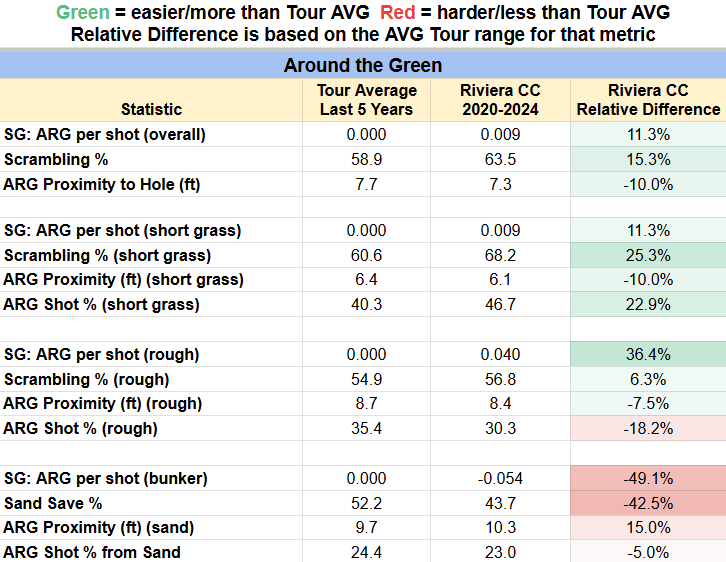
The Genesis Invitational consistently ranks as one of the most demanding events of the season for short-game performance. With 44% of greens missed, players are frequently forced to scramble from Kikuyu rough onto fast, undulating Poa annua greens. Riviera’s deep bunkers add another layer of difficulty, with sand saves playing nine percent tougher than the TOUR average. In fact, these bunkers rank as the second most difficult on TOUR in terms of strokes gained. A missed green that finds a greenside bunker is a legitimate penalty, particularly when the miss is short-sided. Some of the bunkers also distort depth perception, appearing adjacent to the green when they are actually 30 to 50 yards away, complicating club selection and distance control.
While bunker play is exceptionally demanding, scrambling from both Kikuyu rough and tightly mown areas has been slightly easier than the TOUR average. Although Kikuyu makes traditional bump-and-run shots difficult, it has not significantly reduced overall scrambling success rates.
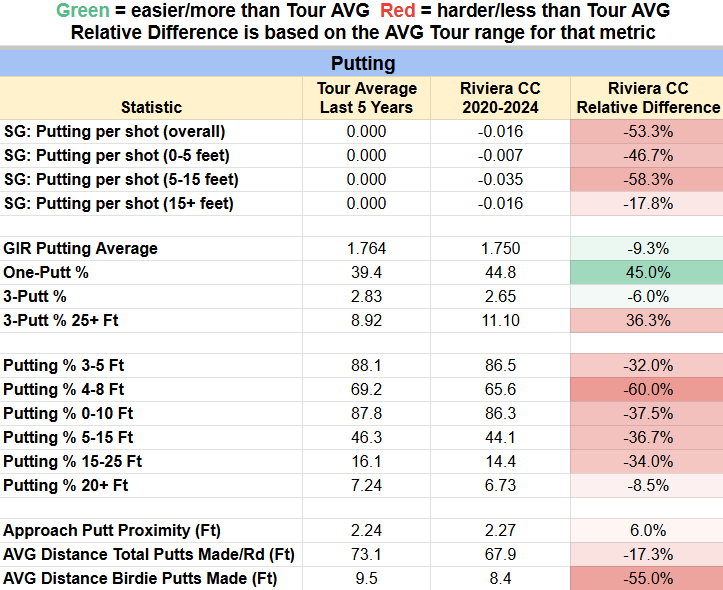
Once players reach the putting surfaces, however, the challenge intensifies. Riviera’s Poa annua greens have long been cited as a defining test of the course, and are often mentioned as a key reason Tiger Woods never captured a title here. They rank as the most difficult on TOUR for putts inside five feet and the fourth most difficult from five to fifteen feet. Their speed, subtle slopes, ridges, and spines demand constant adjustments in pace and line.
Players frequently note that it is nearly impossible to “die” a putt into the hole, as the cups are set slightly above the surrounding surface, causing many attempts to come up short. On already temperamental Poa, this setup magnifies the challenge. Combined with large green complexes and severe contours, it explains why Riviera is the fourth toughest course on TOUR in strokes gained putting. Golfers who struggle with lag putting face a high risk of three-putts, making three-putt avoidance a critical indicator of success.
Most Important Stats For Success at the Genesis Invitational
*In order of importance
- SG: APP
- SG: ARG
- Driving Distance
- SG: Putting (Poa)
- Bogey Avoidance
- Good Drive %
- Course History
- SG: Difficult Courses/Strong Fields
- Proximity 150-200 yds
- Par 5 BoB%
Unique Rabbit Hole Filters
- Course Region: West
- Scoring Conditions: Average
- Course Length: Long
- Field Strength: Strong
- Event Season: West Coast
- Greens Surface: Poa
- Greens Size: Large
- OTT Club Type: Mixed
- Missed Fairway Penalty: Low
- Rough Penalty: Low
- Gain OTT: Very Difficult
- GIR Accuracy: Difficult
- Sand Saves: Difficult
- Par 4 Scoring: Difficult