
The American Express at PGA West – 2024 Preview

Ron Klos

3 years ago

With the “Aloha Swing” concluded, the PGA Tour returns to the mainland as players make a trip to the Coachella Valley desert in La Quinta, California for The American Express at PGA West. This is a very unique event for a number of reasons. First, this tournament is actually part of a Pro-Am where each pro tees off with an amateur for the first three rounds of the tournament. Another difference is that three different courses will be in use instead of the typical single course. Finally, the cut will take place after 54 holes have been completed on Saturday, instead of the usual 36-hole cut on Friday. It will be the top 65 and ties who make it through to Sunday’s final round on the Stadium Course.
Along with the Pete Dye Stadium Course, the Nicklaus Tournament Course and La Quinta Country Club are the other venues in play for this week. The latter two courses are among the five easiest on Tour, which makes very low-scoring rounds the norm. Players will tee off on those two courses only one time. After more than 50 years of course changes, the current rotation of courses has been the same since 2016.
Each of the courses in the rotation share many of the same characteristics. First, with mostly calm winds and clear skies in a desert environment, this tournament is as close to “dome golf” as players will experience all year which leads to each being among the top-10 easiest annual PGA courses. All three courses have four scoreable par-5s and measure under 7,200 yards. Each also has pure Poa trivialis greens and ryegrass fairways surrounded by non-penal dormant Bermuda rough.
The Stadium Course is the toughest of the three and will be used for two of the four rounds. It is a Pete Dye design featuring smaller greens, plenty of bunkers and seven holes with water danger to contend with. Another reason the winning score usually ends up in the 25-under range is that all three are resort-style courses with pin placements made intentionally easy for the amateurs that are playing. It is a tournament where all different styles of players can thrive and those with the hottest flat stick in the inevitable putting contest are usually rewarded.
The Field
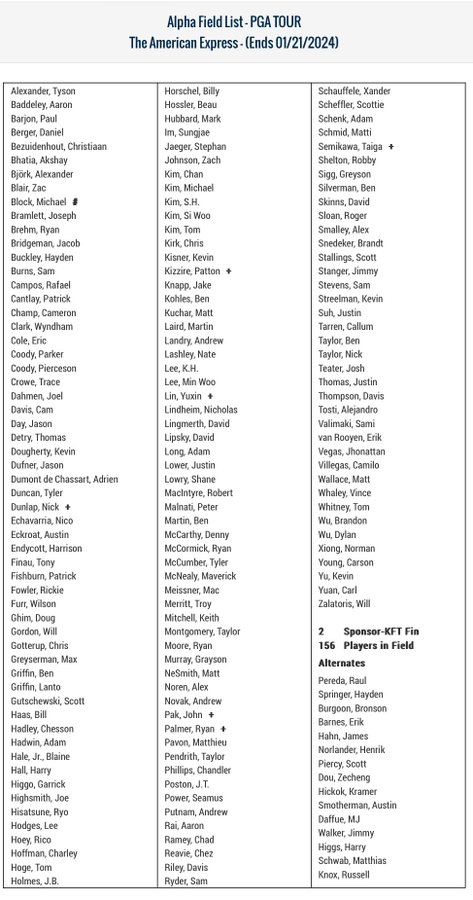
The strongest-ever field will tee it up this week in the California desert at the American Express, including 10 of the top-25 and 22 of the top-50 ranked players in the world. The headliners include #1 Scottie Scheffler, #5 Patrick Cantlay, #6 Xander Schauffele and #10 Wyndham Clark. Also in attendance are numerous other notables like Tony Finau, Sam Burns, Tom Kim, Sungjae Im, Jason Day, Rickie Fowler, Justin Thomas, and Min Woo Lee. Multiple event winner and past Ryder Cup member, Daniel Berger will also make his long-awaited return to play this week. Berger has not played due to injury since the 2022 U.S. Open.
For the first three rounds, players will be paired with an “amateur”. They could be celebrities, professional athletes, CEOs of companies, or someone you have never heard of who thought it would be a great idea to fork over $30,000 to take part in the event. While most PGA players love the conditions of the courses and the weather, they also despise the format and having to play most pro-ams in general. Rounds can approach six hours with the amateurs basically tagging along and hacking their way around the course.
Pete Dye Stadium – Course History
The Stadium Course at PGA West was designed by Pete Dye in 1986 and was created as a sequel to the TPC at Sawgrass. It was inspired by the Scottish links-style courses even though it shares relatively few characteristics with links courses.
Dye was given simple instructions when tasked when building the Stadium Course. “Build the hardest damn golf course in the world,” developers Ernie Vossler and Joe Walser told him. Dye indeed was up to the task as when it opened, its course rating of 77.1 was the highest ever given by the United States Golf Association.
Famous for its dramatic features, including railroad ties, penal hazards, cavernous bunkers, and long forced carries over water, the course is not for the faint-hearted. As Dye wrote in his autobiography, “Length alone would not be the ultimate test for the new course, but I believed strategic hazards, deep bunkers, difficult angles across fairways, slightly offset greens, parallel lakes and desert plants, when combined with cross-current winds, could provide the type of course Joe and Ernie expected.”
When it opened, it was one of the first venues for the popular “Skins” game which was a televised 4-ball match were some of the best players competed against each other in 4-ball matches.
In 1987 the course made its PGA debut by hosting the annual Bob Hope Classic. In what had typically been an easy course setup, players were shocked to see an actual challenge in front of them. Players vociferously voiced their opinions on the course. Raymond Floyd called it “spiteful” and “hateful.” Tom Watson said he was “sick and tired” of Dye’s radical designs. “It requires you to execute shots that no sane golfer should be expected to play,” Watson added. Al Geiberger said that the Stadium Course was like “working through the stages of grief”.
Dye responded, “The professionals forget that the whole idea of a Pete Dye golf course is to require players to hit a wide variety of shots. I’ve always felt that a good player who’s playing well wants to play a difficult golf course because he knows the winner won’t be someone who can just out-putt him.” Dye wanted to truly challenge the best players in the world and to give them a chance to display their amazing skills. As he once said about his style, “We’re just giving them the opportunities to hit great golf shots.”
The PGA Tour professionals were so adamant about how unfair the course was that they actually united together and signed a petition to get it removed as one of the host courses. Believe it or not, they were successful as the course was banned from Tour play until it returned to the rotation in 2016.
In the summer of 2022, the course underwent extensive renovations in which the greens were re-grassed to TifEagle Bermuda and changed back to their original sizes and contouring which had been lost over the years. Also, more than 200 trees from the interior of the course were removed, possibly changing some of the lines that golfers with previous history on the course are used to playing.
We have partnered with Vivid Picks to bring you an easy way to claim a FREE, no-strings-attached 2024 season at Betsperts Golf, plus a 100% deposit match up to $250! Click here to learn more!
Finish Position and Strokes Gained Event History (2016-2023)
This includes the average finish position and Strokes Gained average per round. Players are sorted by SG: Total. Related to how predictive each course is – out of 44 courses, Pete Dye Stadium Course is 33rd, La Quinta Country Club is 37th, and Nicklaus Tournament Course is 41st.