Lookahead – 2026 Masters at Augusta National

Ron Klos

10 months ago

There are less than five months until the opening round of the 2025 Masters. Official invitations to the year’s first men’s major championship will start trickling into players’ mailboxes over the next few weeks. The Masters invites the top 50 in the Official World Golf Ranking at the end of the calendar year and then again a week before the 2026 Masters, along with PGA Tour winners and high finishers from other majors.
The 2025 Masters Tournament culminated in a dramatic sudden-death playoff, ultimately won by Rory McIlroy over Justin Rose, finally allowing McIlroy to complete the coveted career Grand Slam of men’s golf majors on his eleventh attempt at Augusta National. The final round was a chaotic rollercoaster, featuring McIlroy beginning with a double-bogey on the first hole, recovering with brilliant shot-making, and later making critical errors, including a dumped wedge on the 13th and missing a putt on the 72nd hole to win in regulation. After both players finished tied at 11-under-par, McIlroy secured the victory on the first playoff hole, the 18th, with a clutch approach shot to three feet, sinking the birdie putt to capture his first Green Jacket.
The qualification criteria for the 2026 Masters Tournament were recently updated and include a new category to earn an invitation. The Masters has expanded its international scope by adding exemptions for specific national open winners as shown below. 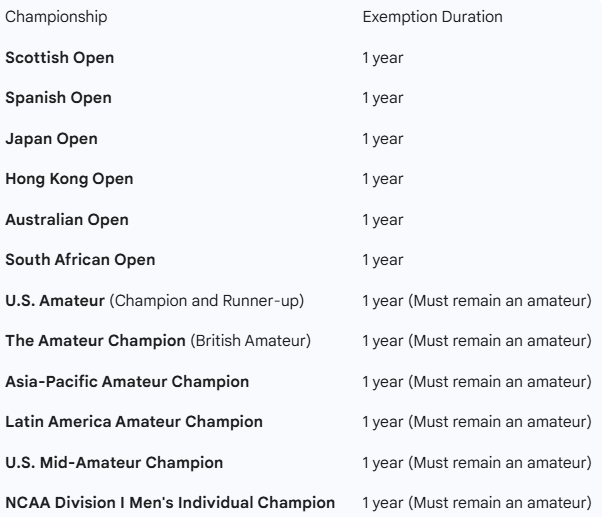
The Masters Committee always reserves the right, at its discretion, to invite players not otherwise qualified, often given to deserving international or prominent players. The following 14 players from LIV Golf currently hold an exemption for the 2026 Masters:

Here’s the breakdown of the 2026 Masters TV & Streaming Schedule:
- Thursday & Friday (April 9-10):
- Amazon Prime Video: Live streaming 1 PM – 3 PM ET (Early Rounds).
- ESPN: Live broadcast 3 PM – 7:30 PM ET (First & Second Rounds).
- Saturday & Sunday (April 11-12):
- Paramount+: Live streaming 12 PM – 2 PM ET (Early Weekend Coverage).
- CBS: Live broadcast 2 PM – 7 PM ET (Third & Final Rounds).
This partnership with Amazon Prime Video adds significant early-round coverage, complementing the established broadcast partners and offering fans more access to the tournament.
The Course
Featuring generous fairways, demanding approach shots, and severely sloped and lightning-fast green complexes, Augusta National is a course that will test every club in the bag and each player’s fortitude along with it. Players in current form, with positive past experience at Augusta National, Carry Distance off the tee, long-iron approach accuracy, creative short-game skills, and a knack for scoring on par 5s will have an edge over competitors who do not possess those traits.
From the towering Georgia pines and flowering magnolia trees to the luscious green fairways and immaculately manicured white-sanded bunkers, Augusta National is a pristine wonder to behold. There are countless characteristics that make the course both timeless and imposing at the same time including the elevation changes, the routing of the holes, the risk-reward options, the genius of Amen Corner, and the treacherous slopes of the green complexes.
Augusta National Golf Club is a par-72 course that was stretched to its longest distance ever starting in 2023 at 7,545 yards. At that length, it measures as the 8th longest course in the annual Tour rotation. With a premium on thoughtful strategic play, every hole offers players bail-out options if the goal is to survive with par. Yet birdie opportunities abound for those who wish to be more aggressive and take on the risk that most holes provide.
Over the past five events, the average score has been +1.34 per round, which ranks as the second-toughest annual course on Tour. Only one of the par-3 holes plays over 180 yards, yet due to the bunkering and difficult green complexes, they rank as the second-toughest group of par-3s, averaging 0.15 strokes over par.
The four par-5s are the holes that bring the most excitement to the course each year. One of the shortest groups of par-5s on Tour averaging only 561 yards per hole, each is reachable in two shots and averages a birdie or better rate at 39.2%. With eagle chances possible on each one, they are the essence of risk-reward holes. This is especially true on the 13th and 15th where stray approaches will be eaten up by the water hazards.
Since 2017, Masters champions are a combined 59-under on the par-5s. Patrick Reed was 13-under when he won back in 2018, while two other recent champions, Dustin Johnson and Hideki Matsuyama, were each 11-under par. Matsuyama’s number included three eagles. Last year Scottie Scheffler finished at 9-under on the par-5s while winning the tournament at 11-under overall.
As important as it is for players to score on the par-5s, it is just as vital for them to survive the par-4s. This is demonstrated by the fact that the past nine winners of this event have ranked an average of second in the field for par-4 scoring. Rated as the toughest set of par-4s on Tour, they play to an average of 0.19 strokes over par. For a great resource on every hole at Augusta explained by a different Masters champion, read this informative article.
The course lines up to be a strategic game of two styles. Attack each of the par-5s and the shorter par-4 third hole while surviving the remaining holes with patience and conservative play. The back nine holes, led by Amen Corner (holes 11-13) are among the most exciting in golf and offer plenty of the risk-reward opportunity that has been highlighted thus far.


Grasses and Greens
Even though it is located in the heart of Bermudagrass country in Augusta, Georgia, due to the timing of the event early in the spring, the Bermuda here is still somewhat dormant. In order to have the best turf possible, ryegrass is used on the fairways and rough, and bentgrass, a cool-season turfgrass, is used on the greens.
Most professional golfers will tell you that bent greens provide the smoothest and most consistent putting surface. They are meticulously groomed to provide a firm and fast surface and are among the most undulated in the world. According to noted professional agronomist David Marcucilli, each green at Augusta National receives personalized treatment and conditioning that best reflects its slope, pin location, and shot-making values. The greens are also brushed before they are mowed. This promotes an upright blade orientation on the grass to ensure a uniform cut. Doing this also eliminates any grain on the greens, allowing them to run even purer.
Back in 2010, an unofficial rating of the course was conducted and green speeds ranged from an average 12′ to an ultra-fast 15′ on the stimpmeter. The variance in speed is meant to protect golfers on the holes that have the most contours and sloping. For more information on these unique greens, along with which players have performed the best on similar green styles, here is a much more detailed article on that subject.
The course is also equipped with an underground irrigation and ventilation system known as SubAir which allows the maintenance staff almost complete control over the playing style of the greens.
Course Defense
Along with the aforementioned treacherous green complexes, Augusta National’s primary defense includes its length, dramatic elevation changes, uneven lies, swirling crosswinds, and tight runoff areas around the greens. Contrasting with other difficult courses, Augusta National is unique in terms of its absence of hazards off the tee and lack of penal rough.
It has been said that the only flat areas on the course are the tee boxes. Former champion, Bob Goalby often remarked on how tired his legs would be after walking the course. From the first tee to the last, it is an absolute brute of a track. The elevation changes are nowhere more exemplified than the walk from the highest point on the course, the 10th tee, to the lowest point, the 11th green, which is over a 100-foot drop.
While Augusta has the fourth-fewest bunkers on Tour, they are deep and have a par save percentage of only 46.7%, making them the fifth toughest on Tour. Players who leave their approach shots in the numerous runoff areas around the greens fare even worse on average. According to Data Golf, Augusta National is the toughest course to gain strokes from around the green. Water comes into play much more on the back nine but ranks far down the list of dangers players will face.
Finally, one of the biggest challenges of Augusta National that cannot be measured is what the course does to players mentally. An anonymous player was quoted as saying, “One of the best things Augusta does is mess with you. And the way they mess with you is they give you options. Pros don’t like options because then they have to make decisions.”
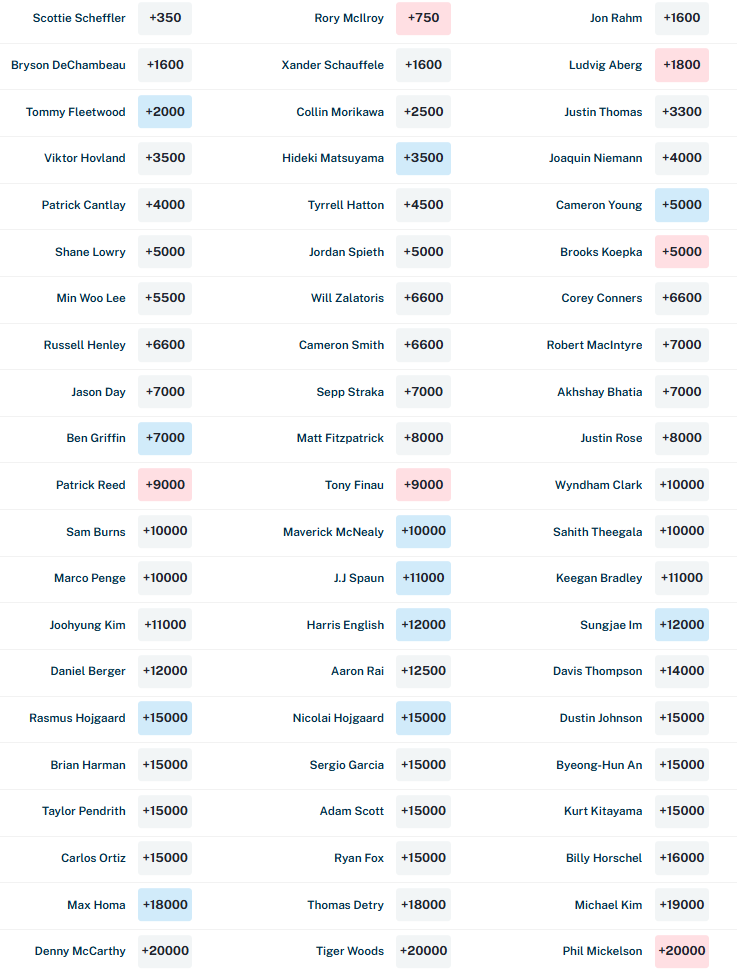
2026 Masters Odds