Lookahead – 2025 U.S. Open at Oakmont Country Club

Ron Klos

2 years ago
Oakmont Country Club will be home to the 125th edition of the U.S. Open which will be contested June 12-15 in eastern Pennsylvania. One of the most storied courses in the nation, no club in America has hosted more U.S. Open Championships than Oakmont with this will be the club’s 10th since 1927.
Established 121 years ago in 1903, Oakmont is regarded as the oldest top-ranked golf course in the United States. It was designated a National Historic Landmark in 1987. With a reputation as one of the most difficult courses in the world, the scoring average for the 2016 U.S. Open held at Oakmont was +3.56 per round and only four players finished under par. Dustin Johnson finished atop the leaderboard at -4, winning his first major championship.
In last year’s U.S. Open at Pinehurst #2, Bryson DeChambeau claimed his second U.S. Open title with a dramatic up-and-down par from a bunker on the 72nd hole to edge 2011 champion Rory McIlroy by one stroke.
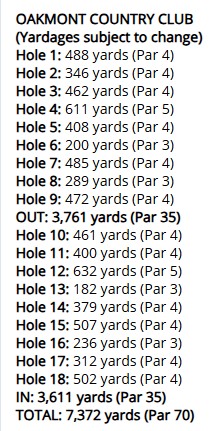
The par 70 course has only two par 5s and measures 7,372 yards, slightly longer than the 7,219 yards it played in 2016. Originally designed by Henry Fownes, he spent a year building Oakmont on old farmland with a crew of 150 men and two dozen mule teams. With the Allegheny River Valley on both sides, it has no water hazards and 175 bunkers (most on Tour) – and since 2007, almost no trees.
Oakmont is generally regarded as one of the most difficult courses in the United States. The greens are a blend of northeastern Poa annua and are extremely fast (14+ on the stimpmeter) and undulating. The rough measures as long as six inches and is a blend of Kentucky bluegrass, rye, and Poa. Originally a links-style course, trees were added in the 1950s before their initial removal began in 1994. Numerous greens are noted for how they slope away from the fairway which only adds to the difficulty both for approach shots and “around the green” play.
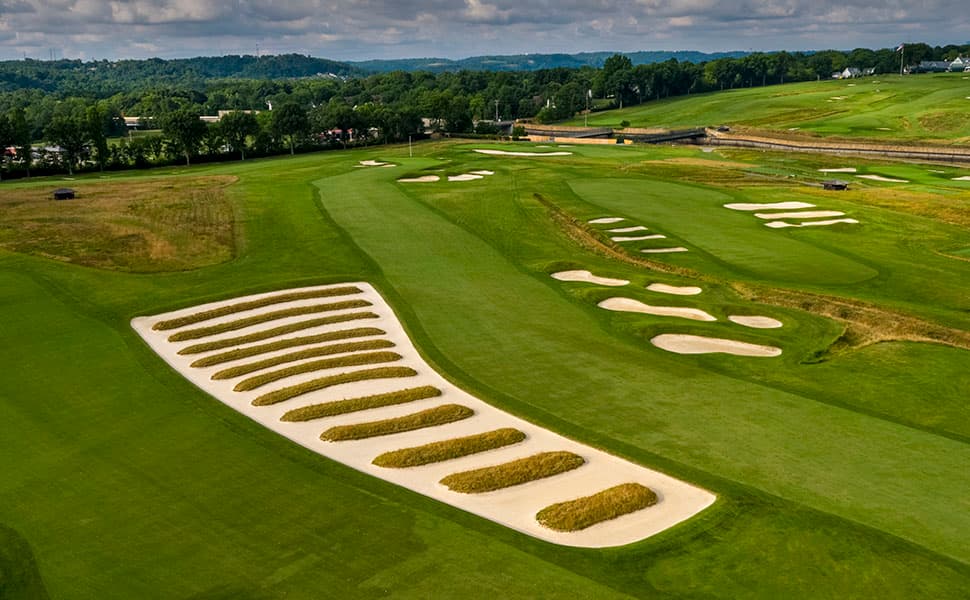
Its famed Church Pew bunker lies between the third and fourth fairways. It is 100 yards long and 40 yards wide and features 12 grass-covered traversing ridges that resemble church pews. The Pennsylvania Turnpike separates seven holes (2–8) from the rest of the course.
Course Changes
During a restoration in 2007, more than 5,000 trees were removed to provide better agronomics and restore the course to the original intentions of designer Henry Fownes. It also offered breathtaking views of the entire layout from the clubhouse.
Oakmont’s greens were already larger than average, but thanks to a recent restoration by Gil Hanse that has added more than 24,000 square feet of green surface, they now average over 8,300 square feet per green.
Hanse was initially brought in to focus on the bunkers. During his trips to the course, he came across photographs from the 1920s and 1930s and noticed the greens used to be much larger before time and natural erosion began chipping away at them. After talking with the club, they enthusiastically agreed, and now the notoriously fast greens are even more difficult than previously.
“The greens are the No. 1 defense on the course,” grounds superintendent Mike McCormick said. “Oakmont, in today’s world, it’s not a crazy-long golf course. There are several holes out here the players will be hitting wedges into and it puts even more of an emphasis on the greens.”
One of the new pin options the expanded greens give the USGA is on the 182-yard, par-3 13th hole. Pin placement previously was limited to the left side of the green, with little wiggle room in terms of yardage. Now there are various options, including a back-right pin that sits in the middle of a bowl, rewarding a good shot but almost inaccessible from other portions of the green, particularly the front right.
Scott Langley, the USGA’s senior director of player relations, thinks Oakmont remains one of the stiffest tests because it lacks the kind of shot options that other recent U.S. Open courses like Pinehurst No. 2 or Los Angeles Country Club provided. “You have strategic width and can play the angles more,” Langley said. “There are spots here where you do that. But by and large, Oakmont is you hit a good shot or you don’t. And if you don’t, the penalty is pretty uniform.”
Oakmont also rebuilt every hazard and revamped the course’s nearly 200 bunkers while updating the drainage system. The club was hit by nearly three inches of rain during the 2016 U.S. Open, forcing the grounds crew and volunteers to get creative while bailing out the sand traps. “The bunkers had deteriorated significantly from 2016 to 2022,” McCormick said. “There’s a lot of newer technology and ways to drain bunkers and hold sand and limit contamination. So the club had an opportunity to make sure that the performance of the playing surfaces remained consistent.”
2025 U.S. Open Odds