
How to Bet on Golf in 2026: Odds, Bet Types, and Dead Heats

Andy Molitor

5 years ago

Betting on golf means picking golfers out of a field that usually runs 70 to 156 players deep, so the odds are long and the sportsbook’s cut is bigger than in most sports. The smart way in is not the outright winner. Start with top-20 bets, learn how dead heats work before your first tie costs you, and never bet without comparing at least three books. On Monday, November 2, 2026, the best winner price on the World Wide Technology Championship board paid at least 10 percent more than the worst for 80 percent of the field.
That last number is the whole game in miniature. Golf rewards patience and price shopping far more than it rewards a hot take on who wins.
How do golf odds work?
Golf odds in the US are American odds. A plus number tells you what a 100-dollar bet wins, so +1450 pays 1,450 dollars in profit, or 145 dollars on a 10-dollar bet. A minus number tells you what you must risk to win 100, so -118 means risking 118 dollars to win 100. Every price also hides a probability. For a plus price, add 100 to the number, then divide 100 by the result.
Ryan Gerard was the betting favorite for the 2026 World Wide Technology Championship at +1450 at DraftKings on Monday morning, which works out to a 6.5 percent chance to win. Read that again. The favorite was expected to lose roughly 15 times out of 16. That is normal in golf, and it is why the outright market feels like a lottery ticket even when you pick well.
The same golfer can carry a very different price at another book. Here is what that looked like on Monday.
World Wide Technology Championship 2026 winner odds at three sportsbooks, checked Monday, November 2, 2026, at 8:56 a.m. Central, with what a 10-dollar bet wins at the best price.
| Golfer | Fanatics | FanDuel | DraftKings | 10 dollars wins at the best price |
|---|---|---|---|---|
| Ryan Gerard | +1200 | +1300 | +1450 | 145 dollars |
| Ben Griffin | +1400 | +1500 | +1550 | 155 dollars |
| Erik van Rooyen | +7500 | +7000 | +10000 | 1,000 dollars |
| Garrick Higgo | +8000 | +8000 | +12000 | 1,200 dollars |
Garrick Higgo at +12000 instead of +8000 is a 50 percent bigger payout for the exact same outcome. Nobody needs a model to find that edge. They need three apps.
What bets can you make on a golf tournament?
Most golf boards offer the outright winner, finishing-position bets (top 5, top 10, and top 20), round leaders, head-to-head matchups, 3-balls, and props such as top American or top European. The finishing-position markets are where most bettors should live, because the odds are shorter, the margin is lower, and a golfer only has to play well, not win.
Here is one golfer across the main markets, so you can see how the price shortens as the bet gets easier. These are Ryan Gerard‘s prices for the 2026 World Wide Technology Championship at DraftKings on Monday, November 2, at 8:56 a.m. Central.
| Bet | What has to happen | Gerard’s price | Implied chance |
|---|---|---|---|
| Outright winner | He wins the tournament | +1450 | 6.5% |
| Top 5 | He finishes fifth or better | +365 | 21.5% |
| Top 10 | He finishes 10th or better | +182 | 35.5% |
| Top 20 | He finishes 20th or better | -118 | 54.1% |
| First-round leader | He leads after the first round | +3000 | 3.2% |
A few markets need a sentence of their own:
- Matchups pit two golfers against each other, either over the full tournament or a single round. You only need your guy to beat one other guy.
- 3-balls are single-round bets on the three golfers playing in the same group. The lowest score of the three wins. If two of them tie for the low score, the book’s tie rule decides the payout, so read it before you bet.
- Make or miss the cut is exactly what it sounds like, and it lives or dies on Friday afternoon.
- Nationality props such as top American and top European were on the World Wide Technology Championship board on Monday. They shrink a 100-plus field into a smaller race.
How much do sportsbooks take on golf bets?
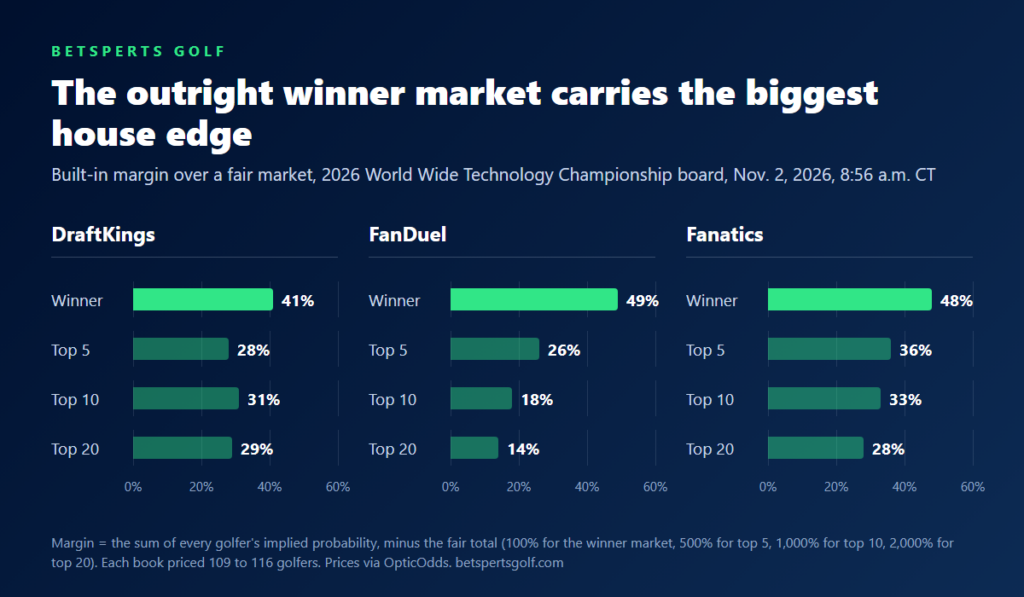
A lot, and far more on the outright winner than anywhere else. If you convert every price in a fair winner market into a percentage and add them up, you get exactly 100 percent. The extra above 100 is the book’s built-in margin. On Monday morning that extra was 41 to 49 percent on the 2026 World Wide Technology Championship winner market, against 14 to 33 percent in the top-10 and top-20 markets.
Built-in margin by market and sportsbook for the 2026 World Wide Technology Championship, computed from every price each book posted on Monday, November 2, 2026, at 8:56 a.m. Central. A fair market would show 0%.
| Market | DraftKings | FanDuel | Fanatics |
|---|---|---|---|
| Winner | 41% | 49% | 48% |
| Top 5 | 28% | 26% | 36% |
| Top 10 | 31% | 18% | 33% |
| Top 20 | 29% | 14% | 28% |
Two honest caveats. Each book priced 109 to 116 golfers, so a book that left a few longshots off its board looks a bit cheaper than it really is, and FanDuel’s top-20 market had the fewest names. Ties also trim place payouts on top of this, which the next section covers. Neither caveat changes the lesson. The outright market is where the house eats best.
That does not make outrights a bad bet. It makes them a bad place to start, and a terrible place to skip price shopping.
Why does shopping for the best price matter so much in golf?
Because the books disagree constantly, and in golf the gaps are huge. Of the 114 golfers all three books priced to win the 2026 World Wide Technology Championship on Monday morning, 91 (80 percent) had a best price that paid at least 10 percent more than the worst. For 41 of them (36 percent), the best price paid at least 20 percent more.
No single book was the answer either. Fanatics had the best or tied-best winner price on 49 golfers, DraftKings on 46, and FanDuel on 40. Loyalty to one app costs real money in this sport. The same goes for the shorter markets. Ryan Gerard to finish top 20 was -118 at DraftKings and -140 at Fanatics on Monday, so the same 10-dollar profit cost 11.80 at one book and 14.00 at the other.
What is a dead heat in golf betting?
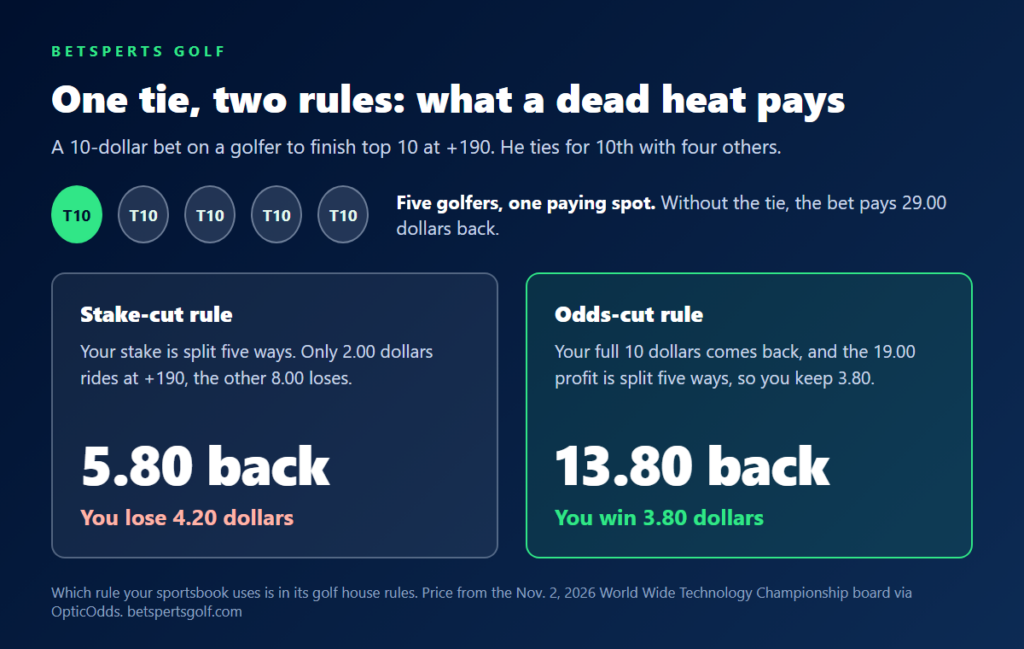
A dead heat is what happens when your golfer ties for the last paying spot in a place bet. Golf ties all the time, so this is not an edge case. If he ties for 10th with four other players on a top-10 bet, five golfers are splitting one paying spot, and your payout gets cut. How hard it gets cut depends on which rule your book uses, and there are two.
The classic rule cuts your stake. Divide your bet by the number of tied players, multiply by the places left, and that slice is paid at full odds while the rest loses. The other rule cuts your odds. You get your whole stake back plus a reduced profit. DraftKings’ house rules describe settling ties under dead heat reduction, and some books now sell separate “ties pay in full” versions of the place markets. Monday’s World Wide Technology Championship board listed “with ties” versions of the top 5, top 10, and top 20 right next to the standard ones.
What one tie pays under each rule, using Ben Griffin to finish top 10 at +190 at DraftKings on Monday, November 2, 2026, and a 10-dollar bet.
| How he finishes | Stake-cut rule pays back | Odds-cut rule pays back |
|---|---|---|
| Ninth alone, no tie | 29.00 dollars | 29.00 dollars |
| Tied for ninth with two others (two spots, three players) | 19.33 dollars | 22.67 dollars |
| Tied for 10th with four others (one spot, five players) | 5.80 dollars | 13.80 dollars |
Look at the last row. Under the stake-cut rule, a golfer who “made” the top 10 still loses you 4.20 dollars. Under the odds-cut rule, the same finish wins you 3.80. Nothing about the golf changed. The only difference is a paragraph in the house rules most bettors never open.
How to bet on golf as a beginner
Start small and start in the place markets. The numbers above make the case on their own: top-20 margins ran 14 to 29 percent on Monday against 41 to 49 percent for the outright, and a top-20 bet on this week’s favorite was priced to cash about half the time, against once in 16 tries for the same golfer to win. That keeps you in the game long enough to learn something.
- Set a budget first, an amount you are fine losing, and keep each bet a small, fixed slice of it. One or two percent per bet is a common rule of thumb.
- Price-shop every bet across at least three books. It is the one edge that requires no golf knowledge at all.
- Read the golf section of the house rules once, for dead heats and withdrawals, before you place anything.
- Track every bet, including the price and the book, so you know whether you are actually good at this or just remembering the winners.
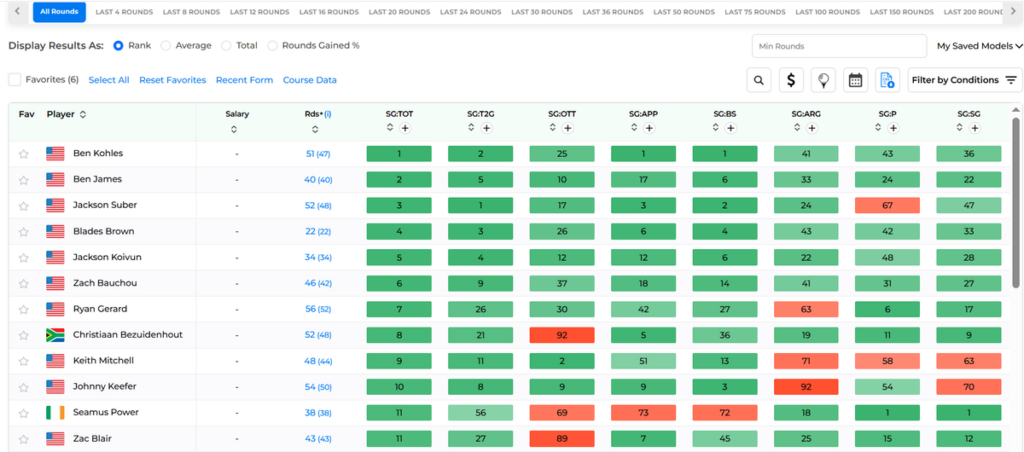
Once the basics are in place, the edge comes from the golf itself. Most serious bettors start with strokes gained, the PGA Tour’s measure of how many shots a player gains or loses against the field in each part of the game, then layer on course fit and recent form. That is exactly what The Rabbit Hole is built for: pick the stats you care about, weight them, and get your own ranking of the field instead of borrowing someone else’s. If a term trips you up along the way, the golf betting glossary covers the lingo, and the golf DFS hub has the fantasy side if contests are more your thing than sportsbooks.
Get the full board before you bet. Make a first deposit at ReBet with code BSG to unlock a free Betsperts Golf subscription and a 100 percent match up to 100 dollars on 10 dollars or more.
Frequently asked questions
When do golf odds come out each week?
Early in the week. For the 2026 World Wide Technology Championship, DraftKings, FanDuel, and Fanatics all had full winner, top-5, top-10, and top-20 boards posted by Monday morning, days before the first round. Head-to-head matchups were not posted yet at that point, so check back later in the week for those.
What happens to my bet if my golfer withdraws?
Most US sportsbooks refund the bet if your golfer withdraws before he hits his first tee shot. Once he has teed off, a withdrawal usually counts as a loss on outright and finishing-position bets. Matchups and live bets can be handled differently, and the wording is not identical from book to book, so the golf section of your book’s house rules is the final word.
21+. Gambling problem? Call 1-800-GAMBLER. Responsible Gaming Resources

Get 25% off
Use code: BSG26
Use code: BSG26
BUILD YOUR OWN
CUSTOM STATS MODEL
FOR BETTING & DFS
CUSTOM STATS MODEL
FOR BETTING & DFS
New Users Only