
CJ Cup Byron Nelson at TPC Craig Ranch – 2026 Preview

Ron Klos

5 months ago

After last week’s second major championship of the year, the PGA TOUR heads back to Texas for THE CJ CUP Byron Nelson. Located within the community of Craig Ranch in the Dallas suburb of McKinney, Texas, TPC Craig Ranch is the host course for the sixth consecutive year. The event dates back to 1944 and has moved all over the Dallas-Fort Worth metroplex in recent years, with both Trinity Forest and the TPC Four Seasons Resort courses also hosting.
Featuring easy scoring conditions, few hazards, wide-open fairways, and large receptive greens, Craig Ranch is a prototypical TPC course. With an average winning score of 25-under par, it is a birdie-maker’s paradise that inevitably boils down to a putting contest. Along with “spike putting” ability, approach play from 200+ yards will be a key “separator” when determining golfers to target this week.
The course is expected to play somewhat more challenging this year after undergoing an offseason renovation led by course designer and former pro Lanny Wadkins. The overhaul included new grass turf, tighter fairways, the movement of bunkers, additional water features, native grasses and waste areas and revamped holes. Wadkins, who won the Byron Nelson in 1973, said he aimed to make the course more difficult for PGA Tour players while still keeping it enjoyable for club members. He hopes the redesign will lower winning scores closer to 12- to 15-under par. Last year, Scottie Scheffler steamrolled the field, winning at 31-under par.
The Field

Traditionally, the Byron Nelson has had a relatively weak strength of field. That continues to be amplified this year with the tournament being in the midst of a six-week stretch that includes two “Signature” events and two majors.
World No. 1 Scottie Scheffler will defend without many of his top-ranked peers around to challenge. Fellow Dallas resident Si Woo Kim, ranked No. 22, is the next highest-ranked player. Other notables include Jordan Spieth, Brooks Koepka, Michael Thorbjornsen, Wyndham Clark, and PGA Championship winner Aaron Rai.
Also in the 147-player field are past champions Taylor Pendrith, K.H. Lee, Aaron Wise, and Billy Horschel.
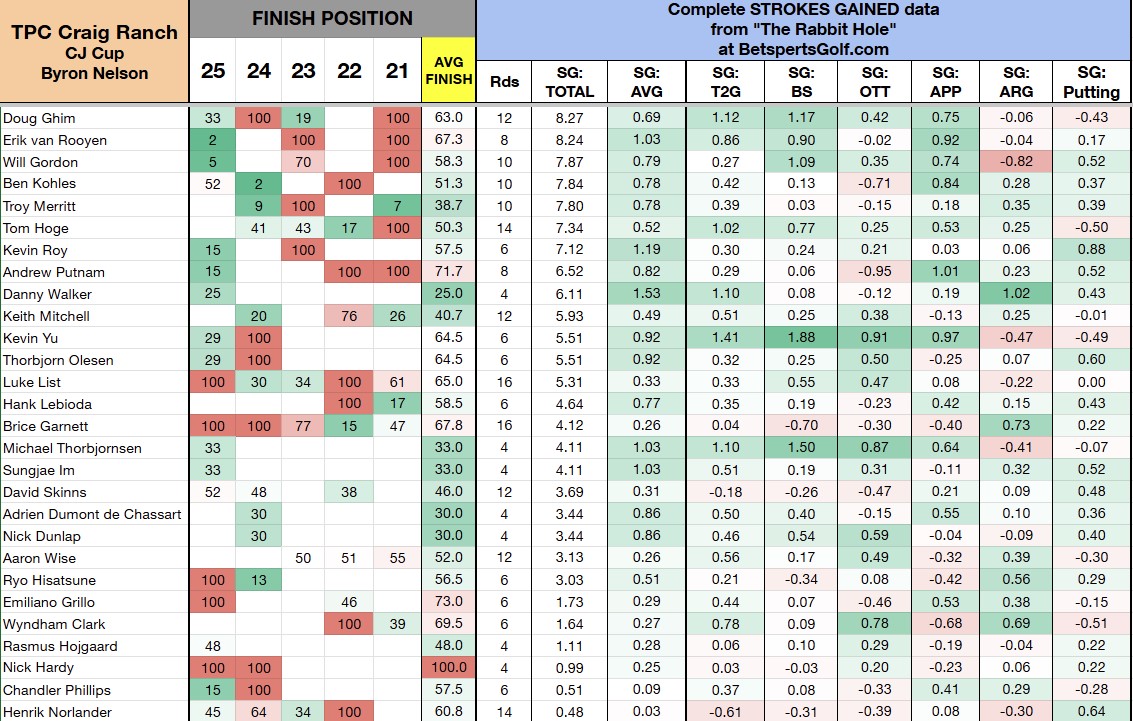
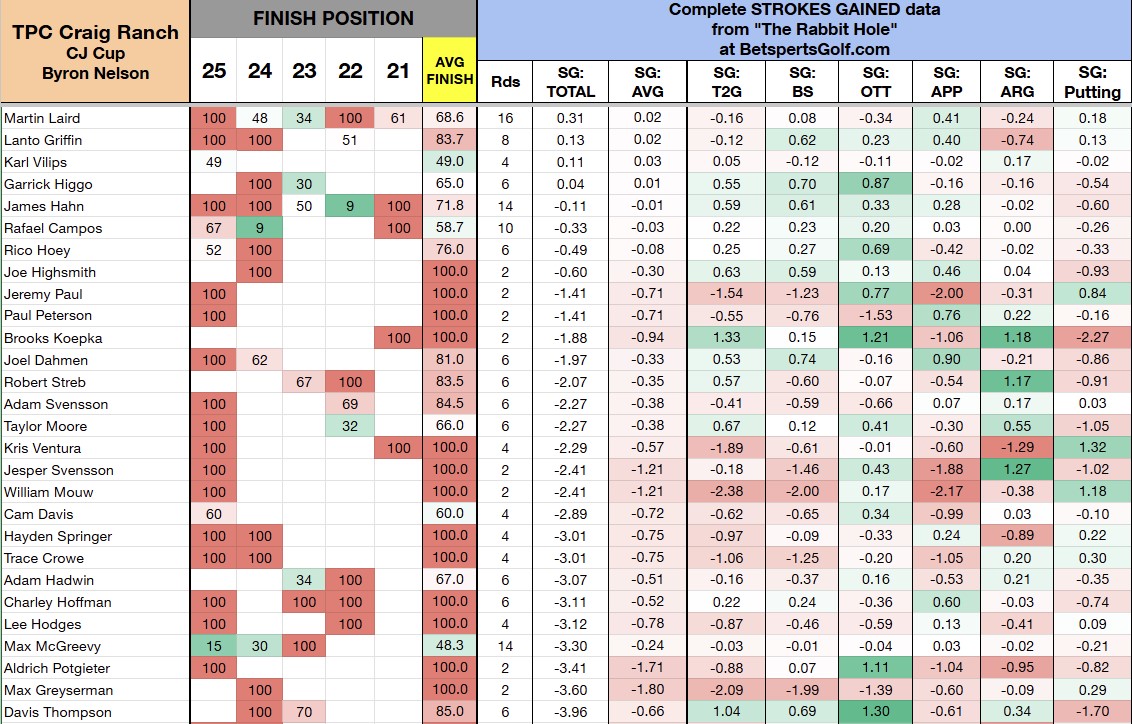
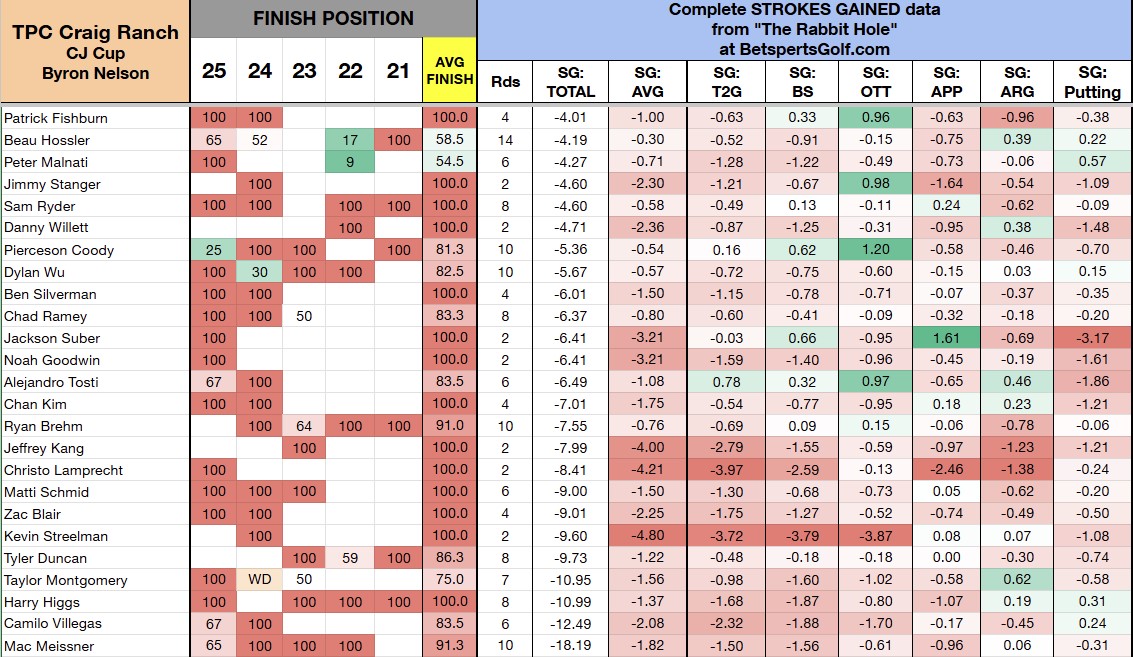
CJ Cup Byron Nelson Finish Position and Strokes Gained History at TPC Craig Ranch (2021-2025)
This includes the average finish position and Strokes Gained per round. Players are sorted by SG: Total. TPC Craig Ranch is the 9th least predictive course on the PGA Tour. 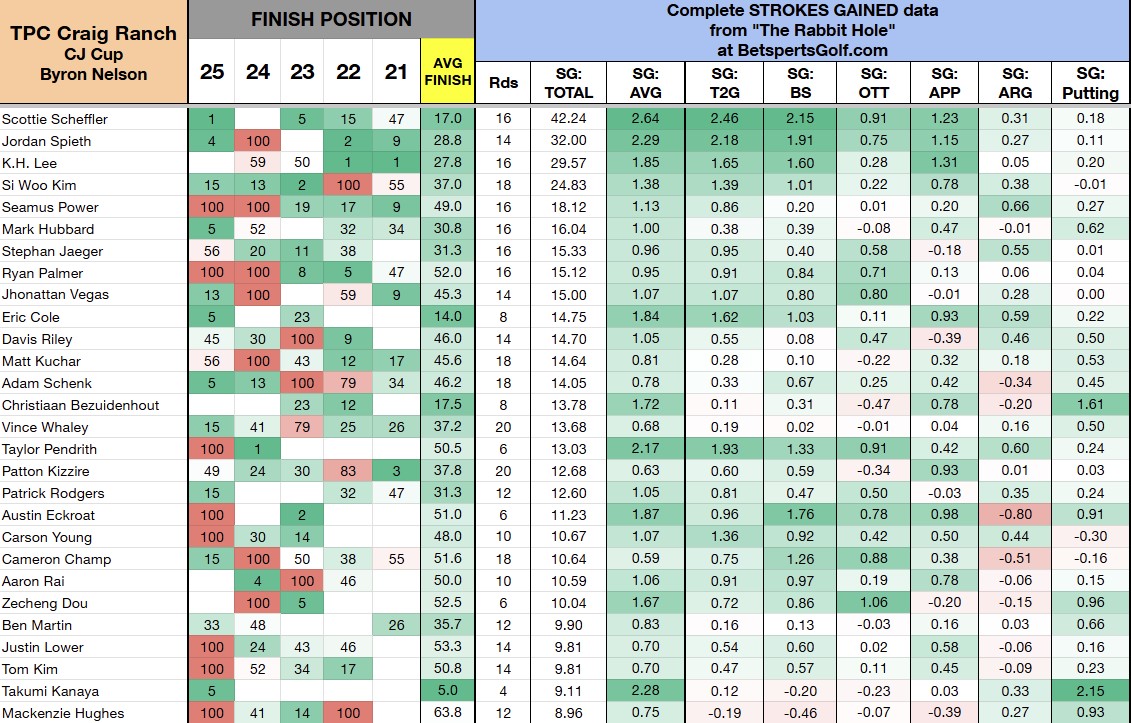
2025 Renovation
The 2025 renovation at TPC Craig Ranch was a sweeping $22 million overhaul led by Lanny Wadkins and the Wadkins Design Group. The project began immediately after the conclusion of the 2025 CJ Cup Byron Nelson and marked the first major renovation since the course originally opened in 2004 as a design by Tom Weiskopf.
The primary motivation behind the renovation was the belief that the course had become too easy for modern professionals. That concern peaked when Scottie Scheffler tied the PGA Tour’s all time 72 hole scoring record at 31 under par during the 2025 Byron Nelson. Invited, the ownership group behind the club, wanted the course to provide a sterner championship test while still maintaining playability and enjoyment for members.
Wadkins did not completely reroute or reinvent the golf course. The overall routing and core framework of Weiskopf’s original design remained intact. Instead, the renovation focused on modernizing strategy, strengthening shot values, and enhancing conditioning and infrastructure throughout the property.
One of the most significant changes involved the greens complexes. Several greens were reshaped, repositioned, and rebuilt entirely. Wadkins specifically noted that greens on holes 3, 4, 5, and 7 were moved or adjusted to alter angles and improve strategic demands. The greens were also made smaller in many locations, immediately placing greater pressure on approach play. Expanded contouring and additional pin positions were added to create more variety and difficulty for PGA Tour setups.
The bunker renovation was equally extensive. TPC Craig Ranch originally featured relatively simple and understated bunkering, but Wadkins redesigned nearly every bunker on the property. Some bunkers were repositioned closer to greens and landing zones to increase strategic decision-making, while others were completely rebuilt with improved drainage and sharper visual presentation. Several reports also noted that bunker clusters became tighter and more penal, especially around the greens.
Another major component of the project involved agronomy and turf replacement. Nearly every playing surface on the course received new grass varieties designed to better withstand Texas heat while improving consistency and championship conditioning. Stadium Zoysia was installed on fairways, collars, and approaches to provide firmer surfaces and more uniform lies. TifTuf Bermuda replaced the rough and tee boxes because of its durability and ability to remain green longer throughout the year. The greens were converted to 777 Bentgrass.
Course Features
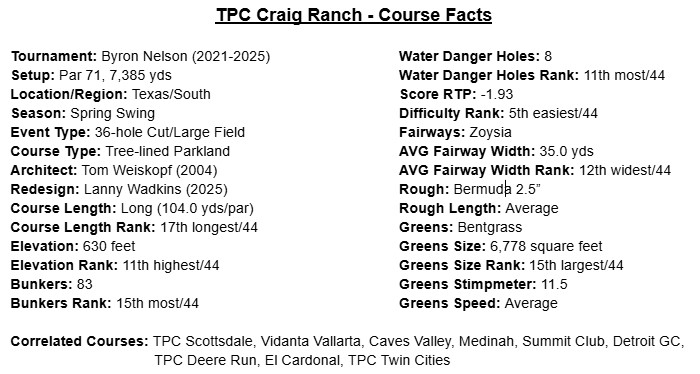
*The rest of this course preview is based on how the TPC Craig Ranch played from 2021-2025 and numerous parts may be completely different for this year’s tournament based on the 2025 renovation.
Featuring gently rolling hills, mature woods, and the ever-present Rowlett Creek, which crisscrosses the course 14 different times, TPC Craig Ranch is a par 71 course that now plays at 7,385 yards, but with new tee boxes it now has even more flexibility to extend or shrink its length. In the first two years here, it played as a par 72. Attempting to make the course less scoreable, in 2023, the 12th hole was shortened from 547 yards to 493 yards and turned into a par 4 instead of a par 5. Designed by Tom Weiskopf in 2004, it has sprawling fairways (now the 12th widest on Tour), few hazards, and benign, flat greens.
Since moving to TPC Craig Ranch in 2021, this tournament has been the definition of a birdie-fest. Overall, the course has played as one of the easiest on Tour at -1.93 per round. It put up such little defense that only five holes average over par, and it contains the highest birdie-to-bogey ratio at 2.2. TPC Craig Ranch is a scorer’s paradise that will come down to ball striking and a putting contest on the greens.
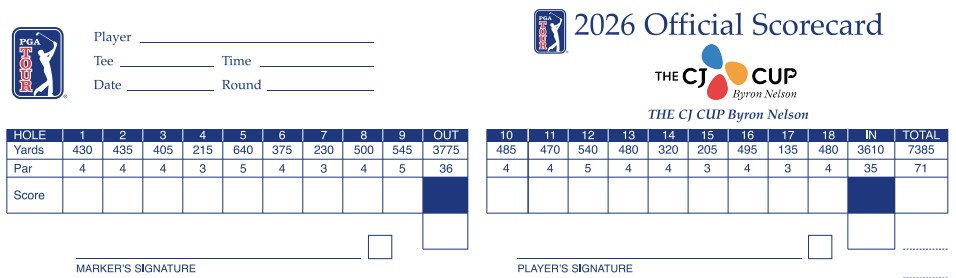
From the overall routing to the bunker placement and green complexes, TPC Craig Ranch has long been viewed as one of the more straightforward and less strategic layouts on the PGA Tour schedule. Designer Tom Weiskopf was known for creating visually clean courses that often emphasized execution over architectural nuance, and Craig Ranch largely follows that blueprint. Outside of a few isolated moments, the course lacks many standout or strategically memorable holes, with the drivable par 4 14th serving as the clearest exception.
Weiskopf frequently incorporated at least one drivable par 4 into his designs, and the 14th perfectly reflects that philosophy. Playing around 340 yards during certain rounds, the hole asks players to decide whether to challenge a downhill tee shot guarded by water down the left side and several bunkers surrounding the green. While driving the putting surface is far from routine, the risk reward nature of the hole consistently creates volatility and excitement. Through the first four editions of the tournament at Craig Ranch, the 14th has produced a birdie or better rate of roughly 41 percent.
The course itself is split into two distinct settings. The front nine runs alongside the Sam Rayburn Tollway, while the back nine transitions into a more residential backdrop winding through housing developments. Several of the par 4s stretch well beyond 465 yards, placing a premium on distance off the tee. In total, seven holes exceed that mark, allowing longer hitters to gain a noticeable advantage.
As part of the recent renovations and championship setup adjustments, multiple holes were lengthened, including the fifth hole, which now stretches to approximately 635 yards. Even at that length, the par 5s remain highly scorable. Historically, the par 5s at Craig Ranch have produced a birdie or better rate around 54 percent, with that number jumping above 62 percent when players successfully attempt to reach the green in two shots.
Ironically, the par 3s have consistently provided the course’s toughest challenge. Three of the four one shot holes measure over 215 yards and each has historically played over par. Collectively, the par 3s routinely rank among the most difficult holes on the course and represent the strongest stretch of resistance players face throughout the week.
Most Important Stats For Success at TPC Craig Ranch
*In order of importance- Region: Texas
- Scoring Conditions: Very Easy
- Course Length: Long
- Field Strength: Weak
- Greens Surface: Bentgrass
- OTT Club: Driver Heavy
- Missed Fwy Penalty: Low
- Gain OTT/APP/ARG/PUTT: Very Easy
- SG: APP
- Birdie or Better %
- Proximity 200+
- SG: Putting (Bent)
- SG: Par 4
- SG: Par 5
- Driving Distance
- SG: Easy Scoring Conditions
- SG: Weak Field Events
- SG: Long Courses
Key Rabbit Hole Filters
- Region: Texas
- Scoring Conditions: Very Easy
- Course Length: Long
- Field Strength: Weak
- Greens Surface: Bentgrass
- OTT Club: Driver Heavy
- Missed Fwy Penalty: Low
- Gain OTT/APP/ARG/PUTT: Very Easy