
Bank of Utah Championship at the Black Desert Resort GC – Preview

Ron Klos

a year ago

The PGA Tour’s celebrated return to Utah continues this year for the Bank of Utah Championship at the Black Desert Resort. Last year, after a 61-year hiatus, the Tour finally returned to the Beehive State. As the new title sponsor, Bank of Utah joins forces with Black Desert Resort—home to a Top 100-ranked course crafted by legendary designer Tom Weiskopf.
Framed by striking lava fields and red rock landscapes in the arid desert of southern Utah, the Black Desert Resort was the last golf course that Weiskopf was associated with before his death. The stunning layout was completed in 2023 by Weiskopf’s design partner, Phil Smith. Sitting at 3,100 feet of elevation, it’s a lengthy desert track that doesn’t play as long as its scorecard yardage. As a resort course, it’s fairly easy-scoring with generous fairways, minimal rough, and large greens.
Last year, PGA Tour rookie Matt McCarty finished at -23 and captured his maiden title by three strokes at the 2024 FedExCup Fall event in what was just his third career start.
The Field

While the field for this year’s tournament is void of high-end players, it is full of young talent eager to make their mark and looking to position themselves for next year’s schedule. Headliners in the 132-player field include Luke Clanton, Jason Day, Max Homa, Billy Horschel, Maverick McNealy, Alex Noren, Aldrich Potgieter, Sahith Theegala, Davis Thompson, Michael Thorbjornsen, and Matt Wallace
Course Features
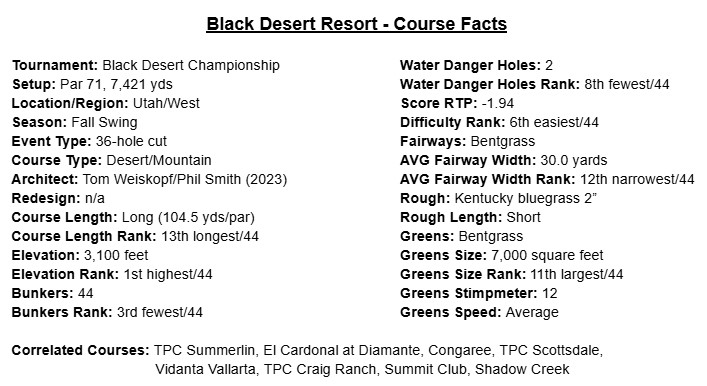
Black Desert’s golf course is part of a 650-acre resort located in Ivins, just about 40 miles away from Zion National Park. The course is a par-71 layout that measures at 7,421 yards and features three par 5s, four par 3s, and 11 par 4s. The front nine opened in November 2022, while the back nine opened in May 2023. The course was shaped from the black lava rock that is pervasive in this corner of southwest Utah. From the green fairways and the blue lakes to the red rock mountains and the black lava, the course offers a visually stunning combination of landscapes.
Nick Taylor played in last year’s inaugural event and remarked, “When I think desert, I think I default to TPC Scottsdale or Summerlin in Vegas. But with the lava rock around, it’s not really a playable desert. There’s so many things about this course that are unique. It’s a lot of fun to come here.”
The entrance to Snow Canyon is visible from nearly every hole, and as you make your way back to the clubhouse on the back nine, it’s as if you’re hitting right into the mouth of the canyon. Though appearing very tight on some tee boxes, the course is much more open and forgiving than you would expect for a course sitting on top of a lava field. As for dealing with the lava when building the course, Weiskopf saw it as a feature instead of a hindrance.
Said Ken Yates, Black Desert Resort’s superintendent, “The way they put the golf course all around the natural lava, it’s like it was meant to be there.” Creating the fairways by clearing the lava was one of the most difficult challenges the design team encountered. They had to dynamite every square inch of the routing, blasting away more than 100 acres of what would become turf. Then the routing was capped with three feet of sand, half a million cubic yards in total. It’s the depth of that sand capping that allows for such smooth fairways amid the lava, Smith said. The edges of each hole might be jagged, but the course itself is perfectly contoured. The sand also provides excellent drainage and the firm, bouncy conditions that are a hallmark of great courses.
Even though mountainous terrain surrounds the course, Black Desert plays relatively flat. With an elevation of 3,100 feet above sea level, golfers will get added distance off the tee. Some blind tee shots will also force players to take note of the proper sight lines during their pre-tournament practice rounds.
Last year, Black Desert averaged -1.94 per round and ranked as the sixth easiest course on Tour. “We certainly designed it to challenge the best players in the world,” Smith said, noting that yardage has been added to a few holes at the Tour’s request. “That’s something Tom and I did throughout our careers together. We always designed golf courses with that possibility in mind. Think about TPC Scottsdale (also designed by the pair), where one week of the year it’s got to challenge the best players in the world, but 99 percent of the time, it’s a resort course.”
It’s frequently risk versus reward throughout Black Desert. Challenge the lava at the edges to gain a strategic advantage, or tack safely around it. Said PGA veteran Zac Blair, “You might go to Arizona and hit it in the desert, and you can still find it and chip it out. Here, you’re not going to find it most of the time. Especially in the rocks. So I think it’s very unique, very different.”
The main risk/reward holes are a couple of par 5s, along with two driveable par 4s. The 320-yard 5th hole finishes at an elevated green protected by a bunker and numerous rock formations. The green of the 326-yard 14th hole sits in a bowl hidden behind a wall of lava rock on three sides. Layups on either hole can lead to chances at birdie, while the more aggressive players have the option of going for the green off the tee.
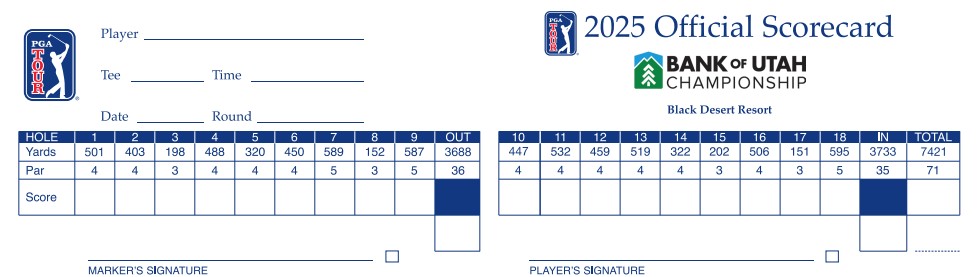
Weiskopf and fellow architect Phil Smith challenge golfers in creative ways—placing a bunker in the middle of the third green, a 196-yard par 3, and introducing water hazards on two of the longest par 4s, the 11th and 13th holes, to heighten shot-making demands. The par-5 7th winds through a compelling maze of black-rock formations. From the back tees, the par 3s range from 151 yards to 202. The 151-yard 17th is Weiskopf’s “spin-off” of the famous Postage Stamp par 3 (no. 8) at Royal Troon, where he won The Open Championship in 1973.
The course features short Kentucky bluegrass rough (2″) along with bentgrass fairways and greens. The greens are undulating and quite large at an average of 7,000 square feet with speeds around 12 on the stimpmeter.
Strokes Gained Analysis
Off the Tee
Knowing there would be lava in play, and that the winds can reach 40 mph on the Black Desert site, Weiskopf and Smith devised a routing that provided plenty of room to swing away. With it being a resort course, extra width provides strategic options for golfers to choose the best angle to the flag and also allows plenty of room to avoid the lava.
This was evident last year with the highest driving accuracy rate on Tour at 84%. “Because we knew you’re pretty much dead outside of the turf, we wanted really wide fairways,” Smith said. “That’s why when you’re out there, you see those super wide fairways (49 yards wide on average) with just a nice band of rough around them.” Black Desert was also the easiest course last year to gain strokes off the tee.
Regarding strategy off the tee this week, Utah native Patrick Fishburn said, “I think the key with any type of desert course is to put the ball in play, keep it out of the rocks, and make sure you’re not hitting provisionals. If you get the ball in play, you can attack and use the different slopes they have to funnel it to the different pins.”
On this same topic, Blair added, “There are definitely some options on a lot of holes. You’re able to decide how much you want to bite off on certain holes or how much you want to push it up the fairway, and with the lava rock, it’s pretty much do-or-die hazards throughout the whole golf course.”
Approach
On approach, the average GIR rate was among the highest on Tour at 76% with an average proximity to the hole of 34 feet (the average is 37 feet). It was the sixth easiest course to gain strokes on approach. As for approach distances, only 14% of shots came from under 125 yards. The biggest increase came on approach shots from 175–200 yards, which accounted for 25% of all approaches compared to the Tour average of 17%.
Said Henrik Norlander, “It’s a fun course, a lot of opportunities, but you’ve got to hit good approaches because the greens are somewhat severe, and you’ve got to get it in the right portions to play well.” After struggling with some approach shots in his second round last year, Patrick Fishburn remarked, “It was little sections, little quadrants you need to hit to score well. I just kept on missing those on the wrong side. If you take it on, you can hit it close and get a good look. If you don’t, you’re going to have a tough two-putt. If you short side yourself out here, then you’re in trouble there as well.
Around the Green and Putting
The toughest part of Black Desert Resort in its inaugural year was on and around the greens. 55% of ARG shots came from short grass lies and resulted in a below-average scrambling rate of only 56%. It was the difficulty in putting metrics, however, that was the most surprising. Three-putt rate is always higher on larger greens, but it was even more pronounced here at 3.8% (2.8% is average). Also, every single range was more difficult than average, including only a 25.5% make rate from 10-15 feet (30.6% is average). This resulted in Black Desert being the fourth toughest course to gain strokes putting in 2024.
Regarding the difficulty on the greens, Nick Taylor remarked, “The greens are quite large but they have small little pockets, and I think being so new, the grass hasn’t quite settled yet. So there’s going to be a lot of subtle breaks that make it pretty tricky to read. We’ve had a lot of little subtle double breakers from 10 feet.” Adam Svensson added, “The greens are tricky, getting faster, a lot of slope.”
Most Important Stats For Success at Black Desert Resort
*In order of importance
- SG: Putting (Bent)
- Birdie or Better %
- DFEF (Distance From Edge of Fairway)
- Par 4 BoB%
- 3-Putt AVD
- Proximity: 150-200
- SG: Easy Scoring Courses
- Scrambling (Short Grass)
- Putting 5-15 feet
- Driving Distance
Key Rabbit Hole Filters
- Course Region: West
- Course Type: Desert
- Scoring Conditions: Very Easy
- Course Length: Long
- Field Strength: Very Weak
- Event Season: Fall
- Bunker #: Low
- Water Danger: Low
- Greens Surface: Bent
- Rough Surface: Bluegrass
- OTT Club Type: Driver Heavy
- Gain OTT: Very Easy
- Gain APP: Easy
- Gain Putting: Very Difficult
- Scrambling Short Grass: Difficult
- 3-Putt AVD: Difficult