
2027 BMW Australian PGA Championship at The Lakes Golf Club Preview

Ron Klos

6 hours ago

The Lakes is short, wide and exposed, and for nearly a century that has been enough to test the best players in Australia. The biggest change to the BMW Australian PGA Championship this year is its location. After two editions at Royal Queensland in Brisbane, the event moves south to Sydney, where The Lakes Golf Club will host the opening event of the 2027 DP World Tour season. It is the championship’s first visit to New South Wales since 1998 and its first trip to The Lakes since 1987.
The Lakes sits in the Botany Water Reserve, a protected stretch of wetlands and lakes that once supplied Sydney’s water, about 10 minutes from Sydney Airport. Few courses in the country have a longer championship record. The club has staged eight Australian Opens and three Australian PGA Championships, and both Jack Nicklaus and Greg Norman won national opens here.
The course is an open, sandy layout with wide fairways, almost no rough and contoured bentgrass greens. The front nine works through dunes and waste sand, and water guards much of the back nine. With so much room off the tee, the test comes from choosing the right lines and controlling the ball on approach. The wind is what gives the course its teeth. Three-time Australian PGA champion Cam Smith said, “If the winds get up, it can be a very testing place to play.”
The Field
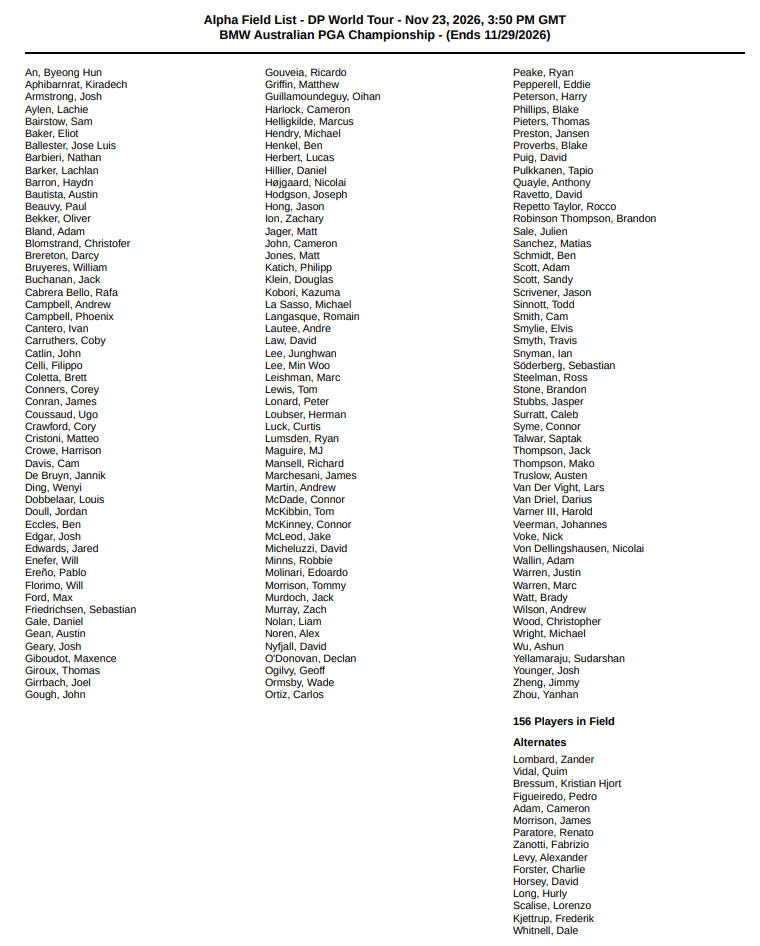
This year’s 156-player field includes four of the top 50 players in the Official World Golf Ranking in Alex Noren, Min Woo Lee, Adam Scott and Nicolai Hojgaard, along with six others ranked inside the top 100: Lucas Herbert, Corey Conners, Daniel Hillier, David Puig, Ross Steelman and Sandy Scott. Beyond that top group, the field is made up mostly of DP World Tour members and players from the Challenger PGA Tour of Australasia, so it thins out quickly.
Cam Smith headlines the rest of the field. He has won this championship three times and returns to The Lakes after finishing T17 at the 2023 Australian Open, even though he has slipped outside the top 150 in the world. He is joined by other notables, including Marc Leishman, Tom McKibbin, Thomas Pieters, Byeong Hun An, Harold Varner III, Carlos Ortiz, Cam Davis and Elvis Smylie. Lee, Scott and Smylie are also past winners of this event, and Puig returns as the defending champion after finishing at 18 under at Royal Queensland last year.
This is the fifth straight year the Australian PGA has opened the DP World Tour season. It is co-sanctioned with the Challenger PGA Tour of Australasia and starts a two-week stretch in Australia, with the Australian Open following next week at Kingston Heath in Melbourne.
The Lakes – Course Background
The Lakes was founded in 1928 on sandhills in Sydney’s southeast, with Eric Apperly and Tom Howard laying out the original par 72. In the late 1960s, the construction of Southern Cross Drive, the freeway that links the city with the airport, cut through the property. Robert von Hagge redesigned the course around the new road, and it reopened in 1970 with seven front nine holes on the far side of the freeway.
The course players will see this week is largely the work of architect Mike Clayton. Between 2007 and 2009, his firm rebuilt every green and bunker, removed many of the pines that had been planted across the property and uncovered large areas of natural sand. The rebuild widened the playing corridors and brought back the open, windswept character of the original site.
The restored course quickly returned to the national open rotation and hosted three straight Australian Opens from 2010 to 2012, each won by an Australian veteran. Geoff Ogilvy, who is in this week’s field, won the first by four shots at 19 under. A year later, Greg Chalmers held off Tiger Woods to win at 13 under, and in 2012 a 53-year-old Peter Senior, whose name suited the occasion, won at 4 under in strong wind.
The Lakes hosted all four rounds of the 2018 Australian Open, when Abraham Ancer won by five shots at 16 under. It has also staged the Australian Amateur, which Cam Davis won before turning professional.
The 2023 Australian Open
The Lakes last hosted top level professional golf at the 2023 Australian Open, which it shared with The Australian Golf Club. Each of the 156 players played one round on each course over the first two days before the weekend moved to The Australian. Joaquin Niemann won at 14 under, beating Rikuya Hoshino with an eagle on the second playoff hole.
The Lakes played as the easier of the two courses. It averaged 71.42, or 0.58 under par, while The Australian averaged 0.42 over par across the same two rounds. Comparing the same players on both courses, The Lakes played about one stroke easier relative to par. More than half of the rounds at The Lakes (54.5%) finished under par, compared with 36.5% at The Australian.
Heavy rain before the event softened the course, and players were allowed to lift, clean and place the ball in both rounds. A storm also flooded at least one green at The Lakes on Thursday and stopped play for about 40 minutes. Cam Davis took advantage of a calm morning to shoot 63 with an eagle on the 14th, the low round on the course that week. In the second round, Rafa Cabrera Bello, Oliver Farr, Lars van Meijel and Jeffrey Guan shared the low score of 66.
The contenders handled The Lakes well. Min Woo Lee and Laurie Canter shot 67, Hoshino and Adam Scott shot 68, and Niemann shot 69. Only one of the eventual top seven, Grant Forrest at one under, failed to break 70 there.
The four par 5s produced most of the scoring. They averaged 4.69, or 0.31 under par, and the 14th, 17th and 8th were the three easiest holes on the course. The 509-yard 14th gave up a birdie or better 56% of the time, including five eagles. The two short par 4s also played under par, with the 315-yard 13th yielding a birdie 36% of the time and the 341-yard 6th 30% of the time.
The par 3s were the hardest part of the course. They averaged 0.15 over par, more than twice the typical DP World Tour course. The 209-yard 18th was the toughest hole of the week, averaging 3.28 with a birdie rate of just 4.5% and a bogey or worse 31% of the time. The 7th and 15th ranked second and third. Among the par 4s, the long 2nd, 1st and 5th played hardest.
These numbers come from just two rounds on a soft course, so they likely understate how difficult The Lakes can play when it is firm and the wind blows. Overall, its scoring relative to par placed it near the middle of the 77 courses the DP World Tour has used since 2020.
Course Features
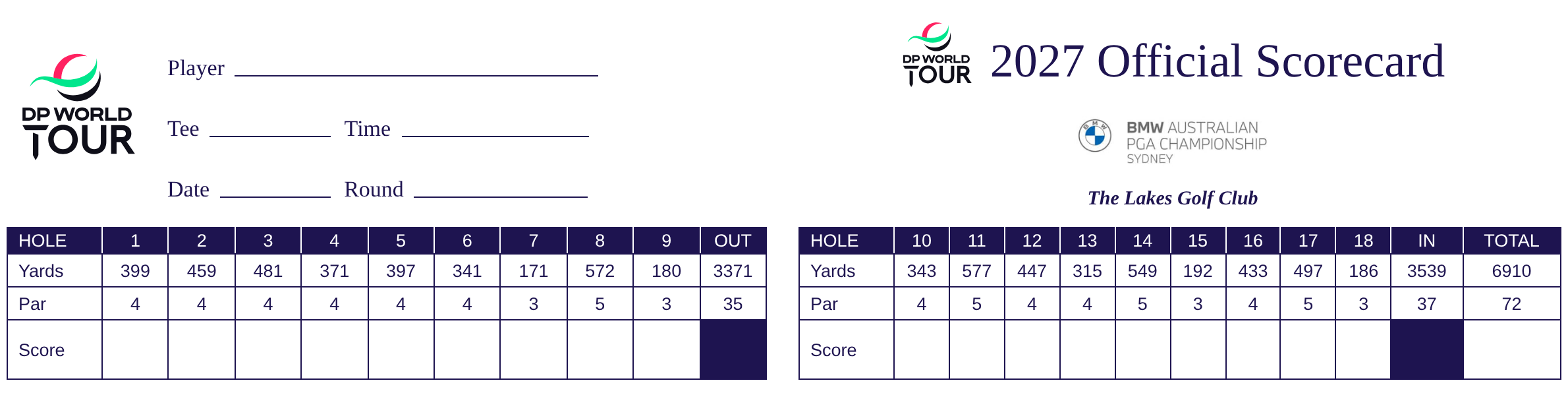
The Lakes will play as a par 72 of 6,910 yards this week, 11 yards longer than it measured for the 2023 Australian Open. It sits on deep sand a few miles from Botany Bay, and the two nines have very different characters. The front nine winds through dunes, waste sand and native scrub with water in play only on the 1st. The back nine plays around the lakes that give the club its name, and water comes into play on the 11th, 13th, 14th, 16th and 17th.
Short on the Scorecard
On paper, The Lakes looks vulnerable. It is a par 72 that measures well under 7,000 yards, with six par 4s shorter than 400 yards, four par 3s that all measure under 200 yards and four par 5s that can be reached in two. Courses with those numbers get overpowered almost everywhere else in the world. In Sydney’s wind, and with the strategy Clayton built into the design, The Lakes has held up far better than its scorecard suggests.
The length that does exist is concentrated on a few holes. The 577-yard 11th bends right around a lake that runs the full length of the hole and wraps in front of the green, so going for it in two takes real commitment. The 497-yard 17th can be reached with a mid iron after a good drive, while the 14th plays 40 yards longer than it did in 2023 at 549 yards. The 2nd, 3rd, 12th and 16th are the only par 4s beyond 430 yards. The par 3s also carry more weight than usual, with three of the four measuring 180 yards or longer.
The ground rolls rather than climbs. The old sand dunes create a handful of uphill shots, most notably on the 2nd, 6th and 7th, and the 13th plays downhill to its green. Elevation changes are modest, and the effect of the terrain shows up more in awkward stances and blind edges than in large swings in yardage.
Off the Tee
Width is the foundation of the design. Clayton explained the thinking behind the rebuild: “Against the trend of modern design, we decided against consciously adding yardage for its own sake. We also chose to remove almost all influence of long, green grass as a way of dictating the play. Our determination was this: that without significant fairway width, there can be no meaningful strategy from the tees; and no one wants to play down narrow fairways in high winds.
“We headed in the opposite direction: there would be no rough around the greens; the fairways would be as wide as we could make them; but the ideal lines into the flags would be from the more difficult to access edges of the fairways. And this would be close to the hazards. Each player would need to make a decision on where it would be best to aim.”
As a result, accuracy off the tee matters less here than on most championship courses. A missed fairway rarely means a bad lie in rough, and the real penalties come from the waste sand areas, the bunkers and the water on the back nine. The edge goes to players who drive it long enough to shorten the par 5s and the 13th and who choose the right side of the fairway for each pin.
Sand defines the course. The Lakes has 97 bunkers, and Clayton’s rebuild gave them rough, natural edges and native colored sand rather than a polished look. Many of the fairway bunkers blend into larger waste areas, such as the sandy carry across the 4th fairway. The bunkers around the greens are deep enough that recovering from them is a real problem.
Approach Shots
Approach shots should fall into two groups. With most drives finishing 135 to 180 yards from the green on the longer par 4s and inside 125 yards on the shorter ones, a large share of second shots will come from 50 to 175 yards. The par 3s and the second shots into the par 5s then add a heavy dose of long irons from 175 to 230 yards. Players who are sharp at both ends of the bag, with wedges and with long irons, should have an edge.
Around the Greens and Putting
The short game is varied. With no rough around the greens, most misses finish on tightly mown grass, in hollows or in bunkers. That gives players the choice to putt, bump or pitch, but firm surrounds make judging the first bounce difficult. A shot that runs through some of the back nine greens can also end up in the water, most notably on the 14th, where the green falls toward the lake.
The greens were rebuilt with heavy contours during Clayton’s work. Some carry spines and ridges, such as the two that cross the 9th green, and the putting surfaces are exposed to the wind across most of the property. They do not normally run as fast as the greens at The Australian, but they become much harder to putt when the course dries out and the wind picks up.
The Closing Stretch
The 13th is the hole most likely to decide the tournament. Clayton wrote about it before the 2018 Australian Open: “This week at The Lakes the most controversial hole is the par 4, 13th. It’s [306 yards], driveable for almost all. What could be difficult about a downhill hole with a fairway [77 yards] wide?”
The challenge is the green, which sits behind a pond on the right and is protected by steep banks instead of bunkers. Clayton added, “The green, modelled on the upturned fourth at Woodlands in Melbourne is defended not by bunkers but steep banks of short grass on either side. The concept is to ensure players missing on the sides are far from guaranteed a simple up and down to make birdie.”
The rest of the closing stretch offers a mix of chances and danger. The 14th and 17th are two of the best birdie holes on the course but both require carries over water. The round then ends with the par 3 18th, which plays 186 yards this week, 23 shorter than in 2023, and where a hollow to the left of the green makes the front left pin especially hard to reach.
Turf and Scoring
The greens are A4 bentgrass, while the fairways and rough are kikuyu and the tees are Santa Ana couch. The bunker surrounds use a mix of fescue and zoysia. Kikuyu fairways give players tight lies and plenty of roll when the weather is dry, and the course plays at its best and most difficult when it is firm.
The Lakes rewards players who score on the par 5s and short par 4s and who limit the damage on the long par 3s. In normal conditions, expect a winning score somewhere between 14 and 18 under par, with that number climbing quickly if the wind blows for more than one day.
Most Important Metrics
These are the metrics that should matter most this week, ranked in order of importance.
- Par 5 scoring. The par 5s are where the field separates itself, and the leaders will need to play them in close to two under each day.
- Long iron approaches (175 to 230 yards). The long par 3s and the second shots into the par 5s put more weight on long irons than most courses do.
- Approaches from 50 to 150 yards. The short par 4s and the layup holes leave plenty of wedges, and those shots are the best chances for birdie outside the par 5s.
- Performance in wind. The course is exposed across the whole property, and players who control their ball flight and handle crosswinds gain the most when it blows.
- Around the green. Tight lies, hollows and deep bunkers around the greens test touch and creativity more than pure scrambling from rough.
- Putting on bentgrass. The contoured bentgrass greens favor players who are comfortable on the surface, especially when the wind starts to affect putts.
- Driving distance. Wide corridors and little rough reduce the penalty for missing fairways, so extra distance helps on the reachable par 5s and the 13th more than accuracy does.

Get 25% off
Use code: BSG26
BUILD YOUR OWN
CUSTOM STATS MODEL
FOR BETTING & DFS
New Users Only