2026 Travelers Championship at TPC Highlands – Preview

Ron Klos

3 months ago
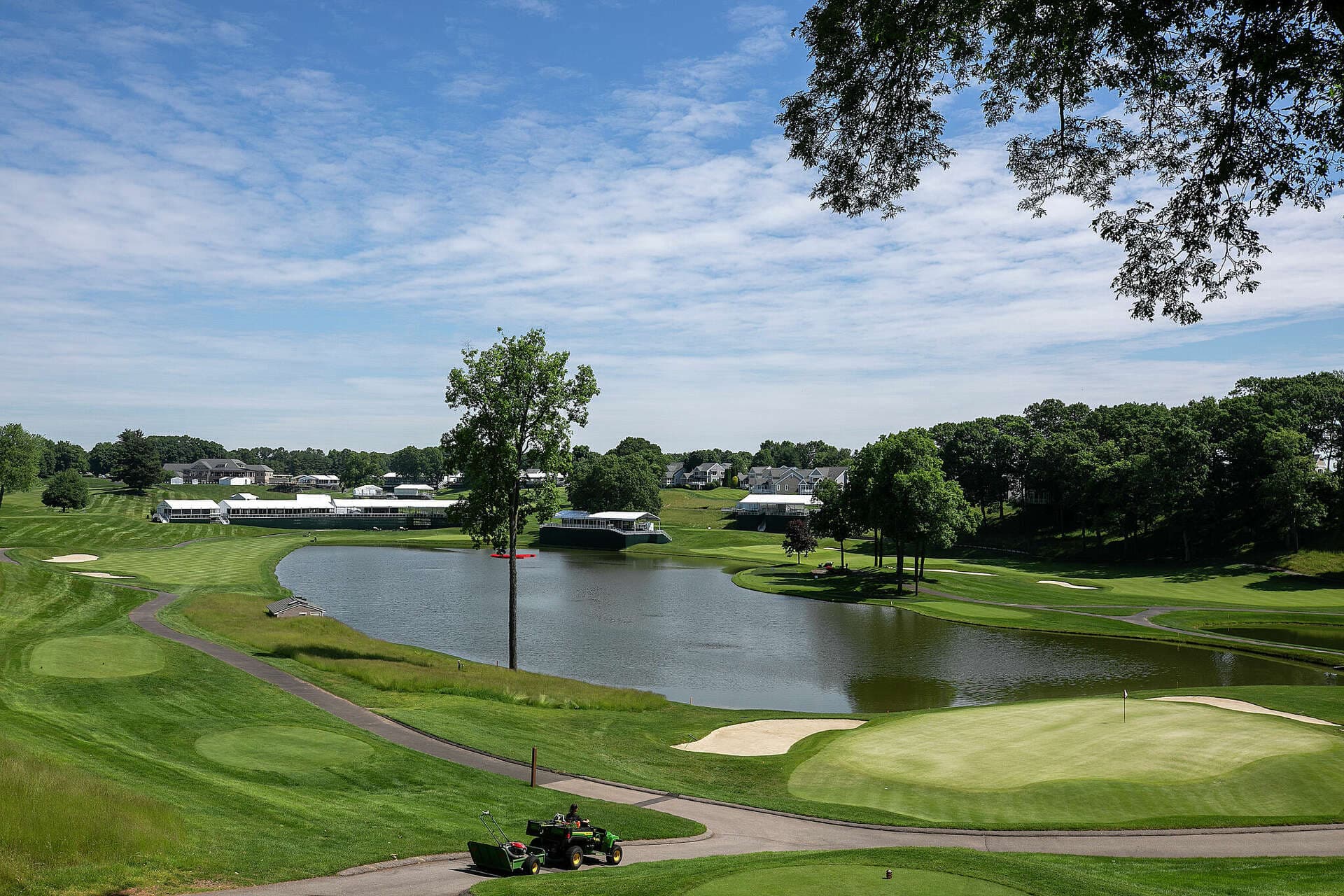
The PGA Tour heads to the Northeast this week for the Travelers Championship at TPC River Highlands in Cromwell, Connecticut. Long considered one of the most popular stops on the schedule among players, caddies, and fans alike, the Travelers has become a fixture on the summer calendar thanks to its elite fields, tremendous atmosphere, and consistently dramatic finishes. It is the final Signature Event of the 2026 season, featuring a limited-field, no-cut format and many of the best players in the world competing for a $20 million purse.
TPC River Highlands is a classical, tree-lined par 70 that rewards creativity and precision far more than brute force. The course underwent a significant redesign by Pete Dye in the 1980s before Bobby Weed later refined and modernized the layout, helping create the strategic test players face today. Many of Dye’s trademarks remain evident throughout the course, with preferred angles off the tee, subtle risk-reward decisions, and an emphasis on shot-making over power. At just under 6,850 yards, it is one of the shortest venues on the PGA Tour schedule, yet it remains a complete test.
Players are asked to shape shots both directions, work their way into proper angles off the tee, and consistently attack with wedges and short irons into small, tiered green complexes. The rough is penal, the greens place a premium on distance control, and subtle doglegs and changes in direction force players to think their way around the golf course rather than simply overpower it. As 2019 champion Chez Reavie explained, “You can shape it both ways off the tee, hit every club in your bag from longer irons to short irons. It’s just a test of all your shots.”
Although TPC River Highlands routinely yields birdies, it has proven capable of identifying virtually every style of winner. The average winning score since 2010 sits around 16-under-par, but recent years have seen the tournament increasingly dominated by elite players as the event’s stature has continued to rise. Winners over the past decade include Scottie Scheffler, Xander Schauffele, Jordan Spieth, Dustin Johnson, Bubba Watson, and Keegan Bradley, highlighting the quality required to separate from a world-class field.
The tournament’s greatest strength may be its finish. The closing stretch, particularly the risk-reward sequence on holes 15 through 17, consistently produces volatility and leaderboard movement late on Sunday. Few events generate more drama down the stretch, with 16 of the last 22 editions decided by a single stroke or in a playoff. For a course that appears straightforward on paper, TPC River Highlands has a remarkable ability to create memorable finishes year after year.
The Field

As the final Signature Event of the season, the Travelers Championship once again features one of the strongest fields of the year. Seventy-two players will tee it up at TPC River Highlands in the no-cut format, including 49 of the top 50 players in the Official World Golf Ranking. The only notable absence is Rory McIlroy, who elected to skip the event for the third time this season after another emotionally draining week at the U.S. Open. McIlroy has significantly scaled back his PGA Tour schedule in 2026 and will instead take several weeks off before returning for the Scottish Open and Open Championship.
Headlining the field is World No. 1 Scottie Scheffler, who returns to a venue that has suited him extremely well in recent years. He is joined by an impressive collection of elite talent that includes Xander Schauffele, Collin Morikawa, Ludvig Aberg, Jon Rahm, Justin Thomas, Viktor Hovland, Tommy Fleetwood, Patrick Cantlay, Hideki Matsuyama, Russell Henley, Sepp Straka, and defending champion Keegan Bradley.
One of the more difficult handicapping challenges this week is determining which players will be able to quickly recharge after the mental and physical demands of the U.S. Open. While the three-hour trip from Shinnecock Hills to Connecticut is considerably easier than many previous years, the Travelers still occupies one of the most difficult spots on the schedule. Players are coming directly from one of the toughest tests in professional golf and immediately transitioning to a course where birdies are plentiful and aggressive scoring is required. History has shown that some players embrace the relaxed atmosphere and post-U.S. Open reset, while others understandably struggle to maintain the same level of focus and energy after four mentally exhausting days at a major championship.
TPC River Highlands – History
Designed in 1928 by Robert Ross and Maurice Kearney, the club was originally known as Middletown Golf Club and became one of the most popular courses in Connecticut. By the early 1980s, it was bought by the PGA Tour, which hired famed architect Pete Dye to completely redesign the course to fit professional tournament standards. In 1984, the course reopened as the “TPC of Connecticut” and became host to the Greater Hartford Open.
The course underwent another renovation in 1989 by architect Bobby Weed, who had Tour players Howard Twitty and Roger Maltbie helping as consultants. The club reopened again in 1991 with almost a completely new front nine holes and was renamed the TPC at River Highlands.
In 2024, players arrived to find a course that had undergone some “competitive enhancements” thanks to how easy scoring was the previous year, combined with Rory McIlroy‘s comments about technology having rendered the layout obsolete. While no length was added, six holes experienced significant changes.
“We want the golf course to be a challenge no matter what yardage you drive the ball to,” said Gary Young, senior vice president of rules and competition for the PGA Tour. “So from the longest hitter to the shortest hitter, you’re looking at whether they are basically taking on the same risk for the same reward. Everything we did was, we don’t want to take it away entirely. But we want to make it even riskier for that guy who’s going to try. And that risk should be rewarded.”
Despite the “enhancements”, the 2024 tournament saw the easiest scoring ever a TPC River Highlands with the average score per round of -2.37. Last year was a much different story as the course played nearly a stroke and a half tougher at -0.76 per round.
Finish Position and Strokes Gained History at TPC River Highlands (2016-2025)
This includes the average finish position and Strokes Gained per round. Players are sorted by SG: Total. TPC River Highlands is the 11th most predictive course on the PGA Tour.


Course Features

Situated about 120 miles northeast of New York City and around 30 miles from the Atlantic coast, TPC River Highlands is located just outside of Hartford in the town of Cromwell, Connecticut. Beautifully carved into slightly rolling terrain, the course gets its name from being situated on a bluff high above the Connecticut River. It meanders over 148 acres with an assortment of trees framing its gently rolling fairways.
It is a par-70 course and is the 3rd shortest on Tour at only 6,844 yards. Immaculately maintained, the course features numerous subtleties that enhance both its strategic demands and overall challenge. The routing of the holes demands certain shot types and shapes. This style of course design has produced a diverse range of champions over the years. Past winners include bombers and shorter fairway finders, Tour veterans and course “first-timers”, and even a blend of favorites and longshots.
Said 2017 winner, Jordan Spieth, “You’ve got to work both ball flights. You’ve got to kind of be fearless in playing different shots. You can’t get out there and just step and hit just draws the whole day. It forces you to hit different shots.”
The agronomy this week features over four inches of Bluegrass/Fescue rough along with a Bentgrass/Poa annua blend on the greens and fairways. Several lakes and ponds enhance the visual appeal of the property, though water is only truly in play on a handful of holes. In classic Pete Dye fashion, however, players are repeatedly tempted into aggressive decisions, particularly on the back nine where risk-reward opportunities require carrying water hazards in pursuit of birdies and eagles.
The primary defense at TPC River Highlands is its penal rough. Players who miss fairways often find themselves unable to attack pins and are instead forced to play conservatively back into position. Combined with small, tiered greens and strategic angles into the putting surfaces, the course places a premium on precision rather than power.

While TPC River Highlands consistently yields birdies and low scores, it is far from a pushover. The course has a long history of rewarding elite ball-striking while punishing even slight lapses in execution. Jordan Spieth provided a perfect example in 2018 when he opened with a 63 before struggling to a 73 the following day. At the same time, players who find a rhythm can produce historic scoring performances. Jim Furyk carded the PGA Tour’s first-ever 58 here in 2016, while Patrick Cantlay, Mackenzie Hughes, and Cameron Young have all posted rounds of 60 or better.
Hole Preview

The hole distribution at TPC River Highlands is typical of a par-70 layout with 12 par-4s, four par-3s, and two par-5s. What separates it from most Tour venues is the length. The course has the shortest combination of par-4s and par-5s on Tour, averaging just 432 yards per hole. Nine of the 12 par-4s measure under 445 yards, placing a greater emphasis on wedges, short irons, and positioning than power. Players who excel on shorter par-4s should have a distinct advantage, while strong par-5 scoring is somewhat less important than it is at most venues.
The two par-5s still provide the easiest scoring opportunities on the course, producing a birdie-or-better rate of roughly 38%. The drivable par-4 15th is not far behind at 37%, making it one of the most important holes in the tournament.
The front nine is relatively straightforward. Most tee shots are played directly in front of the golfer with few forced carries and minimal visual intimidation. The closing stretch is where TPC River Highlands earns its reputation. Stewart Cink once called holes 15 through 18 “four of the most exciting finishing holes anywhere in the world,” and it is easy to see why.
The finishing stretch regularly produces swings on the leaderboard because players are constantly forced to choose between aggression and caution. Holes 15 through 17 all play around a four-acre lake and can quickly turn a birdie opportunity into a costly mistake.
The 296-yard 15th is one of the best risk-reward holes on the PGA Tour. Players can attempt to drive the green, but water guards the entire left side while bunkers and thick rough await on the right. Eagle and double bogey are both very much in play.
The 171-yard par-3 16th is played entirely over water and sits in one of the most exposed areas on the property. Wind can make club selection difficult, and any shot long leaves one of the toughest recovery shots on the course.
The 431-yard 17th requires two quality shots. The tee shot follows the edge of the pond before players face an approach into a back-to-front sloping green that is difficult to hold from the wrong angle. Together, these holes are a major reason why so many Travelers Championships are decided late on Sunday afternoon.
Strokes Gained Analysis

Off the Tee

At just over 6,800 yards, TPC River Highlands is one of the shortest courses on the PGA Tour schedule and one where players frequently take a conservative approach off the tee. The average driving distance here is typically among the lowest on Tour at roughly 286 yards, due in large part to the number of doglegs, tree-lined corridors, fairway bunkers, and positional tee shots. Driver is used on only about 59% of tee shots, one of the lower rates on the PGA Tour, as many players opt for fairway woods, hybrids, or long irons to find preferred landing areas.
Length is not irrelevant, but accuracy and positioning are far more important. Fairways are among the narrowest on Tour, and many tighten considerably in the 300 to 320-yard range where longer hitters would normally land their drives. Several holes also feature strategically placed bunkers that force players to make a decision between challenging a hazard for a shorter approach or laying back to a wider section of fairway.
The rough is the primary defense. At more than four inches thick this week, the Bluegrass/Fescue rough can make it difficult to control spin and trajectory into the course’s small green complexes. Players who miss fairways often find themselves playing defensively and are frequently forced to lay up short of the green rather than attack tucked pins. TPC River Highlands consistently ranks among the toughest courses on Tour for strokes lost after missing the fairway, and approximately 8% of drives that miss the short grass ultimately lead to a penalty stroke.
As a result, driving accuracy at TPC River Highlands is routinely several percentage points higher than the Tour average. Players understand that finding the fairway creates a significant advantage, even if it means sacrificing distance. That said, power can still be an asset when paired with control. Bubba Watson won three times here, Dustin Johnson won in 2020, and Cameron Young‘s runner-up finish in 2024 was fueled in part by his ability to hit shorter clubs into many of the course’s approach shots.
Rory McIlroy described the challenge well:
“You feel like you have a wedge in your hand every hole. But if you don’t hit it in the fairways and don’t put yourself in position, it can be a little tricky. You need to be accurate here and not feel like you can be super aggressive, but just sort of rein that back a bit, knowing that there’s plenty of opportunities and just to stay patient.”
The players who succeed here are rarely the ones who overpower the course. More often, they are the ones who consistently place the ball in the correct section of the fairway and give themselves clean looks with their wedges and short irons.
Approach

Despite the small targets, greens are hit at a rate of about 71%, several percentage points above the Tour average. The combination of short approach distances and frequent fairway lies allows players to attack flags more often than they can at most venues. As a result, TPC River Highlands consistently ranks among the easier courses on Tour for proximity to the hole and birdie opportunities created.
The course’s defense comes from the green complexes themselves. Many greens are angled relative to the line of play, forcing players to approach from the correct section of the fairway. Pin positions are often tucked near edges, ridges, and shelves, making it difficult to consistently hit approach shots inside makeable birdie range. Players can hit plenty of greens here without necessarily creating quality scoring chances.

Because of the short approach distances, elite iron play is helpful but not always the deciding factor. The 2022 Travelers Championship was a good example. The players who finished inside the top 10 gained an average of only 0.4 strokes on approach for the entire week. That same group gained roughly six strokes putting on average, illustrating how frequently this event becomes a contest of converting opportunities rather than simply creating them.
Spieth summed up approach play at TPC River Highlands and the scoring opportunities available. “You get so many opportunities, you feel like you’re losing to the field if you don’t birdie with a wedge in your hand. But they put these pins in such difficult locations it’s hard to feed it next to it, once you do, it’s difficult to get the right line on the green. So recognizing that the course is 6,800 yards for a reason. It’s tricked out elsewhere. We’re going to have a lot of chances, greens in regulations is going to be an important stat.”
Around the Green and Putting

Around the greens, TPC River Highlands is considerably more difficult than its scoring average would suggest. The course consistently ranks among the toughest on Tour for Strokes Gained: Around the Green and is one of the most difficult venues for saving par after a missed green. Scrambling rates sit below 52%, largely because of the thick Bluegrass/Fescue rough surrounding many of the putting surfaces.
The challenge is not limited to the rough. Many greens feature steep runoffs, collection areas, and multiple tiers that leave players facing a variety of recovery shots. Tight lies from short grass are common, requiring precise contact and distance control. Players who are comfortable chipping from both thick rough and closely mown areas tend to have an advantage when greens are missed.
The greens themselves are a Bentgrass/Poa annua blend commonly found throughout the Northeast. Unlike the Poa annua surfaces seen on the West Coast, these greens generally roll more consistently throughout the day and do not develop the same level of bumpiness in the afternoon. From a putting perspective, TPC River Highlands plays close to Tour average across most key metrics.
The smaller green sizes also reduce the number of long lag putts players face, resulting in fewer three-putts than the PGA Tour average. As a result, putting often becomes more about converting birdie chances than avoiding mistakes.
Recent leaderboards reinforce that point. Most contenders arrive at the weekend having created plenty of opportunities with their wedges and short irons. The players who ultimately separate themselves are usually the ones who capitalize on those chances. Winning scores at TPC River Highlands are rarely driven by elite ball striking alone. More often, they come from players who pair solid approach play with a hot putter and convert a high percentage of birdie looks inside 15 feet.