2026 PGA Championship at Aronimink Golf Club – Preview

Ron Klos

4 months ago

The 2026 PGA Championship returns to the historic Aronimink Golf Club in Newtown Square, Pennsylvania, a suburb west of Philadelphia.
As the 108th edition of the tournament, it marks the second time in championship history that the Wanamaker Trophy will be contested at this classic Donald Ross-designed layout — the first being in 1962 when Gary Player claimed victory. The PGA TOUR has visited a few times since, including the 2010 and 2011 AT&T National, and most recently for the 2018 BMW Championship won by Keegan Bradley at -20.
Originally designed by the legendary Donald Ross in 1928, the course showcases many of his signature architectural traits, including strategic use of the natural terrain, crowned turtleback greens, and elaborate bunkering. The course underwent a comprehensive restoration by Gil Hanse and Jim Wagner in 2016-2017 to return it to Ross’s original vision.
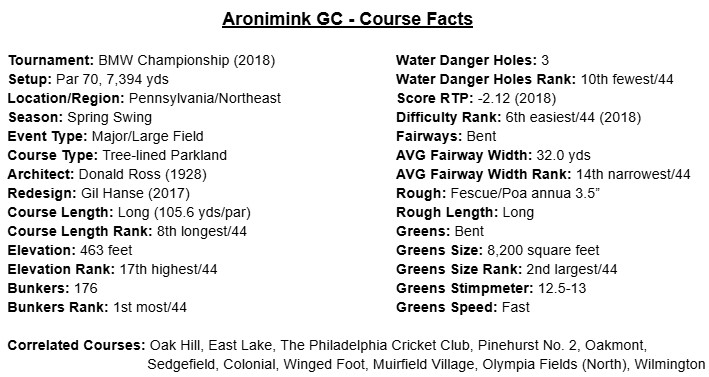
Aronimink is a par-70 layout that stretches approximately 7,394 yards. It features Bentgrass fairways and greens, as well as fescue rough approaching four inches and 176 bunkers.
It should present a different test than what we have typically seen in recent PGA Championships, where length and power off the tee have provided a sizeable advantage. With only two par 5s, any distance advantage should be muted even further.
In the past, Aronimink’s routing and strategically placed hazards have forced the world’s best players to rely on course management, mid iron precision, and short game skill around its tricky green complexes. Whether that formula still holds true in an era where the game’s longest hitters seem capable of overpowering any course remains to be seen.
Aronimink’s greatest strength is its lack of weaknesses. It demands a complete game, testing every aspect in equal measure. Pars are difficult to make here, and birdies are even harder to come by.
Said Hanse, “I believe Aronimink will be a full examination of a player’s game. You will have to drive the ball well because the rough will be penal. You’re going to have to hit good irons because the greens often feature different sections or quadrants, which will make them challenging to read. You won’t just be able to hit the putting surface, you will have to hit an exact area of the green to be in a position to score.”
The Field
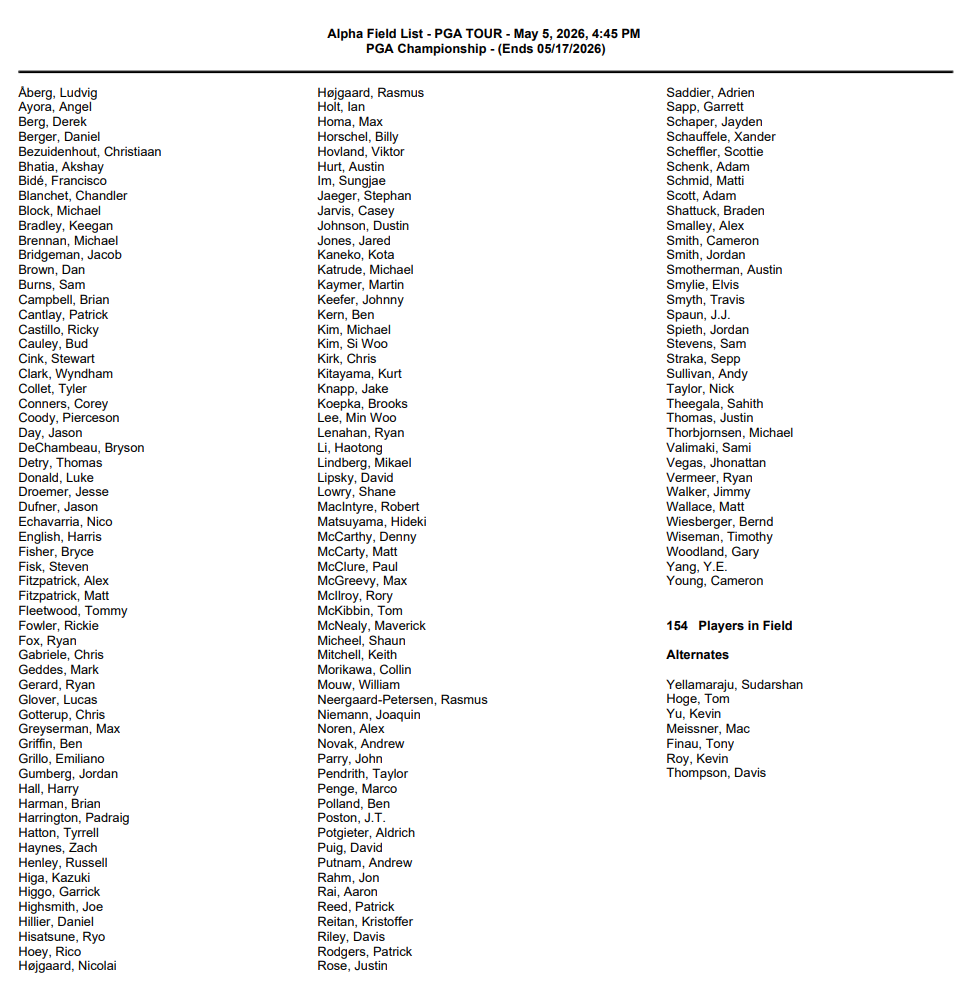
The PGA Championship has long carried the reputation of having the strongest field in golf. It features the largest field of the four majors with 156 players, includes virtually everyone inside the top 100 of the Official World Golf Ranking, and has fewer irrelevant exemptions than the other major championships. As is tradition at the PGA Championship, the field will include the top 20 PGA Professionals who qualified through the PGA Professional Championship.
Defending champion Scottie Scheffler, who won by five shots at Quail Hollow Club a year ago, enters once again as the tournament favorite. Reigning Masters champion Rory McIlroy sits close behind as he pursues the second leg of a potential calendar Grand Slam. Unlike many recent majors, however, a number of players arrive this week with legitimate momentum and confidence to win.
Cameron Young secured the biggest victory of his career at The Players Championship before adding another win two weeks ago at Trump National Doral, where he defeated Scheffler by six strokes. After capturing the Valspar Championship in March, Matt Fitzpatrick followed it up a month later by defeating Scheffler in a playoff at the RBC Heritage. He then teamed with his brother Alex Fitzpatrick to win the Zurich Classic, giving him three victories over the past eight weeks.
The LIV Golf contingent is equally dangerous with Jon Rahm, Bryson DeChambeau, Joaquin Niemann, and Tyrrell Hatton all firmly in contention. They are joined by a deep group of past major champions that includes Xander Schauffele, Collin Morikawa, Justin Rose, Brooks Koepka, Justin Thomas, and Jordan Spieth, who will be attempting to complete the career Grand Slam.
Twenty-nine players in the PGA field were at Aronimink in 2018 for the BMW Championship, where Keegan Bradley beat Justin Rose in a playoff. With course history not being a factor this week, using the “Comp Course” and “Long/Par 70” filters in the Rabbit Hole are vital for researching the field this week.
The tournament will utilize the standard PGA Championship cut format. After 36 holes, the field is cut to the top 70 players and ties. Any player inside that number advances to the weekend rounds on Saturday and Sunday.
Gil Hanse Restoration
When officials at Aronimink Golf Club began discussions with the PGA of America about bringing another PGA Championship to the Philadelphia area during the nation’s 250th anniversary celebration, they understood the course first needed to return to its Donald Ross roots.
That process began in 2016 when renowned architect Gil Hanse and design partner Jim Wagner launched a major restoration project aimed at recapturing Ross’s original vision.
The most dramatic transformation came through the bunkering. The bunker count increased from 74 to 176 as Hanse replaced large modernized greenside bunkers with smaller, more intricate bunker clusters inspired by Ross’s original style.
The project also expanded several greens by up to 30 feet to create additional hole locations, widened fairways, added strategic length, and removed select trees to restore the course’s classic parkland appearance.
“The restoration of that bunker style and those configurations is definitely the most dramatic part of what we did,” Hanse recalls. “It’s the visual, the character of these clusters and how they sit in the landscape, that stands out. Plus, you have a wonderful set of Ross greens.”
Course Features
Established in 1896, Aronimink Golf Club purchased 300 acres of rolling terrain outside Philadelphia in 1926 and hired Donald Ross to design a course at the height of his career. Built across a rugged, sprawling piece of farmland, Aronimink embraces the natural contours of the land, resulting in reverse cambers and uneven lies throughout the fairways.
One of the defining characteristics of the routing is how consistently Ross varies the challenge from hole to hole. Few consecutive holes ask for the same type of shot shape, trajectory, or strategy. The course moves players across ridges, into valleys, and along side slopes while constantly changing visual angles through its bunker placement. That variety, combined with Aronimink’s restored Ross green complexes, is a major reason many architects and players consider it one of Ross’s greatest championship routings.
Along with adding over 100 yards to the course from new tee boxes, other changes since the 2018 BMW Championship include fairways pinched in at the landing zones to around 32 yards wide and the rough being grown out to around 3.5-4 inches.
“It’s a classic northeast Donald Ross course,” says Jeff Kiddie, PGA, who had been the Head Professional at Aronimink for the last 17 years. “If you look at players who have won here – Gary Player, Justin Rose (2010 AT&T National) and Keegan Bradley – they always seem to be a well-rounded player,” Kiddie says. “They’re not the longest, but they’re long enough. They’re really good iron players and streaky putters.”
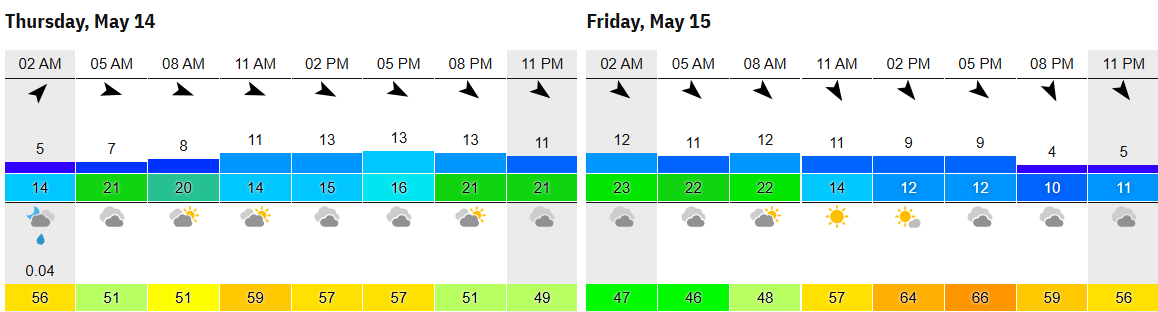
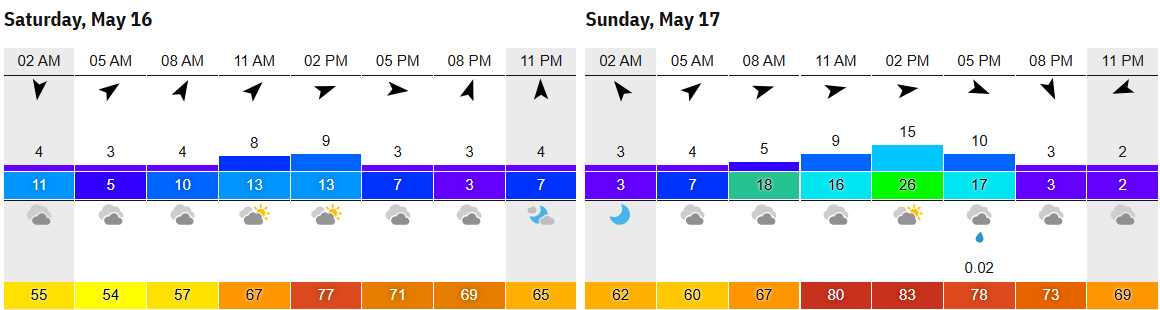
Weather will play a huge role in how the course plays this week. “We’d like it to play fast and firm,” explains Kiddie, “but that won’t be up to us.” With cooler conditions expected during the opening rounds and rain forecast for Wednesday evening, the course could play soft and receptive. If that happens, scoring may push past 15-under par and resemble the favorable scoring conditions seen during the rain soaked 2018 BMW Championship.
Strokes Gained Analysis
Off the Tee
While Aronimink is not overloaded with sharp doglegs, Donald Ross created movement and strategic pressure primarily through bunkering and fairway contouring rather than forced directional turns. Fairway bunkers pinch landing zones throughout the course, often appearing in staggered clusters that challenge players to choose precise carry distances and preferred angles into the greens. Many of those bunkers were restored and expanded during Gil Hanse’s renovation to better reflect Ross’s original intent.
The course also features numerous fairways with reverse cambers and side slopes that can redirect even well struck drives into the rough or awkward positions. It demands disciplined driving strategy and the ability to control trajectory and shape off uneven terrain. Players who consistently place the ball in the proper sections of the fairway will gain a major advantage entering the greens, while those who miss positioning targets can quickly find blocked angles, fairway bunkers, or thick rough.
Distance still matters at a modern major championship venue, but Aronimink has always placed a far greater premium on placement and control than many recent PGA Championship sites. In 2018, driver usage was at 67% with the average distance off the tee at 290 yards.
While the prevailing narrative suggests bombers may not hold a significant advantage, analysis of satellite imagery combined with the distance gains seen in today’s game indicates that some of the longest hitters could still carry fairway bunkers with driver on several holes and attempt a bomb and gouge strategy.
Approach
Approach play projects as the most important statistical category for the 2026 PGA Championship. Ross designed many of the par 4s to encourage conservative tee shots into wider portions of the fairway, but those safer lines often leave longer approach shots ranging from roughly 150 to 200 yards. Combined with the course’s rolling terrain and uneven stances, players will frequently be forced to hit mid and long irons from awkward lies into elevated greens.
The greens themselves are highly segmented with pronounced internal contours and subtle shelves that place enormous pressure on distance control. Elite iron shots will be rewarded with birdie opportunities, but misses into the wrong sections of the greens can quickly lead to defensive putting or difficult recovery situations. Players who fail to control spin and trajectory may find themselves putting across ridges or leaving delicate chips from tightly mown runoff areas.
Around the Green and Putting
Short game creativity and scrambling ability are expected to play a massive role throughout the championship. Ross’s trademark green complexes feature tightly mown chipping areas, steep runoffs, collection areas, and sharply contoured surfaces that repel erratic approach shots. Players will face a constant variety of recovery shots including bump and runs, lofted pitches from the penal rough, delicate spinners from tight lies, and lengthy putts from off the surface.
Said Hanse, “I think it’s going to be somebody’s creativity around the greens, the ability to get up and down, that will be the critical part,” he says. “You’re going to miss greens, and it’s the scrambling ability that will be important. As with any Donald Ross course, being able to read those greens will be key because they have such significant contours, but also an amazing series of subtle breaks within them that will be crucial.”
The Bentgrass greens at Aronimink are expected to be among the most demanding surfaces players will see all season. Ross designed many of the putting surfaces with strong back to front tilt, pronounced shoulders, and canted edges that can feed balls away from hole locations and toward collection areas. Leaving approach shots above the hole is particularly dangerous, as downhill putts can quickly become defensive efforts simply to avoid three putting.
With massive green sizes averaging 8,200 square feet and running around 12.5 on the stimpmeter, players will face a heavy volume of long lag putts throughout the week due to the size, speed, and internal movement of the greens.
Hole Preview
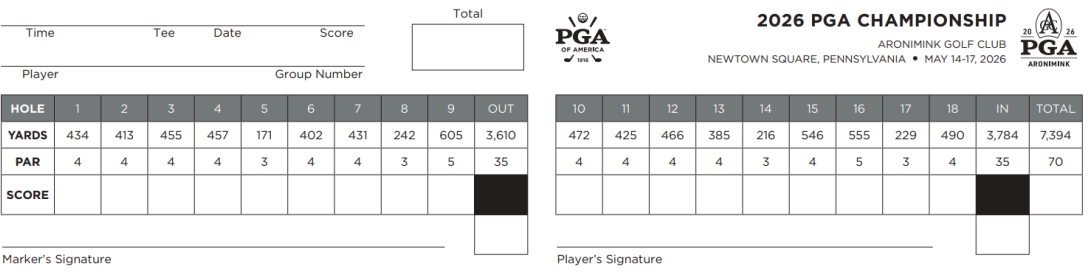
Aronimink features three lengthy par 3s, demanding par 4s, and a pair of reachable but strategic par 5s. Ross routed the course in a way that constantly changes the player’s perspective. Several holes move across slopes instead of directly uphill or downhill, creating uneven stances and forcing players to shape shots into angled fairways and elevated greens.
Though the front nine is far more scoreable than the back, it opens with a brutal sequence of par 4s that feature heavy bunkering, subtle elevation changes, and places immediate pressure on a player’s ball-striking.
The back nine is generally regarded as the stronger and more difficult side. It opens with a demanding stretch from holes 10 through 12 that many expect to play among the toughest on the course during the championship. The tenth features one of Aronimink’s most severe green complexes with water guarding the left side and sharp runoff areas surrounding the putting surface. The eleventh and twelfth continue the pressure with heavily bunkered fairways and elevated greens that punish imprecise iron play.
Ross changes tempo again at the short par 4 thirteenth, which introduces risk reward strategy into the routing. A forward tee can make the green drivable, but bunkering and out of bounds lurking near the green create volatility. The fourteenth and fifteenth immediately swing the momentum back toward survival golf. The fifteenth, stretched to 546 yards, now plays as one of the longest par 4s in major championship golf.
The routing closes with a classic major championship finish. The sixteenth is the second and final par 5 and likely the best birdie opportunity on the inward nine, though its shallow green and deep bunkering still require precision. The seventeenth is expected to become one of the defining holes of the championship. The long par 3 plays slightly downhill with water running the entire length of the left side, forcing players to choose between aggression and survival late on Sunday. The eighteenth then finishes uphill toward the clubhouse with a demanding tee shot and a large terraced green that can produce difficult final hole locations.
Most Important Stats For Success at Aronimink
*In order of importance
- SG: APP
- Proximity 100-175 yds
- SG: Par 4 (Difficult par 4s)
- DFEF
- SG: Long/Par 70 courses
- SG: Putting (Difficult)
- Scrambling/ARG Proximity (Rough/Sand)
- Bogey Avoidance (Difficult Scoring)
- Good Drive % (Difficult Approach)
- 3-Putt Avoidance
- Comp Course History
Key Rabbit Hole Filters
- Course Region: Northeast
- Scoring Conditions: Average/Difficult
- Course Length: Long
- Field Strength: Very Strong
- Par: 70
- Event Type: Major
- Field Size: Large
- Green Surface: Bent
- Greens Size: Large
- Greens Speed: Fast
- Bunker #: High
- Rough Surface: Fescue
- Rough Length: Long
- Architect: Pete Dye/Gil Hanse
- OTT Club: Mixed
- Gain APP: Difficult
- Gain ARG: Difficult
- Gain Putting: Very Difficult
- 3-Putt AVD: Difficult
- Par 3s: Difficult
- Par 4s: Difficult
Weather Forecast: Newtown Square, PA