2026 FedEx St. Jude Championship at TPC Southwind – Preview

Ron Klos

2 months ago

The top 70 golfers in the FedExCup standings will travel to Tennessee for the FedEx St. Jude Championship, the opening event of the PGA Tour’s season long FedExCup Playoffs. Set in the rolling countryside just southeast of Memphis, TPC Southwind will host a playoff event for the fifth consecutive year after previously serving as a regular Tour stop for more than three decades.
TPC Southwind is infamous for its “water balls” and has historically rewarded some of the best ball strikers in the world. Recent winners at the course include Hideki Matsuyama, Will Zalatoris, Justin Thomas, Brooks Koepka, Dustin Johnson, Abraham Ancer, and two time champion Daniel Berger. Last year’s winner, Justin Rose, also arrived in strong ball striking form, gaining 9.4 strokes ball striking across his two starts leading into the week. The course also tends to favor players with experience and comfort on Bermuda grass, particularly with firm greens and penal rough becoming more difficult to manage in the heat and humidity of the American South.
Rory McIlroy, who owns two top five finishes at TPC Southwind, gave an excellent summation of what it takes to succeed here. “If you do hit it in the rough, it’s going to be hard to control your ball from there. So first thing, you put it in the fairway and put it in play, but I think the biggest thing around here is your approach play. I think there seems to be a lot of approach shots between 140 to 170 yards, so that’s a key distance this week. If you can get your pitching wedge through 7-iron dialed in and get those working really well, I think you’ll always have a good chance around this course.”
The Field

The FedEx St. Jude Championship brings together the top 70 players in the final FedExCup standings for the first of three playoff events. There is no cut this week, but the field will be reduced considerably from here, with only the top 50 in the standings advancing to next week’s BMW Championship before the top 30 move on to the TOUR Championship in Atlanta. With a $20 million purse and 750 FedExCup points going to the winner, there is still plenty at stake, particularly for those entering the week near or outside the top 50.
The field is led by World No. 1 Scottie Scheffler, who enters the postseason atop the FedExCup standings after another dominant season. Matt Fitzpatrick, Cameron Young, Wyndham Clark, Chris Gotterup, Collin Morikawa, Si Woo Kim, Sam Burns, Tommy Fleetwood, and Ludvig Aberg round out the top 10 entering Memphis. Rory McIlroy is also back at TPC Southwind after skipping this event last season, while defending champion Justin Rose returns after defeating J.J. Spaun in a playoff here a year ago.
There was also significant movement at the bottom of the standings during the Wyndham Championship. Michael Brennan entered the week outside the playoff picture before winning at Sedgefield to jump comfortably inside the top 70, while Jackson Koivun held onto the 70th and final position. For those beginning the week outside the top 50, the situation is similar. Four guaranteed rounds at TPC Southwind provide an opportunity to make up ground, but anything short of a strong finish could bring their FedExCup season to an end.
TPC Southwind – Course History
Designed with tournament golf in mind, TPC Southwind was built in 1988 and was designed by Ron Prichard, in consultation with Tour professionals Fuzzy Zoeller and Hubert Green. Prichard is well-known in golf architecture circles as the “father of restoration”, most notably with certain Donald Ross-designed courses. Though not a restoration, it is one of the more difficult “TPC” courses played on Tour.
In 1989, the course began hosting the Federal Express St. Jude Classic just one year after it was built and would continue to do so through 2018. From 2019-2021, the course hosted the World Golf Championship (WGC) FedEx St. Jude Invitational. 2022 marked the first year TPC Southwind hosted the first round of the FedExCup Playoffs.
TPC Southwind was first renovated in 2004 to modernize the course and make it more challenging. 11 new tee boxes were added along with 125 trees and 15 new bunkers. Three of the water hazards were also enlarged. Even more changes occurred back in 2020. This time, most of the upgrades were related to adding, resizing, and re-edging numerous bunkers. There were also a few holes, such as the 3rd and the 7th, that were extended fifteen-plus yards.
The course just underwent a major renovation that started in November of 2024 and which was recently completed. It was the most extensive update in two decades, with a complete rebuild of the green complexes on 18 holes, tee boxes being resurfaced, and practice and putting greens getting a complete overhaul.
“You’ve got to crack some eggs to make an omelet, and we cracked some eggs out here,” said Nick Bisanz, Director of Agronomy for TPC Southwind. “I mean it was gross, we banged it up pretty good. We weren’t trying to fix a bad golf course, we were trying to make a good golf course better,” said Bisanz. “We just updated the surfaces, so I think you’ll see a big improvement in the quality of surfaces.”
Finish Position and Strokes Gained History at TPC Southwind (2016-2025)
This includes the average finish position and Strokes Gained per round since 2016 for each of the categories. Players are sorted by SG: Total. TPC Southwind is the 18th least predictive annual course on Tour.


Course Features

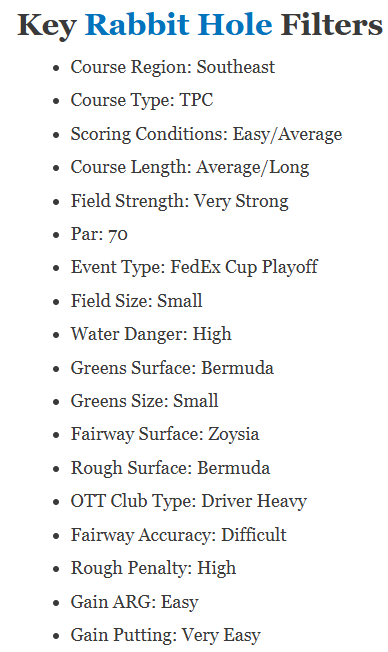
Built on the remnants of a former dairy farm, TPC Southwind is a par 70 measuring 7,288 yards. The tree lined layout features narrow, undulating Zeon Zoysia fairways that average just 28 yards wide, 3 inch Bermuda rough, and TifEagle Bermuda greens. Players who grew up in the South or have extensive experience chipping and putting on Bermuda should be comfortable with both the surfaces and the hot, humid Memphis conditions. Past contenders repeatedly reference that comfort level. Zoysia is also well suited for the local climate, which combines extreme summer heat with periods of cold weather during the winter.
Over the past five events, TPC Southwind has played to an average of approximately 1.02 strokes under par per round, putting it slightly on the easier side of Tour difficulty. Winning scores, however, have remained remarkably consistent. Since 2004, only one champion has finished outside the 9 under to 19 under range. While it is a par 70, this is not a short positional course in the mold of Harbour Town or Pebble Beach. There are eight lengthy par 4s, and the numerous doglegs can make the course play longer than its listed yardage. Recent changes added approximately 50 yards without materially changing the overall difficulty of the course.
The defining feature of TPC Southwind is water. Lakes, streams and ponds are directly in play on 11 holes, and the course annually produces more “water balls” than any other regular Tour venue. Three different holes have historically produced double bogey or worse rates above 5%, illustrating how quickly an otherwise manageable round can unravel.
Webb Simpson explained how those penalties are often connected to what happens off the tee: “You drive it in the fairway. You’re going to have a lot less chances to hit balls in the water. I think these water balls often come from guys who drive it in the rough on holes like 9 or 15, even 18, even 12. There are a lot of holes where in the rough you have a decision to make: Are you going to bring on the water and go for the green or are you going to lay up? It’s really hard to lay up from 150 yards.”

With only two par 5s, easy scoring opportunities are limited compared to most Tour courses. Par 4 scoring takes on additional importance, and the threat of bogey is considerably greater than at many of the birdie heavy venues played during the summer. Ten holes have historically carried a bogey rate of at least 17%, compared with only six producing birdies at that same rate. Even the two reachable par 5s combine for a birdie or better rate of only 43%.
The Bermuda rough is only 3 inches and does not appear especially severe, but its unpredictable lies make controlling approach shots difficult. That becomes particularly important with water and bunkers surrounding many of the greens. Missing fairways and greens consistently makes TPC Southwind considerably more difficult, while finding the water brings double bogey into play immediately. The greens compound the challenge. Even after being expanded during the renovation, they average only 4,500 square feet and are frequently protected by water or clusters of deep greenside bunkers.
TPC Southwind does not rely on dramatic elevation changes or an abundance of individually distinctive holes. Instead, the challenge remains consistent throughout the round: narrow tree lined corridors, small targets and hazards positioned around important landing areas and greens. Players need to avoid the large mistakes that water can create while still finding enough opportunities to score. Patience is important, but simply grinding out pars is rarely enough. With only two par 5s available, players must capitalize on those opportunities and identify the right par 4s to attack.
Strokes Gained Analysis
Off the Tee
While approach play receives most of the attention when discussing ball striking at TPC Southwind, performance off the tee is an underrated part of success here. The course features 12 doglegs and the seventh narrowest fairways on Tour, averaging just 28 yards wide in the primary landing zones. Water hazards, strategically placed fairway bunkers, trees, and unpredictable Bermuda rough further punish poor positioning.
Players who consistently find fairways and leave themselves favorable angles will have checked the first box toward success. As Brendon Todd explained, “It’s not overly long and it rewards accuracy. Even though I only drive it 280, I can hit the ball in the fairway and still attack the pins. So I feel like it’s a really fair course for all the different lengths we have out here and it just comes down to who’s playing well, hitting good shots and making putts.”
Similar to Sedgefield, the Bermuda rough can be difficult to predict because the grass stems tend to wrap around the ball. That can produce fliers that carry through the green or low spinning approaches that come out dead and finish well short of their target. Either way, controlling trajectory and spin becomes considerably more difficult from the rough. TPC Southwind ranks among the 10 toughest courses on Tour in both Rough Penalty and Missed Fairway Penalty, making accuracy more valuable than the relatively modest rough height would suggest. Scottie Scheffler summarized the problem: “It’s Bermuda rough. You can get flyers. You can just lose control of the ball and end up in a pretty bad spot.”
Accuracy is important, but distance still provides a meaningful advantage on the longer par 4s. As driving distances have increased across the Tour, more players have been able to challenge the corners of Southwind’s doglegs and shorten holes that were traditionally played more conservatively. Average driving distance has exceeded 297 yards over the past two years, the highest two year stretch since TPC Southwind became a PGA Tour venue. The ideal profile is therefore not simply an accurate driver, but a player with enough distance to take advantage of aggressive lines while still keeping the ball in play.
Good Drive % is another important statistic to consider, particularly performance on other courses with difficult rough. It helps identify players who can still produce a successful result after missing the fairway by either finding the green or leaving themselves in a favorable position. Over the past three years at TPC Southwind, 43 of the 48 players who finished near the top of the leaderboard gained on the field in Good Drive %, further reinforcing how important quality positioning off the tee is throughout the week.
Approach
Approach play has historically been the most important part of success at TPC Southwind. Nearly 45% of strokes gained at the course have come on approach, compared to a Tour average of approximately 35%. The combination of small greens, water hazards, greenside bunkers, and unpredictable Bermuda rough places a significant premium on iron play. That challenge increased following the green renovation, as GIR% dropped from 62% to just 58% last year.
The importance of finding fairways becomes even more apparent when looking at approach performance. Players hit the greens at a 73% rate when approaching from the fairway, but that number drops all the way to 33% following a missed fairway. The Bermuda rough makes it difficult to predict both distance and spin, and the location of the hazards often forces players to decide whether attacking the green is worth the risk. When water is involved, a poor drive can quickly turn an otherwise routine approach into a decision between taking on the hazard or playing conservatively and accepting a more difficult chance at par.
When players do find the fairway, short to middle iron play becomes especially important. Approximately 65% of approaches at TPC Southwind come from 125 to 200 yards, well above the Tour average of 56%.
Around the Green and Putting
With below average rates in both Driving Accuracy and GIR, players will inevitably be forced to rely on their short games at TPC Southwind. Brandt Snedeker explained the challenge: “You’re going to miss the greens here. The greens are very small and are tough to hit. So you have to understand you’re going to miss four, five greens a day here. That’s just the way it is. Got to be able to get it up and down.” The difficulty, however, depends heavily on where the miss finishes. Scrambling from the Bermuda rough can be challenging because of the unpredictable lies, while recovery shots from short grass and greenside bunkers have historically been among the easiest on Tour.
Putting presents a much different challenge. Nearly every major putting metric on TPC Southwind’s Bermuda greens has historically played easier than the Tour average. Three putt rates are low, while make percentages from short, middle, and longer distances are generally higher than average. The relatively small greens also leave players with fewer extremely long first putts when they do hit the putting surface.
With minimal undulation and generally manageable hole locations, these greens have not required an especially high level of putting performance compared to other Tour venues. That makes putting less of a separator and shifts more of the emphasis toward tee to green play. The players creating the most opportunities through accurate driving and strong approach play should have plenty of reasonable birdie chances without needing an outlier putting performance to contend.
Most Important Stats For Success at TPC Southwind
*In order of importance
- SG: Approach
- Total Driving – DFEF
- SG: ARG/Scrambling (Bermuda)
- Proximity: 125-200
- SG: Par 4
- Birdie or Better %
- Good Drive % (Bermuda rough)
- Bogey Avoidance
- SG: Total (Bermuda rough/greens)
- SG: Putting (Bermuda)