
2026 Austin Championship at Fazio Canyons Course

Ron Klos

2 hours ago

The PGA Tour returns to Austin, Texas for the first time since the 2023 WGC Dell Technologies Match Play, and it arrives at a course nobody in the field has played in competition. The inaugural Austin Championship presented by Compliance Solutions will be held on the Fazio Canyons Course at Omni Barton Creek Resort & Spa, a Tom Fazio design that opened in 1999 and was rebuilt under his direction in 2022. It is the first PGA event ever held on this course.
The tournament has already lived two lives before a single shot has been struck. It was announced on October 20, 2025 as the Good Good Championship, with the YouTube golf brand Good Good Golf as title sponsor in a multi year agreement. Good Good stepped away on August 27, 2026 after the backlash to a Callaway driver ad, and the Tour renamed the event the Austin Championship. Compliance Solutions, a Florida based tax and accounting firm that already sponsors a Korn Ferry Tour event in Oklahoma, was announced as presenting sponsor on November 2, 2026 on a one year deal. The purse stayed at $6 million, with $1.08 million and 500 FedExCup points to the winner.
Fazio Canyons will play to a par of 72 at 7,451 yards. The course runs through limestone canyons on the eastern edge of the Texas Hill Country, with Short Springs Branch, a limestone bedded creek, crossing or bordering a number of holes. The themes that repeatedly come up from those who have played it are large elevation changes on almost every hole, forced carries over creeks and ravines, a premium on finding the fairway from elevated tees, and a back nine that carries most of the difficulty. Robert Gogulich, first assistant and tournament director at Barton Creek Lakeside, stated, “Of the courses on property here at Barton Creek, the Fazio Canyons course is a true test. It challenges every part of your game while providing beautiful views of Hill Country scenery.”
The Field

The field for the Austin Championship does not include a single player ranked inside the top 50 of the Official World Golf Ranking. Austin Smotherman is the highest ranked player at No. 53, one of five players inside the top 60 along with Marco Penge (No. 54), Matt Wallace (No. 56), Andrew Novak (No. 58) and Jackson Koivun (No. 59). It is one of the thinnest fields of the FedExCup Fall, which makes it one of the more open events of the season.
Smotherman, Andrew Novak and Jackson Koivun are the main headliners. Smotherman won the Bank of Utah Championship and the Butterfield Bermuda Championship in consecutive starts, and Novak won the Mexico Open by five shots at 25 under on November 1. Koivun won the 3M Open in July. They are joined by other notables, including Brian Harman, Daniel Berger, Michael Kim, Max Homa, Nick Taylor, Chris Kirk, Denny McCarthy, Stephan Jaeger, Rasmus Hojgaard and 19 year old Blades Brown. As an inaugural event, there is no defending champion or list of past winners.
The local angle is the University of Texas. Five former Longhorns are in the field: Pierceson Coody, Doug Ghim, Beau Hossler, Christiaan Maas and Tommy Morrison. Maas and Morrison are two of the four sponsor exemptions, along with Miles Russell and Austin native Cole Sherwood. Casey Russell is in as the Section Champion. Morrison won the 2026 Korn Ferry Tour Route 66 Cup, a points race co-introduced by Compliance Solutions.
This is the penultimate event of the 2026 FedExCup Fall, with only the RSM Classic left after it. The top 100 in the FedExCup standings keep full status for 2027, Nos. 51 through 60 earn the Aon Next 10 spots in the first two Signature Events at Pebble Beach and Riviera, and Nos. 101 through 125 fall to conditional status. The event is 72 holes of stroke play with the standard 36 hole cut to the low 65 and ties.
Course Features
Fazio Canyons occupies roughly 210 acres of Texas Hill Country about 20 minutes west of downtown Austin, where the land sits around 800 feet above sea level and drops into limestone canyons cut by Short Springs Branch, the creek that winds through the heart of the property. The course is a par 72 at 7,451 yards, with four par 3s, ten par 4s and four par 5s. The two nines play very differently. The front is the gentler and shorter side, with larger and flatter greens, while the back holds the three hardest par 4s on the card and most of the forced carries.
Length is concentrated in the par 4s and par 3s. Six of the ten par 4s stretch to 448 yards or more, the par 3s average 212 yards with two of them at 228 and 230, and only one par 4 is short enough to tempt anyone with a driver. The par 5s all sit between 560 and 591 yards, which would be long on flat ground, but two of them play from tees high above the fairway and should be reachable in two for most of the field. The result is a course that asks for a lot of long clubs into greens while still handing out a few genuine scoring chances on the long holes.
Elevation change shapes nearly every shot. Almost every hole plays uphill or downhill, with many tees perched well above the landing area and several approaches climbing back up to greens set on ledges. The number on the card rarely matches the shot in hand, and distance control becomes the central skill of the week, with downhill tee shots playing well short of their yardage and uphill approaches playing a club or two longer. As one 2026 visitor put it, “Most holes feel like you’re either going up or down a hill, putting a premium on finding the fairway.” Players and caddies who trust their numbers over their eyes will have a meaningful edge in the first competitive rounds ever played here.
Off the tee, distance will matter more than accuracy. The fairways are generous by Tour standards, the rough is Bermuda that will be thinning toward dormancy in mid November, and the real penalties sit well off line in the ravines, out of bounds and creek rather than a few paces into the grass. Only two holes run straight from tee to green. Three are true doglegs and most of the rest set the fairway at a slant to the tee, so the correct side of the fairway opens the green while the wrong side leaves a blocked or awkward angle, and two of the par 5s ask for a zig zag route rather than a straight line.
On most holes the trouble sits on only one side, whether that is out of bounds, a ravine or the creek. A long hitter who knows which side is safe and can carry the fairway bunkers will be able to swing freely nearly all day. A drive in light rough still leaves a clean look at most of these greens, while a drive 40 yards back in the fairway leaves a long iron into an elevated target, and that trade will separate the field more than driving accuracy does.
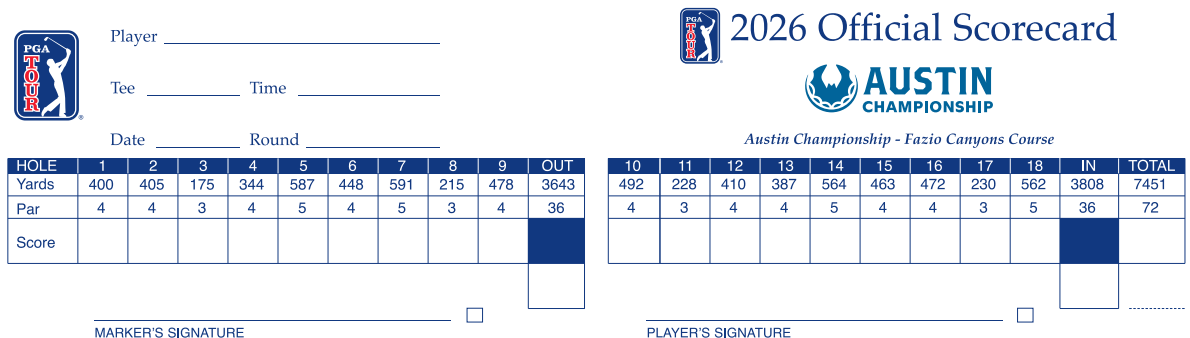
Water is in play far more often than on a typical Fazio layout. The creek cuts across two fairways, runs the full length of another on the side the fairway tilts toward, fronts one green and wraps the left side of the closing green, so four or five holes carry a real chance of a penalty shot. The course has 43 bunkers, large and steep faced in the usual Fazio style, and most of them guard greens rather than landing areas. A handful of fairway bunkers dictate the line on the longer holes, and one green is ringed by seven, but sand is far more of a factor on the approach than off the tee.
Approach play should skew long. With so many par 4s over 448 yards and par 3s averaging over 200, a large share of the week’s second shots will come from 175 to 225 yards even after the downhill tees take yardage off several drives. The 150 to 200 yard range should be the busiest overall, with the shortest par 4s and the layups into the par 5s providing the only real volume of wedges. Players who are strong with the long irons and hybrids, and who can flight the ball to a specific number when the shot is playing a club up or down from the card, will have an advantage over the pure wedge players who thrive at the Fall’s shorter venues.
Around the greens the test is short grass and sand rather than deep rough. Most of the green sites sit on natural shelves and benches, so a miss tends to run down a closely mown bank or into a bunker rather than settle in thick grass beside the putting surface. That puts a premium on bunker play and on controlling spin and trajectory from tight lies, especially when chipping back uphill to a green that falls away. The few greens with water in front or alongside turn a short miss into a drop rather than a recovery.
Putting should be one of the easier parts of the week. The greens are MiniVerde ultradwarf Bermuda, running 29 to 50 yards deep, large and gently sloped on the front nine and more tiered and contoured on the back, with enough movement to reward course knowledge but nothing that regulars describe as severe. This was built as a resort course, so the challenge is landing on the correct tier from the correct distance rather than surviving the putting surface once there. A player who stays below the hole on the back nine will have plenty of makeable looks, and the biggest putting mistakes should come from long lag putts across tiers after a missed section rather than from the surfaces themselves. In a dry November, expect them to roll quick and true.
Conditions should be firm. The fairways are 419 Bermuda at the edge of dormancy, and the Barton Creek watershed has been in exceptional drought for three years, so the course should arrive with plenty of roll in the fairways and little to stop an approach that lands past the flag. Rough height and green speed targets had not been released as of the weekend before the event.
Fazio Canyons sets up for the long, aggressive driver who is comfortable with a long iron in hand and sharp from the sand. Keeping the ball in play on the handful of holes where the creek matters, and judging distance correctly on a property where few shots play their true yardage, will decide the week more than anything on or around the greens. With no scoring history, a reasonable expectation is a winning total in the mid to high teens under par if the wind stays down.