2025 U.S. Open at Oakmont Country Club – Preview

Ron Klos

a year ago

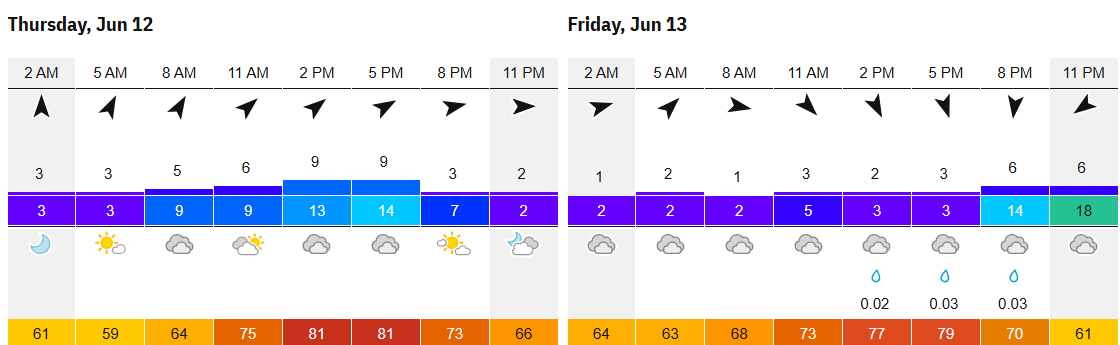
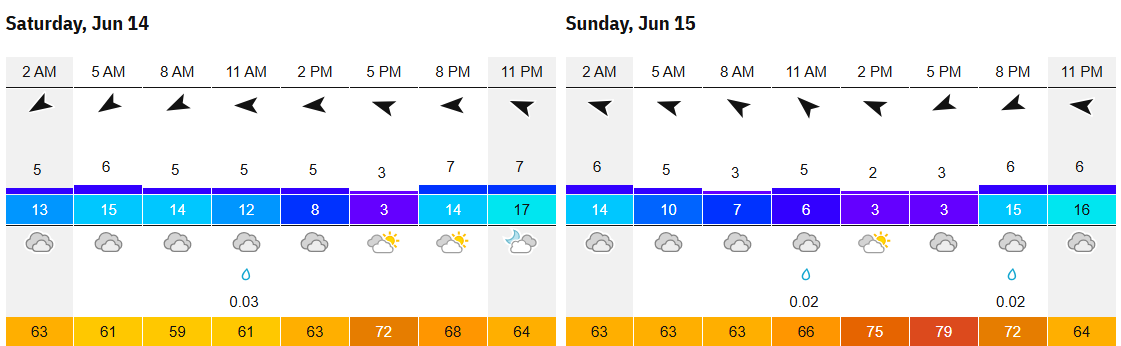
The 125th U.S. Open returns to western Pennsylvania and the legendary Oakmont Country Club for the ultimate examination of championship golf. Renowned for being one of the most difficult courses in the world, Oakmont presents a true test of skill, mental toughness, and resilience.
With its narrow fairways, deep bunkers, unforgiving rough, and lightning-fast greens, Oakmont offers little room for error. The course’s signature feature, the notorious “church pew” bunker, lies between the third and fourth fairways and will undoubtedly come into play, punishing errant tee shots. The undulating greens, among the fastest in the world, demand precision putting, as any misread or overhit putt can easily lead to a three-putt or worse.
Established 121 years ago in 1903, it’s one of the oldest and most revered courses in the United States. Oakmont is no stranger to hosting major championships. No course in America has hosted more U.S. Opens than Oakmont, with this being the club’s 10th since 1927. Several of the game’s best have won the national championship here: Ben Hogan, Jack Nicklaus, Johnny Miller, Ernie Els, and Dustin Johnson, to name a few. Eight of its nine U.S. Open champions are multiple major winners.
It has also presided over three PGA Championships, six U.S. Amateurs, two U.S. Women’s Opens, and three NCAA men’s championships. It was designated a National Historic Landmark in 1987.
Due to three inches of rain and soft conditions at the 2016 U.S. Open at Oakmont, the average score was +3.56 per round. Only four players finished under par as Dustin Johnson finished atop the leaderboard at -4, winning his first major championship. The 2007 edition at Oakmont had the highest U.S. Open average this century at +5.70, with Angel Cabrera outlasting Tiger Woods and Jim Furyk by one shot to win at +5.
“This course is really dependent on weather,” said John Lynch, President of Oakmont Country Club. “If we get wet weather, you’ve got an opportunity to go under par. If it’s dry with a little bit of wind, they’re gonna be over par.”
There have been several changes to the historic course since it last hosted the U.S. Open in 2016. It underwent an extensive renovation project led by Gil Hanse that aimed at returning the property to its original design.
In last year’s U.S. Open at Pinehurst #2, Bryson DeChambeau claimed his second U.S. Open title with a dramatic up-and-down par from a bunker on the 72nd hole to edge 2011 champion Rory McIlroy by one stroke.
The Field
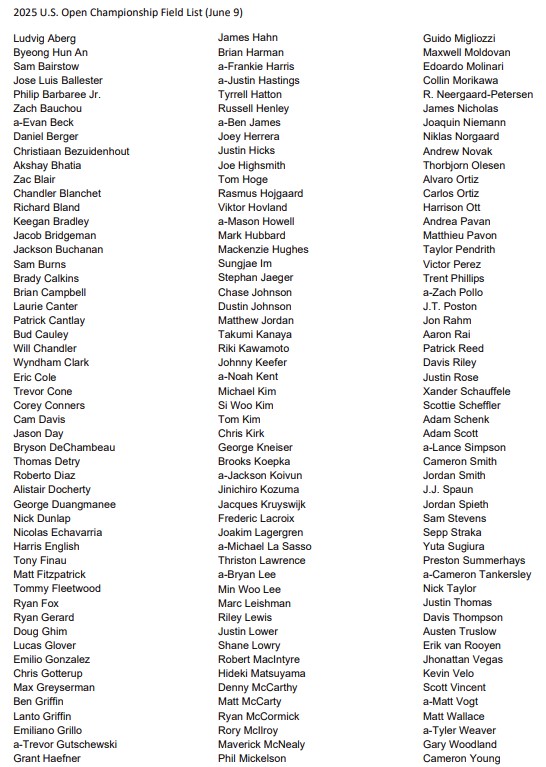
The U.S. Open Championship represents the essence of meritocracy in professional sports. Any professional or amateur with a 0.4 handicap index or lower can sign up to compete for a spot in the tournament. “Golf’s Longest Day” once again witnessed high drama as amateurs, first-time qualifiers, past major winners, a 17-year-old high schooler, and even a dentist competed to earn their way to Oakmont.
This year, the USGA accepted a record 10,202 entries. While several players qualified for the U.S. Open via various exemption categories, others chased a spot at Oakmont via two stages of qualifying. Local Qualifying (18 holes) was contested across 110 sites in late April and early May. Players who advanced from the local stage competed at Final Qualifying (36 holes in one day), which was contested across May 19 (three sites) and June 2 (10 sites).
Anyone in the top 60 of the OWGR automatically earned a spot in the field. Overall, 74 of the top 80 players in the world rankings will be in attendance at Oakmont. Headlining the field is the unquestioned No. 1 player in the world, coming off his third career major victory at the PGA Championship, Scottie Scheffler.
While Scheffler and world No. 2 Rory McIlroy are chasing multiple majors this season, they arrive at Oakmont going in different directions. After having won the PGA, Scheffler followed that by winning the Memorial two weeks ago. McIlroy, on the other hand, finished 47th at the PGA and last week posted a +9 score to miss the cut at the RBC Canadian Open.
Other elite players in the field, many of whom are lacking in recent tournament wins and who are also in mediocre form, include Xander Schauffele, Viktor Hovland, Collin Morikawa, Ludvig Aberg, Justin Thomas, Patrick Cantlay, Hideki Matsuyama, Russell Henley, and Tommy Fleetwood.
With McIlroy appearing disinterested since his Masters victory, Scheffler’s main challenger is LIV golfer and defending U.S. Open champion, Bryson DeChambeau, who has five top-6 finishes in his last six major appearances.
After 12 LIV golfers competed in The Masters and 16 made their way to Quail Hollow for the PGA Championship, 14 players from the PIF-backed circuit will travel to Oakmont. Other LIV players in the field are Jon Rahm, Brooks Koepka, Phil Mickelson, Dustin Johnson, Cameron Smith, Joaquin Niemann, Tyrrell Hatton, Patrick Reed, Richard Bland, Carlos Ortiz, Marc Leishman, Jinichiro Kozuma, and the newly signed Josele Ballester.
The U.S. Open is a four-round, 72-hole stroke-play championship, with a cut after 36 holes. The top 60 players and ties make the cut.
Oakmont Country Club – History
As one of the most respected designs in the history of course architecture, it’s a unique twist that Oakmont was the only layout ever created by Henry Fownes. With a crew of 150 men and a little under two dozen mule teams, the course was hand-dug on old farmland by Fownes and his team in just over a year. Fownes designed Oakmont as an expansive “playing field” with a links-like aesthetic, set in the heart of the countryside. Straddling the Allegheny River Valley, Oakmont first opened in 1903, playing to 6,406 yards as a par 80. Fownes famously said, “A shot poorly played should be a shot irrevocably lost.”
Legend says Fownes stood on the clubhouse porch every day watching the action, taking notes as golf balls slid and rolled and bounced throughout the hilly terrain. Anytime a golfer hit a quality shot without any trouble, he had greenskeepers install sand traps in those very spots where balls landed, eventually creating 300-plus bunkers along the 191-acre track.
William Fownes (Henry’s son) played a huge role in the evolution of the course, consistently making adjustments. He elevated the course’s difficulty significantly by adding around 200 bunkers—including the now-iconic Church Pews—carving out the deep, grass-lined ditches, and pushing green speeds to unprecedented levels for that era.
Around 1950, the club launched a “beautification” process that ultimately involved planting more than 5,000 trees. Over the following decades, the once open farmland on which the course was built transformed into a landscape of narrow, tree-lined corridors. In the 1990s, Oakmont undertook an ambitious tree-removal initiative, gradually restoring the course’s expansive, open character.
During a restoration in 2007 by Tom Fazio, more than 5,000 additional trees were removed to provide better agronomics and restore the course to the original intentions of Fownes. It also offered breathtaking views of the entire layout from the clubhouse. Today, almost no trees remain standing in the interior of the course.
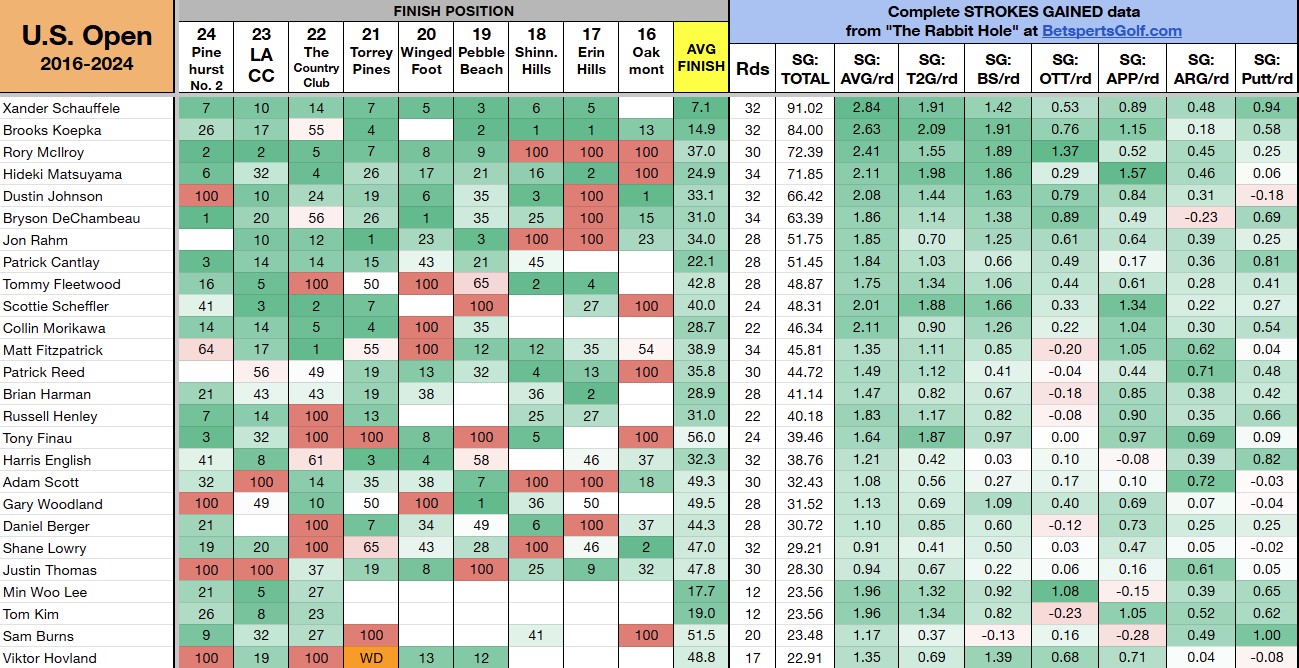
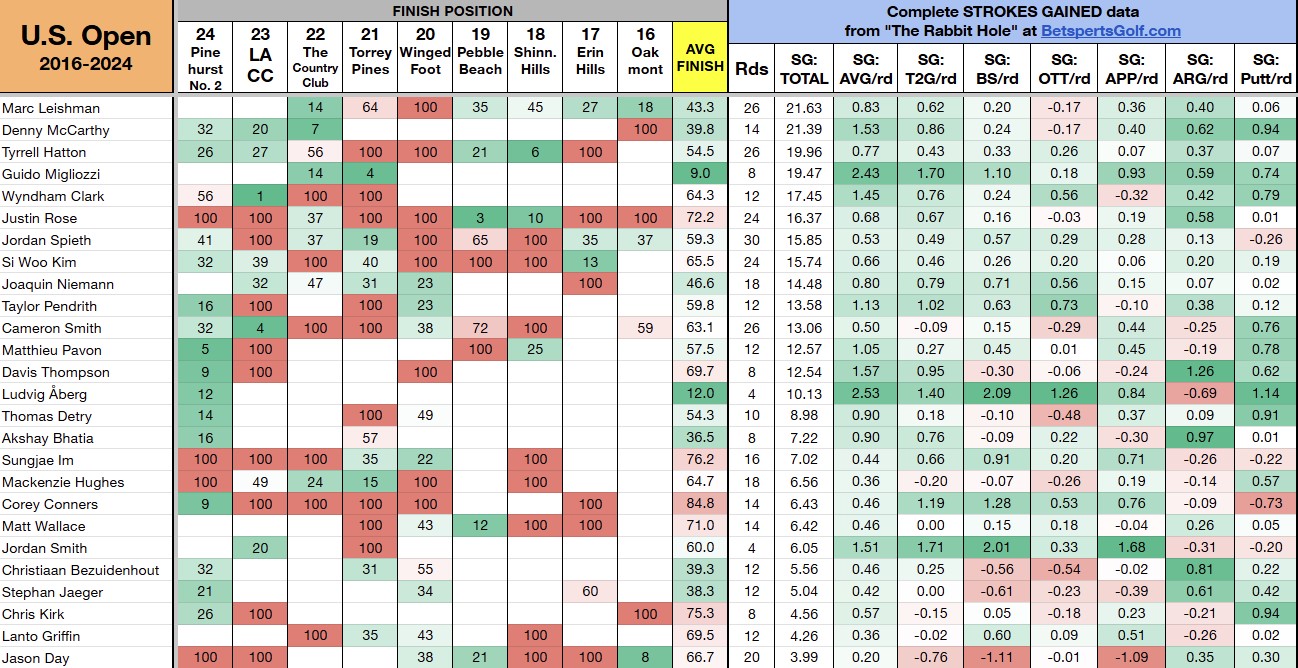
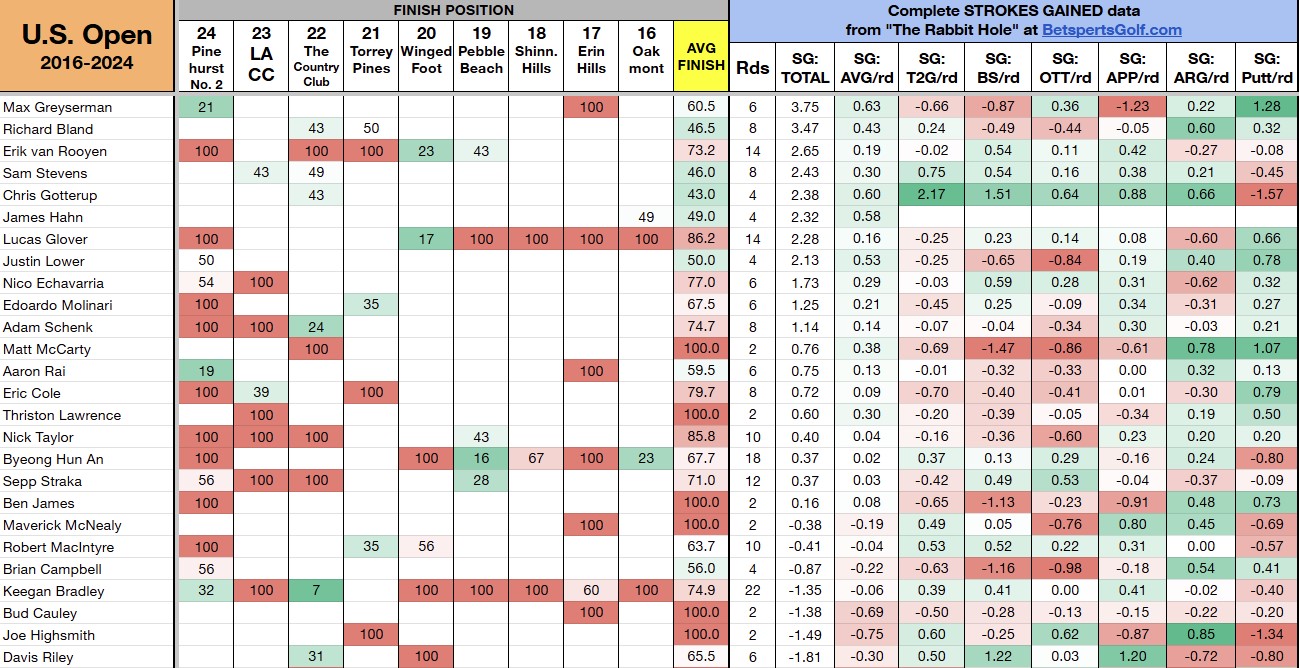
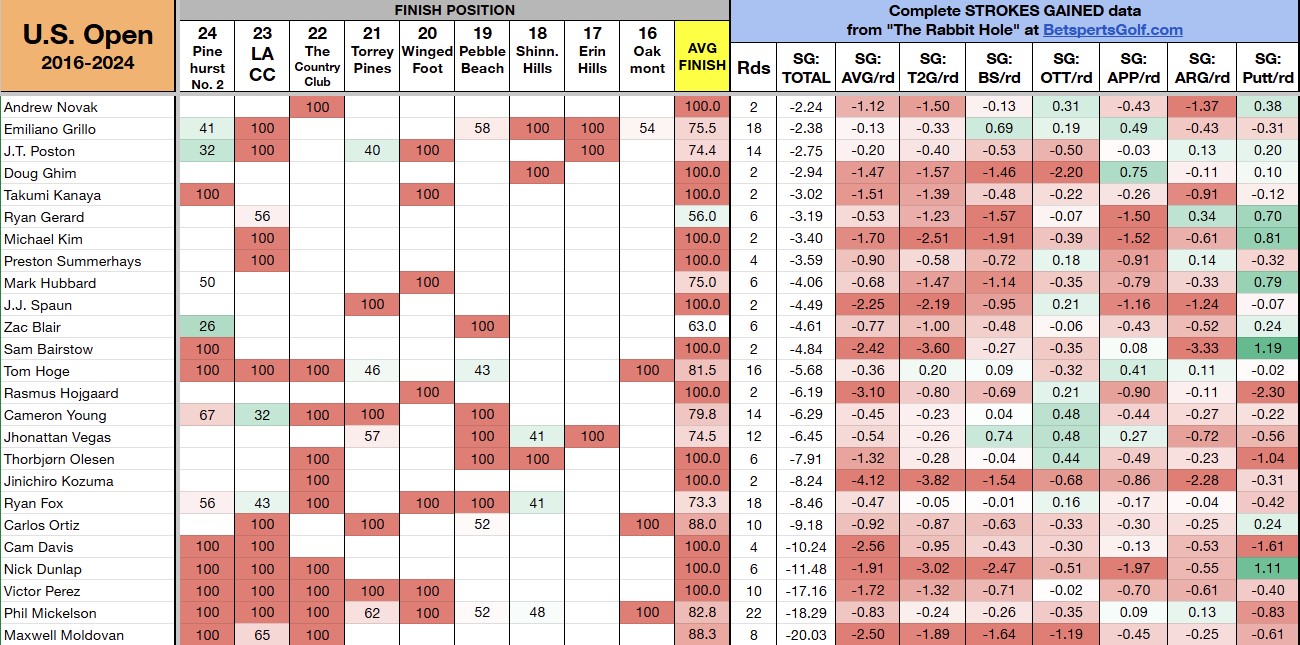
Finish Position and Strokes Gained History at the U.S. Open (2016-2024)
Course Changes Since 2016
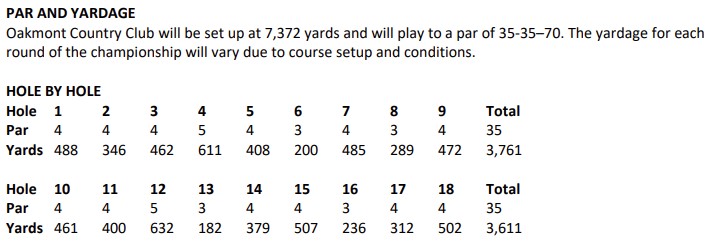
At this year’s 125th U.S. Open, participants and fans will see a different Oakmont than the one last held in 2016. The course has been lengthened from 7,219 yards to 7,372 yards. While the tree-removal process has been ongoing for the last 30 years, course architect Gil Hanse was brought in to restore the bunkers. During his research, he noticed older photos showing more extensive green surfaces.
Along with revamping the course’s bunkers, Hanse added more than 24,000 square feet of green surface and was able to add more pin locations that have never been used before. “They’ve added some new cross bunkers to give the guys something to think about. The new changes are a better challenge for the modern game and how far these players can hit the golf ball,” USGA senior director of championship agronomy Darin Bevard said.
One of the new pin options the expanded greens give the USGA is on the 182-yard, par-3 13th hole. Pin placement previously was limited to the left side of the green, with little wiggle room in terms of yardage. Now there are various options, including a back-right pin that sits in the middle of a bowl, rewarding a good shot but almost inaccessible from other portions of the green, particularly the front right.
Said Hanse about the biggest changes that players will notice compared to 2016 at Oakmont, “The edges of the greens now are more like tabletops as opposed to having build-up along the edges. I think they are going to feel a little bit more difficult to hit into.”
Hanse also rebuilt every hazard, specifically the numerous ditches that traverse certain holes. Said Brevard, “I enjoy the restoration of the ditches to run through the fairways. It is a really nice look. There are no water hazards out there or penalty areas. These ditches run through, and they are well-positioned. If you do not hit a precise shot, and if you get into one of them, it is going to be a battle.” These ditches will pose a greater hazard for this U.S. Open compared to 2016.
As John Bodenhamer, USGA chief championships officer, said with a hint of pleasure: “In 2016, we carved out those ditches to where players could get in there and play. This year we’re not doing that. You hit it in those ditches, good luck. There might be some that will play out of it, but it’ll be 12 to 18 inches of wispy, pesky stuff, and they’re nasty.”
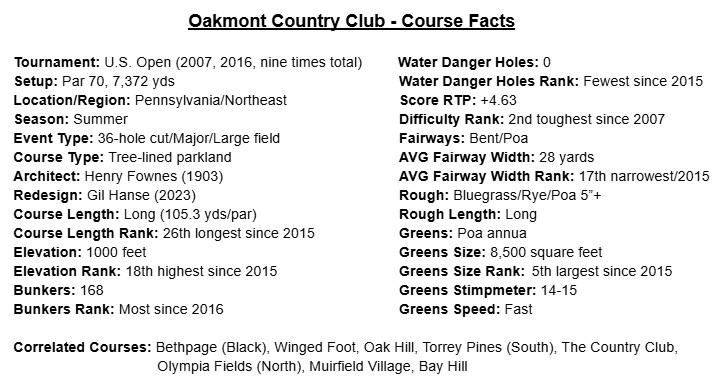
Course Features
The Most Difficult Test
For over a century, the essential elements that make Oakmont the most challenging and consistently demanding U.S. Open venue have remained unchanged: its famously treacherous greens that slope like tilted basketball courts, coffin-like fairway bunkers that are equivalent to a penalty shot, and club-twisting rough that is five inches deep. Throw in 150 yards of added length for this year’s tournament, and if conditions remain firm, the stage is set for potentially one of the most difficult scoring majors in history. The scoring average at Oakmont from the last two championships here (2007, 2016) is +4.63 per round, the highest of any course this century.
Oakmont presents a challenge that is infinitely interesting and challenging at the same time. What Henry Fownes wanted was a true “man versus course” struggle. The goal has always been the most difficult bunkers, fairways that ran out into the rough, and the fastest and firmest greens. One of the things that makes Oakmont unique, even among other difficult courses, is that most of the holes do not offer a location for a “good miss”.
Said Jeff Hall, Director of Rules and Open Championships for the USGA, “We can make any golf course difficult. That’s not hard to do, but is it difficult for the right reasons? Are we differentiating good golf, great golf, and average golf? And that’s really what our job is as a setup team. If good shots and bad shots are finishing in the same place, we haven’t done our job properly.”
Scott Langley, the USGA’s senior director of player relations, thinks Oakmont remains one of the stiffest tests because it lacks the kind of shot options that other recent U.S. Open courses like Pinehurst No. 2 or Los Angeles Country Club provided. “You have strategic width and can play the angles more,” Langley said. “There are spots here where you do that. But by and large, Oakmont is you hit a good shot or you don’t. And if you don’t, the penalty is pretty uniform.”
You hit a good shot, you get rewarded for it here”, said 2015 U.S. Open winner Jordan Spieth. “And if you don’t, you’re in big trouble. It’s pure golf, no funny business about it.”
2006 U.S. Open winner, Geoff Ogilvy, remarked, “It’s just so relentless, but it’s such a beautiful place. Even though they’re hard, they’re fun shots to hit. Every hole is totally different from every other hole, but every hole feels like Oakmont. The breathers come depending on where the tees and pins are. Anything other than a driver into a narrow fairway and a long iron in feels like a relative breather.”
Oakmont is very democratic in its difficulty. No specific type of player has a distinct advantage. Power hitters will have an edge in getting out of the rough and getting their approach shot closer to the green from fairway bunkers. While shorter, more accurate hitters won’t have to contend with the hazards as frequently, they can make up for a lack of length by using the ground game to run the ball up onto the greens.
The closing stretch of holes 15-18 may very well decide the championship on Sunday afternoon. Yardage was added to each hole except No. 17. On that hole, however, the previous bailout area at the front left of the green has been mostly eliminated. Said Ogilvy, “If you par the last four holes to win the tournament, you’ve earned your U.S. Open.”
The Topography of the Land
Though not an exceptionally long course, because of the absence of trees, the scale of the landscape is massive. The size of the features is also taken to the extreme. At 8,500 square feet on average, the greens are the fifth-largest in any tournament played since 2015. Oakmont also has more bunkers (168) than any other course. The elevation changes are also dramatic and constantly challenge players’ ability to find the right yardage.
Considering the speed and firmness of the greens, having spin control on approach shots is crucial. “Flight matters, spin matters, and where you land it matters”, said Ogilvy. “Add in the complication that you rarely have a flat stance, and that’s another reason why it’s such a great championship venue.”
The land upon which Oakmont lies includes two prominent ridges that descend into a central basin, now occupied by the Pennsylvania Turnpike, which bisects the course, separating holes 2-8 from the rest of the layout. The speedy fairways stretch across the hillsides, requiring players to shape their shots carefully to avoid having the ball roll into troublesome spots.
Oakmont displays certain links-style qualities with a layout that follows the natural contours of the terrain as if the holes are draped seamlessly across the landscape. On numerous holes, the terrain of the land can be used to feed balls into the greens. The first hole perfectly illustrates this, with a fairway that slopes downhill and flows effortlessly into a similarly sloped green.
“The routing is incredible”, said Ogilvy. “Holes have no consistent pattern and go in different directions. And they never follow straight down the hill or straight across it. There’s always some sort of angle.” There are also numerous blind tee shots and approaches that players must contend with.
One of the most underrated parts of Oakmont is how the topography forces drives to be placed to the proper side of the fairway. Players will be challenged off the tee by not only the sloped fairways but also the staggered bunkering on both sides. Because the slopes are constantly pushing drives to one side or the other, they will have to decide how much they want to challenge the bunkers on the left to avoid the ones on the right.
The Rough
While Oakmont’s bunkers and greens steal much of the spotlight, the rough might be the biggest menace of them all. The USGA has announced that the rough will be topped off at five inches to start the week and will not be cut again. Additionally, the recent trend of using graduated rough with a shorter, less penal first cut near the fairway to reward players who miss by just a yard or two—will not be used this year.
The rough is so thick and varied in certain spots that getting out is completely unpredictable. This will create some high drama when trying to scramble from around the green, as chipping onto the lightning-fast surfaces from poor lies is sure to create some nightmare scenarios.

Though fairways average around 28 yards wide, many are much narrower. Because landing areas are so tight, the course plays much longer than its scorecard distance. It’s an absolute necessity that golfers keep their ball in the fairway to avoid the wrist-breaking rough and deep bunkers that swallow errant tee shots. “You have to drive the ball in the fairway,” said 2019 U.S. Open winner Gary Woodland. “The rough is unplayable, and you are pretty much pitching out. If you can keep the ball in the fairways, you can make pars.”
This is why a majority of players will only use driver between 4-8 times per round, opting for more control with long irons and fairway woods. Though length is always a benefit, accuracy off the tee will be rewarded much more this week.
The Seemingly Endless Bunkers
When the world’s best golfers tee off at Oakmont, they will be welcomed by 168 bunkers, an average of more than nine per hole. While the famed “Church Pew” bunkers receive most of the acclaim, every bunker at Oakmont is unique, penal, and designed with a purpose. “You have to dodge the bunkers at all costs,” said Joe Highsmith, who played the 2021 U.S. Amateur at Oakmont. “If you have to go on another hole, then so be it.”
Awkward lies and positioning in dozens of fairway and greenside bunkers will force players to revert to hitting out sideways or backward to avoid striking the face. “You just can’t be aggressive,” said local amateur champion Darin Kowalski. “When you are in those bunkers, if you have any question whether the ball will hit the lip or not, my experience is that there is an 80% chance it will. The vast majority of time, I take my medicine and wedge out to the fairway.”
While contestants will know where all the bunkers are located, they won’t be able to see many of them from the tee or even from the fairway. And the bunkers they can’t see are some of the deepest, most penalizing bunkers on the course.
Placed between the fairways on Nos. 3 and 4, the “Church Pews” are 108 yards long and 43 yards wide, and filled with more than 26,000 square feet of sand. It’s the kind of hazard that fans love to watch, but players dread finding themselves in. At 100 yards in length, the “Sahara” bunker runs along the left of the No. 8 green, adding difficulty to the longest par 3 in U.S. Open history. Players looking to chase a ball onto the green will need precision—otherwise, they’ll find themselves stranded in this sandy wasteland.
Though not as long as the “Church Pews”, the “Piano Keys” are similar in style and structure and can be just as fierce with eight grassy mounds inside a long bunker. Sitting along the left side of the 15th fairway, they are a well-placed hazard in the driving zone. As its name indicates, the “Big Mouth” bunker is quite deep and known to swallow tee shots that sail toward a drivable green on the short par-4. It sits short and right of the 17th green, and is so cavernous that players are unable to see the hole when standing in it.
The Toughest Greens in the World
Most course experts agree that the greatest part of Oakmont’s design is the green complexes, and particularly how you have to hit approach shots into them. All are original save for the 8th, which was moved several yards to the left to make way for the Pennsylvania Turnpike in the late 1940s. Fownes let the terrain on each hole decide the style and size of the green. Some have extreme tilt while others are simply massive in size. Many are uniquely sloped from front to back. Each is endlessly fascinating.
They are large, extremely fast, and showcase strong natural sloping and pronounced undulations. The USGA said they will play around a 14.5 on the stimpmeter, which is faster than any other tournament course. The speed affects so many other areas of play. You think about it on approach shots, it terrifies you on downhill putts, and chipping around the greens suddenly becomes exponentially harder.
“The greens are the No. 1 defense on the course,” grounds superintendent Mike McCormick said. “Oakmont, in today’s world, it’s not a crazy-long golf course. There are several holes out here the players will be hitting wedges into, and it puts even more of an emphasis on the greens.”
“The real skill here is being creative into the greens,” remarked Justin Rose, who missed the cut here in 2016. “Sometimes using the contours to your advantage, and other times simply not getting on the wrong side of those contours and just giving yourself uphill putts. You just can’t short-side yourself here.”
Said Ogilvy, “On greens that are traditionally the fastest in the world, it asks you to hit links-like shots. Where you have to aim and then land the ball, it’s hard for your imagination to capture. You can have pitch shots that you need to land 45 feet right of the hole. We just don’t see that very often.”
Putting is so difficult that Arnold Palmer remarked, “You can hit 72 greens [in regulation] at Oakmont and not come close to winning.” Lee Trevino claimed that every time he two-putted at Oakmont, he knew he was passing somebody on the leader board. As for a golfer’s strategy, Ogilvy quipped, “They are the type of greens where you say, ‘I want to hole this, but if I don’t, how do I best have two putts max?'” These greens are so extreme that if you don’t have that thought process, you will end up off the green, scrambling to four-putt.
“They are by far the most difficult greens I’ve ever played,” exhaled Tiger Woods at the 2007 U.S. Open. “I thought Winged Foot was pretty tough. Augusta is pretty tough. But both courses have flat spots. Here, I’m trying to figure out where a flat shelf is.”
Most Important Stats For Success at Oakmont
*In order of importance
- Distance From Edge of Fairway/Driving Accuracy
- 3-Putt Avoidance/25+ feet (Difficult/Large Greens)
- SG: Approach/GIR (Very Difficult Approach)
- SG: Total (Very Difficult Scoring Conditions)
- Scrambling (Long Rough)
- SG: Putting (Fast Greens)
- Driving Distance
- Bogey Avoidance (Very Difficult Scoring Conditions)
- ARG Proximity (Difficult ARG)
- Par 4 BoB% (Difficult Par 4s)
Key Rabbit Hole Filters
- Course Region: Northeast
- Scoring Conditions: Very Difficult
- Course Length: Long
- Field Strength: Very Strong
- Par: 70
- Event Type: Major
- Green Surface: Poa
- Green Speed: Fast
- Green Size: Large
- Missed Fairway Penalty: High
- Rough Penalty: High
- Gain OTT: Very Difficult
- Gain APP: Very Difficult
- Gain ARG: Very Difficult
- Gain Putting: Very Difficult
- 3-Putt AVD: Difficult
- Par 4s: Difficult
Weather Forecast – Oakmont, Pennsylvania