2025 TOUR Championship at East Lake Golf Club – Preview

Ron Klos

a year ago

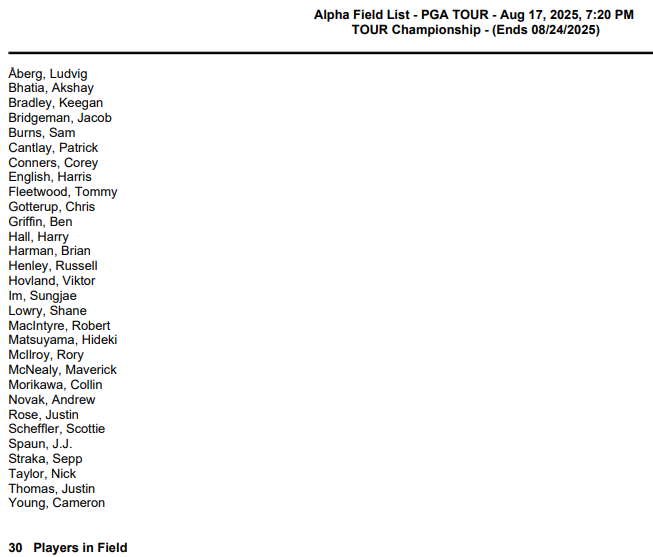
The PGA Tour’s 2025 regular season will conclude at East Lake Golf Club in Atlanta, Georgia, with the finale of the FedExCup Playoffs. The top 30 golfers in the FedExCup standings will compete for $40 million, with $10 million to the winner.
There is one major change to this year’s tournament. The Tour eliminated the controversial starting-strokes format from the Tour Championship in its latest attempt to make its season-ending tournament more compelling and climactic. All 30 players in the field will start at even par in a stroke-play tournament. The winner after 72 holes will capture the FedEx Cup and collect a bonus and five-year PGA Tour exemption.
The oldest golf course in Atlanta, East Lake, is an urban track that was the home course of the legendary golfer Bobby Jones. It has recently undergone a complete restoration under the guidance of noted architect Andrew Green. Even with substantial changes that emphasize its classical characteristics, East Lake remains a lush parkland layout with narrow fairways, difficult Bermuda rough, uneven lies, and fast greens.
With numerous holes presenting strategic choices, the course is regarded as a classic ‘risk-reward’ layout. It consistently ranks among the more demanding venues on Tour, where birdie opportunities are limited and scoring is at a premium. It has been the permanent home of the Tour Championship since 2004, and it has been held at East Lake 23 times since 1998.
Success at East Lake still hinges on avoiding the punishing Bermuda rough, which makes controlling approach shots far more difficult. However, the recent expansion of hole locations and the addition of short-grass collection areas place greater emphasis on short-game specialists, as players will face a wider variety of shots both into and around the greens.
East Lake Golf Club – Course History
East Lake’s proud history dates back well before it began hosting the PGA Tour Championship. With Burton Smith at the helm, a group of 65 men formed the Atlanta Athletic Club in 1898. The club initially did not have a golf course, but four years after it was founded, it had more than 700 members. The club leaders soon realized the increased interest in golf, and in 1904, acquired some property in the “suburbs” of Atlanta to create a country club. They approached architect Tom Bendelow to lay out the course.
The grand opening of the Bendelow course took place on July 4, 1908, on the property known as East Lake. The course, a sparkling stretch of water surrounded by forestland, was originally the site of an amusement park in the 1890s. In 1913, famed golf course architect Donald Ross redesigned the Bendelow course at East Lake. The remodeled course featured a routing plan that allowed each of the nine holes to conclude at the clubhouse.
After the Ross rebuild, the course remained untouched until some changes were made before the 1963 Ryder Cup. Not long after the United States team destroyed Europe in that event, the neighborhood surrounding East Lake began to deteriorate and the course fell into disarray and was mostly forgotten. Fast forward to 1993 when the property was purchased by the East Lake Foundation and the job began to restore the course as a tribute to Bobby Jones.
In 1994, famed architect Rees Jones completed a restoration of Donald Ross’s original layout. Rees would go on to renovate the course again in 2008 and 2016. It has been the permanent home of the Tour Championship since 2004 and is the culminating event of the PGA Tour playoffs.
2023-2024 Renovation
In the latter half of 2023, architect Andrew Green was brought in to do a complete restoration of the course. The goal was to recapture the feel of the golden age of East Lake and to return the course to a version that better embodied the design Donald Ross left behind. The course underwent a complete overhaul: hundreds of trees were removed, every inch of turf was replanted, and all 18 greens were fully redesigned.
Said Green before last year’s Tour Championship, “Nothing is the same, not a single golf shot on the property.” After doing a deep dive into the history of the course, Green relied on a rare aerial photo from 1949 as his blueprint.
Greens were planted with TifEagle Bermuda (replacing Mini-Verde) and sit lower and are larger. They also feature expanded perimeter options for new hole locations. In addition to refurbished bunkers and greens, Green recontoured the fairways to create more movement and slide. In dry conditions, they’ll run faster with the switch to Zorro Zoysia. Tees were also adjusted to emphasize more shot shaping.
“I will feel it’s a success if we see a variety of shots played by the champion,” Green said. “Not only different clubs off the tees, but around the greens being able to get up and down from not only the traditional heavy Bermuda grass rough but also the (new) short grass areas. The bunkers aren’t nearly as deep as they were before but I still think there is a lot of challenge there.”
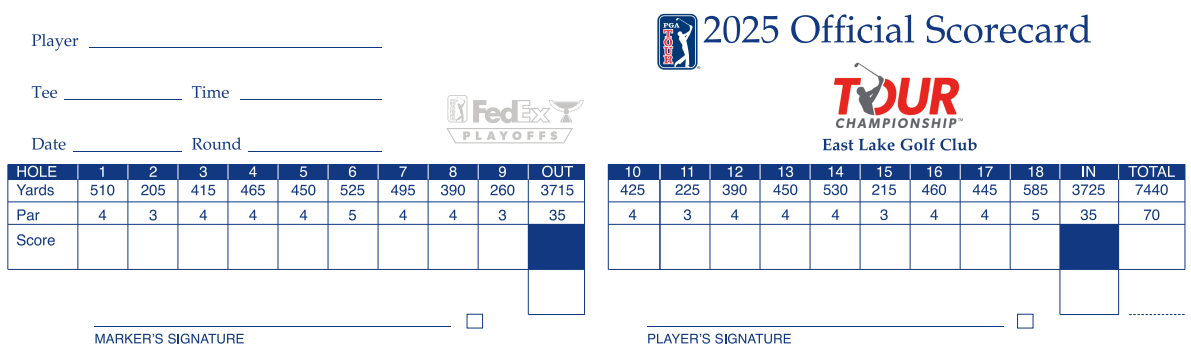
After a one-year experiment playing East Lake’s 14th hole as a par 5, the hole will will return to a par 4 for this week’s championship. Last year, No. 14, at 580 yards on the card, played as the easiest hole for the week with a 4.33 scoring average. For this year’s Tour Championship, the hole will play 50 yards shorter (530 yards), similar to how it played in 2023 as a par 4.
Course Features
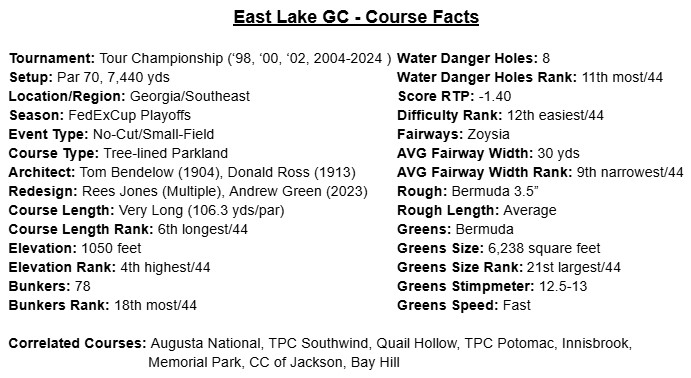
Playing as a par-70 with a distance of 7,440 yards with only two par-5s, East Lake is a brute of a course. It measures as the 6th-longest course in the Tour rotation. Typically, a par-72 layout for members, the 1st and 14th holes are converted from par-5s to long par-4s, which adds to the challenge. Built on gently rolling hills, there are numerous elevation changes and uneven lies. The front and back nines start off playing uphill at the lake. Except for four holes, the routing is east-to-west with holes typically playing either into the wind or downwind.
One of the most consistent themes from players when talking about East Lake is how the course is all right in front of you. There aren’t any doglegs, tricks, or quirks. While it is tree-lined, it is open enough in most directions to view other parts of the course. Along with its length, the course will challenge players in other ways as well. Before fairways were slightly widened last year, it was known for having some of the tightest fairways on Tour. This year, they will average around 30 yards wide.
Water hazards influence play on eight holes, simultaneously enhancing the course’s visual appeal and raising its degree of difficulty. Historically, before 2021, winning scores (excluding the staggered-start format) ranged from –7 to –13. In contrast, the past three years have seen East Lake play noticeably easier, averaging -1.90 strokes to par per round, highlighted by the 2022 event on a softened layout, which ranked as the easiest on record at –2.09.
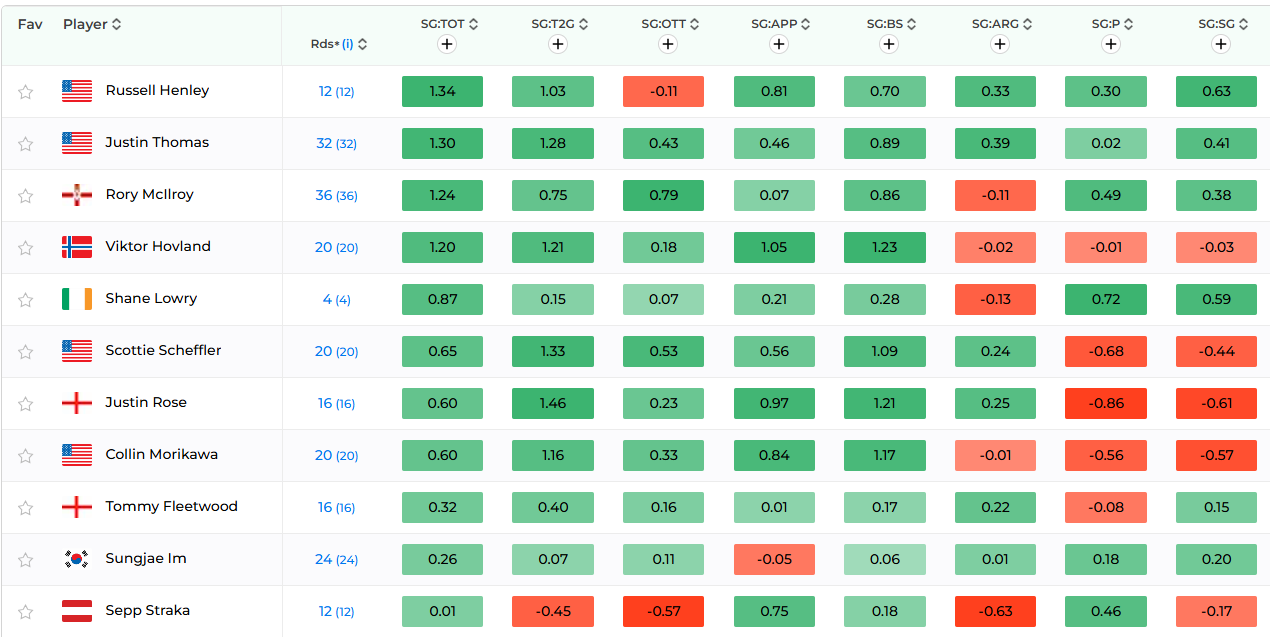
Based on data since last year’s tournament and the 2023 course changes, players found it comparatively easier to gain strokes off the tee and on the greens, while strokes gained on approach and around the green proved more difficult than the historical averages at East Lake.
Warm-weather grasses dominate the course as the fairways are Zoysia, and the greens and rough are Bermuda turf. This year’s rough length has been increased by one inch, as players who can’t keep the ball straight on their tee shots will have to deal with tricky 3.5″ Bermuda rough. Bermuda at that length is one of the most penal on Tour due to its unpredictability and tendency to wrap around the ball.
As part of one of his most recent renovations, Rees Jones redesigned the greens and bunkers to more closely resemble Ross’s original design. The greens sit elevated above the surrounding bunkers and feature challenging slopes that test players on both approach and putting. When firm, they can become particularly quick, typically rolling between 12.5 and 13 on the Stimpmeter.
Each of the four par-3s measures over 197 yards and has the second-longest average out of any group on Tour. The par-5s are reachable in two shots and, along with the par-3s, provide plenty of risk/reward opportunities. The two par-5s average a combined -0.54 under par are must-birdie holes. It is the par-4s, nine of which are over 440 yards, that make East Lake a brute of a course. Those holes average 4.07, with five of them featuring a bogey or worse rate of at least 18%.
The course itself starts underwhelmingly, with the first four holes being rather nondescript. Once past that early section, the course provides an exciting mix of challenging and easy holes. The last six holes provide a challenging closing stretch. The highlights include the island par-3 15th hole that brings a double bogey into the equation on errant approaches off the tee. The 18th is a long par-5 that usually has the tees moved up on Sunday to entice players to be aggressive on their approach.
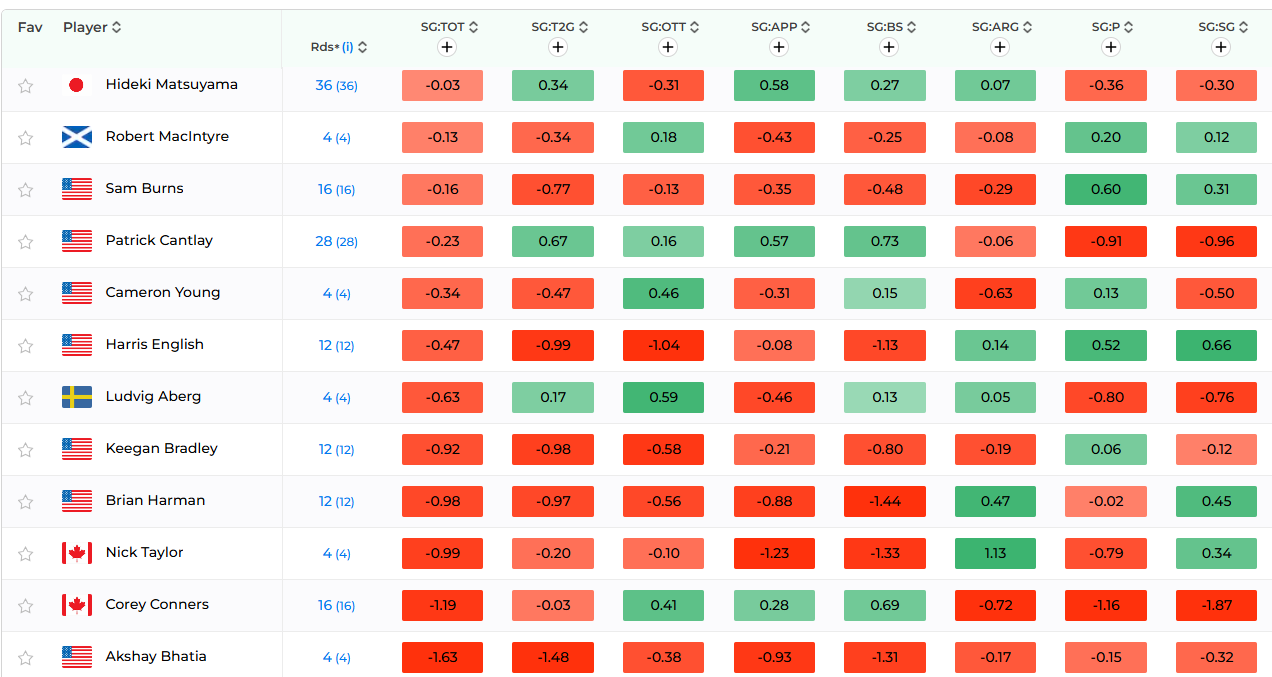
Most Important Stats For Success at East Lake GC
*In order of importance
- Total Driving
- DFEF
- SG: Approach
- Proximity: 200+
- SG: Par 4
- Driving Distance
- Good Drive % (Bermuda Rough)
- Birdie or Better %
- SG: Putting (Bermuda)
- Bogey Avoidance
Tour Championship Key Rabbit Hole Filters
- Course Region: Southeast
- Scoring Conditions: Average
- Course Length: Very Long
- Field Strength: Very Strong
- Par: 70
- Event Type: No Cut
- Event Season: Playoffs
- Field Size: Small Field
- Course Architect: Donald Ross
- Greens Surface: Bermuda
- Rough Surface: Bermuda
- Rough Length: Long
- OTT Club Type: Driver Heavy
- Gain OTT: Easy
- Gain Approach: Difficult
- Gain ARG: Difficult
- Gain Putting: Easy
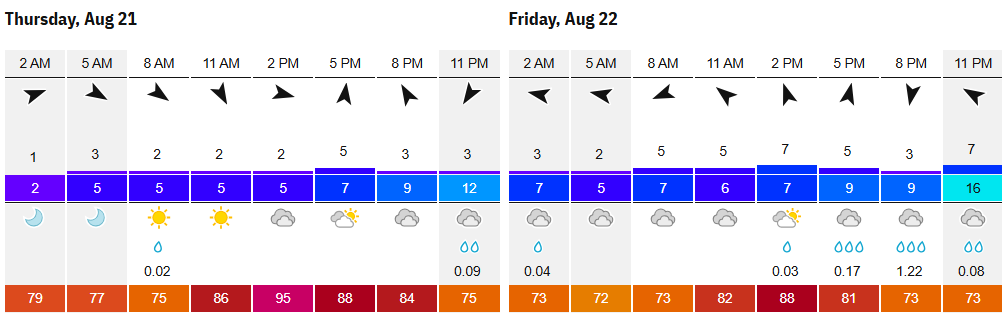
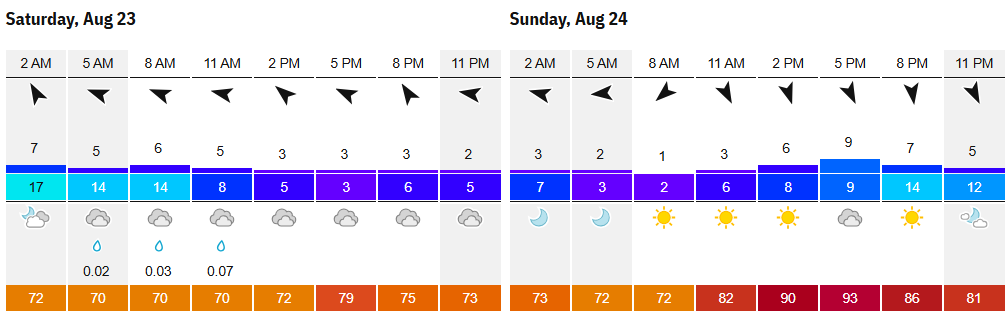
Weather Forecast – Atlanta, GA