
2025 Procore Championship at Silverado Resort – Preview

Ron Klos

a year ago
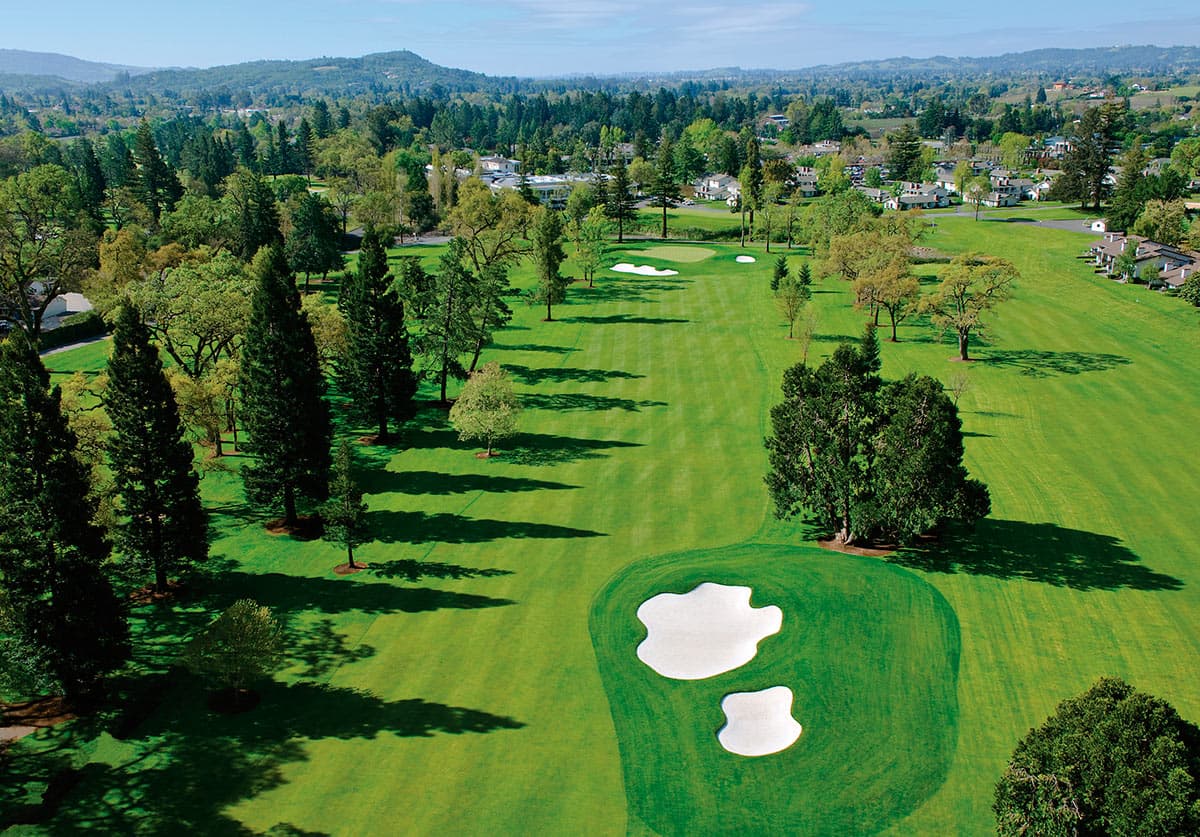
Surrounded by the golden hills of the Napa Valley, the fall portion of the season begins out west with the Procore Championship (formerly the Fortinet Championship). Played on the North course at the 1,200-acre property known as the Silverado Resort and Spa, this will be the 12th year for the resort to host this event.
The North course at Silverado is one of the shortest on Tour and features extremely narrow tree-lined fairways, few hazards, non-penal rough, and tricky sloping greens. It is a very straightforward and scoreable course with a winning score that has averaged 17 under par since 2014.
The Procore Championship will double as a Ryder Cup tune-up, with 10 of the 12 U.S. team members in the field. As the opening event of the PGA Tour’s fall schedule, it boasts a strong lineup largely due to captain Keegan Bradley, who encouraged his players to head to Napa, California, as preparation for this month’s matches at Bethpage Black outside New York City.
The Field

The field at the Procore Championship will be headlined by world No. 1 Scottie Scheffler and include Sam Burns, Patrick Cantlay, Harris English, Ben Griffin, Russell Henley, Collin Morikawa, J.J. Spaun, Justin Thomas, and Cameron Young. From the U.S. Ryder Cup team, only Xander Schauffele and Bryson DeChambeau will not be in the field at Silverado Resort. DeChambeau isn’t qualified for the event as a member of LIV Golf, although various sources said he will be in the area for team events.
Other notables include Akshay Bhatia, Ben An, Max Homa, Tom Kim, Maverick McNealy, Keith Mitchell, Sahith Theegala, Gary Woodland, and defending champion Patton Kizzire.
The Procore Championship marks the first event of the 2025 FedExCup Fall. The FedExCup Fall consists of eight official PGA Tour events, providing players with an opportunity to secure or improve their positions in the priority ranking and earn additional playing opportunities for the 2026 FedEx Cup Season, which begins at The Sentry in January. Furthermore, points can only be earned by players ranked 51st or lower.
Silverado (North) – Course History
Having been a large Napa Valley ranch in the post-World War II years, the original Silverado Country Club opened in 1955. Eleven years later, in 1966, famed golf architect Robert Trent Jones was called in to modernize the original course and also build a second one. By 1967, the “new” South course opened alongside the renovated North course.
From 1968 to 1976, the North Course hosted the Kaiser International Open on the PGA Tour, followed by a Champions Tour stop from 1977 through 1980. Decades later, in 2010, two-time major champion Johnny Miller purchased the resort and redesigned both courses the following year with hopes of attracting a U.S. Open or PGA Championship. While those ambitions never materialized, the venue did secure a new PGA Tour stop—the Frys.com Open, which debuted in 2014. The event was rebranded as the Safeway Open in 2016, and in 2021 transitioned to its current sponsorship under Fortinet.
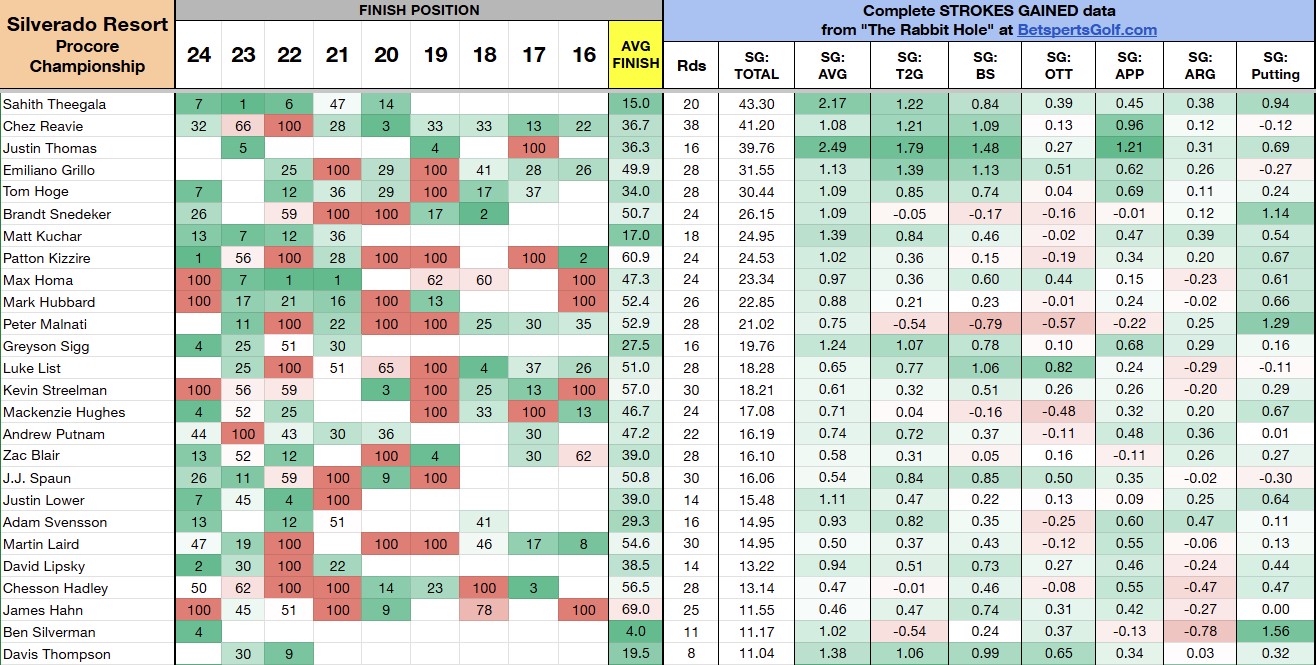
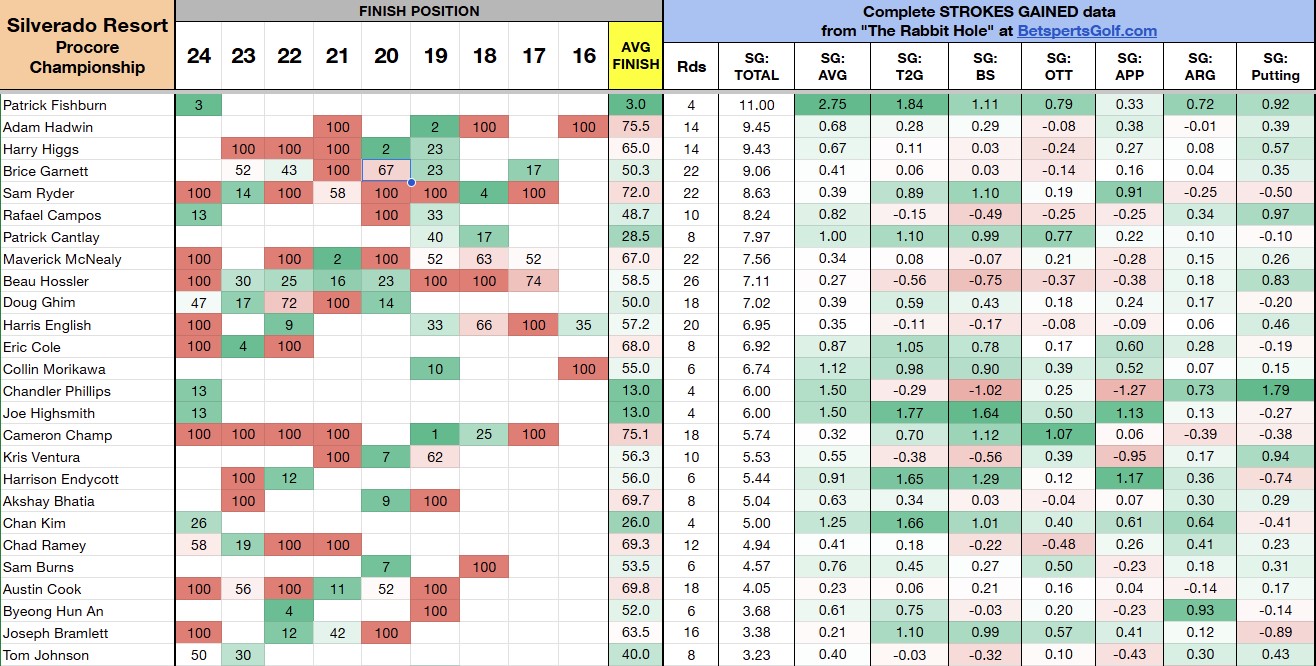
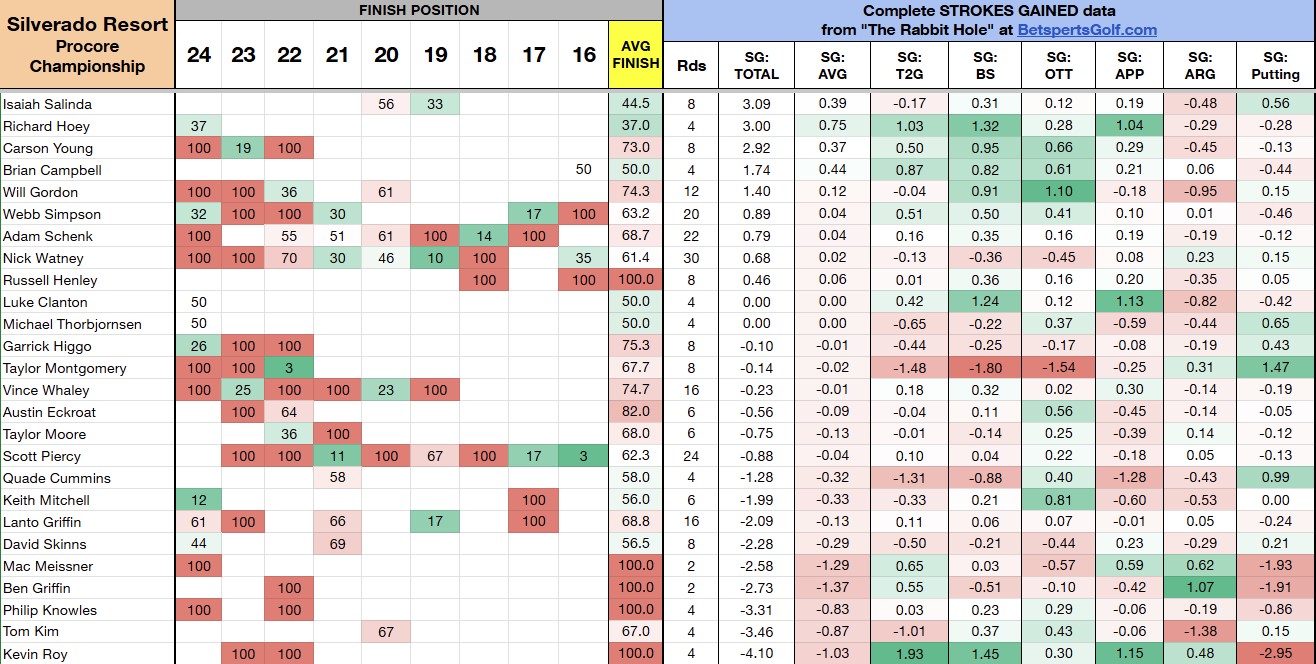
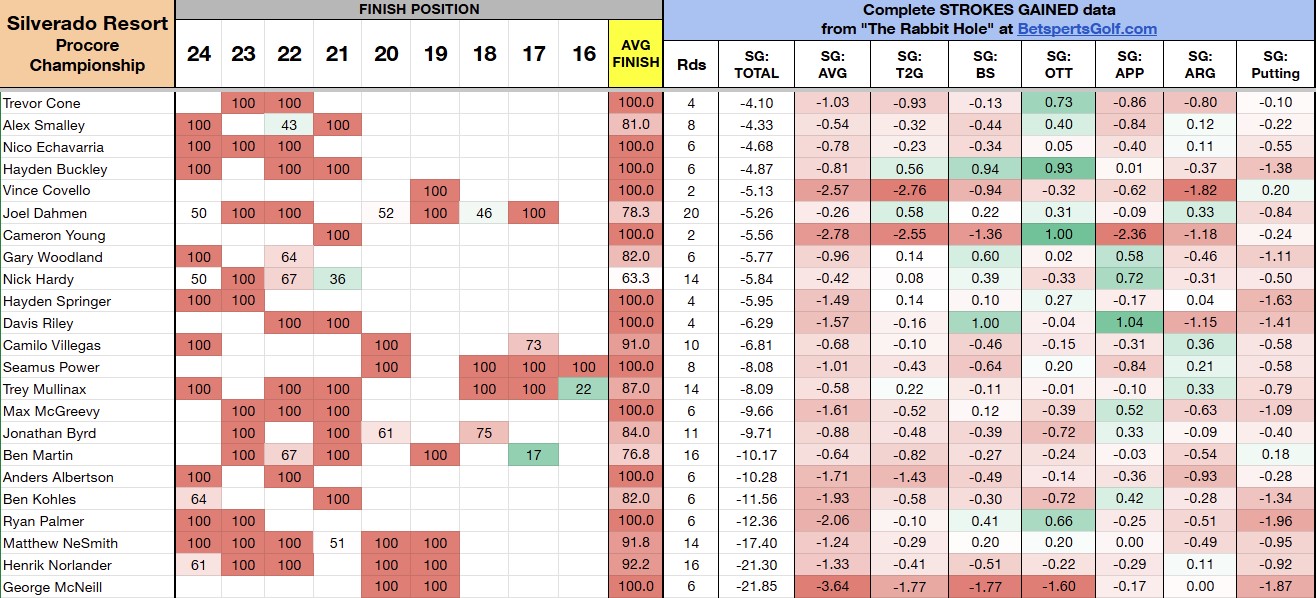
Finish Position and Strokes Gained History at Silverado Resort (2016-2024)
This includes the average finish position and Strokes Gained per round since 2016 for each of the categories. Players are sorted by SG: Total. Silverado is the 18th most predictive annual course on Tour.
Course Features
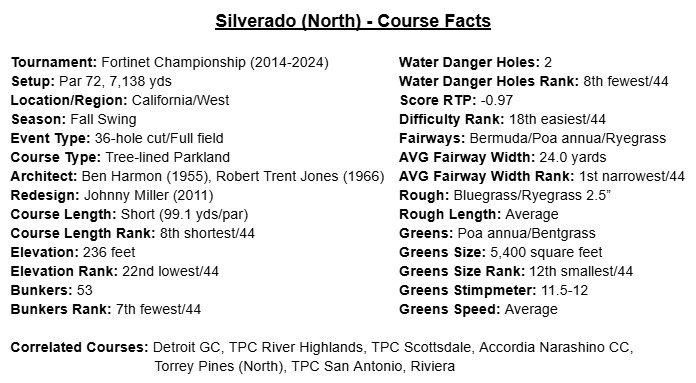
Located in the heart of California’s Napa Valley wine country, Silverado is a classical, tree-lined resort-style course with a setup that is quite scoreable. The birdie-to-bogey ratio of 1.47 is one of the highest on Tour. Over the past five events here, the course ranks as the 18th easiest annual course, with an average score of -0.97 per round.
While Silverado features some rolling terrain and a handful of holes with elevation changes, it is largely a flat layout. With just two holes bringing water into play and only 53 bunkers, there are limited opportunities for big mistakes. The course’s primary defenses come from its narrow, tree-lined fairways and the severe undulations on several greens.
The course’s relatively modest length also adds to its playability. At under 7,200 yards from the tips, the par-72 layout ranks as the eighth-shortest on the PGA Tour schedule. Its winners’ list reflects that versatility—big hitters like Cameron Champ and Stewart Cink have triumphed here, but more methodical players such as Chez Reavie and Emiliano Grillo have also found success. 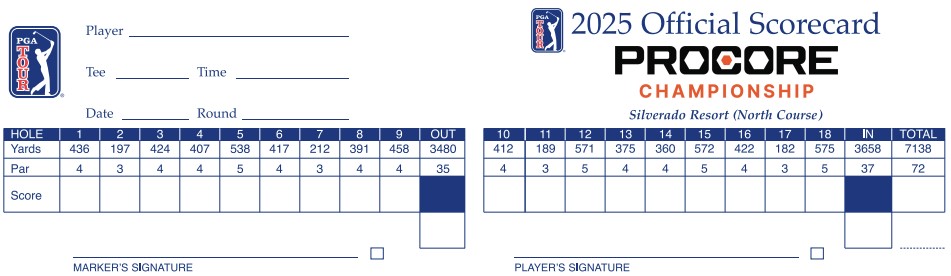
From an agronomy standpoint, Silverado features a unique blend of grass types. The fairways combine Bermuda, Poa annua, and Ryegrass, while the rough is a Bluegrass/Ryegrass mix maintained at roughly three inches. The greens are predominantly West Coast Poa annua—known for their “bumpy” texture—with some bentgrass mixed in.
As one of the shorter courses on Tour, Silverado doesn’t feature a single par 4 over 460 yards. In fact, eight par 4s fall between 375 and 435 yards, giving players ample chances to attack with short irons and wedges—especially as average driving distances continue to climb (291.6 yards last season). All four par 5s are reachable in two shots and collectively yield a “Birdie or Better” rate of 39%. The real defense lies in the par 3s, three of which rank among the four toughest holes on the course, carrying a bogey-or-worse rate of 21%.
Strokes Gained Analysis
Off the Tee
Silverado ranks as the 16th-toughest course on Tour for gaining strokes off the tee, largely due to its extremely narrow, tree-lined fairways. Accuracy is nearly 11% more difficult to achieve here compared to the Tour average. But a closer look reveals a different story.
Most holes are relatively straight with only a few doglegs, and with hazards largely absent, players can often take aggressive lines and let driver fly. Unlike other shorter venues such as Waialae or Harbour Town, Silverado rarely forces layups.
Even the rough offers little resistance. Cut to three inches, it still produces a GIR rate from missed fairways that is 9% easier than the Tour average. The “Birdie or Better” rate from the rough is also nearly 5% higher than normal. With the rough playing benign, distance becomes the true separator—giving longer hitters a clear edge.
Looking more closely at the bomber angle, when Cameron Champ won here in 2019, he highlighted this was actually part of his strategy by saying, “Sometimes I don’t even care if I’m in the rough, it doesn’t really matter. I’ll just try to position it off the tee. I’ll take it in the rough being way up there and hitting driver. That’s kind of how I look at it this week.”
That year, Champ’s driving accuracy was only 53.6% but he still hit 73.6% of GIR. One year later in 2020, the winner, Stewart Cink’s numbers were even more pronounced with a fairway rate of 55.4% and a GIR of 84.7%.
Course renovator Johnny Miller, known for his own aggressive play off the tee, designed Silverado to reward rather than punish drivers. None of the par 4s or par 5s bring water into play, and the limited number of fairway bunkers can be carried with ease by nearly the entire field.
Approach
The lack of penalty off the tee, combined with sloping greens, makes Silverado a genuine second-shot course that will allow players with strong iron play to separate themselves from the field. Players often point to the challenging pin locations at Silverado, emphasizing the importance of placing approach shots on the correct tier of the green. Most surfaces slope from back to front and feature pronounced undulations, with misses frequently funneled into closely mown run-off areas that punish imprecise approaches.
One of the main reasons for the GIR% being so high, even from the rough, is that 44% of approach shots come from the 75-150 yard range. That is 11% above the Tour average of 33%. On measured courses with ShotLink data, Silverado is the 14th toughest course on which to gain strokes on approach from that range.
Martin Laird spoke of how high ball flights with shorter irons are an advantage by saying, “There’s some tight pins on the front of the greens that some guys just can’t get to if you don’t hit it high. So coming in with mid-irons, coming in landing soft is definitely a big advantage as opposed to maybe hitting a slightly longer club and coming in a little flatter.”
As a resort course, Silverado’s greens are generally soft and receptive, encouraging players to attack. Beyond a few tricky tiered sections, the main obstacles to approaches come from strategically placed oak and redwood trees that can obstruct angles into the greens.
Around the Green and Putting
Silverado plays slightly easier than average in traditional “Around the Green” stats like Sand Saves and Scrambling, yet strokes gained data tells a different story—it ranks as the 10th most difficult course in this category. The challenge stems largely from the tightly mown run-off areas that demand precision on chips, as well as a handful of deep bunkers among the steepest on Tour that can severely punish missed approaches.
On the greens, putting stands out as the course’s toughest test. While three-putt avoidance is marginally easier here, every putting range plays slightly more difficult than the Tour norm. Most notably, Silverado ranks as the fifth-toughest venue on Tour for putts inside five feet. Green speeds are typical, rolling between 11.5 and 12 on the Stimpmeter, but the West Coast Poa annua surfaces add another layer of difficulty. Players often note that as rounds progress, the greens become bumpier in the afternoon, making it harder to hole putts with confidence.
Most Important Stats For Success at Silverado (North)
*In order of importance
- Course Region: West
- Scoring Conditions: Easy
- Course Length: Short/Very Short
- Field Strength: Strong
- Event Season: Fall
- Bunker #: Low
- Water Danger: Low
- Greens Size: Small
- Architect: Robert Trent Jones
- Greens Surface: Bent/Poa
- Fairway Accuracy: Difficult
- Rough Penalty: Low
- Scrambling Short Grass: Difficult
- 3-Putt AVD: Easy
- SG: Approach
- Par 5 Scoring
- SG: ARG/Scrambling
- Driving Distance
- SG: Par 4: 400-450
- Birdie or Better %
- Proximity: 75-150
- Bogey Avoidance
- SG: Putting (Poa/Bent)
- Course History – Silverado/Comp Courses
Key Rabbit Hole Filters
- Course Region: West
- Scoring Conditions: Easy
- Course Length: Short/Very Short
- Field Strength: Strong
- Event Season: Fall
- Bunker #: Low
- Water Danger: Low
- Greens Size: Small
- Architect: Robert Trent Jones
- Greens Surface: Bent/Poa
- Fairway Accuracy: Difficult
- Rough Penalty: Low
- Scrambling Short Grass: Difficult
- 3-Putt AVD: Easy