2025 PGA Championship at Quail Hollow – Preview

Ron Klos

a year ago
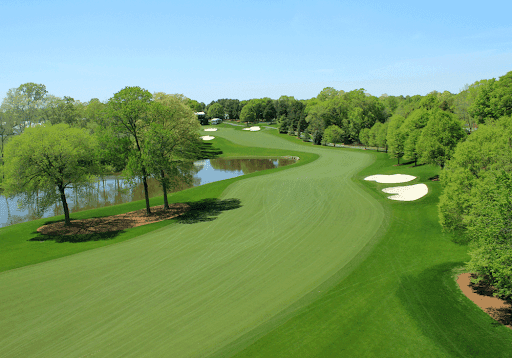
The 107th edition of the PGA Championship returns to Quail Hollow Club, where eight years ago a 24-year-old Justin Thomas captured the Wanamaker Trophy with a clutch performance down the stretch. Coming off Rory McIlroy‘s “Grand Slam” clinching victory at last month’s Masters, the drama is building for the year’s second major where McIlroy, world No. 1 Scottie Scheffler, LIV stalwart Bryson DeChambeau, and last year’s PGA Championship winner, Xander Schauffele, are set to clash once again.
Located just southeast of downtown Charlotte, North Carolina, Quail Hollow Club has hosted a PGA Tour event almost every year since 2003. Along with the 2017 PGA Championship, the world-class course also hosted the prestigious 2022 Presidents Cup. It is one of the most challenging courses on Tour, averaging almost one stroke over par per round at the annual Wells Fargo Championship (now the Truist Championship). At the major here in 2017, it played to an average of +2.47 per round, which ranked as the fifth toughest major played since 2014.
Resembling the length of some of the most recent PGA Championship courses like Valhalla, Oak Hill, Southern Hills, and Kiawah Island, it’s a brute of a par-71 layout that measures 7,626 yards from the tips. It’s a tree-lined parkland course that is a favorite among players. Along with immaculate conditions played on scenic rolling terrain, it’s known as one of the most pleasant walks in golf. The course has a natural flow as players step off one green and the next tee box is just yards away.
As with any course that has hosted major events, every facet of a golfer’s game will be tested this week. As recent past winners here demonstrate, including Wyndham Clark, Rory McIlroy (four times), Max Homa, and Jason Day, distance off the tee and positive long iron play are especially advantageous this week. Another important skill is scrambling for pars on some of the toughest green complexes that players will face all year.
Said Quail Hollow’s Director of Green and Grounds, Keith Wood, “We want a fair course, and a challenge,” he said. “We want it to play long but not soft. Honestly, from my point of view, we just want to see a great competition. On Sunday, as the leaders are making the turn to the back nine, you know, we want to have six or seven guys in contention. That’s exciting, a lot of competition, good drama.”
The Field
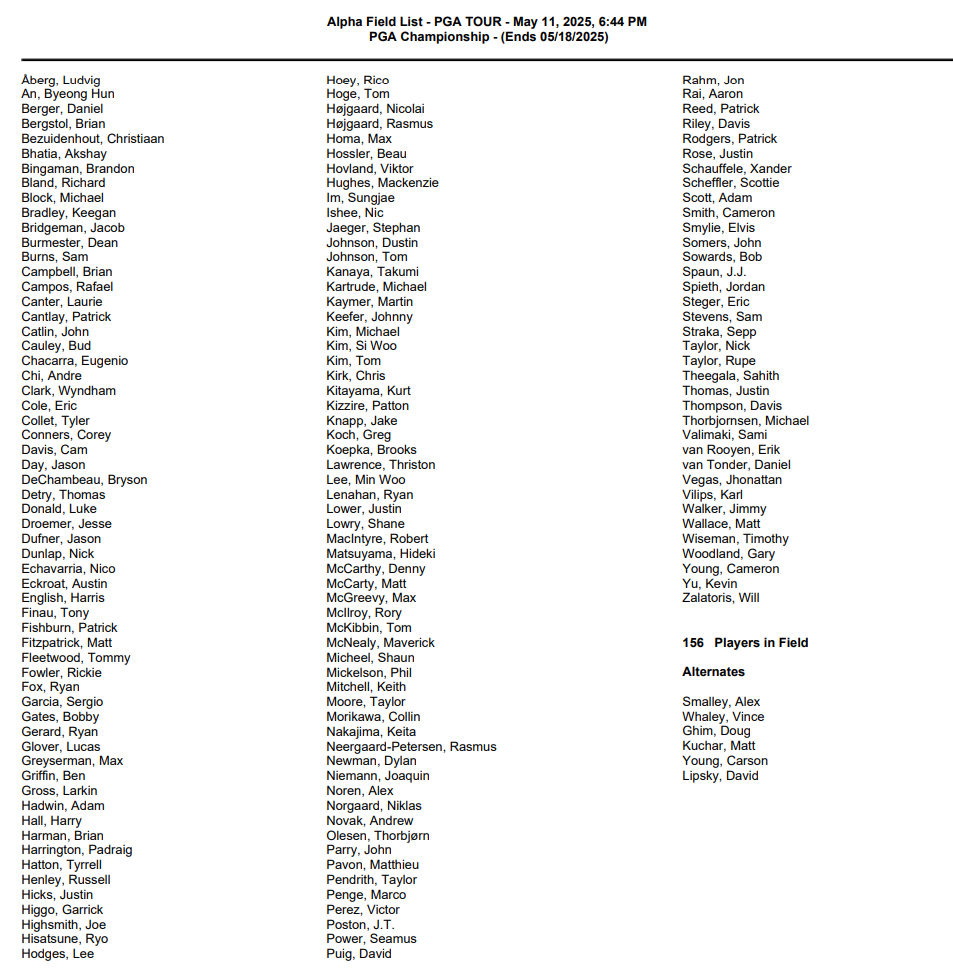
With 156 players in the field, every single notable player who qualified will be in Charlotte this week. Scottie Scheffler and Rory McIlroy, each coming off recent wins, are in a league of their own at the top of the board this week. With his recent play in majors, it can be argued that Bryson DeChambeau is the third-best golfer in this field. Jordan Spieth will attempt to follow McIlroy as he will make his eighth attempt at completing the career “Grand Slam”.
Along with DeChambeau, 15 LIV golfers will be competing this week, including seven who were extended special invitations: Joaquin Niemann, Dustin Johnson, Patrick Reed, Sergio Garcia, Tom McKibbin, David Puig, and John Catlin. As per usual, 20 PGA teaching professionals fill out the bottom of the field.
McIlroy was the last player to win at Quail Hollow, winning the Wells Fargo Championship in 2024, making it his fourth career win at this venue. Other past winners at the Wells Fargo Championship at Quail Hollow Club include Wyndham Clark, Max Homa, Jason Day, Rickie Fowler, and Lucas Glover. The top 70 and ties will advance past the 36-hole cut on Friday.
Quail Hollow Club – History
Quail Hollow was laid out on what once was the largest dairy farm in North Carolina and was named for the plethora of quail that inhabited the property. Built on a 270-acre tract of land, architect George Cobb completed the course in 1961, intending to capture the beauty and natural terrain of the Piedmont region. The early Cobb design was a product of its times, with flashed-up bunkers rising to meet elevated putting surfaces that required an aerial attack through tight tree-lined fairways. It hosted the Kemper Open on the PGA Tour from 1969 through 1979 followed by the Senior Tour’s Paine Webber Invitational from 1983 through 1989.
Arnold Palmer helped to redesign the layout in 1986. Tom Fazio made further alterations in 1997 and again in 2003 to prepare the course for PGA Tour competition. The club stepped back into the limelight that year with the PGA Tour’s Wachovia Championship. Over time, it was renamed the Quail Hollow Championship and is now the Wells Fargo Championship.
Most of what is seen on the ground today is the result of decades of work led by Tom Fazio, one of the most successful golf architects of the modern era. “There’s not much of the George Cobb design left, except for a little bit of the routing,” Wood said. “Mr. Palmer came in and did some work, and it still was a Cobb course. Mr. Palmer took what was there and created new greens complexes, new bunkers, things like that. But after Mr. Fazio really started having some influence and doing things on the golf course, it really became a Fazio course.”
From 2014 to 2016, in preparation for the 2017 PGA Championship, Fazio renovated much of the course, including a complete rebuild of all 18 greens and converting the putting surfaces to Champion Bermuda turf. Tee boxes were shifted, and more than 100 trees were removed to allow for more sunlight and clearer sight lines. The course now plays through wider corridors, still with trees at the sides but with much more room to navigate while allowing ample sunshine to nourish the turf. The greens are flatter to the ground and much more natural in appearance than the pushed-up originals.
Four holes were also significantly altered and lengthened to further strengthen Quail Hollow’s championship credentials. The club also hosted the 2022 Presidents Club in which the U.S. team soundly defeated the International team 17.5 to 12.5.
In 2023, Fazio was back at it in what Wood called more of a housekeeping renovation in which the greens were re-grassed with the modern Tif Eagle Bermuda grass. “There was very little architectural change in 2023,” Wood said. “We did change the 13th tee complex, and we added a tee on 16, but that was it. We did resurface the greens, and there were a few hole locations that we softened here and there just so Kerry [Haigh] could use some corners of the greens and get the speeds up to 13. And we redid the bunkers and put new liners in the bunkers.”
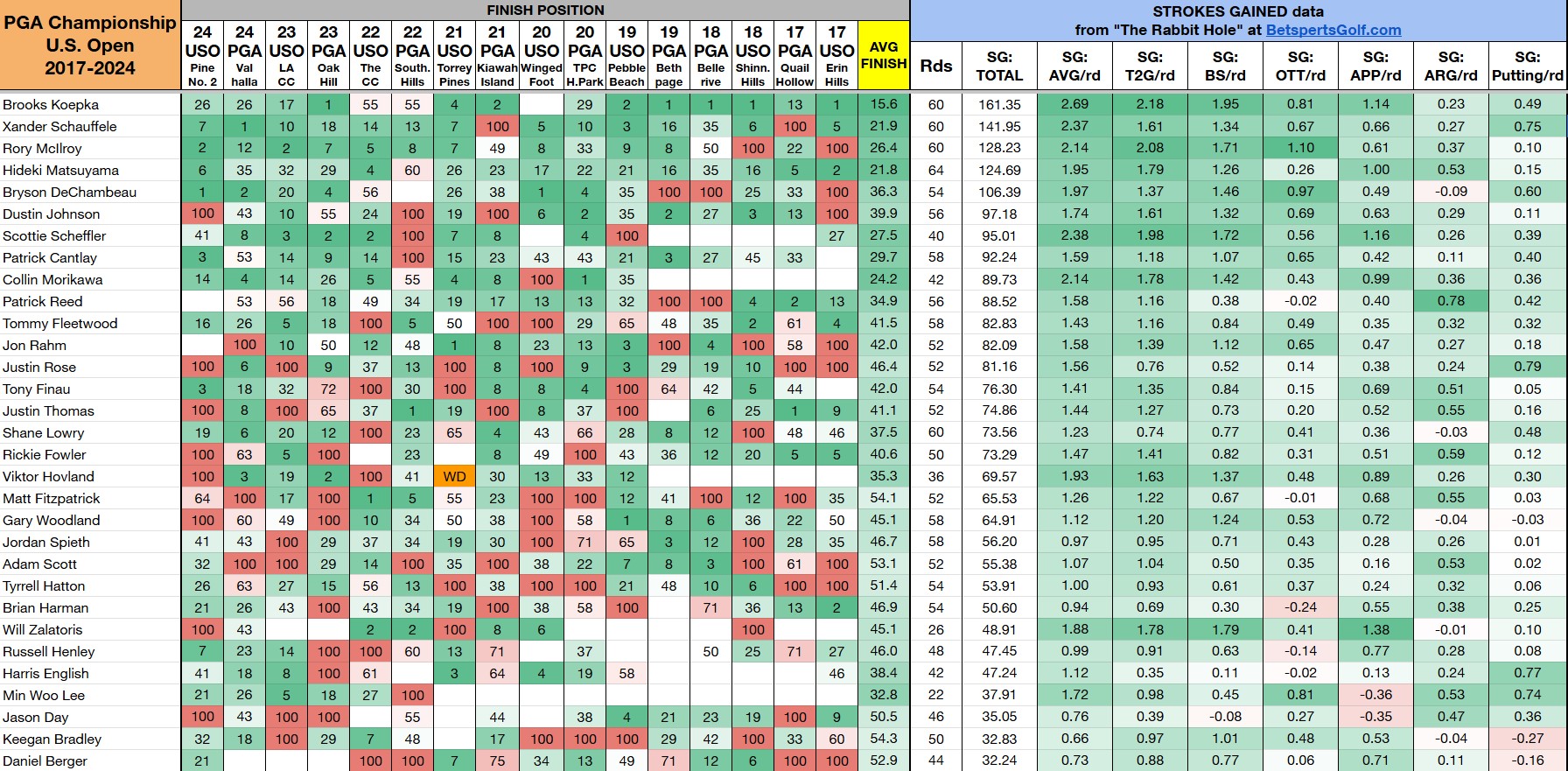
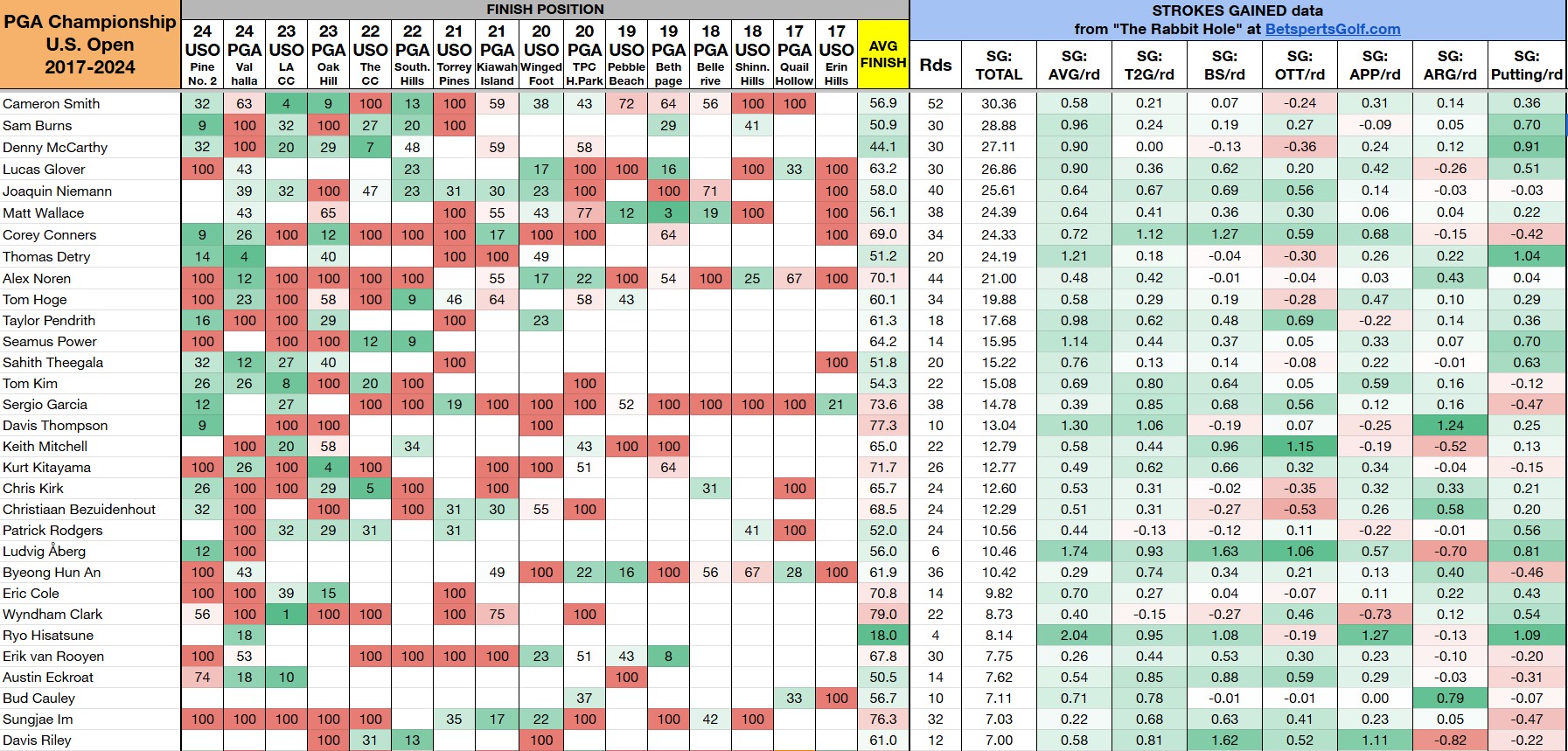
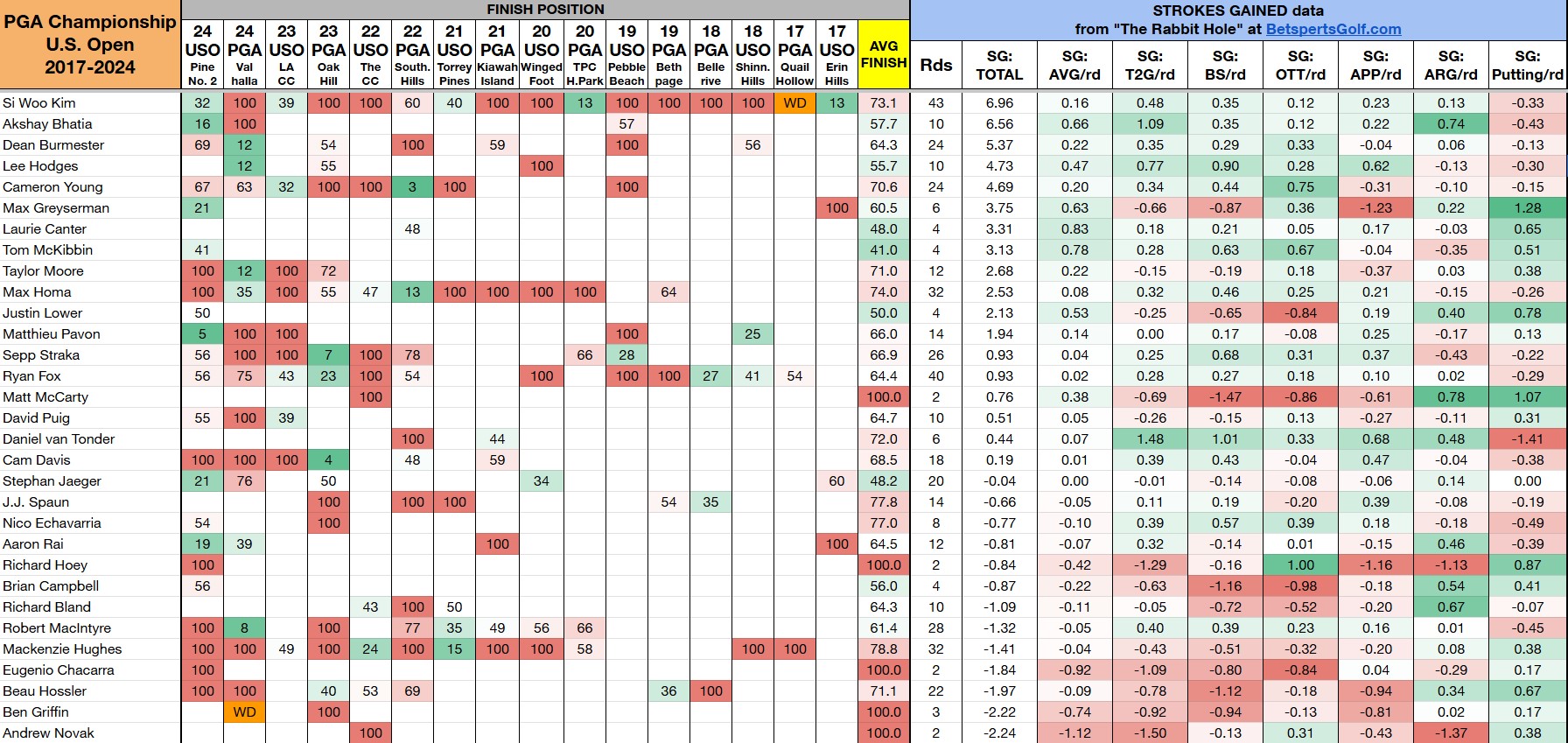
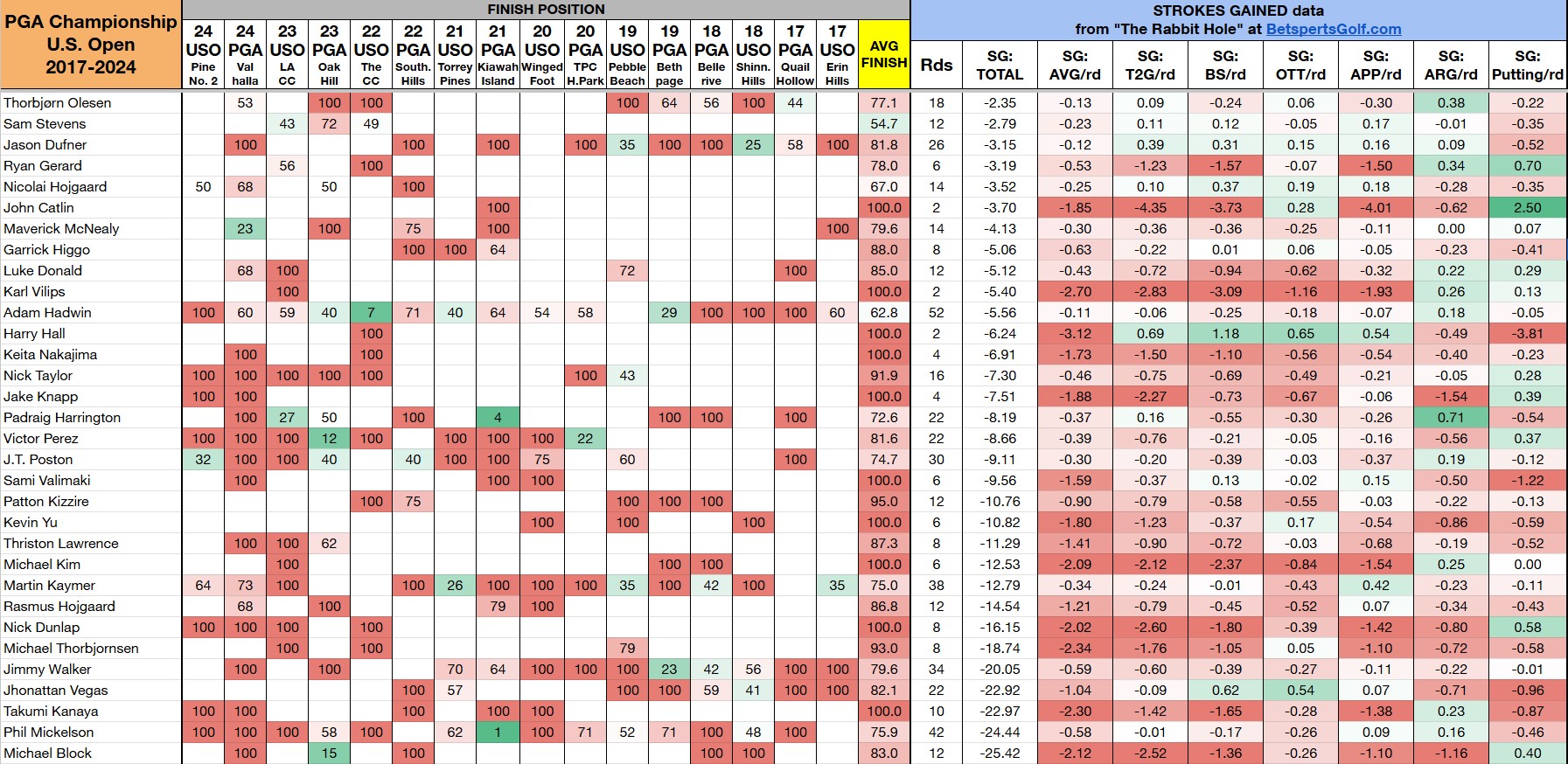
Finish Position and Strokes Gained History at Quail Hollow Club (2017-2024)
This includes the average finish position and Strokes Gained per round since 2017 for each of the categories. Players are sorted by SG: Total. Quail Hollow is the 5th most predictive annual course on Tour.
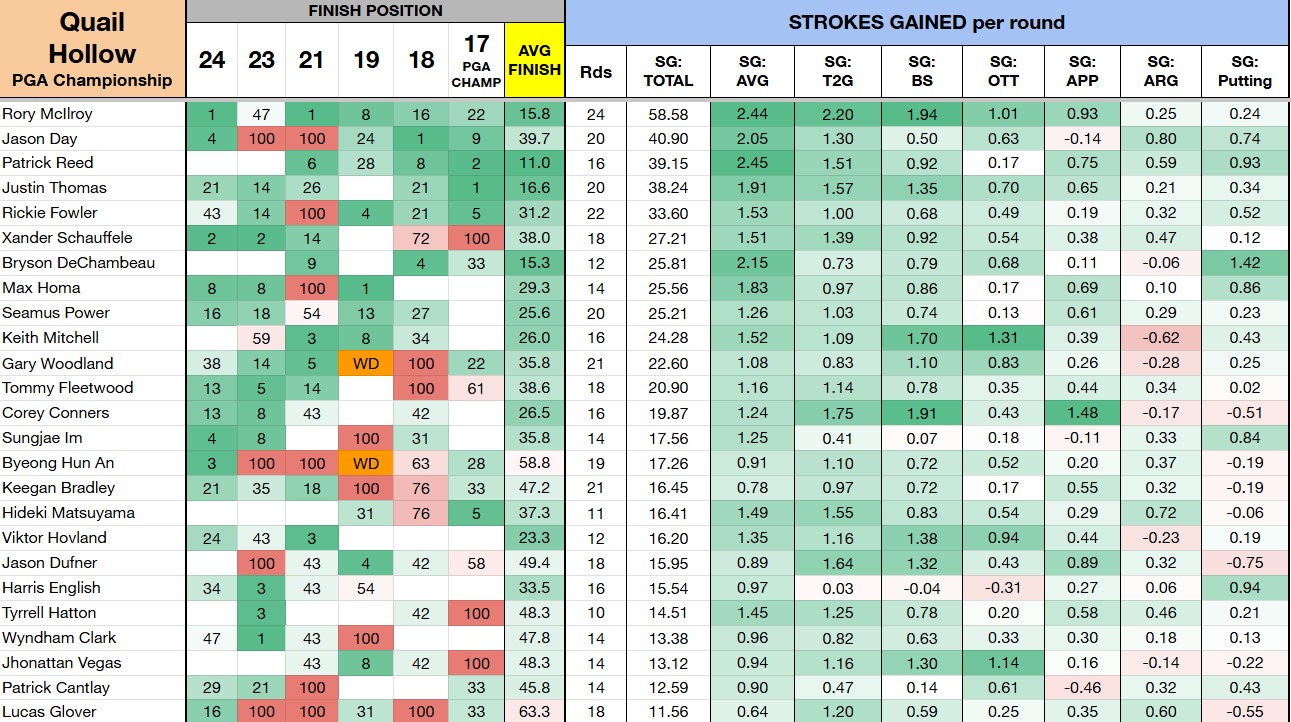
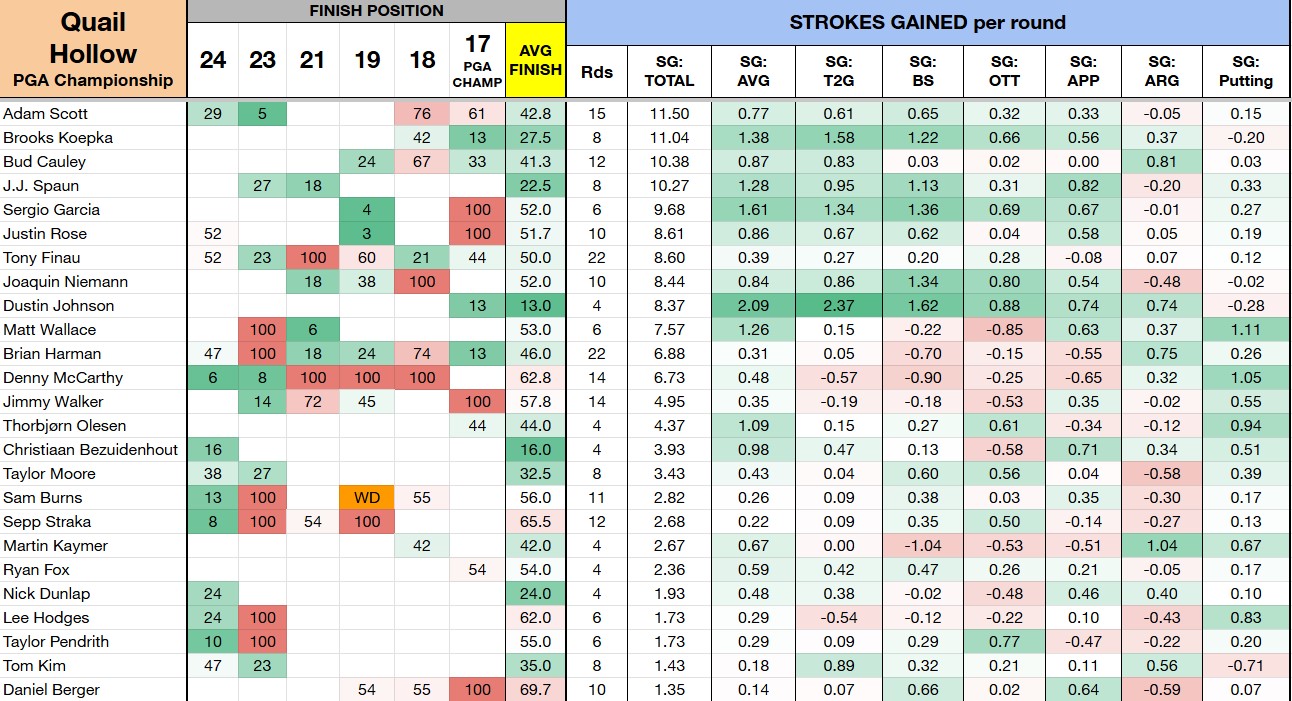
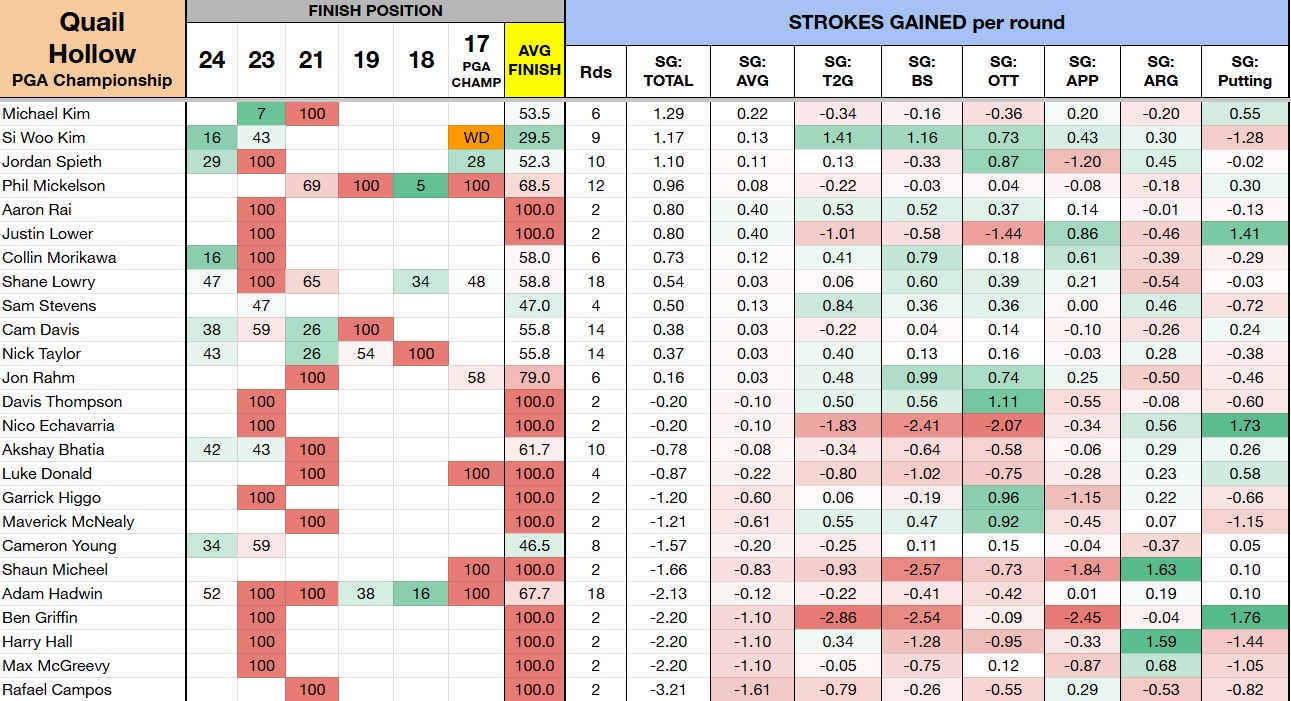
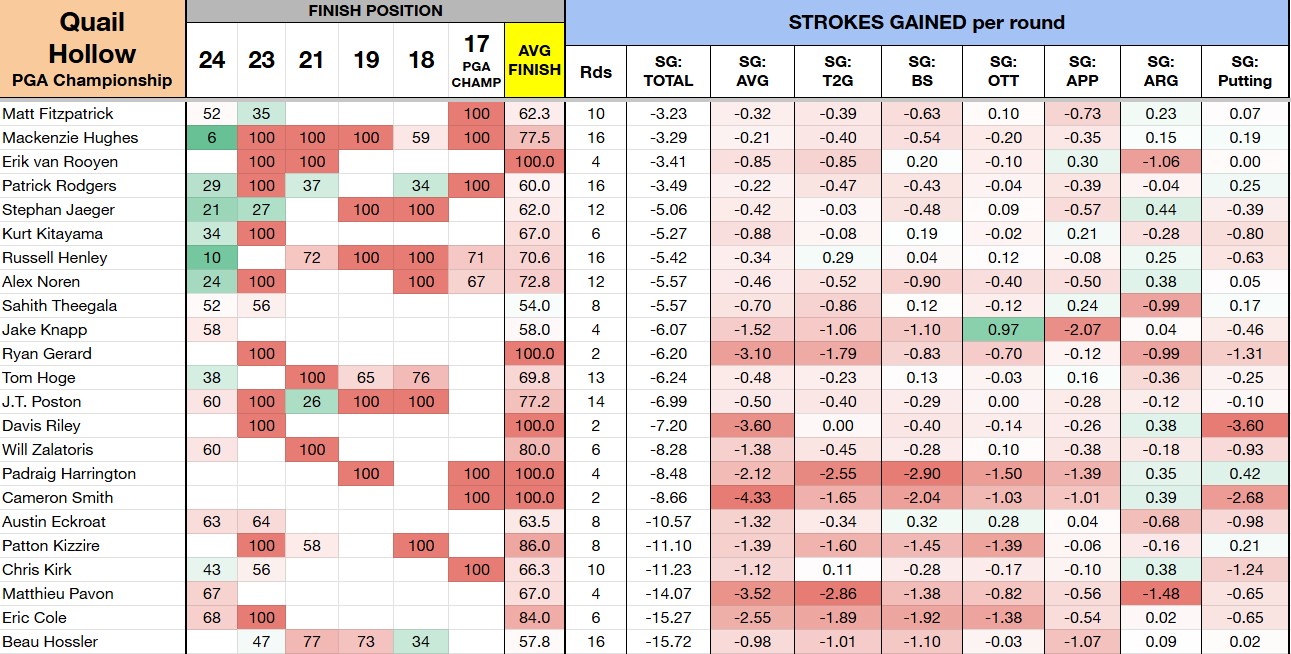
PGA Championship/U.S. Open Finish Position and Strokes Gained History (2017-2024)
Course Features
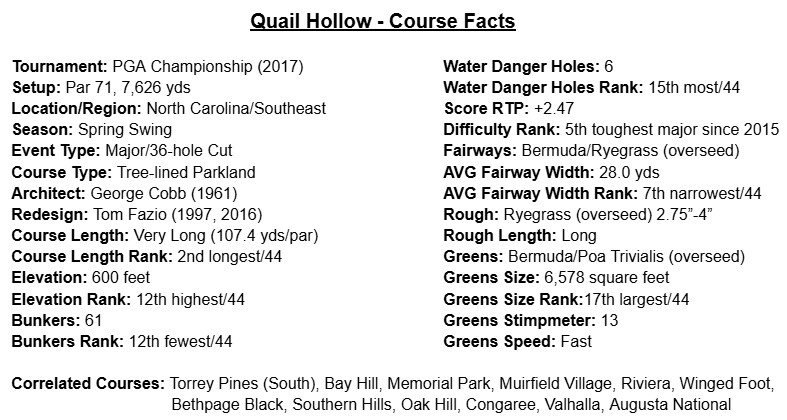
Measuring 7,626 yards, Quail Hollow is a par-71 layout. Similar to courses like Torrey Pines and Bay Hill, it presents a challenging combination of length and difficult scoring conditions. It is the second-longest and fifth-toughest scoring course in the annual Tour rotation. It also has the sixth-longest combined par 4s and par 5s on Tour.
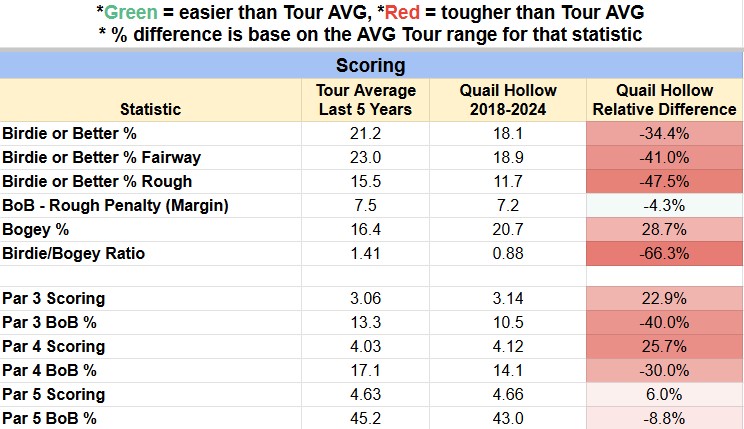
There are only five scoring holes at Quail Hollow – the three par 5s and the two semi-driveable sub-350-yard par 4s. To have success, players will need to birdie as many of those as possible and then hold on for dear life on the other 13 holes, which all average over par.
The course features tree-lined fairways, rolling terrain, strategically-placed water hazards, and firm, undulating greens on approach. There is a wonderful mix of doglegs veering off in all directions. Though there are only 61 bunkers (12th fewest), they are well-utilized near landing zones along the fairways and often in the direct line of approach shots around the greens.
With a SubAir system below the greens, rainy conditions have a very limited effect. Tournament officials gradually firm up the surfaces throughout the week so that by Sunday, it becomes very tough to hold the green surface. This is another reason why long drivers of the ball have an advantage at Quail Hollow. More distance off the tee equates to higher-lofted and softer landing approach shots into firm, tricky pin positions.
Championship contenders must work the ball, curving their shots to match the fairways’ frequent bends while avoiding overhanging branches and vibrant rough. The drier Bermuda grass will put a premium on such shotmaking skills. “If we have those firm conditions and you just hit it long without shaping it, you’re probably going to end up in the rough because the ball is going to bounce,” Wood said. “We can put a real premium on hitting fairways, hitting greens and making putts, which is what major championship golf is all about, right?”
According to Golf Channel analyst and Quail Hollow member, Johnson Wagner, “The fairways are as firm and fast as I’ve ever seen them. While the rough isn’t long, it’s super thick, and it’s been mowed back towards the tees. It’s going to play gnarly. I think this will be the best that Quail Hollow has ever presented itself.”
From an agronomic standpoint, the base turf at Quail Hollow is 100% bermudagrass. In the fall of each year, groundskeepers seed the course with bermuda, a warm-weather grass, and with rye, a grass meant for colder seasons. Right after the conclusion of the Wells Fargo Championship, a herbicide is used to kill the ryegrass and let the bermuda grow for the summer.
With Charlotte being in the mid-Atlantic region, the beginning of May is still too cool for the bermuda to completely break through the overseed. According to Wood, approaches, tees, and fairways are around a 50/50 mix of overseeded rye grass and the underlying bermuda. The rough is 90% overseeded rye. “The Bermuda grass will wake up,” said Wood, who has worked at Quail Hollow for a decade and oversaw course conditions for the 2017 PGA Championship. “It’s coming alive. I’m very happy with the turf quality and where we’re going to be.
“Once that Bermuda grass wakes up and starts putting out some roots, it starts using up the moisture in the soil. It’s also providing a denser, tighter surface because it’s starting to compete with the rye grass for space in the canopy. Things are going to be firm so that balls can bounce and give people the opportunity to shape the ball versus just hit it long.”
The rough length at the annual Wells Fargo Championship has consistently been maintained at 2″. For this week, however, Wood said the rough will start at 2.75″ on Monday and will be around 4″ by Sunday. Greens are a 50/50 mix of Poa trivialis overseed and bermuda. Greens will be a speedy 13+ on the stimpmeter and are on the larger side, averaging over 6,500 square feet. Scrambling, putting from 5-15 feet, and three-putt avoidance will be key “short-game” stats this week.
Hole Preview
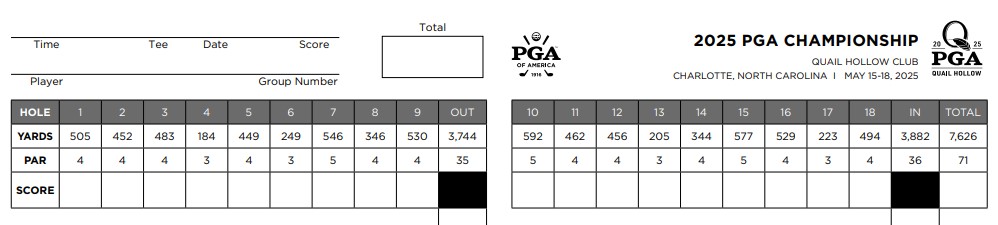
Architecturally, Quail Hollow has a reputation as a rather bland course with few exciting holes that stand out. Most of the first 15 holes are rather straightforward and repetitive. The course is all right there in front of you with nothing tricked up about it.
As a par-71 track, Quail Hollow only has three par 5s, which gives players one less opportunity to score. All three have a birdie or better rate of at least 34% and are must-birdie holes for players to have a chance to contend. On the opposite end, each of the four par-3s plays over par to a combined average of 3.14. The par-3 6th hole is an absolute beast, playing over 250 yards for some rounds.
While there are two drivable par 4s (8th and 14th), five of them measure over 480 yards. The first hole, which was lengthened as part of Fazio’s redesign, sets the early tone as a strenuous 495-yard par 4, which has a bogey-or-worse rate of 28%.
Quail Hollow is perhaps best known for its three-hole closing stretch known as the “Green Mile”. Each hole of the white-knuckle stretch features dangerous water hazards, strategically placed sand traps, tricky elevation changes, and firm, undulating green complexes. Tour player, Brandt Snedeker said, “It’s got to be one of the toughest stretches in golf. There’s no bail-out on any of the holes. You just have to suck it up and get through it.”
“Those are three really brutal finishing holes,” Tour veteran Adam Scott said. “If you can survive those holes and win, you’ve certainly proved that to yourself because they’re so demanding. There is no breather.” The three holes have combined to play a staggering 0.87 strokes over par with a bogey-or-worse rate of 29.7% compared to a birdie rate of only 8.4%. Since 2003, there have been over 1,800 “water balls” on these three holes combined.
Strokes Gained Analysis
Off the Tee
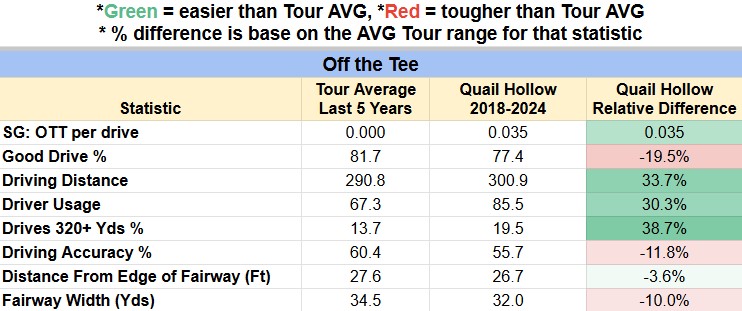
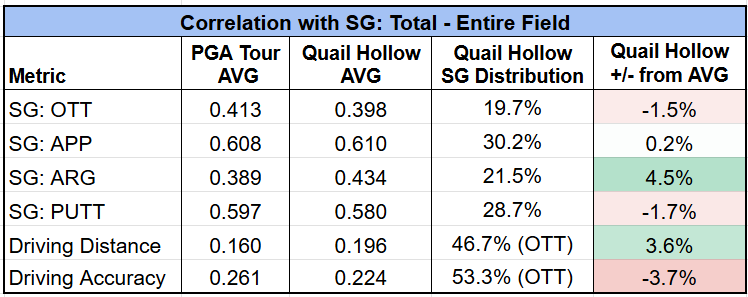
With an average driving distance of 301 yards, combined with the course’s length and overall lack of hazards, the course sets up perfectly for being driver-heavy off the tee and gives “bombers” a clear advantage. Over the last five events at Quail Hollow, 85.5% of all drives measured at least 280 yards, which is the highest driver usage rate on Tour. With softer fairways from all the recent rainfall combined with tall trees on the corners of dog legs, carry distance and apex height are crucial this week.
Because of how long the course plays, Quail Hollow is a strong test because of the distance demands placed off the tee. Shorter drivers who have accurate long-iron games can still compete here, but their path to success is much more difficult. Fairway accuracy is one of the lowest on Tour at only 55%, and the added rough growth will only increase the importance of total driving for the shorter hitters. The last five winners have averaged 316 yards off the tee, with none of them finishing in the top-40 in accuracy for the week. When McIlroy won in 2021, he finished second in driving distance and shockingly finished dead last out of 156 golfers in fairways gained. And then again last year, McIlroy led the 68-player field in driving distance and was 59th in accuracy.
Bombers and golfers with elite carry distance have littered recent leaderboards. The distance correlation has even proven true when tracking performance leading up to this event as every single winner since 2014 (except for James Hahn) has ranked in the top 15 in Driving Distance in their last 36 rounds leading into the tournament.
Brooks Koepka spoke on the importance of length off the tee here, saying, “It’s a bomber’s paradise. There’s some lines we can take over some trees. Number two, I just take it up over the tree. You can take a short line into a bunch of them. Like I hit a pitching wedge into number one today. I’m pretty sure a bunch of guys are going to be hitting a six-, maybe five-iron into that hole. Length is a key factor out here.”
Along with inaccurate drives not being punished as much as at other venues, those with longer distance off the tee will have shorter approach shots into the firm greens. This will allow them to benefit more from those shots than at other courses where holding the green is not as difficult. In summary, Quail Hollow presents more opportunities to play aggressively off the tee and will allow those players a better chance to separate from opponents who are shorter hitters.
Approach
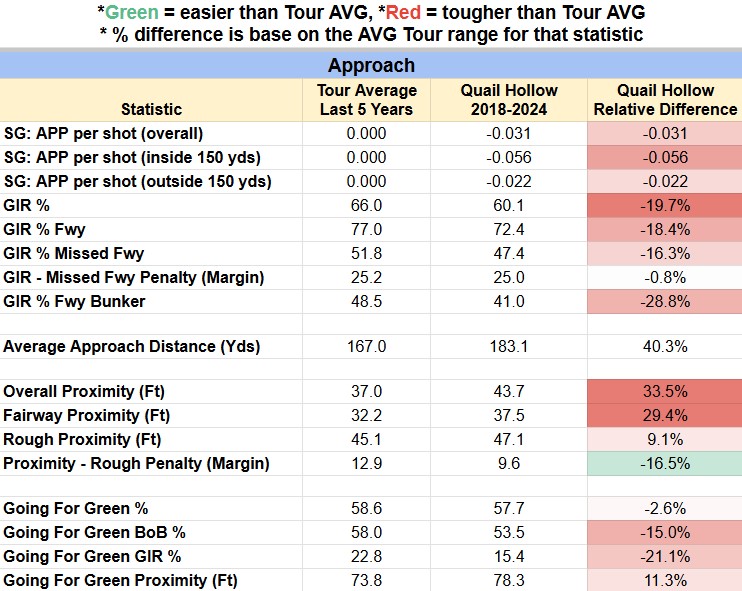
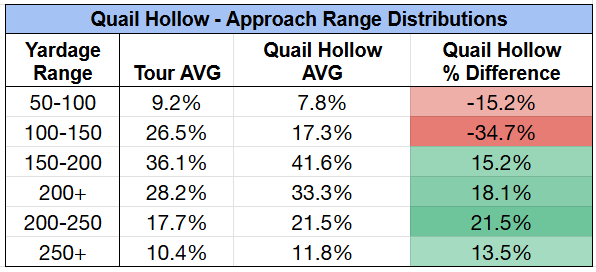
On approach, over the last five years Quail Hollow ranks as the 9th toughest ShotLink course on which to gain strokes. The average Greens in Regulation (GIR) rate is 60%, which is well below the Tour average of 66%. Much of the difficulty is due to the aforementioned firmness of the greens, combined with 55% of approaches coming from 175+ yards. Long approach shots that don’t have the necessary precision and trajectory could bounce ten yards off the green and leave difficult recovery shots. Thanks to many of the tricky pin placements, proximity to the hole is one of the furthest on Tour at 43.7 feet.
On his first trip to Quail Hollow in 2021, Viktor Hovland finished third. Related to how difficult proximity to the hole is here, he said, “With how hard it’s playing, you’ve just got to hit greens. There are so many hole locations where you’re just not looking at the pin. Maybe on a couple of holes, you can get it close, and the par 5s maybe you can make some birdies. The rest of the place you’re just trying to hold on for dear life.”
While gaining off the tee with distance matters more than usual this week, being positive on approach, and especially with long irons, is still paramount. Last year, 16 of the top 20 gained on approach, with 13 gaining at least 2.2 strokes on the field. On the Par 5s, players “Going for the Green” with their second shots will also have a challenging test as the “Hitting the Green” rate is only 15% compared to the Tour average of 22.4% on Par 5s at other Tour courses.
Around the Green and Putting
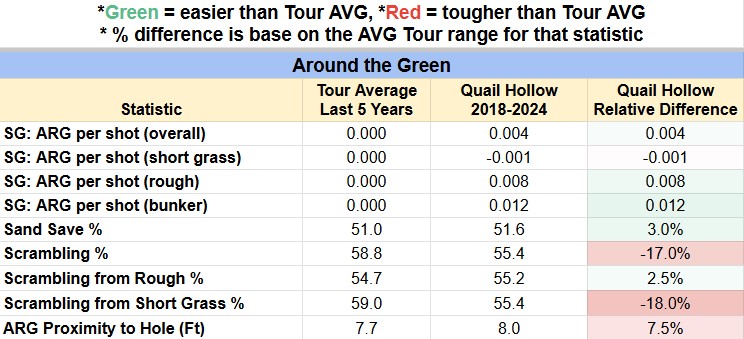
Around the green, Quail Hollow rates as slightly tougher than average when compared to other courses. Because of the difficult green complexes, scrambling from the rough and the short grass is between 2-4% tougher here. There are some shaved runoff areas and false fronts that players will have to contend with that can make chipping difficult. Overall, if golfers are hitting the greens in regulation at a solid number, the short game shouldn’t factor in as much.
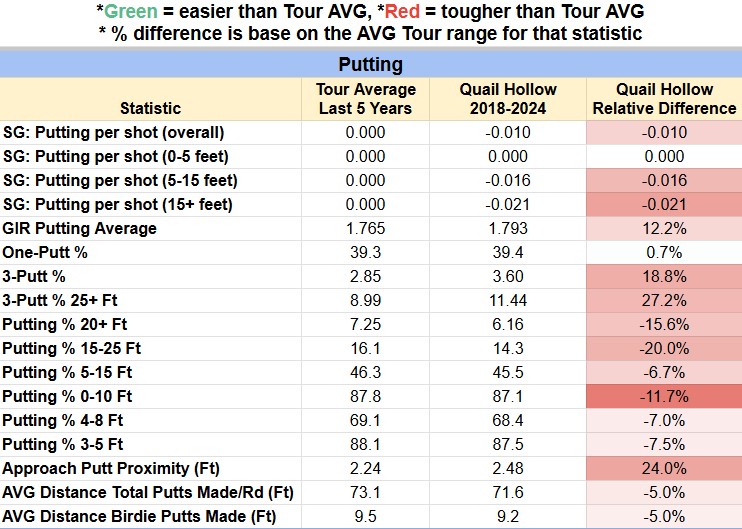
The greens at Quail Hollow are among the most challenging aspects of the course. Overall, it ranks as the 6th toughest venue in which to gain strokes putting. Longer putts will be even more difficult, as it ranks as the second toughest course for putts outside of 15 feet. The 3-putt rate is one of the highest on Tour at 3.6%.
While tee-to-green play is much more important than putting this week, going cold on the greens will quickly knock a player out of contention. Three of the last five winners gained more strokes putting than any other category. In 2023, though Wyndham Clark gained 8.9 strokes on approach, he also gained 7.5 on the greens in 2023. And last year, McIlroy gained 4.3 strokes with the flat stick in his victory.
Most Important Stats For Success at Quail Hollow
*In order of importance
- SG: APP
- Carry Distance
- Proximity 175+
- Par 4 Scoring (Difficult par 4s)
- SG: Long/Difficult Courses
- SG: Putting
- Scrambling
- Bogey Avoidance
- Total Driving
- 3-Putt Avoidance
Key Rabbit Hole Filters
- Course Region: Southeast
- Scoring Conditions: Very Difficult
- Course Length: Very Long
- Field Strength: Very Strong
- Event Type: Major
- Green Surface: Poa Trivialis/Bermuda
- Green Speed: Fast
- OTT Club: Driver Heavy
- Gain APP: Difficult
- Gain Putting: Very Difficult
- 3-Putt AVD: Difficult
- Par 4s: Difficult
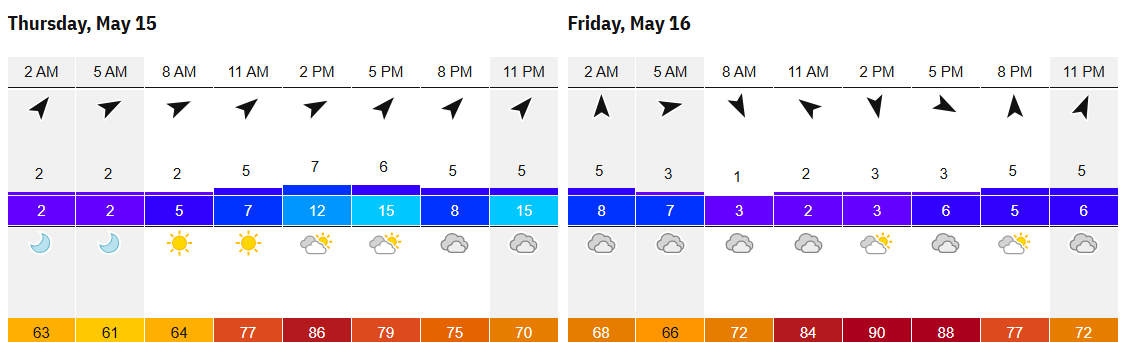
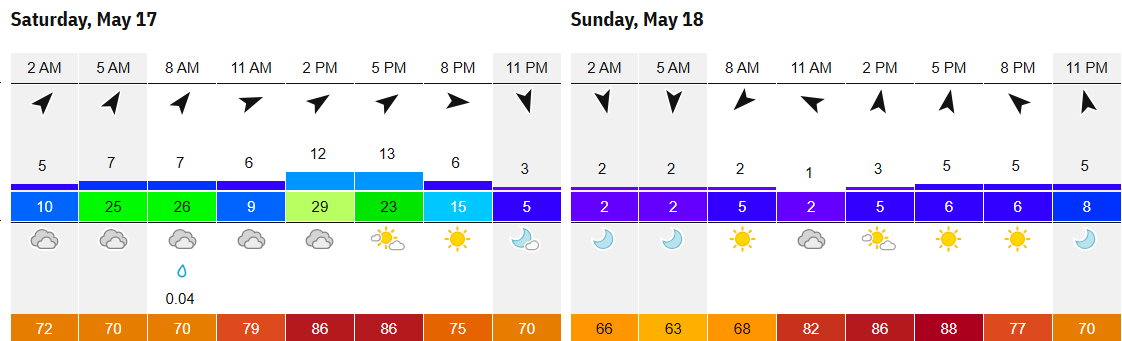
Weather Forecast – Charlotte, North Carolina