2025 Open Championship at Royal Portrush Golf Club – Preview

Ron Klos

a year ago

The 153rd Open Championship returns to the majestic coast of Northern Ireland as Royal Portrush Golf Club plays host to golf’s oldest and most prestigious major. Steeped in over 160 years of history, The Open—first contested in 1860 at Prestwick—has crowned legends of the game from Old Tom Morris to Tiger Woods.
As the only venue outside of mainland Great Britain to have ever staged The Open, Portrush stands apart with its rugged beauty, rich history, and undeniable test of championship golf. Nestled above the Atlantic Ocean in County Antrim, Royal Portrush boasts stunning views of the Skerries and Donegal cliffs, offering a dramatic stage as players vie for the Claret Jug.
The Dunluce Links, originally laid out by Harry Colt and updated by Martin Ebert for the 2019 Open, is a relentless challenge carved through towering dunes and wind-swept terrain. Royal Portrush features dramatic elevation changes, firm and undulating fairways, and small, elevated greens—all of which place a premium on precise approach play. Players must control trajectory and distance to hold these tricky green complexes, especially when factoring in coastal winds and uneven lies throughout the course.
Royal Portrush’s hole variety is a masterclass in links design. The mix of hole lengths, directions, and topographical features ensures that no two holes play the same, and that players must deploy every club and every ounce of creativity in the bag.
Royal Portrush made a triumphant return to the Open Championship rota in 2019 after a 68‑year hiatus (1951), and the longest gap in the tournament’s history. The successful return culminated with Northern Ireland’s own Shane Lowry’s emphatic six-shot victory, electrifying the passionate home crowd and reestablishing Portrush’s legacy for years to come. Last year, Xander Schauffele claimed his first Claret Jug, finishing at 9‑under after a spectacular final‑round 65, edging out Justin Rose and Billy Horschel by two strokes.

Sign up here for access to the premier PGA Tour database: http://betspertsgolf.com/the-rabbit-hole
The Field
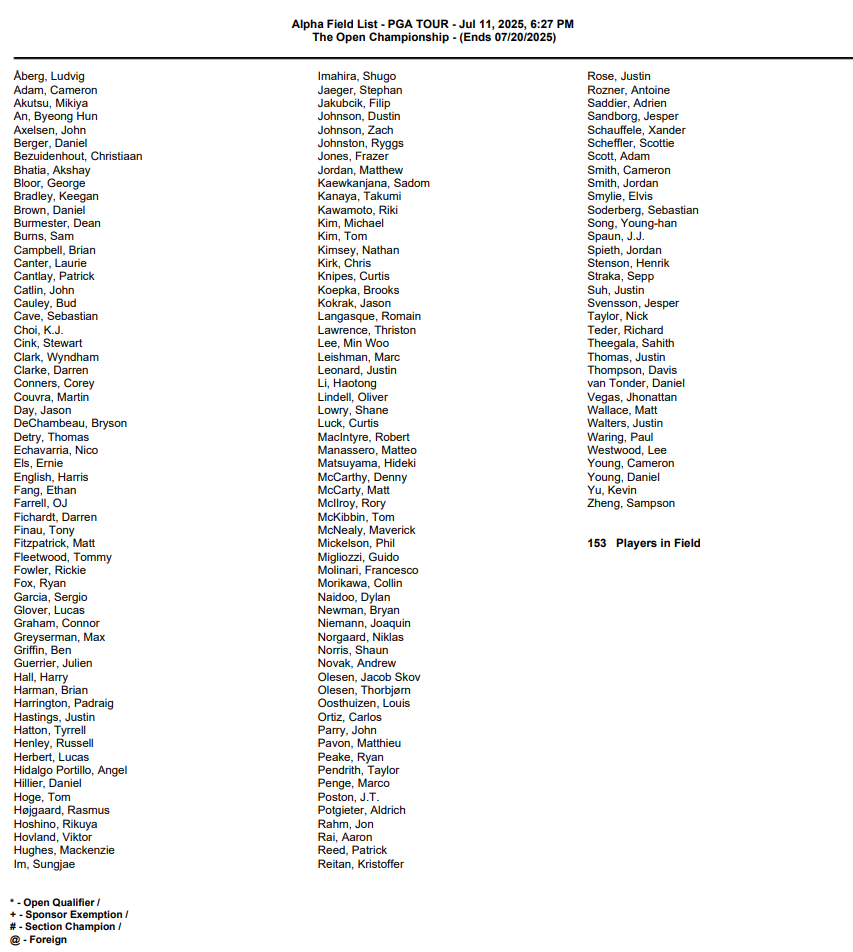
The field for the 2025 Open Championship at Royal Portrush features 156 players, comprising a mix of the world’s best professionals and a select group of elite amateurs. As is tradition with The Open, the field is drawn from a wide range of qualification categories, including major champions, world rankings, international tours, and Final Qualifying. Chris Gotterup, Nicolai Hojgaard, and Matti Schmid were the final three players to gain entry into the Open field based on their finish at the Scottish Open.
This year’s field is stacked with talent, including the majority of the top 70 players in the Official World Golf Ranking. Leading the way is World No. 1 Scottie Scheffler, who comes in as the most consistent player in the game, with multiple wins and top finishes in 2025. Rory McIlroy, the 2014 Open Champion and native of Northern Ireland, returns to Portrush with a chance to win in front of a home crowd. Xander Schauffele, the reigning Open Champion, and Jon Rahm, a two-time major winner with past success on Irish links, also headline the field. Other high-profile contenders include Collin Morikawa, Shane Lowry, Viktor Hovland, Jordan Spieth, and Tommy Fleetwood, all of whom have the pedigree and links course experience to contend on this demanding layout.
The LIV Golf contingent has its largest representation yet at a major, with 19 players teeing it up at Royal Portrush. This includes top names like Bryson DeChambeau, fresh off a major win earlier this season, as well as Dustin Johnson, Tyrrell Hatton, and Cameron Smith, the 2022 Open Champion. Several LIV players qualified through exemptions, world ranking positions, or Final Qualifying events.
From the DP World Tour, the top-30 players in the 2024 Final Race to Dubai Rankings and the first five players on the 2025 Race to Dubai Ranking not otherwise exempt have also gained entry into this week’s field. This includes players such as Laurie Canter, Thriston Lawrence, Marco Penge, Jordan Smith, and Kristoffer Reitan.
The Open Championship uses a straightforward cut rule: the top 70 players and ties after 36 holes advance to the weekend. Unlike some other tournaments, such as the Masters, there is no 10-shot rule—meaning players outside the top 70 are eliminated regardless of how close they are to the lead. This creates a more defined line and often raises the pressure on Friday, especially for those hovering near the cut late on Friday as conditions toughen and Portrush bares its teeth.
Royal Portrush Golf Club – History
Originally founded in 1888 as The County Club, Royal Portrush was renamed in 1892 and granted “Royal” status in 1895 by the Prince of Wales. The club features two courses—the Dunluce Links and the Valley Links—but it is the Dunluce, perched atop dramatic limestone cliffs overlooking the Atlantic, that has earned international acclaim.
In 1929, Harry Colt, one of the most influential golf course architects in history, was brought in to redesign the Dunluce Links. While Colt is celebrated for iconic designs like Wentworth Club, Royal Liverpool, and Hamilton Golf and Country Club, it is his transformative work at Royal Portrush that many consider his crowning achievement. His work transformed Portrush into a world-class championship venue, characterized by its flowing routing, natural dunes, and demanding green complexes. Colt’s design has endured as one of the finest in golf, and recent updates by Martin Ebert ahead of the 2019 Open Championship carefully honored Colt’s original vision while strengthening the layout for modern competition.
Ebert shifted numerous holes to make the course stronger. He added new seventh and eighth holes, fashioned from land on the club’s Valley Course to replace the weaker 17th and 18th holes. Ebert retained Harry Colt’s original greens, which are considered among the best putting surfaces in the world. He also built eight new boxes and ten new bunkers.
Royal Portrush holds a unique place in golf history. It first hosted The Open Championship in 1951, becoming the first (and still only) venue outside of mainland Great Britain to do so. That year, Max Faulkner claimed the Claret Jug in front of record crowds. The Open returned in 2019, when Shane Lowry produced a memorable performance, capturing his first major in front of passionate local fans. Beyond The Open, Portrush has also hosted the British Amateur Championship multiple times and was a regular venue for the Irish Open, showcasing its status as a championship-caliber course for well over a century.
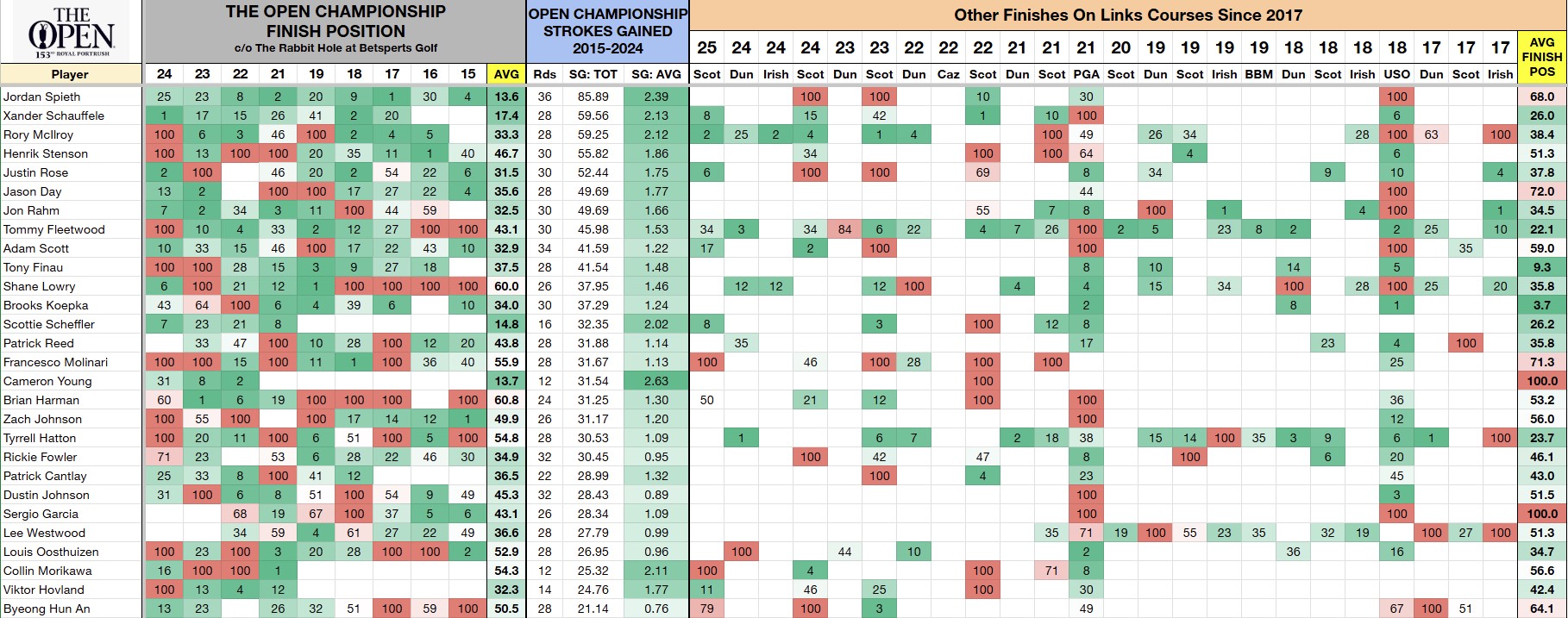
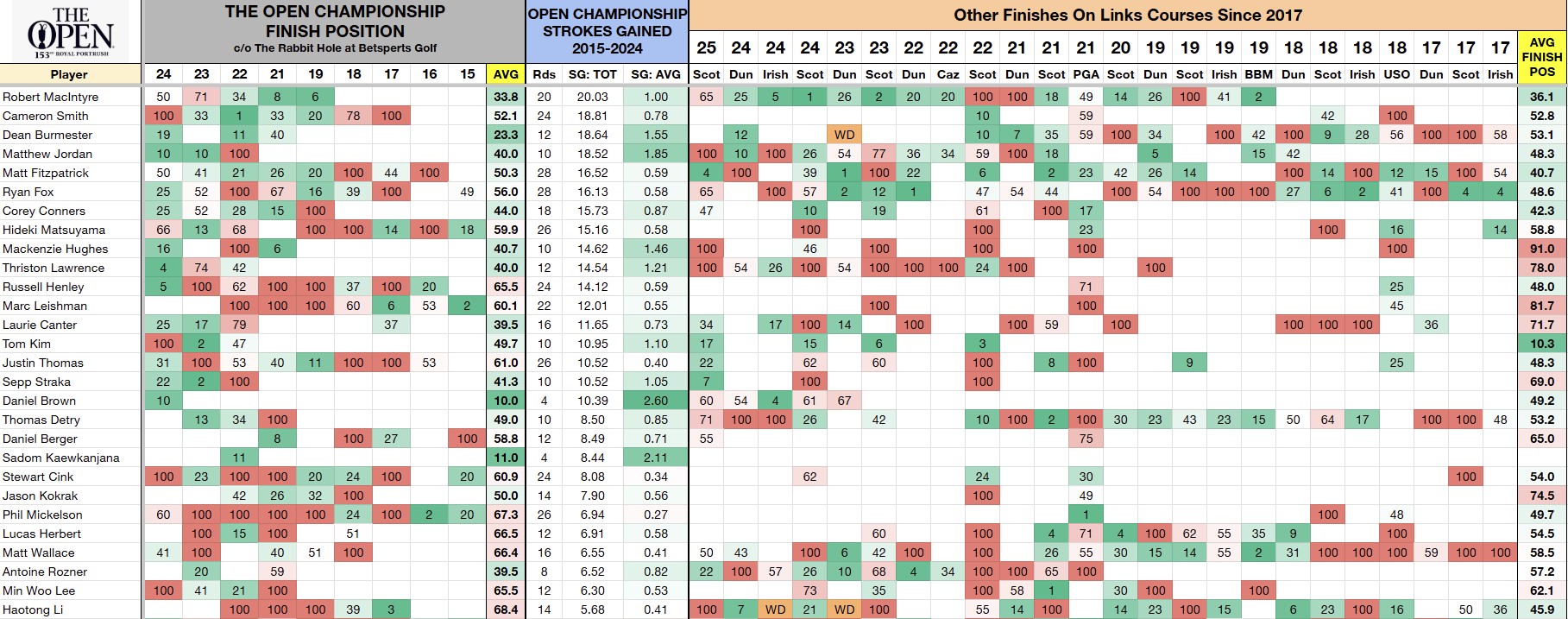
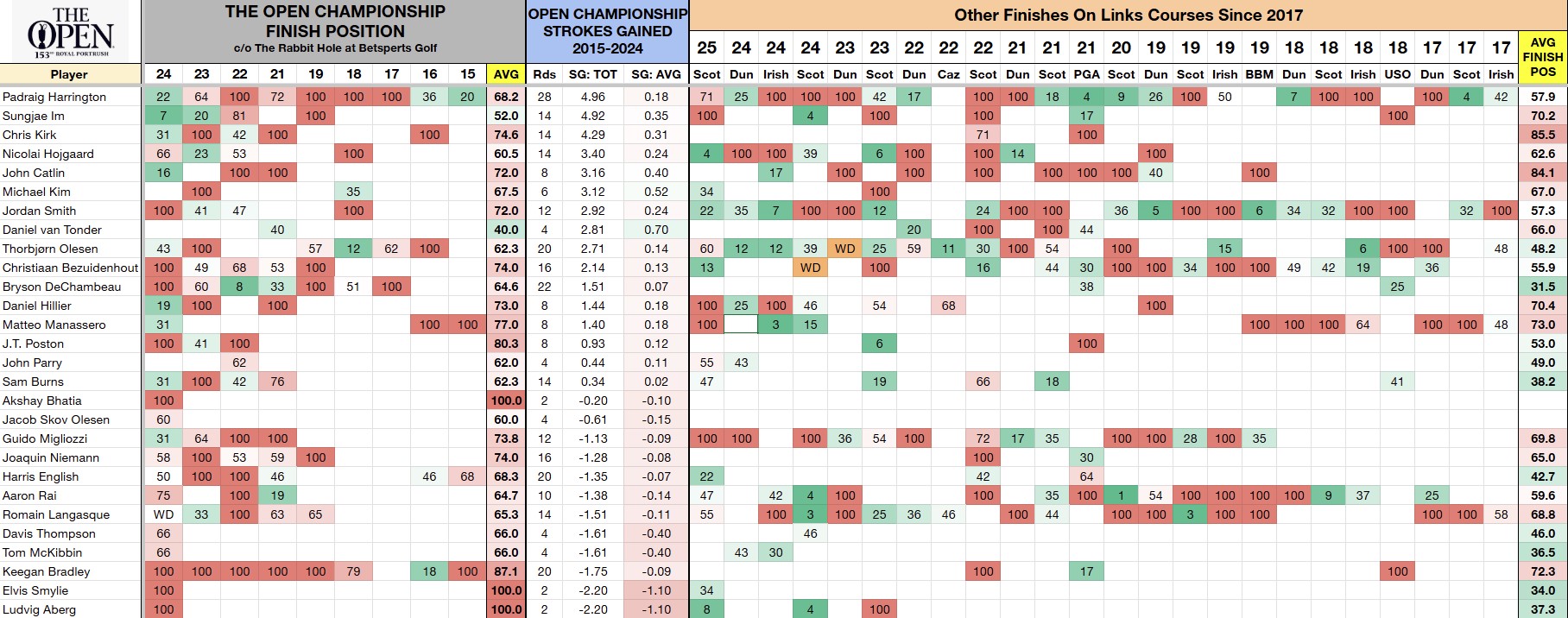
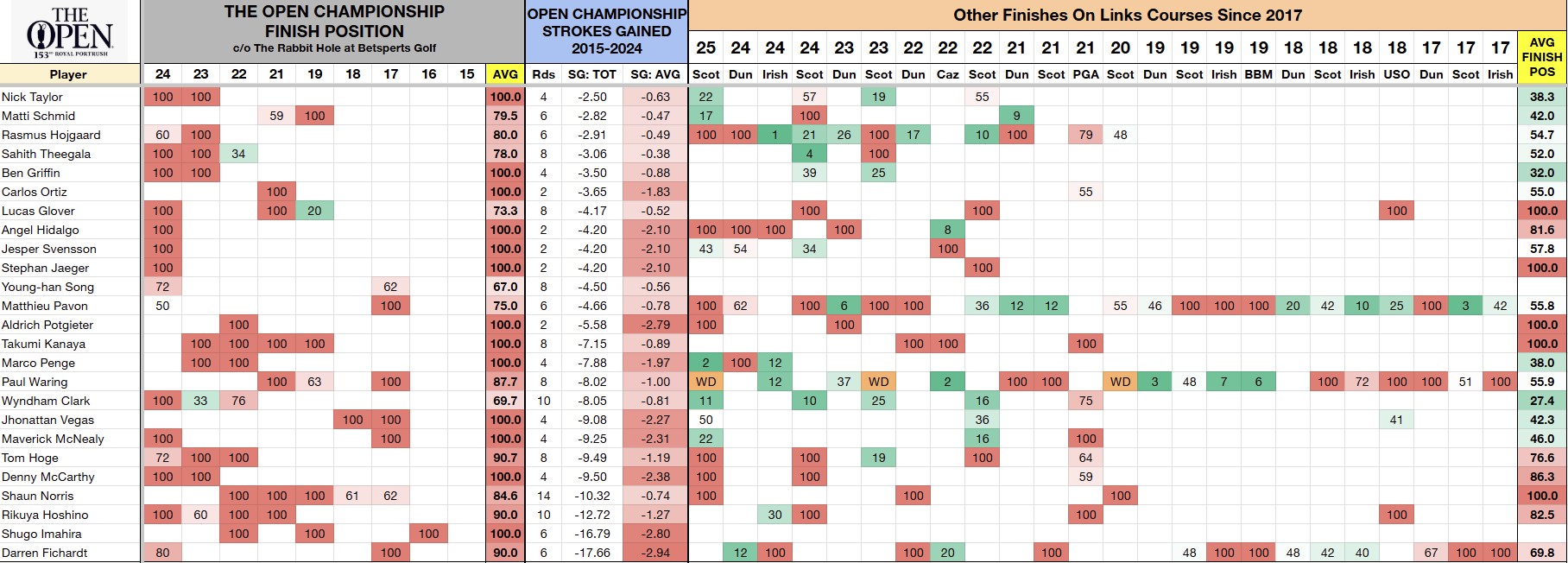
Finish Position and Strokes Gained Open Championship/Links History (2015-2024)
Combined Open Championship history since 2015. It includes average finish position and Strokes Gained per round. Players are sorted by SG: Total. Other links course history goes back to 2017 and includes the Scottish Open, Alfred Dunhill Links, Irish Open, 2022 Cazoo Classic, 2021 PGA Championship at Kiawah Island, 2019 Betfred British Masters, and the 2018 U.S. Open at Shinnecock Hills.
Course Features
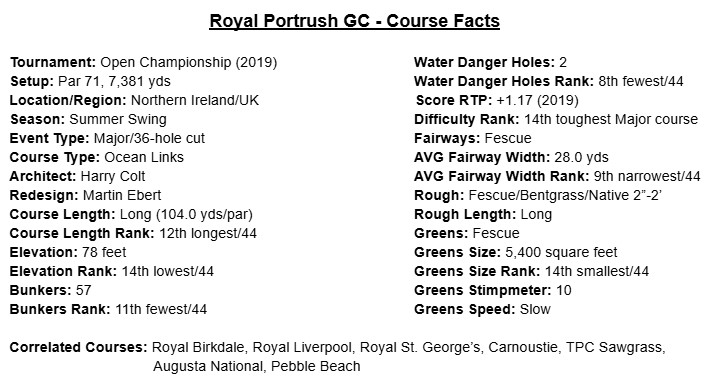
Royal Portrush is a par-71 course that measures 7,381 yards. It is very comparable in length to other recent Open courses, including Royal Liverpool, Royal St. George’s, and Royal Troon. Though the ball can run out significantly on the fairways, the course’s length still favors players who can carry the ball long distances and generate lofted, controlled approach shots into elevated greens.
While Royal Portrush is a true major championship test, it offers scoring opportunities for those in control of their game. Solid ball-striking can lead to low numbers, especially with firm fairways and accessible pins. But for players who are even slightly off with their ball-striking, the course can be brutally unforgiving—bogeys, or worse, can stack up quickly thanks to penal rough, tricky runoffs, and the ever-present wind off the Atlantic.
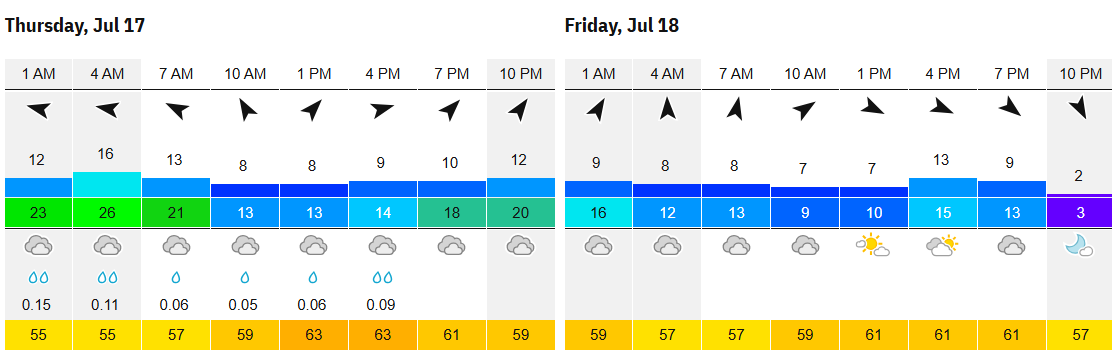
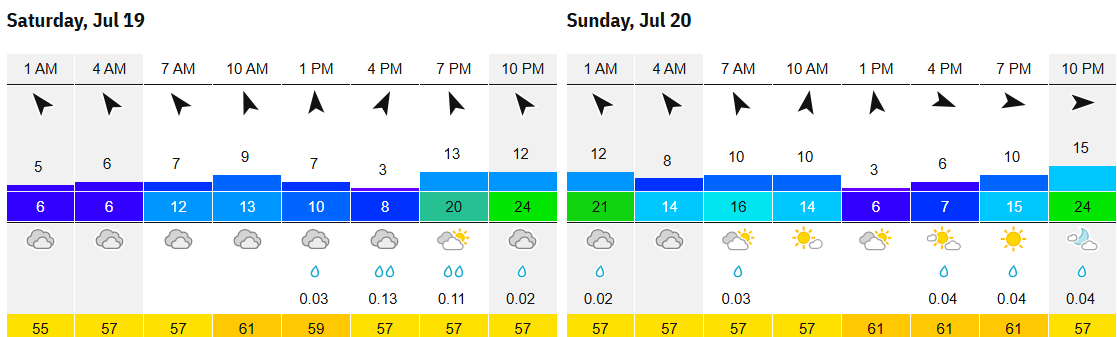
In 2019, the course played to an average of +1.17 per round. While the unpredictable weather will ultimately determine scoring conditions, the warm summer temperatures and clear skies over the last six weeks have helped to dry out the venue, with strong winds also playing their part in leaving fairways and greens in immaculate – albeit fast – condition. Though rain is in the forecast for the first part of the week, the course should play firmer and faster than it did in 2019.
Although the Open in 2019 was only one tournament, Royal Portrush produced a wider scoring gap than most Open rota venues, separating contenders from pretenders by rewarding quality shots and punishing mistakes. Shane Lowry won by six strokes over Tommy Fleetwood, and was the only player to finish double-digits under par.
The fairways nestle in natural valleys between the towering dunes. They pitch and zag through towering, lush sandhills, twisting and turning along the bluffs of the North Atlantic. The small greens blend perfectly into the landscape, one of Colt’s masterstrokes.
One of the most striking features of Royal Portrush is the relative lack of green-side bunkers. Even after the extensive course updates ahead of the 2019 Open, the Dunluce Links contains just 57 bunkers—by far the fewest of any course on The Open rota. Instead of relying on sand to challenge players, Portrush defends itself with dramatic elevation changes, grassy hummocks and hollows surrounding most greens, and the towering sandhills that shape and frame nearly every hole. Even though it was recreated from the old 17th hole, “Big Nellie”, a cavernous, revetted trap guarding the fairway on the right side of the par-5 7th, remains the most famous bunker on the course.
From an agronomic standpoint, greens and fairways are primarily composed of fescue grass. The first cut of rough is 2″ high and two yards wide and is a mixture of fescue, bentgrass, and indigenous grasses and wildflowers. Surrounding the fairways beyond the first cut is much thicker fescue, along with a myriad of other vegetation. When fescue is left to grow, it becomes wispy, thick, and penal. Balls can sit up one time and be completely buried the next.
Marram grass and other native dune vegetation are found on the high dunes and outer areas beyond the rough. Marram grass is tough, wiry, and nearly impossible to play from. It adds to the wild, natural aesthetic and poses a serious threat to wayward drives. Patches of heather and coastal shrubs like gorse may be found in less-maintained zones, especially beyond the dunes. These areas aren’t in play often, but when they are, it’s typically a lost ball or forced punch-out.
While a few blind shots add to the intrigue, most of the course is right in front of the player. The fairways provide enough width to be fair off the tee (28 yards wide on average), but wayward drives are still penalized, though perhaps less harshly than at some other Open venues. The rough is unpredictable and punishing, and the ever-present coastal wind can quickly turn a solid round into a scramble for survival.
Precision off the tee is paramount at Royal Portrush, where players must control the golf ball to steer clear of the scattered deep pot bunkers in the landing zones and the punishing rough. There are eight holes with doglegs at Royal Portrush, and with no trees to obstruct sightlines, players are often tempted to cut the corner off the tee. While this aggressive line can shorten the hole significantly, it brings real risk—an errant drive can easily find the thick native vegetation and penal rough that guard the edges of the fairways. On many of these doglegs, hitting a specific side of the fairway allows a better angle of attack into the greens, only increasing the need for accuracy.
Said Rory McIlroy on his plan of attack off the tee this week, “I have a real appreciation for how well bunkered it is off the tee. It’s like, okay, well, I can hit a 2-iron off the tee, but that brings this bunker into play. But then if I hit driver, it’ll bring this bunker — so you have to take on the shot. You have to say, okay, I’m going to commit to hitting this shot and I just know I’m going to have to avoid the bunker.”
Rickie Fowler, who finished T6 at 5-under-par in 2019, felt that the course challenged players in different ways. “I think this golf course is a great test,” he said. “It’s very different from what I’ve seen from a lot of traditional links golf courses. There are a lot of more forced carries and doglegs. It does force you to play the ball in the air a bit more and test your ball-striking.”
As Rory McIlroy found out on the first tee at the last Open here, there are five driving holes with out-of-bounds in play (first, second, fourth, fifth, 18th), only adding to the pressure and importance of finding the fairway off the tee.
While the term “second-shot course” is often overused, it genuinely applies at Royal Portrush, where approach play is even more critical than at many other venues on The Open rota. The combination of small, elevated greens, coastal winds, and challenging runoffs places a premium on precision with irons and wedges. Looking back at 2019, it is no surprise that Shane Lowry and Tommy Fleetwood, elite ball-strikers with excellent skill around the greens, finished atop the leaderboard.
Unlike most links courses that have large, flat greens where players can use the ground game to run the ball onto the greens with relatively straightforward recovery options, Portrush is an entirely different story. A majority of the holes require an aerial approach and demand flighted precision to avoid the penal green surrounds.
Said Tiger Woods, who missed the cut here in 2019, “The difference between this layout versus most of the Open layouts is that the ball seems to repel around the greens a lot. You’re going to have a lot of either bump-and-run chips or slow putts coming up the hills.”
Greens are also smaller here than typical links venues, at an average of only 5,400 square feet, and are much more undulating. At Royal Portrush, saving par can mean facing recovery shots from well below the level of the green. These tightly mown runoffs and tricky lies force players to get creative, with anything from a putter or lob wedge to an 8-iron or even a 5-wood. It’s a type of test many aren’t used to, and those who find themselves repeatedly in these spots simply won’t contend come Sunday.
Royal Portrush distinguishes itself from many traditional Irish and Scottish links courses through its dramatic dunes and sophisticated green complexes. While older links layouts were often “found” rather than built—utilizing flatter pockets of land among the dunes for greens—Portrush benefited from being developed later, during the Golden Age of golf architecture. The course reflects Colt’s advanced skill in shaping greens. Rather than relying on natural flat spots, Colt crafted dynamic, intricate green sites with complex, subtle undulations that introduce additional layers of strategy and challenge.
When discussing the other part of the course that stood out to him, McIlroy said this about the greens, “I’m always surprised when I come here how much movement there is on the greens. The greens are quite slopey here for a links golf course. You’re having to play two feet of break.” While there is plenty of movement on the greens at Portrush, they will be at a slower speed of 10 on the Stimpmeter.
Hole Preview
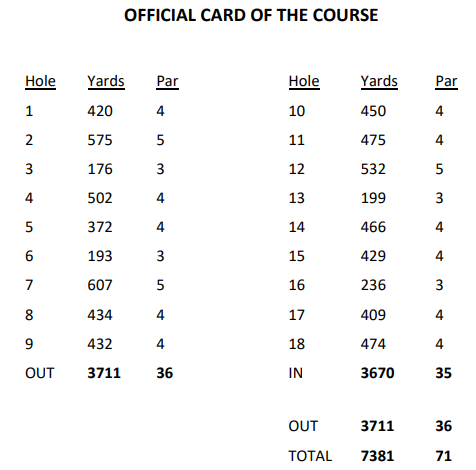
Royal Portrush presents a balanced and varied layout across its 18 holes, featuring four par 3s, 11 par 4s, and three par 5s. Each set of holes brings its unique character, demanding different skill sets and strategic decisions.
This course isn’t your typical out-and-back links. Outside of the opening stretch, the constant changes of direction rarely leave you playing into the wind for consecutive holes. That makes it extremely difficult for players to consistently judge conditions. The constantly shifting angles and elevation changes demand total commitment and adaptability on every shot.
The course opens by climbing steadily uphill and out toward the cliffs, delivering a string of unforgettable early shots that culminate at the dramatic 5th green. From there, the routing dips into the heart of the dunes for the visually stunning new 7th and 8th holes, with the white cliffs of the Antrim coast providing a breathtaking backdrop.
The middle stretch—holes 9, 10, and 11—shifts into a slightly different landscape, moving through less dramatic but still strategically rich dune corridors. Holes 12 through 15 maintain the intrigue with subtle elevation shifts and a mix of shot shapes, keeping the change in direction varied enough to stay engaging.
Then comes the unforgettable closing stretch—beginning with the legendary 16th, Calamity Corner, a long 236-yard, uphill par 3 over a huge ravine short and right, with mounds and hollows to the back and left of the green. It’s arguably the most intimidating par 3 in the world not set beside a body of water.
There are several signature holes on both the front and back nine. The fourth hole is a long par four that measures 480 yards from the championship tees, with out-of-bounds to the right and thick rough on the left. There are several bunkers in the undulating fairway, and the green is placed between two small sand hills.
The fifth hole is a relatively short downhill par four with a dogleg to the right. It has no bunkers but a heavily undulating green perched on the edge of a large drop down to the beach and has views across the White Rocks beach, and the Dunluce Castle, after which the course was named.
Most Important Stats For Success at Royal Portrush
*In order of importance
- SG: Approach (Difficult APP, Small Greens)
- Distance From Edge of Fairway/Driving Accuracy (Difficult OTT)
- Scrambling – Short Grass (Difficult ARG/Short Grass)
- Bogey Avoidance (Difficult Scoring)
- SG Total (Very Difficult/Difficult Scoring)
- SG: Open Championship/Links courses
- SG: Putting (Last 50 rds/Slow Greens)
- Total Driving
- SG: Wind 18+ mph
- Par 4 BoB% (Difficult Par 4s)
Key Rabbit Hole Filters
- Course Region: UK/Ireland, Coastal
- Scoring Conditions: Very Difficult
- Course Length: Long
- Field Strength: Very Strong
- Par: 71
- Event Type: Major
- Green Surface: Native
- Green Speed: Slow
- Green Size: Small
- Architect: Harry Colt
- Missed Fairway Penalty: High
- Rough Penalty: High
- Gain OTT: Very Difficult
- Gain APP: Very Difficult
- Gain ARG: Very Difficult
- Scrambling – Short Grass: Difficult
Weather Forecast – Portrush, Northern Ireland