2025 John Deere Classic at TPC Deere Run – Preview

Ron Klos

a year ago

The PGA Tour stays in the Midwest this week, shifting from Detroit in the city to a rural setting on the banks of the Rock River along the Illinois-Iowa border for the John Deere Classic. First held in 1971 as the Quad Cities Open, the tournament found a permanent home in 2000 at TPC Deere Run in Silvis, Illinois, where it has remained a steady fixture on the PGA Tour schedule.
Coming off a “birdie-fest” in Detroit, this week will present more of the same. Often turning into a putting contest and low-scoring shootout, TPC Deere Run features wide fairways, tight doglegs, receptive greens, and relatively straightforward putting surfaces. It is very scoreable for players who excel at managing their way strategically around the course, rather than trying to overpower it. It’s no surprise that each of the last 15 winners has finished at 18-under or better, including last year’s champion Davis Thompson, who set a tournament record at 28-under par.
While all playing styles can have success at TPC Deere Run, this course has favored fairway finders and accurate wedge players who can get streaky hot with their putter. Past winners such as J.T. Poston, Steve Stricker, Jordan Spieth, and Brian Harman exemplify these traits.
The Field

Due to its spot on the calendar, the John Deere Classic typically features one of the weaker fields on the PGA Tour schedule. This year, the tournament falls two weeks before the Open Championship, with most of the elite players choosing to rest for a second consecutive week before heading across the pond to play in next week’s Scottish Open. The field is headlined by world No. 17, Ben Griffin, who will be playing his 10th event in the last 11 weeks. Other players of note include last year’s winner, Davis Thompson, Sungjae Im, J.T. Poston, Denny McCarthy, Jason Day, Lucas Glover, and Stephan Jaeger.
TPC Deere Run – History
When descendants of the John Deere family donated the land to serve as the annual host of the John Deere Classic, course designer D.A. Weibring was the perfect architect for building the course. As an Illinois native and three-time PGA Tour champion of the Quad Cities Open, Weibring left the natural environment undisturbed as much as possible and at the same time incorporated a great mix of challenge and playability to all 18 holes. Looking back on the course he created, Weibring remarked, “It has all the things I think you’d like to have in a golf course. There are elevation changes, great views and scenery, and hardwood trees. You have the Rock River complemented with small ponds and deep ravines… and best of all, there’s no real estate.”
It wasn’t until 2020’s small renovation that any changes were made to TPC Deere Run. The course underwent a comprehensive bunker renovation and competitive enhancement project. Bunkers were completely rebuilt with new grass surrounds, drainage, liners, and sand, including reducing overall square footage by 30% and repositioning as needed to increase course strategy.
“We moved some of the bunkers into a more competitive aspect as to where we wanted them,” said Mark Peterson, the PGA Tour advance man who has been helping in preparing the course over the past month. “They made changes using statistics from recent tournaments as a guide to what needed to be adapted. They also tightened up some fairways.“
Additional changes completed in 2021 included tightening several fairways near key landing zones, adding difficulty for longer hitters. Greenside areas also saw numerous updates, including significant bunker renovations. “We recaptured a couple of greens in order to have some different hole locations,” noted Peterson.
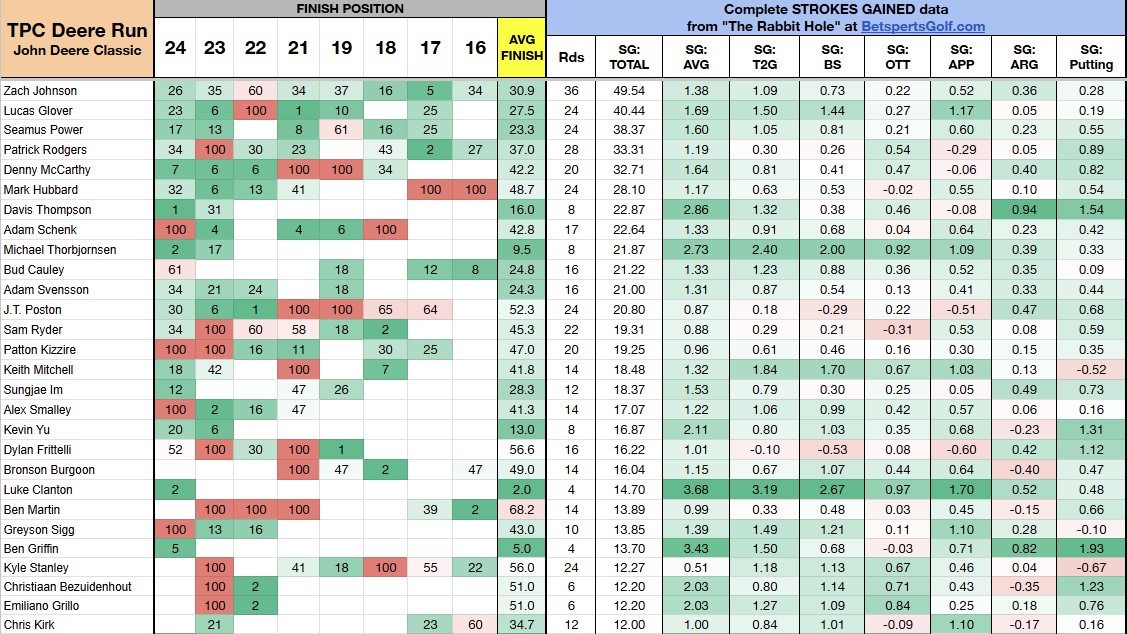
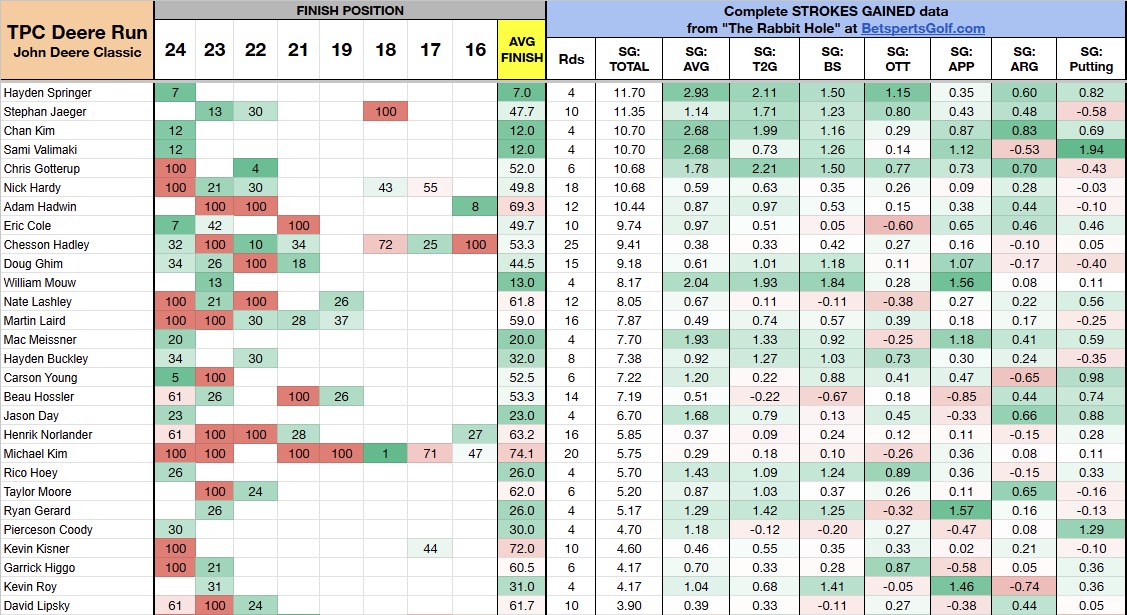
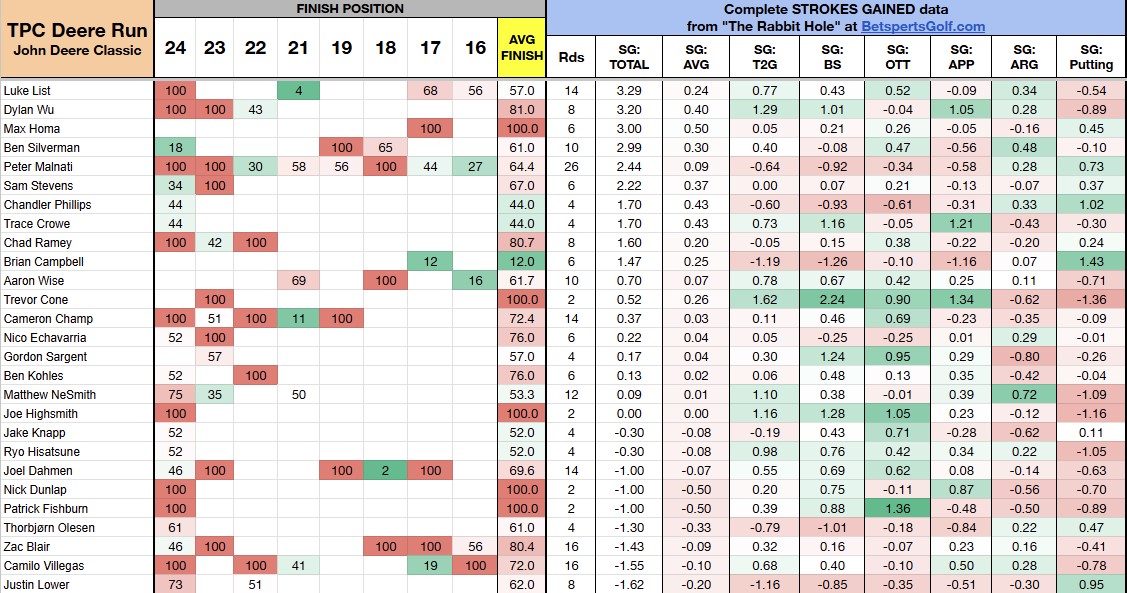
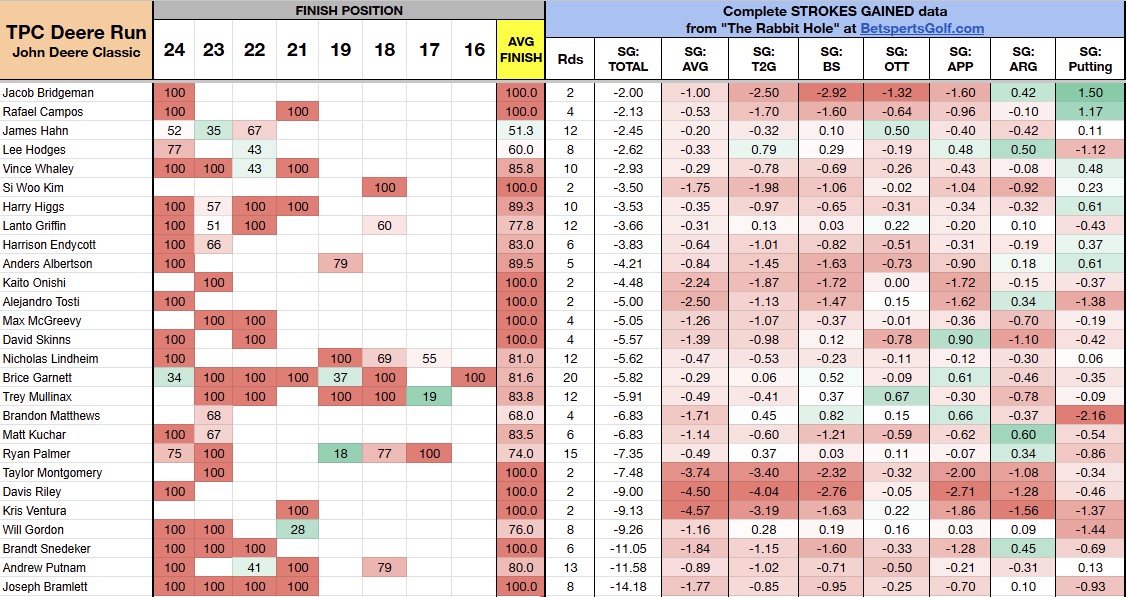
Finish Position and Strokes Gained History at TPC Deere Run (2016-2024)
This includes the average finish position and Strokes Gained per round since 2019 for each of the categories. Players are sorted by SG: Total. TPC Deere Run is the 14th least predictive annual course on Tour.
Course Features
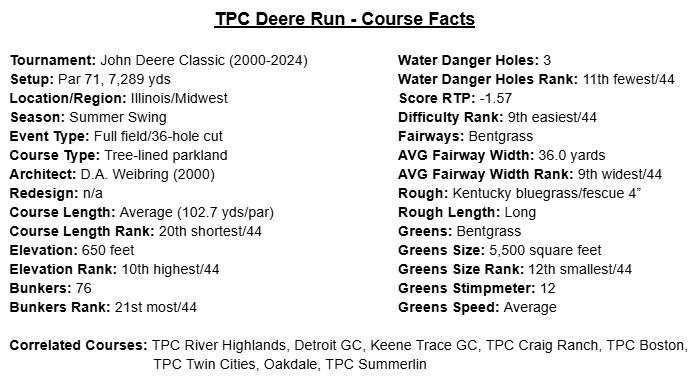
Located in the “Quad Cities” region of Silvis, Illinois, TPC Deere Run is a public par-71 course that measures 7,289 yards. Once home to an Arabian horse farm, the 385-acre property that now hosts TPC Deere Run is rich in American history. The land’s past includes Native American settlements, coal mining, cattle breeding, and farming. Located in one of the most rural settings on the Tour, the course is full of natural beauty, featuring rolling terrain along the Rock River, elevation changes, and perfectly framed oak trees, all highlighted by numerous ponds and ravines.
Despite receiving consistent praise from players and insiders, TPC Deere Run might be the most underrated annual stop on Tour. It hasn’t cracked any national top-100 public course rankings and lacks the cachet of a marquee location. TPC Deere Run thrives in its playability and fairness, making it a course that players enjoy but critics often overlook because it doesn’t emphasize “difficulty” or architectural boldness. The Iowa/Illinois border might not evoke images of beautiful hilly landscapes, but this course has fantastic routing and movement throughout the property as the holes switch directions back and forth. Like all TPC courses, it is gorgeously maintained with bentgrass fairways, Kentucky bluegrass rough, and bentgrass greens.
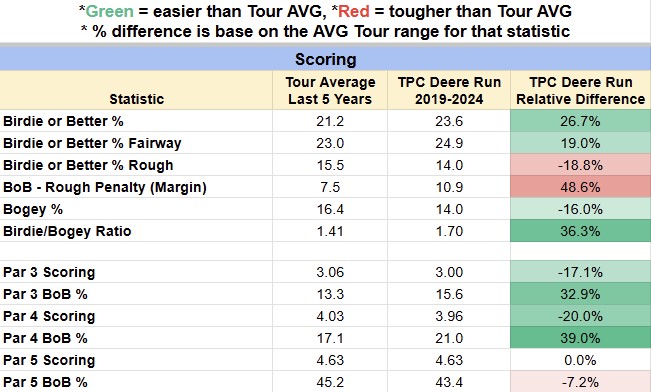
While TPC Deere Run is not a challenging course, the sloping fairways, the elevation changes, and the tight dogleg holes will ask players to use their entire bag of clubs. Over the past five events, it has averaged -1.57 per round, making it the ninth easiest course played in the Tour’s annual rotation.
As for what type of player should have success at TPC Deere Run, Weibring said, “The course rewards a guy who shapes the ball well into the greens and hits a lot of quality shots. It’s not a place where you can fool anyone. It’s a good, straightforward golf course, no tricks. It’s a shot-maker’s course.” A wide range of player types have found success at TPC Deere Run over the years, a testament to the quality and balance of the course. The winning formula consistently revolves around precise iron play and getting hot with the putter.
Says two-time John Deere winner, Steve Stricker, “Guys enjoy coming and playing. It’s there in front of you. It’s not tricked up. It’s fair. If conditions are favorable, then good scores are going to be shot.” Because the grounds crew must heavily water the greens during the hot July summer to keep them from drying out, the surfaces typically stay soft and receptive—offering players easier targets to attack the flagsticks.
The course’s main defense lies in its 4″ mix of Kentucky bluegrass and fescue rough. This rough is much more penal than the rough in Detroit, ranking as the third toughest course on approach from the thick grass. Although the fairways are wide, subtle undulations in key areas often funnel drives toward the rough. The course also ‘gently’ fights back with numerous elevated greens, surrounded by tricky short-grass runoff zones that test precision around the edges.
Hole Preview
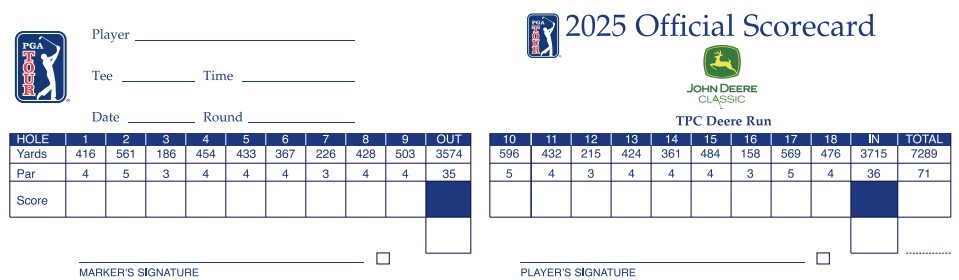
The course has three par-5s, four par-3s, and 11 par-4s. The par-3s are longer and more difficult, with three of the four averaging over par. Eight of the par-4s are under 445 yards. All three of the par-5s are in the 550-600 yard range and should be reachable in two shots. The Birdie or Better rate is almost 44% on just those three holes. This is one of the reasons that shorter hitters love this course.
While TPC Deere Run doesn’t feature a signature three-hole stretch, each hole offers its own distinct character. Take the par-4 fourth, for example, where a massive oak tree stands prominently in the center of the fairway, forcing players to carefully strategize their tee shot placement.
The par-3 16th hole is known as the signature hole at TPC Deere Run. Measuring 158 yards from the back, the green is situated next to a cliff that leads down to the Rock River. The 17th hole is a reachable par-5 with a unique green that has a 3% eagle rate. The finishing 18th hole is a daunting par-4 with a tough tee shot and water guarding the left side of the green.
Strokes Gained Analysis
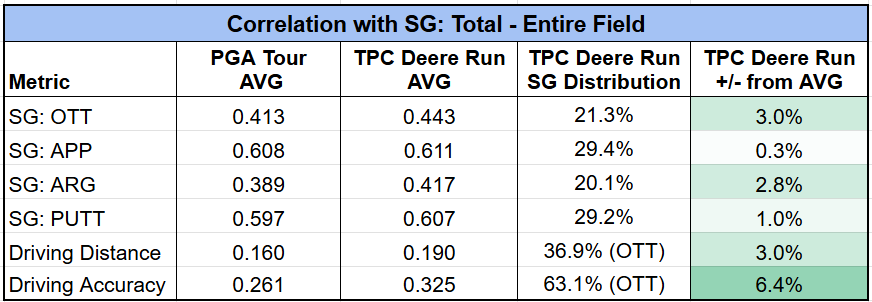
Off the Tee
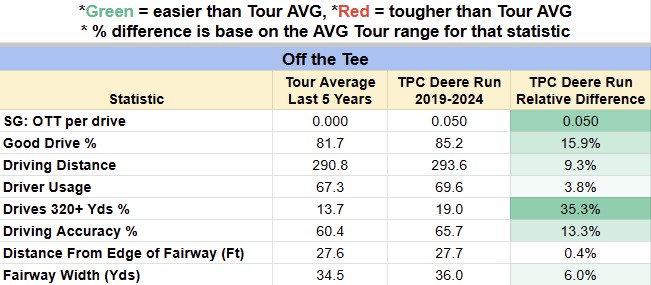
Even with generous and forgiving fairways that average over 36 yards wide, TPC Deere Run is typically not a course that bombers can overpower. While tree-lined, TPC Deere Run isn’t overly tight off the tee. On several holes, the smartest play is to lay back and avoid the course’s trouble spots. Straying from the fairways can be costly, with thick 4-inch rough, strategic fairway bunkers, and creative mounding that produces uneven lies. With a number of doglegs throughout the layout, the ability to shape shots off the tee is a definite advantage.
Overall, TPC Deere Run is among the top-5 easiest courses to gain strokes off the tee on Tour. Over the last three years, driver usage has averaged 72%, while driving accuracy sits at almost 66%. It has the second-highest rough penalty of any course, which is why players are more conservative off the tee on certain holes. The GIR rate drops from 80% from the fairway to only 55% when hitting from the rough or bunkers.
The list of past winners is full of shorter, more accurate drivers. Golfers who keep their ball in the fairway will be best able to attack the soft and receptive greens on approach. Last year, 18 of the top 20 finishers gained strokes off the tee. In 2023, every player in the top five gained at least three strokes off the tee, including two of the shorter and more accurate drivers on Tour, J.T. Poston and Christiaan Bezuidenhout.
Approach
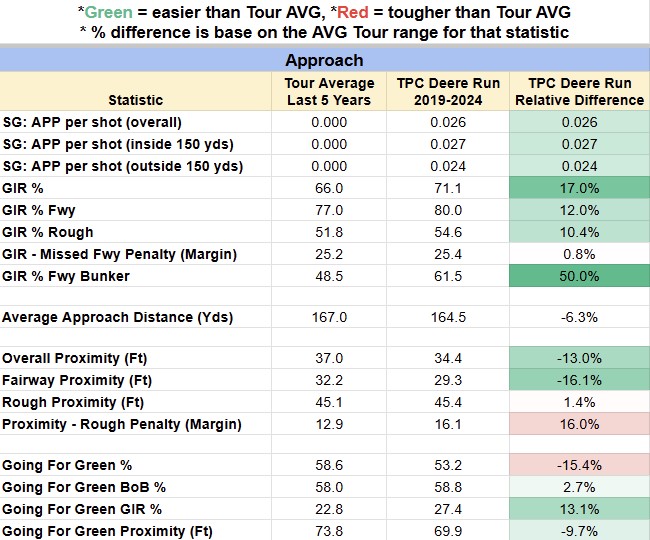
With 43% of all approach shots coming from inside 150 yards, accuracy with wedges to set up shorter birdie chances will be vital this week. While the average GIR rate of 71% shows that the greens are easy to hit, their shape tends to be long and narrow. Five of them are around 40 yards from front to back. This means a premium on distance control to generate those easier birdie opportunities.
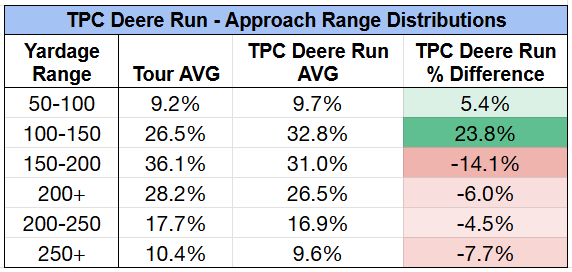
Underscoring the importance of hitting fairways at TPC Deere Run, approach shots from the short grass average just 29 feet to the hole, compared to 45 feet from the rough. That 16% gap—known as the “Rough Penalty” — ranks among the highest on Tour.
Around the Green and Putting
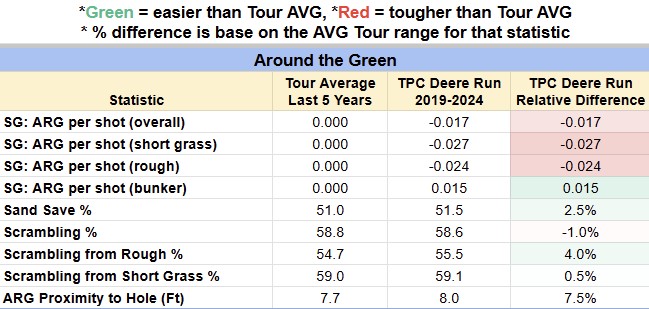
One design feature at TPC Deere Run that continues to puzzle players is the use of short-grass collection areas. Despite high greens-in-regulation rates, the course consistently ranks as one of the toughest tests around the green, demanding touch, precision, and creativity from players in these tricky spots.
Many greens are elevated, which causes misses to be propelled down shaved slopes to runoff areas below the greens. Also, the greenside bunkers are fairly deep, and the rough is thick. In any “birdie-fest” type of event, avoiding bogeys and being able to scramble for pars when necessary is the key to keeping the momentum to move up the leaderboard.
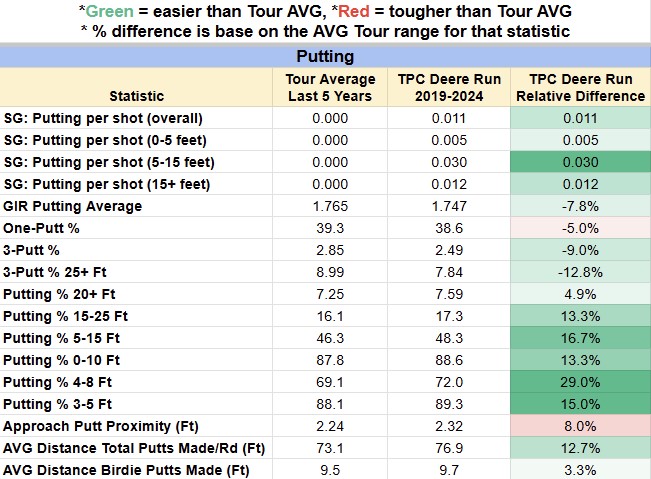
The greens at TPC Deere Run feature some slope but are generally straightforward and among the easiest to read on Tour. With minimal tiering and few dramatic ridges, longer putts have a better chance of finding the hole, contributing to a low 3-putt rate of just 2.49%. As a subtle but consistent influence, many putts tend to break toward the nearby Rock River, which wraps around the course.
Past winners at this event include both superior putters like J.T. Poston, Steve Stricker, Jordan Spieth, and Zach Johnson, and below-average putters like Lucas Glover, Ryan Moore, and Dylan Frittelli. With such a high GIR% and most approaches being wedges into soft greens, this typically turns into a putting contest. Consistently making 5 to 15-foot putts is paramount. Back in 2019, the winner, Dylan Frittelli, made 60 out of 62 putts from inside 10 feet. Three years ago, third-place finisher Emiliano Grillo made 66 out of 68. The last six winners have gained an average of seven strokes putting for the tournament. In 2023, Sepp Straka gained 6.8 with his flat stick. Last year, Davis Thompson gained 7.44.
Most Important Stats For Success at TPC Deere Run
*In order of importance
- Birdie or Better% (Easy Scoring)
- SG: Approach
- SG: Putting (Bent)
- SG: Easy/Very Easy Scoring
- Proximity: 75-150 yds
- Distance From Edge of Fairway (DFEF)
- Par 4 BoB% (Easy Par 4s)
- SG: ARG (Difficult to gain ARG)
- Good Drive% (Long Rough)
- Putting %: 5-15 feet
Key Rabbit Hole Filters
- Course Region: Midwest
- Course Type: TPC
- Scoring Conditions: Very Easy
- Course Length: Short
- Field Strength: Weak/Very Weak
- Field Size: Full Field
- Greens Surface: Bent
- Green Size: Small
- Rough Surface: Bluegrass
- Rough Length: Long
- Rough Penalty: High
- Gain OTT: Easy/Very Easy
- Gain APP: Easy
- Fairway Accuracy: Easy
- GIR Accuracy: Easy
- Scrambling – Short Grass: Difficult
- Gain Putting: Very Easy
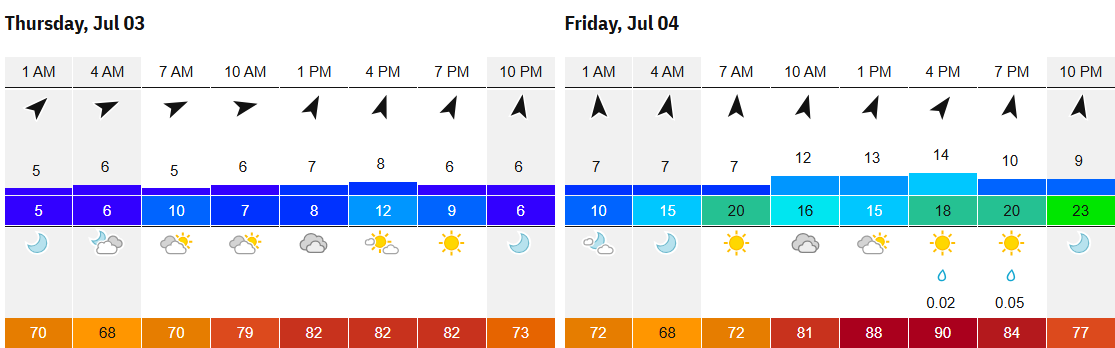
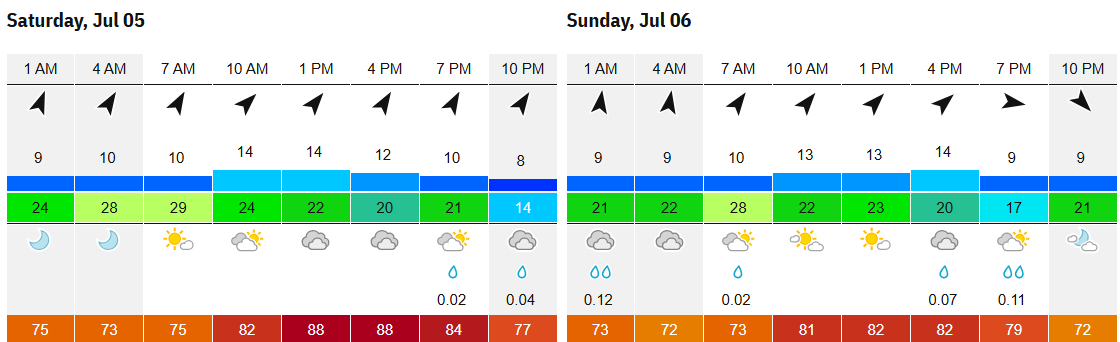
Weather Forecast – Silvis, Illinois