
2025 3M Open at TPC Twin Cities – Preview

Ron Klos

a year ago
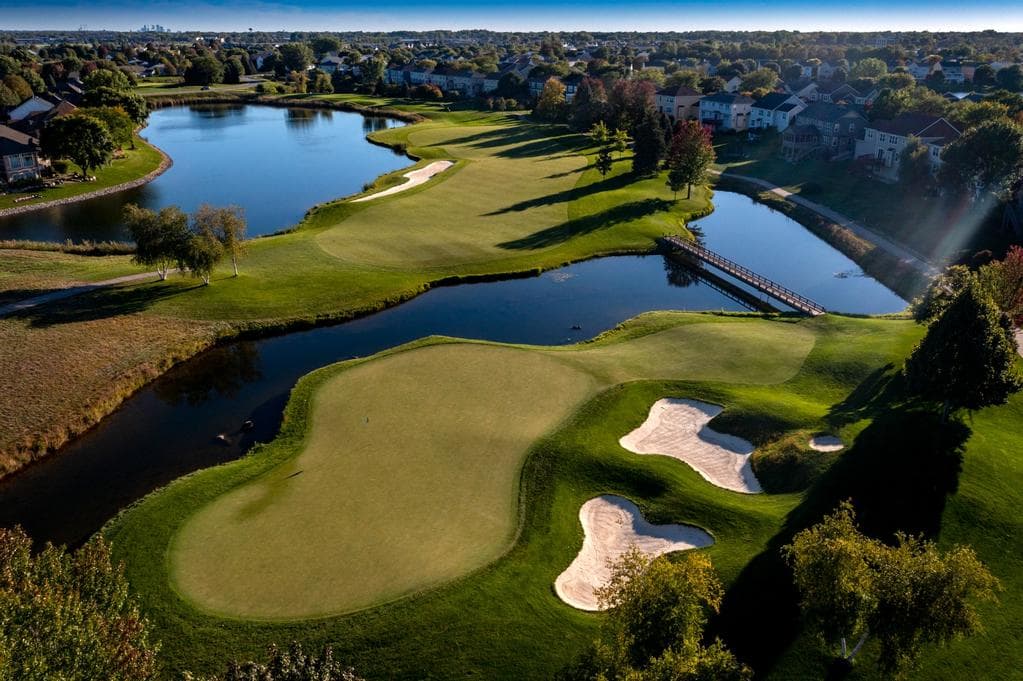
The PGA Tour heads back stateside for the inevitable post-major letdown and the 3M Open held at TPC Twin Cities. Designed by the legendary golfer and architect Arnold Palmer, the course was laid out on a 235-acre tract of property on the site of a former sod farm in the Minneapolis suburb of Blaine, Minnesota.
After two straight events on links-style courses, the 3M Open also signals a return to the familiar confines of parkland-style golf. But TPC Twin Cities is not your typical parkland course. With 27 different bodies of water spread throughout the property, along with a full-sized housing development, it appears more like a “Florida” course than one in the upper Midwest.
While TPC Twin Cities has one of the highest birdie rates on Tour, it also has one of the highest “double-bogey or worse” rates, as the multitude of water hazards and thick rough present a challenge to those not in good form. This course also features numerous “risk-reward” holes, which provide excitement, along with a challenging final stretch of holes that will ensure no lead is safe on Sunday.
As the ninth-longest course on Tour and with water threatening tee shots on nine different holes, this layout places a premium on both distance and accuracy. Players who excel in Total Driving will hold a significant advantage. This is evidenced by four excellent drivers off the tee among past winners in Jhonattan Vegas, Tony Finau, Cameron Champ, and Matt Wolff. When factoring in the importance of gaining strokes on approach, TPC Twin Cities emerges as one of the most ball-striking-dependent courses on Tour, with a notable 59% of total strokes gained coming from this category.
2020 winner, Michael Thompson, summed up the mental aspect of TPC Twin Cities quite well. “It is very much like PGA National. You know what shots you have to hit. There’s no if, and or but about it, you’ve just got to step up and hit the shot, and execute. If you’re not confident over the ball, you’re more likely to make a poor swing, which is going to result in a penalty. So you have to be really diligent with your visualizations, your commitment to each shot, pick your target, and trust it.”
The Field

The week after a major typically tends to struggle to attract big names. For this week’s 3M Open, only eight of the top 40 players in the world are in attendance. There is a small upper tier of favorites headlined by Sam Burns, Maverick McNealy, Chris Gotterup, Tony Finau, Wyndham Clark, Akshay Bhatia, Max Greyserman, and Taylor Pendrith.
As we head down the final stretch of the season and the typical weaker fields that come along with it, there is still a massive amount of FedEx Cup points on the line. Motivation becomes a real intangible this time of year as many players will be trying to either qualify or better their position with just two events remaining before the FedExCup Playoffs begin. And with the FedExCup Playoffs limited to just the top 70 players this year, several golfers hovering around the bubble arrive in Minnesota with their seasons on the line — playing in full desperation mode. This includes golfers like Adam Scott, Sungjae Im, Max Homa, Tom Kim, and Rickie Fowler.
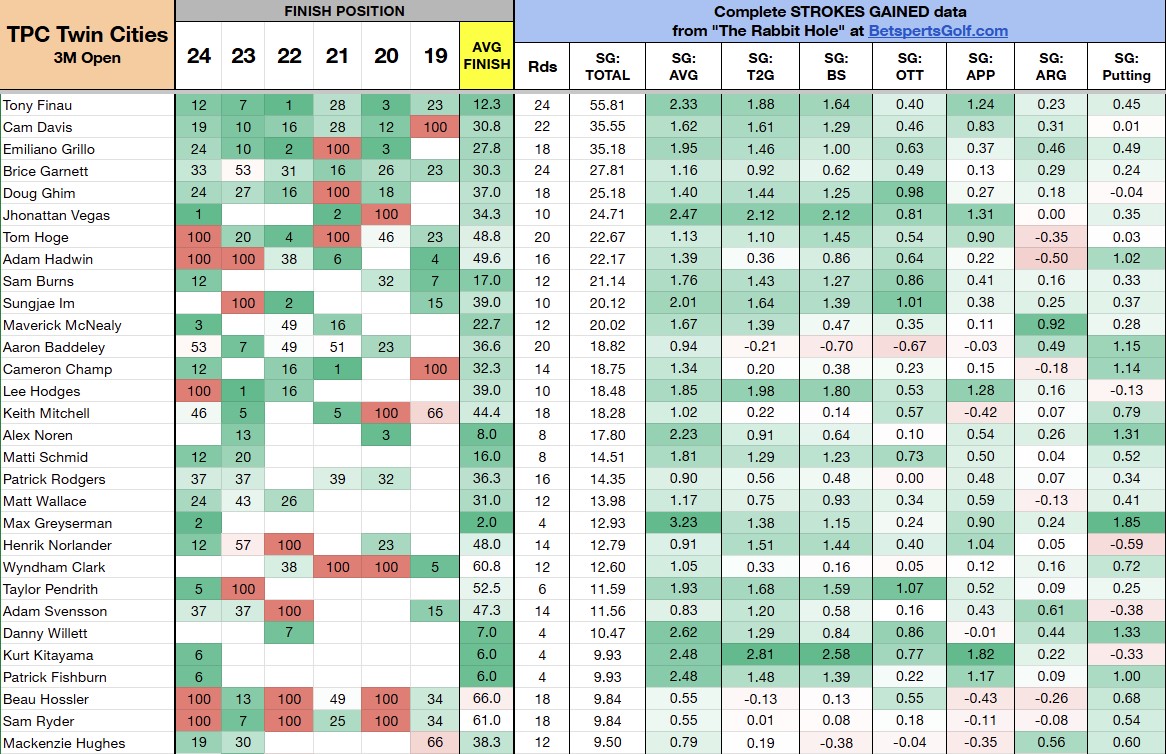
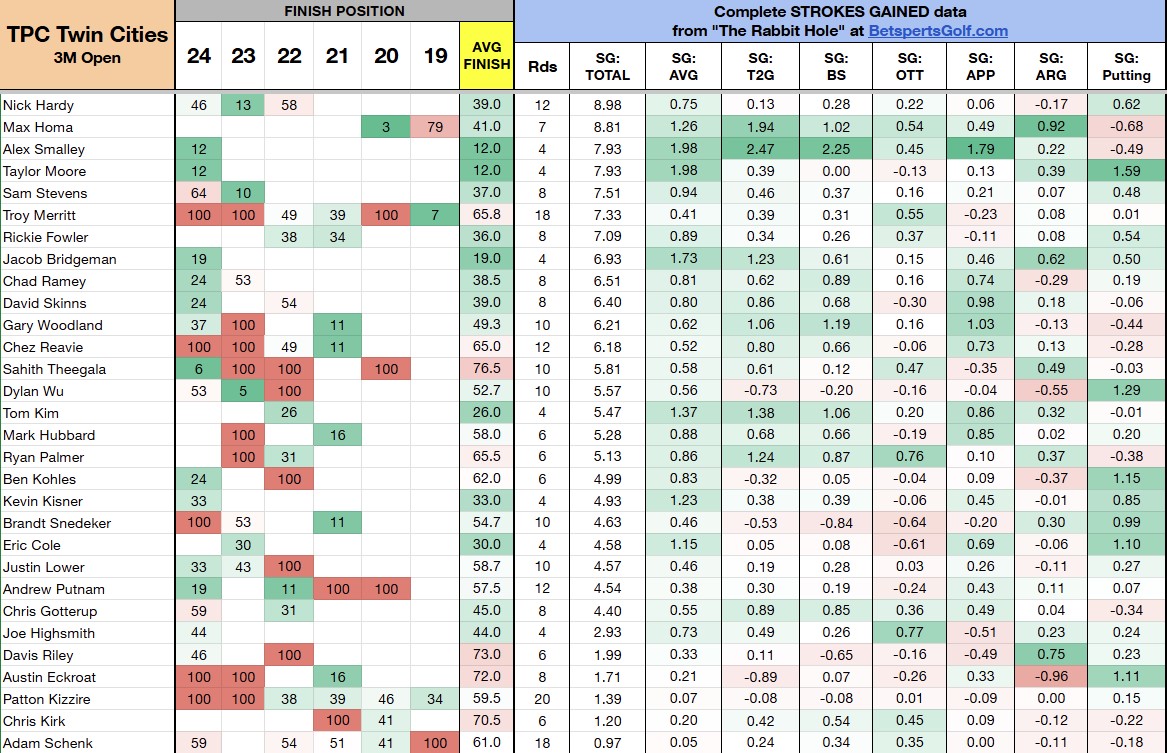
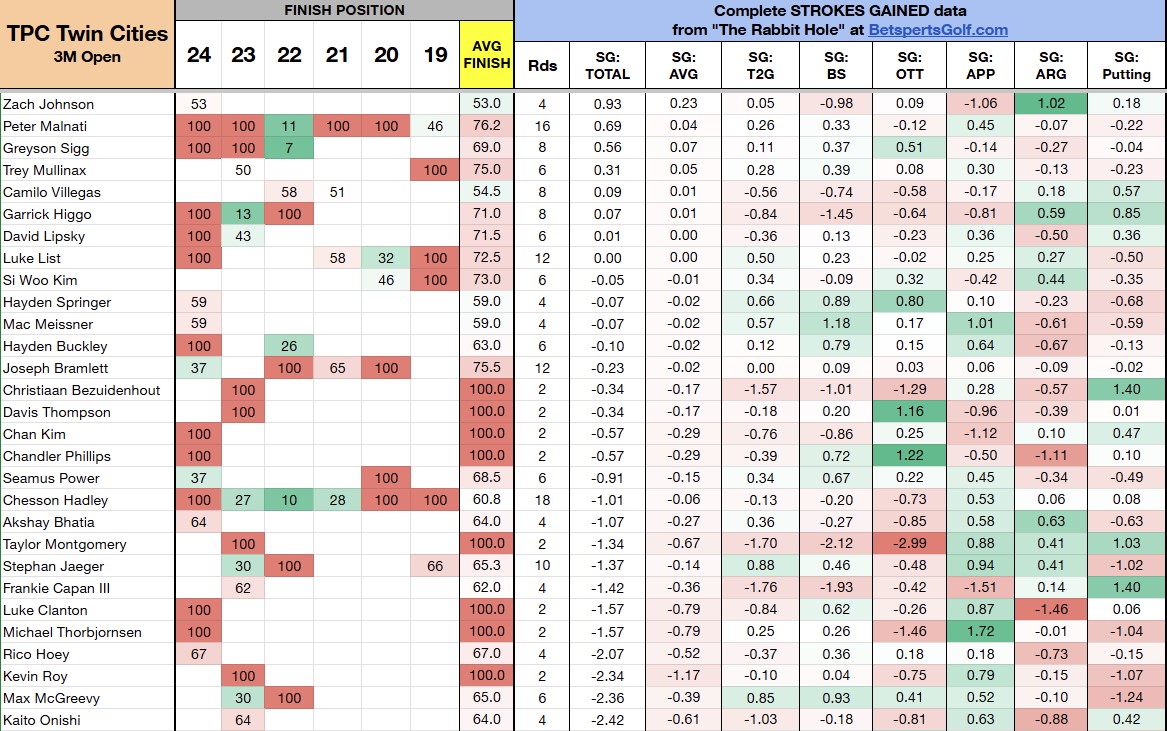
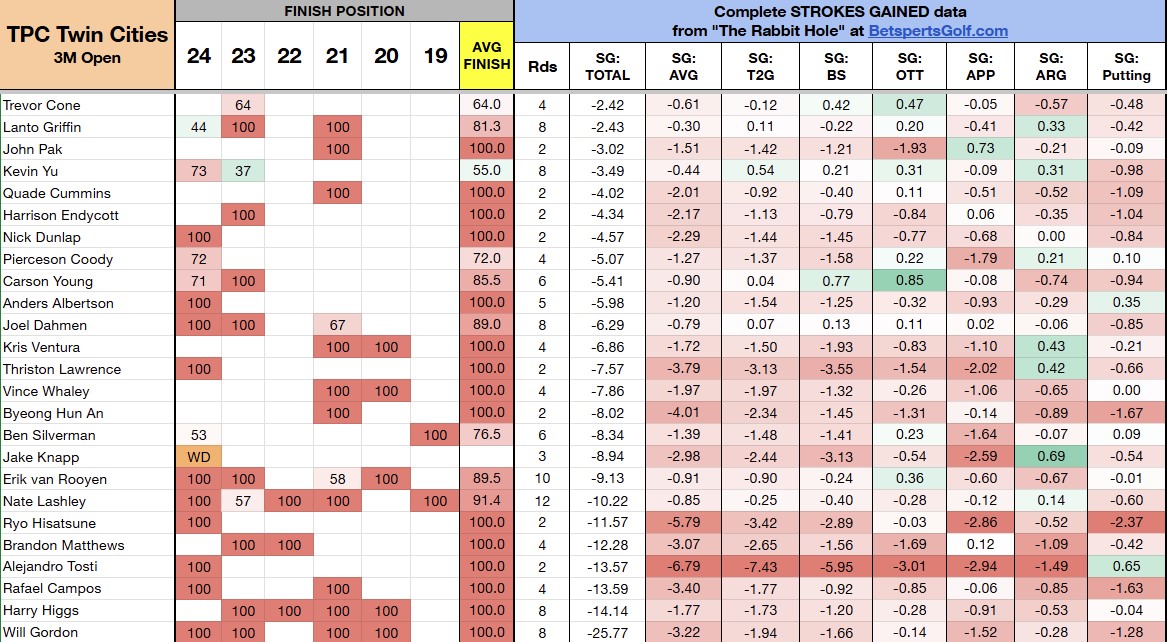
Finish Position and Strokes Gained History at TPC Twin Cities (2019-2024)
This includes the average finish position and Strokes Gained per round since 2019 for each of the categories. Players are sorted by SG: Total. TPC Twin Cities is the 15th least predictive annual course on Tour.
Course Features
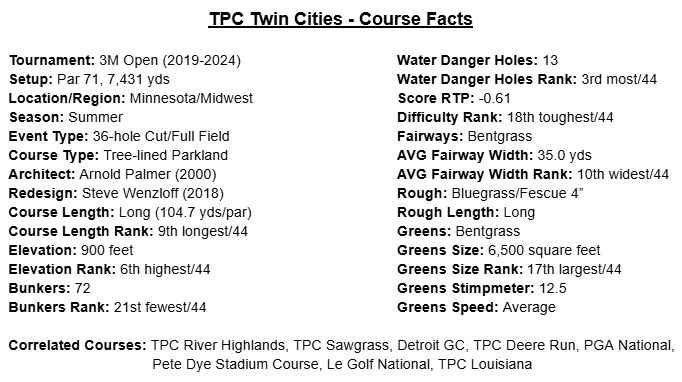
Located in the “Land of 10,000 Lakes,” TPC Twin Cities is a relatively flat par-71 layout stretching 7,431 yards. The course features bentgrass fairways and greens, native prairie grasses, and 27 bodies of water framed by mature oak, spruce, and pine trees. Architecturally, TPC Twin Cities tends to fall flat. Many holes blend together due to the repetitive use of water hazards, giving the course a Florida-like feel despite its Midwestern setting. The abundance of homes lining the fairways also detracts from the natural beauty of the property, making the overall experience feel more manufactured than memorable.
Before the inaugural event back in 2019, tournament founder Hollis Cavner gave a brutally honest description of how organizers wanted the 3M Open to play by saying, “We want birdies and train wrecks, and we don’t want to be the hardest golf course on the tour”. While the course features tons of birdies and low scoring, the data points to it not being a complete “birdie-fest.” Thanks to all of the danger off the tee, longer rough, and a typically firm course (if weather permits), the scoring average per round since 2019 is only -0.61.
TPC Twin Cities has always emphasized positioning off the tee — setting up aggressive approaches to tucked pins while carefully navigating the 13 water hazards in play. Stray drives that end up in the water tend to lead to a bogey or worse. Said Adam Long who has three top-25s here, “There’s a lot of intimidating shots out there. There’s room to miss and stuff, but there’s a lot of water out there as we saw the first few days. It’s kind of in your face, you can’t avoid it. You just have to kind of step up and hit a golf shot a lot of times out there. So it provides a lot of birdies, but it’s also pretty visually intimidating.”
Despite its reputation as a scoreable layout, TPC Twin Cities ranks sixth in penalty strokes per round and records more water balls than any other course on Tour — elevating the importance of tee shot control and Bogey Avoidance compared to typical birdie-friendly tracks. Additionally, with the course not fully tree-lined, the open layout allows wind to play a larger role — something that was especially evident during the 2022 tournament.
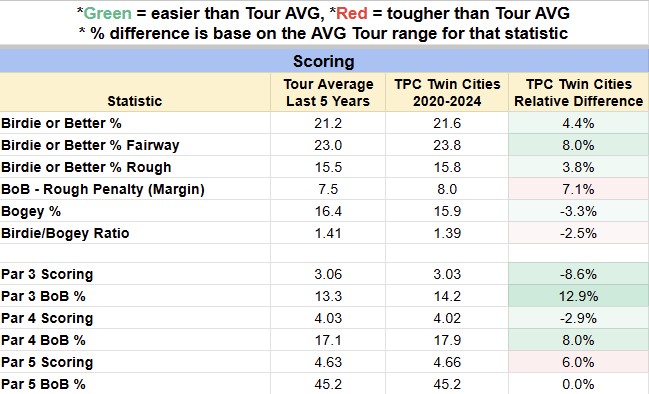
Nevertheless, in line with other low-scoring events like the John Deere and Rocket Mortgage Classics, TPC Twin Cities is expected to produce ample birdie opportunities and a winning score likely reaching the high teens or better. In 2023, Lee Hodges ran away with the trophy and won by seven strokes at 24-under. With the greens typically playing very soft and receptive, it comes down to a test of who can keep their ball dry off the tee followed by a ball-striking and a putting contest.
From an agronomy standpoint, the rough is a four-inch blend of bluegrass and fescue. Fairways and greens are pure bentgrass with the greens running at around 12.5 on the stimpmeter. Greens are average in size at 6,500 square feet.
Hole Preview
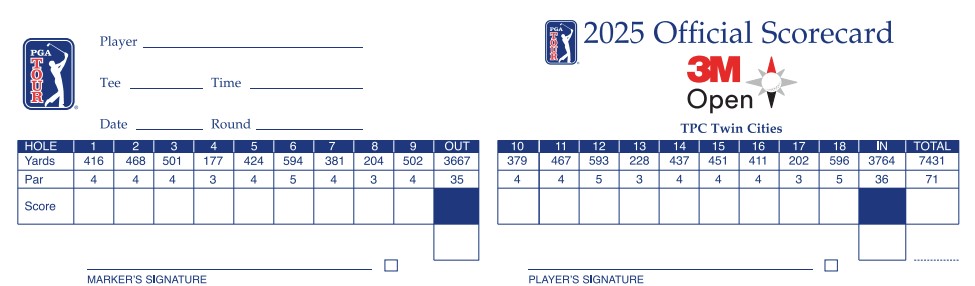
The layout includes four par-3s, three of which are over 200 yards. They rank as three of the eight toughest holes on the course. Each of the three par-5s plays between 590-600 yards. Even with that length, each is quite reachable in two shots. One reason the eagle rate is only around 2.4% on these holes is that they are the toughest set of par-5s on Tour in proximity to the hole when going for the green at an average of 96 feet. No other annual PGA Tour course is within nine feet of that number.
The 11 par-4s on the course are among the easiest on Tour and average under par. Six of them have a birdie or better rate of over 20%. Two are under 400 yards, and the par-4 16th hole is often pushed closer so that it becomes a drivable hole, which adds to the weekend drama on the final stretch of holes. Not shockingly, it is the five longer par-4s, each with water hazards, that have a bogey or worse rate of at least 17%. Players who can survive those holes and manage to gain strokes on the field will have a distinct advantage.
The second hole at TPC Twin Cities is one of the toughest par-4s on Tour with a scoring average of 4.42. Players found the water off the tee an incredible 73 times – or 16% of all tee shots. This led to 43 double bogeys and nine triple bogeys. No other hole on Tour yielded more than 26 doubles and four triples or worse. Water comes into play on numerous holes down the stretch. None more so than the par-5 18th hole, where to reach the green in two shots, players must thread the needle with the driver off the tee to find the fairway. This leaves them with a shorter iron into the green.
Strokes Gained Analysis
Off the Tee
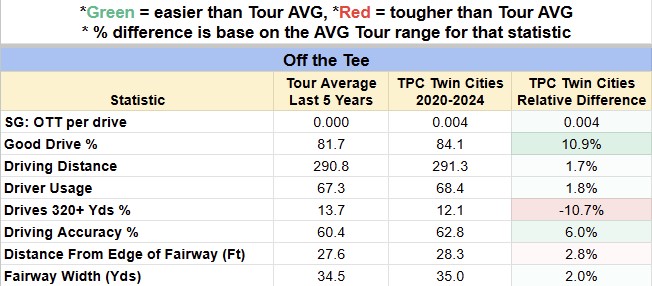
TPC Twin Cities is among the top-10 courses on Tour with the highest rate of strokes gained off the tee. With the 10th widest fairways on Tour averaging 35 yards on average, landing areas are substantial enough so that anyone finding the water is striking the ball very poorly. Given how many penal areas there are with water coming into play on nine of 14 drives off the tee, hitting fairways is truly at a premium this week. A few holes require a forced layup due to either bunkers pinching into the landing zone or water playing too big of a risk to hit over the top. Last year, 31 of the top 36 on the leaderboard gained strokes off the tee through accuracy.
While some players consistently view the water as a mental obstacle, it’s those contributing to the ‘splash parties’ who are largely responsible for a driving accuracy rate that hovers only slightly above average.” That being said, TPC Twin Cities is not a Pete Dye-type course where you must have a proper angle to the green to experience success. Simply finding the fairway will allow for scoring opportunities. Said Rickie Fowler on the keys to success here, “Hit the fairway, hit the green, you’re going to be okay. Big thing here, keep it out of the water. There’s a handful of little lakes, ponds that come into play, but drive the ball well, you’re going to have plenty of opportunities to make birdies.”
Distance isn’t mandatory to contend at TPC Twin Cities, but with seven holes measuring over 465 yards, longer hitters do gain a noticeable edge. While the data shows that players here are only slightly above average distance-wise, players who confidently strike the ball off the tee with a combination of distance and accuracy (Total Driving) have the best chance at success. And when looking at the list of past champions, the bomber narrative makes sense.
Approach
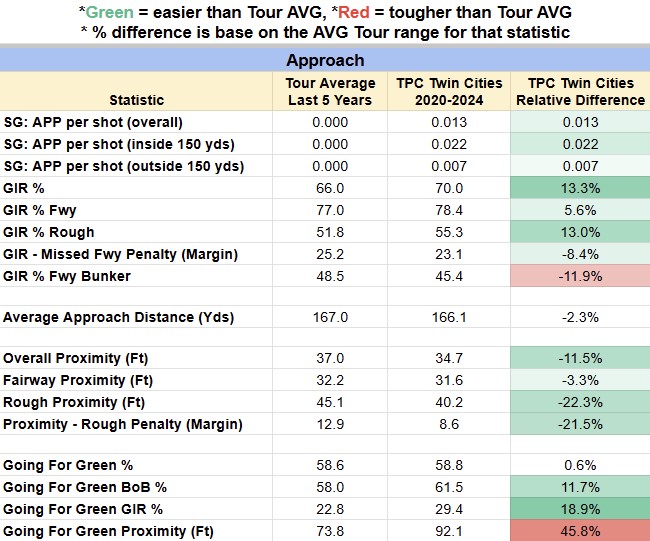
With easy-to-hit fairways, the thicker-than-average rough has not been as much of a factor in limiting greens in regulation percentage. With the GIR rate at 71%, golfers who keep their ball dry should have no trouble gaining birdie opportunities.
Over the past three events at TPC Twin Cities, 46% of approach shots have come from over 175 yards. With the green complexes lacking difficulty, proximity averages to the hole are also much easier than the Tour average. Overall, this is the eighth easiest course in which to gain strokes on approach.
Around the Green and Putting
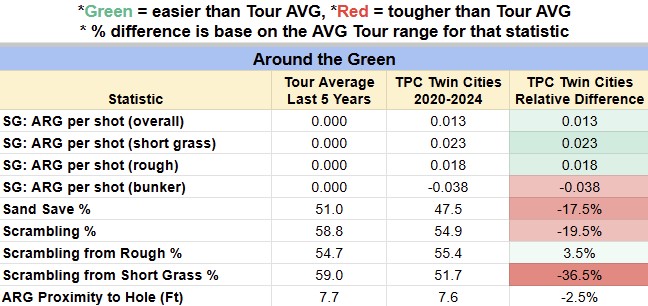
With such a high GIR%, gaining strokes around the green will not factor into the scoring much this week. That being said, while the chances might be less, the data does show that areas surrounding the greens, especially the short-grass areas, can be a challenge. Both sand save and scrambling rates are 2-3% tougher than average, with the tight-lied areas from the fairway being the most difficult. Looking back at history at this event, 2022’s winner, Cameron Champ, lost strokes around the green. No one in the top-10 overall on the leaderboard finished in the top-15 around the green. 2020’s winner, Michael Thompson also lost strokes in this area.
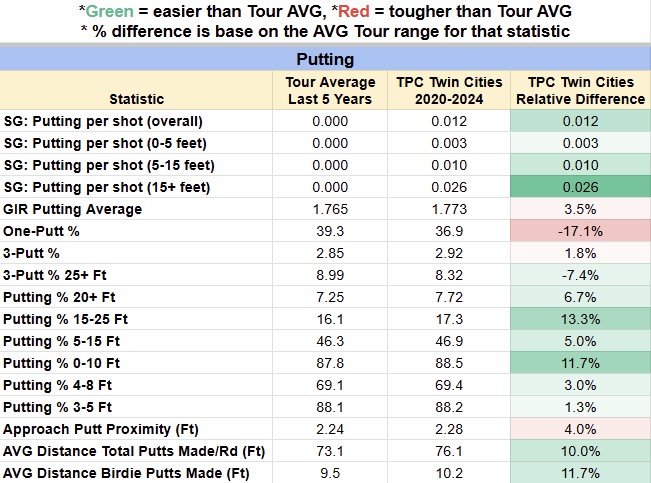
The greens do not have many undulations and typically get rave reviews from players as some of the smoothest-running greens on Tour. Compared to the averages in all the major putting categories, it ranks as one of the easiest on Tour. Everything from 3-putt % to putts made from the all-important 5-15 foot range is easier than average. Of course, with the majority of players gaining birdie looks on the greens, whoever can make the most putts is often one of the deciding factors as to who wins the tournament.
Most Important Stats For Success at TPC Twin Cities
*In order of importance
- Course Region: Midwest
- Scoring Conditions: Easy/Average
- Course Length: Long
- Field Strength: Weak
- Field Size: Full Field
- Water Danger: High
- Greens Surface: Bent
- Rough Length: Long
- Rough Surface: Bluegrass
- Architect: Arnold Palmer
- OTT Club Type: Mixed
- Missed Fairway Penalty: High
- Fairway Accuracy: Easy
- GIR Accuracy: Easy
- Gain Putting: Very Easy
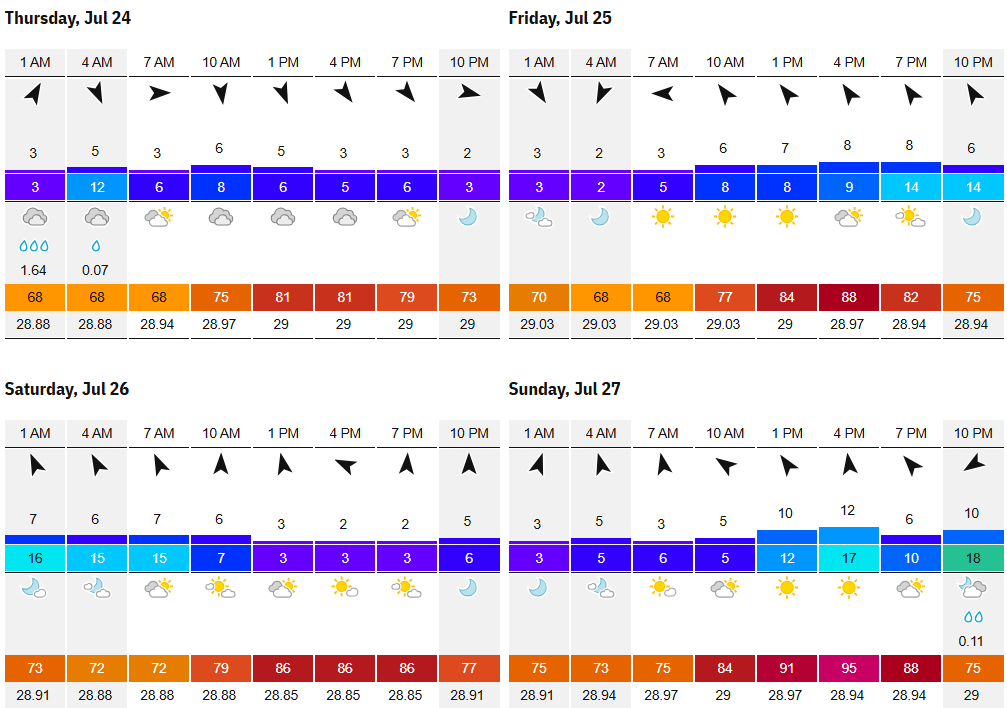
Weather Forecast – Blaine, Minnesota
- Distance From Edge of Fairway (DFEF)
- SG: Approach
- SG: Ball Striking (high water danger)
- Bogey/Double-Bogey Avoidance
- Good Drive %
- Proximity 175+
- Birdie or Better %
- Par 4 BoB %
- Total Driving
- SG: Easy/Average Scoring Courses
Key Rabbit Hole Filters
- Course Region: Midwest
- Scoring Conditions: Easy/Average
- Course Length: Long
- Field Strength: Weak
- Field Size: Full Field
- Water Danger: High
- Greens Surface: Bent
- Rough Length: Long
- Rough Surface: Bluegrass
- Architect: Arnold Palmer
- OTT Club Type: Mixed
- Missed Fairway Penalty: High
- Fairway Accuracy: Easy
- GIR Accuracy: Easy
- Gain Putting: Very Easy
Weather Forecast – Blaine, Minnesota