
2024 Wells Fargo Championship Betting Card Picks and Preview

Ryan Noonan

2 years ago

Quail Hollow Club, host of the 2017 PGA Championship (and soon-to-be 2025 edition), serves as a worthy Signature Event tune-up for this week’s field, with 2024’s second major just one week away.
While we still await the arrival of ‘Baby Schef,’ the best player in the world, Scottie Scheffler, is notably absent this week. That creates a less paralyzing experience when approaching this week’s betting board for this 68-man, no-cut event.
Any course history pre-2017 is meaningless because the redesign after the 2016 event completely altered the course, especially the front 9. It’ll play 7,558 yards as a Par 71, which is one of the longest Par 71s played on the PGA Tour over the past decade. Elite tee-to-green play is required here, and the course favors distance off the tee. I’m also looking at corollary courses like Torrey Pines, Riviera, Bay Hill, and Copperhead because previous leaderboards have a decent amount of overlap with Quail Hollow.
For more course details, check out Ron’s course preview. It’s the best in the business, bar none. Here’s an important tidbit about Quail Hollow:
Measuring 7,558 yards, Quail Hollow is a tree-lined parkland par-71 layout. Similar to courses like Torrey Pines and Bay Hill, it presents a challenging combination of length and difficult scoring conditions. It is both the third longest and fifth toughest scoring course in the annual Tour rotation. It also has the sixth longest combined par 4s and par 5s on Tour.
From an agronomic standpoint, the base turf at Quail Hollow is 100% bermudagrass. In the fall of each year, groundskeepers seed the course with bermuda, a warm-weather grass, and with rye, a grass meant for colder seasons. Right after the conclusion of the Wells Fargo Championship, a herbicide is used to kill the ryegrass and let the bermuda grow for the summer.
With Charlotte being in the mid-Atlantic region, the beginning of May is still too cool for the bermuda to completely break through the overseed. According to the Director of Green and Grounds, Keith Wood, the greens, approaches, tees and fairways are around a 50/50 mix of overseed and the underlying bermuda. The rough is 90% overseed.
Because of how long the course plays, Quail Hollow is a strong test because of the distance demands placed off the tee. Shorter drivers who have accurate long-iron games can still compete here, but their path to success is much more difficult. While fairway accuracy is one of the lowest on Tour at only 54%, it has proven to not matter. The last four winners have averaged 314 yards off the tee, with none of them finishing in the top 40 in accuracy for the week. When McIlroy won in 2021, he finished second in driving distance and shockingly finished dead last out of 156 golfers in fairways gained.
On approach, Quail Hollow ranks as the 11th toughest ShotLink course on which to gain strokes. The average Greens in Regulation (GIR) rate over the past three events is 60.5% which is well below the Tour average of 65.8%. Much of the difficulty is due to the aforementioned firmness of the greens combined with 55% of approaches coming from 175+ yards.
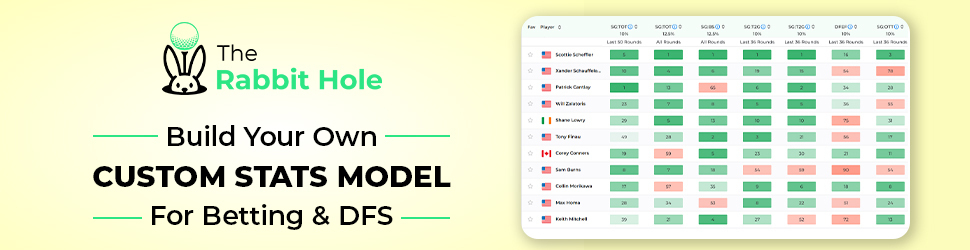
Remember to check out the Rabbit Hole, our customizable stat database that can help you pair down your player pool each week.
Please take advantage of the Discord feature and community. It’s the best way to get up-to-the-minute lines and advice, and if you need help getting started, please reach out. That’s where my full card will be posted, along with any live in-tournament bets.