2023 Travelers Championship at TPC River Highlands – Preview

Ron Klos

3 years ago
After a unique U.S. Open setup in Los Angeles that saw longshot Wyndham Clark win his first major, the Tour heads back to familiar territory and a much more energized environment for the Travelers Championship at TPC River Highlands. One of the most favored tournaments by players and caddies, the event attracts a strong field each year, and its huge crowds make it the second-most attended Tour event behind only the Waste Management Open.
TPC River Highlands is a classical, tree-lined par-70 Pete Dye design where shot-shaping is almost required and where players are encouraged to get creative and utilize every club in their bag. It is very scoreable yet will challenge players at the same time thanks to its penal rough, challenging pin placements on small tiered greens, and subtle changes in direction. Players who are accurate with their position off the tee, who can separate from the field with their wedges and short irons, and who can get on a roll with the putter have the best chance for success. 2019 winner, Chez Reavie summed up the course quite succinctly. “You can shape it both ways off the tee; hit every club in your bag from longer irons to short irons. It’s just a test of all your shots.”
The average winning score over the past 12 events has been 15-under par and has included a wide range of golfers. There has, however, been a recent trend of more quality, upper-tier players winning this event. The average odds of the last eight winners is +3300 and includes elite players such as Bubba Watson (twice), Jordan Spieth, Dustin Johnson, and last year’s champion, Xander Schauffele. Thanks to its tremendous finishing stretch of holes, it also almost always seems to deliver a climactic ending with 14 of the last 19 events being decided by one shot or less.
The Field
Due to its “Elevated Event” status and $20 million purse, this year’s Travelers Championship will have the strongest field in its storied history. Each of the eligible top-10 players in the OWGR will be in attendance with the exception of Jordan Spieth. And other than the still-injured Will Zalatoris, every other top-40 golfer is playing except for Tyrrell Hatton, Sam Burns, and Justin Rose.
The headliners include Scottie Scheffler, Jon Rahm, Rory McIlroy, Patrick Cantlay, Viktor Hovland, Xander Schauffele, Matt Fitzpatrick, and Max Homa. It will be another intriguing week to see how these elite players respond to flying across the country to play the week directly after an intense U.S. Open major tournament.
TPC River Highlands – History
Designed in 1928 by Robert Ross and Maurice Kearney, the club was originally known as Middletown Golf Club and became one of the most popular courses in Connecticut. By the early 1980s, it was bought by the PGA Tour which hired famed architect Pete Dye to completely redesign the course to fit professional tournament standards. In 1984, the course reopened as the “TPC of Connecticut” and became host to the Greater Hartford Open.
The course underwent another renovation in 1989 by architect Bobby Weed who had Tour players Howard Twitty and Roger Maltbie helping as consultants. The club reopened again in 1991 with almost a completely new front nine holes and was renamed the TPC at River Highlands.
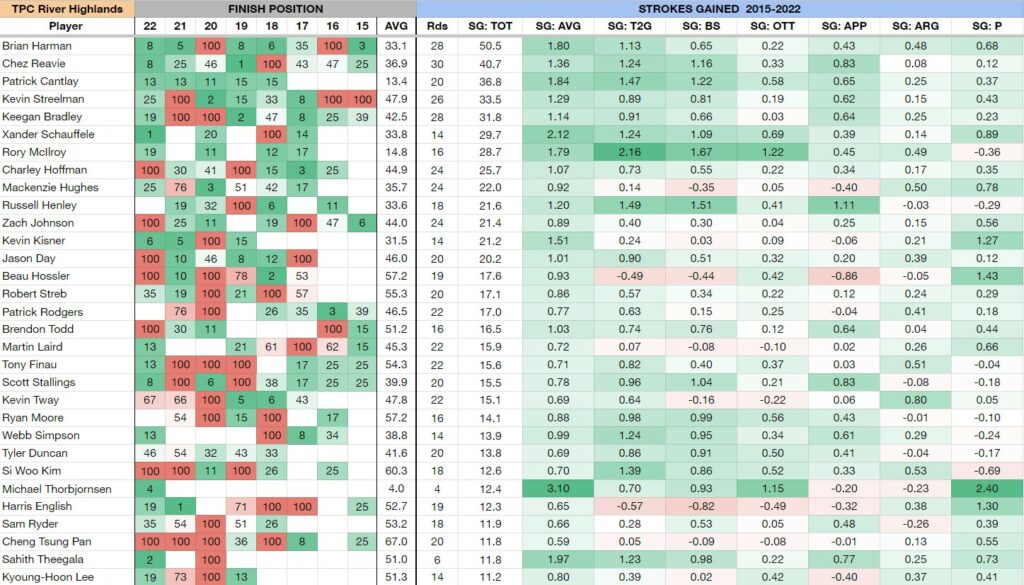
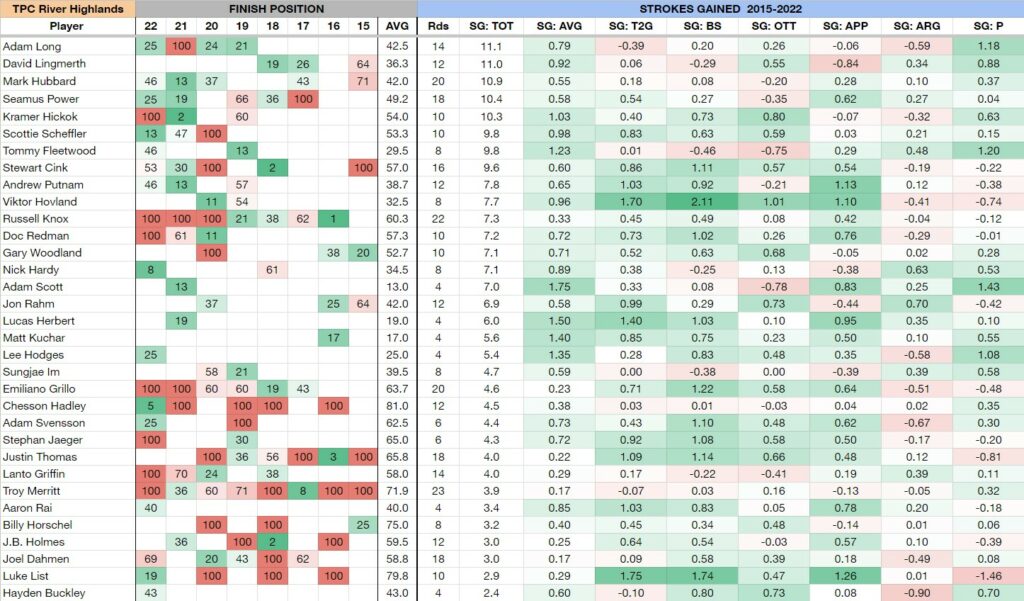
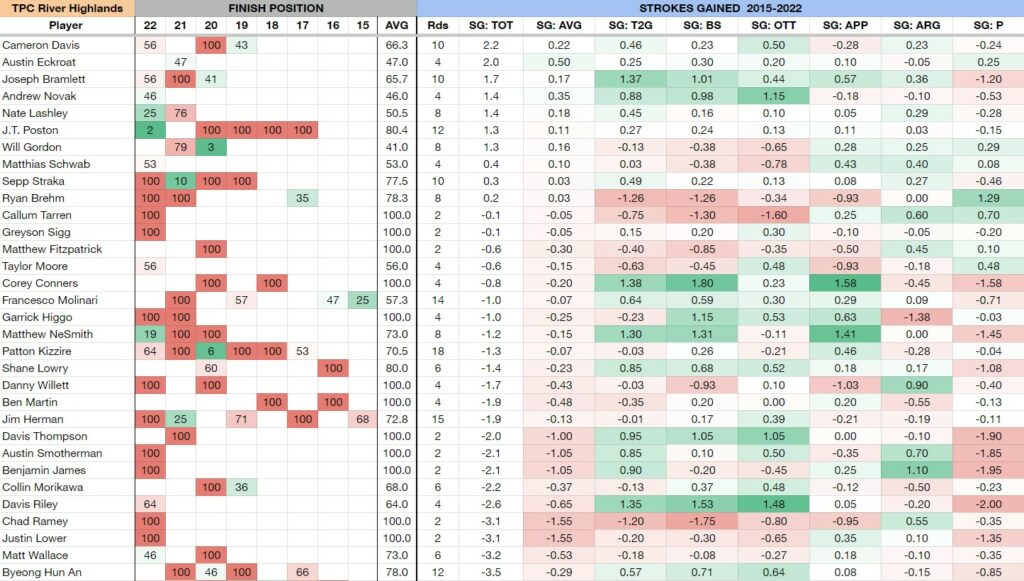
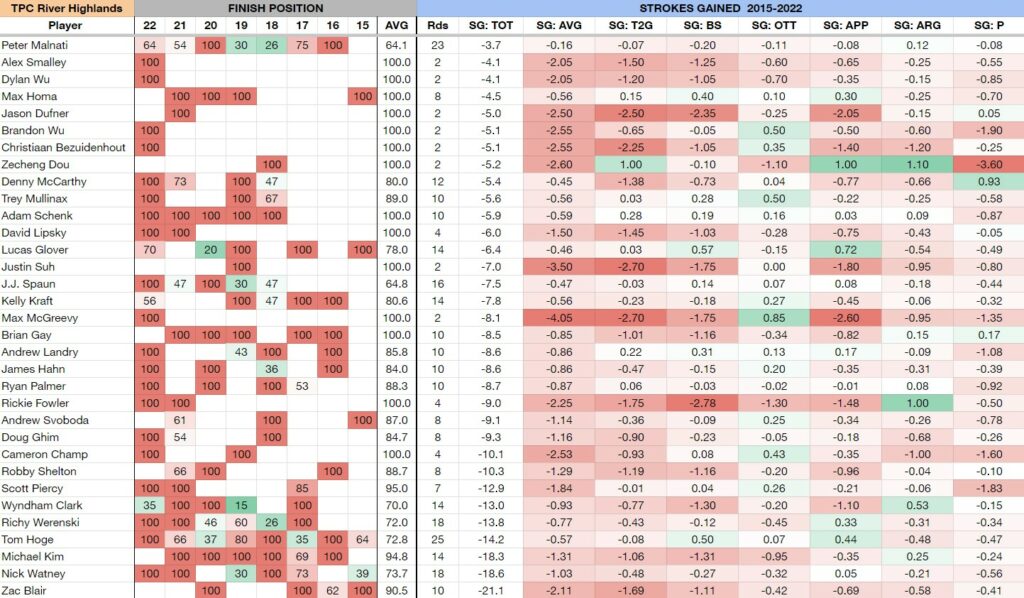
Finish Position and Strokes Gained Event History (2015-2022)
*This includes the average finish position and Strokes Gained per round in each category. Players are sorted by SG: Total. TPC River Highlands is the seventh most predictive annual course on Tour.
Course Features
Situated about 120 miles northeast of New York City, and around 30 miles from the Atlantic coast, TPC River Highlands is located just outside of Hartford in the town of Cromwell, Connecticut. Beautifully carved into slightly rolling terrain the course gets its name from being situated on a bluff high above the Connecticut River. It meanders over 148 acres with an assortment of trees framing its gently rolling fairways.
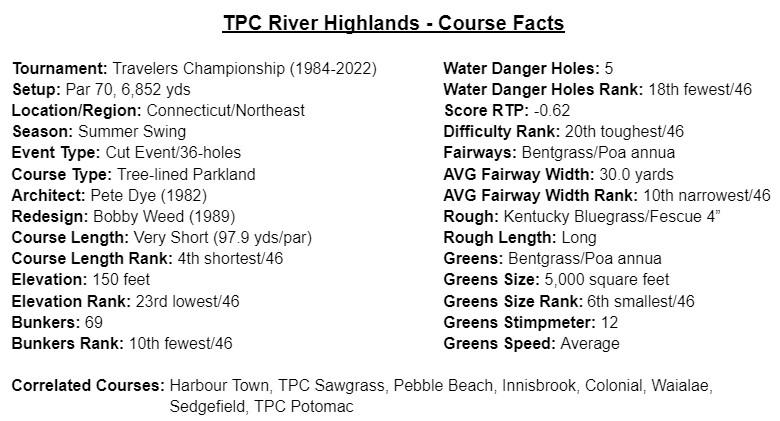
It is a par-70 course that is the 4th shortest on Tour at only 6,852 yards. Immaculately maintained, it has numerous subtleties which add to the strategy and challenge of the layout. The routing of the holes demands certain shot types and shapes. This type of course and design has allowed for a variety of champions over the years. Past winners include bombers and shorter fairway finders, Tour veterans and course “first-timers”, and even a blend of favorites and longshots. Any style of play can have success at TPC River Highlands and that is one of the reasons so many high-quality players return year after year.
The agronomy for this week features 4-plus inch Bluegrass/Fescue rough and a Bentgrass/Poa annua mixture on the greens and fairways. Numerous lakes and ponds add to the course’s beauty although only five holes actually have water in play. In Pete Dye fashion, the course (mostly on the back nine) does entice players into taking shots over some of these water hazards. The penal rough stands out as the course’s best defense. Players who end up off the fairway and in trouble will be forced to layup instead of going for the green with their approach shot.
While TPC River Highlands does yield low winning scores (15-under par average the last 12 events) and birdies are there to be taken, it still presents numerous challenges and won’t give anything away. A perfect example of this occurred in 2018. In the first round, Jordan Spieth shot a 63 and then followed it up with a 73 the very next day. The average overall score for the last five events is only 0.62 shots under par which puts it slightly on the tougher side for average Tour courses. But this is also the course where Jim Furyk shot a Tour record low 58 and Patrick Cantlay shot a 60.
Taking advantage of birdie opportunities, staying out of the rough, and minimizing mistakes are the name of the game at this course. Shot-making and creativity are two other traits that matter here. Bubba Watson and Jordan Spieth have a combined four titles at this track and they epitomize those qualities.
Hole Preview
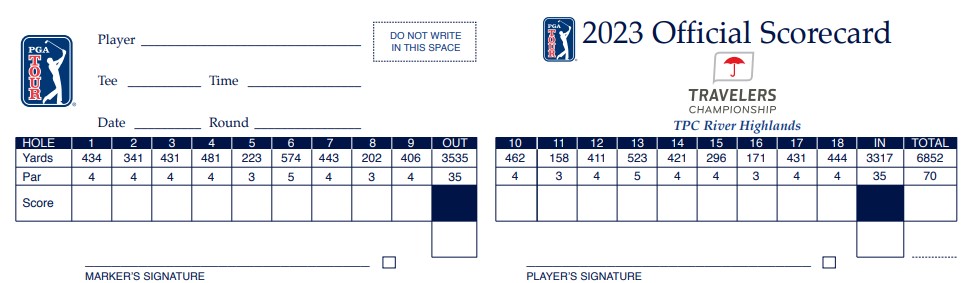
The hole layout at TPC River Highlands is typical for a standard par-70 course with only two par-5s and four par-3s. It has the shortest combination of par 4s/par 5s on Tour at an average of only 432 yards per hole. The character of this course lies in its 12 par-4s, nine of which measure under 445 yards. Players who have success in shorter par-4s and who perhaps struggle with par-5s will be licking their chops this week.
That being said, the two par-5s have the easiest scoring opportunities with a birdie or better rate of 38%. The driveable 296-yard 15th hole also presents another scoring chance with a 37% birdie or better rate.
As for the layout of the holes, the front nine is very pastoral and relaxed with very little deception. Everything is out in front of the players and there are few hazards off the tee. The tough finishing stretch from holes 15-18 is what makes the course special. Stewart Cink, who won the 2008 Travelers Championship, called them, “four of the most exciting finishing holes in a group anywhere in the world.” This stretch of holes is typical of Pete Dye courses as he loves tempting players to hit towards hazards on drives and approach shots. With precise control, hitting toward the hazard usually makes the next shot easier though it certainly increases the risk.
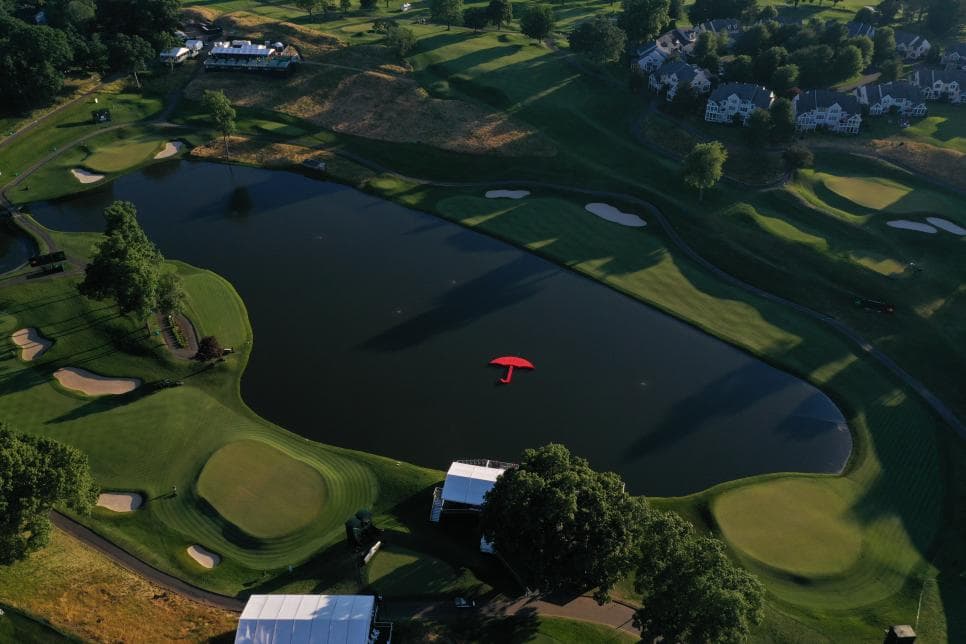
The challenge these holes present are why no lead is ever safe and why there are so many nail-biting finishes at this course. Holes #15-17 all play around a four-acre lake. The 15th is one of the best risk-reward holes on Tour. It tempts players to go for the three-tiered green with water surrounding on the left side and a forested hilly area with bunkers on the right. Both double-bogey and eagle are very possible. The 171-yard par-3 16th hole is in the most wind-affected area of the course and is completely over water with a near-impossible up-and-down if you go long. The par-4 17th is 431 yards and wraps around the pond with a demanding shot off the tee and on approach towards the back-to-front sloping green.
Strokes Gained Analysis
Off the Tee
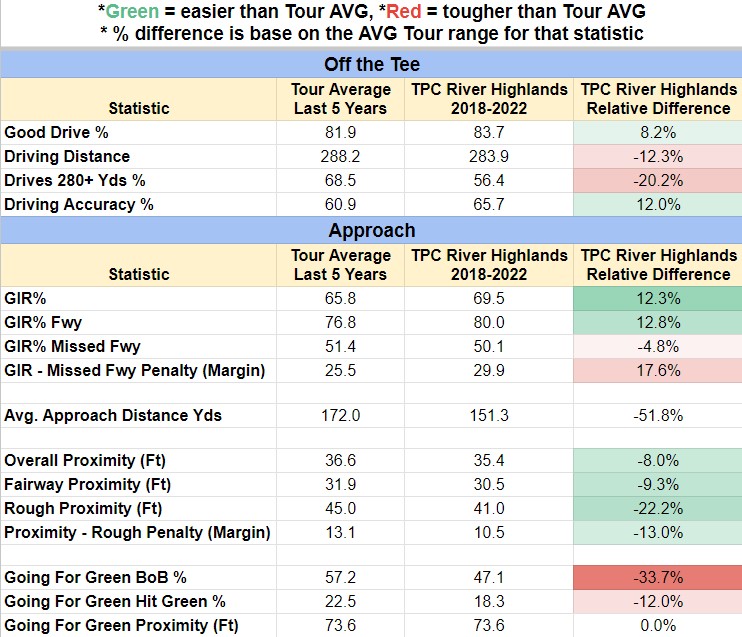
With TPC River Highlands a shade over 6,800 yards, and similar to other “short” courses we have seen this year, distance off the tee is typically dialed back. It has one of the lowest average driving distances on Tour at only 284 yards. With fairways being the 10th most narrow and many holes being tree-lined doglegs, many players club down and use less-than-driver from the tee. Perhaps the bigger reason players club down is some of the most penal rough that has been grown to 4+ inches long for this week. And when players find themselves out of position off the tee, they will often have to layup out of the rough in order to avoid trouble areas around the greens.
Many of the fairways also tend to bottleneck around the 315-yard range, and there are numerous inconveniently placed fairway bunkers. 8% of all shots that miss the fairway incur a penalty stroke, and the course ranks as the 7th toughest for strokes lost from a missed fairway. This quest for finding the fairway has resulted in a driving accuracy rate that is 5% higher than the Tour average. That being said, distance works here as well with numerous past winners such as Bubba Watson (3x) and Dustin Johnson winning this event. Thus, golfers can be aggressive and keep the driver in hand or play it conservatively with irons and woods. But for the most part, players who have control over their tee shots tend to play well here.
Rory McIlroy summed up the patient mindset needed off the tee at this course. “You feel like you have a wedge in your hand every hole. But if you don’t hit it in the fairways and don’t put yourself in position, it can be a little tricky. You need to be accurate here and not feel like you can be super aggressive but just sort of reigning that back a bit but knowing that there’s plenty of opportunities and just to stay patient.”
Approach
When hitting their approach shots, players will be attacking the sixth smallest greens at an average of only 5,000 square feet. TPC River Highlands has the shortest average approach shot distance of any course on Tour at only 151.3 yards. With 48% of approaches coming from the 125-175 yard range, short iron and wedge play will be extremely important. Similar to fairway accuracy, players are reaching these greens in regulation at an above-average clip of almost 70%. It would seem that those who can repeatedly play target golf will give themselves plenty of chances to have birdie opportunities, and that indeed is the case.
To prevent a complete birdie-fest, the pin positions on the greens are typically in tougher locations. A Pete Dye course is not just going to give away birdies. Many of the green complexes are also angled away from the directional path of the hole. That being said, precise approach play is not mandatory to have success here. Two years ago, the top-10 finishers gained an average of only 0.4 shots on approach for the entire tournament! On the flip side, that same top-10 gained an average of six shots putting for the week.
A couple of years ago, Jordan Spieth summed up approach play at TPC River Highlands and the scoring opportunities available. “You get so many opportunities, you feel like you’re losing to the field if you don’t birdie with a wedge in your hand. But they put these pins in such difficult locations it’s hard to feed it next to it, once you do, it’s difficult to get the right line on the green. So recognizing that the course is 6800 yards for a reason. It’s tricked out elsewhere. We’re going to have a lot of chances, greens in regulations is going to be an important stat.”
Around the Green and Putting
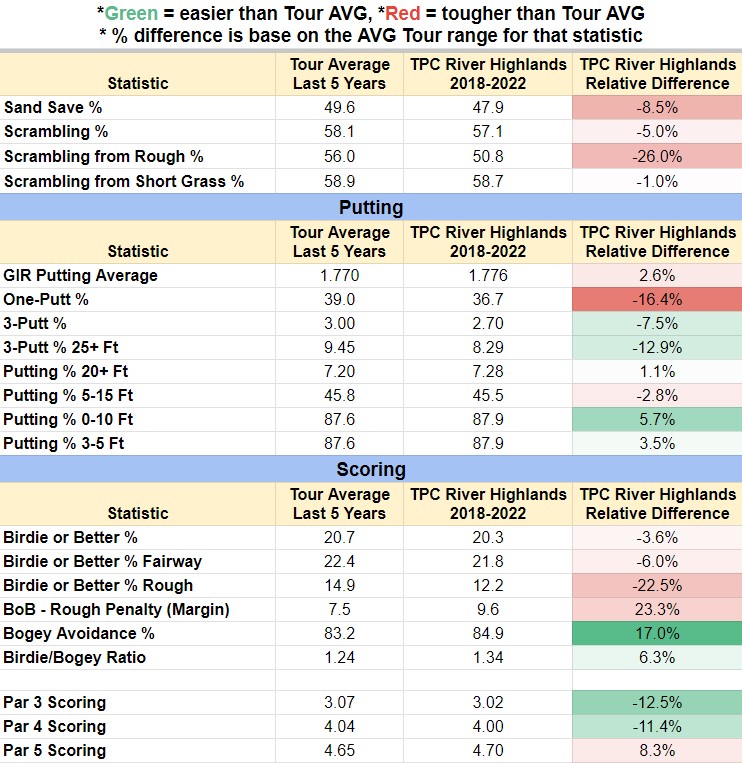
TPC River Highlands is the third toughest course to gain strokes around the green. A scramble rate from the thick green-side rough at less than 51% makes this one of the toughest layouts on Tour in getting up and down for par from those areas. There is also a variety of tiered small green complexes and collection areas that can make chipping from short grass and tight-lied areas a challenge as well.
The green surfaces are a combination of “northeastern” Poa annua and bentgrass. This is not the bumpy inconsistent “west coast” Poa that is often complained about out west. The putting data shows greens that play right around average in all the major categories. There are less 3-putts due to the smaller green sizes. As previous leaderboards and data have shown, players who can generate birdie opportunities and get hot with the putter have the best chance to succeed here.
Most Important Stats For Success at TPC River Highlands
*In order of importance
- SG: Approach
- SG: OTT (Short Courses)
- Par 4: 0-450
- Birdie or Better %
- SG: Putting (Bentgrass)
- Proximity 125-175
- SG: ARG
- SG: TPC River Highlands
- Opportunities Gained
- Good Drive %
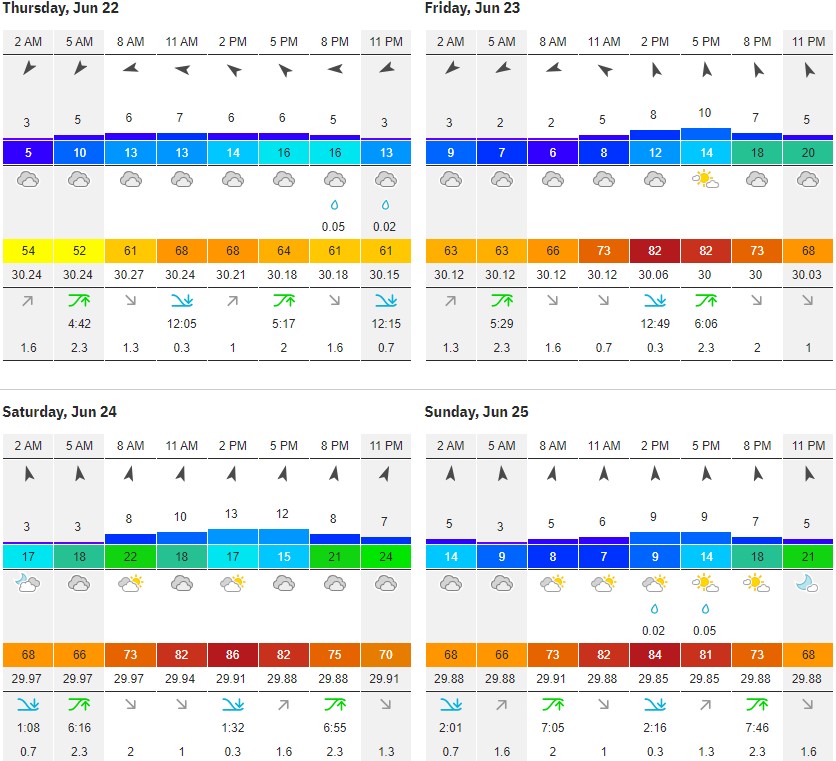
Weather Forecast – Cromwell, Connecticut