2023 THE PLAYERS Championship at TPC Sawgrass – Preview

Ron Klos

4 years ago

On the heels of a stunning victory by Kurt Kitayama at the Arnold Palmer Invitational, the stage is set for yet another elevated event as the 2023 edition of The Players Championship kicks off this week at TPC Sawgrass in Ponte Vedra Beach, Florida. The most iconic Pete Dye creation, TPC Sawgrass is a hazard-filled, positional, Florida-style test that hosts what many consider the most competitive and thrilling tournament of the year. Though the field is packed with talent again this year, with some of the world’s best being ineligible to play this week, we can safely discard the title of The Players Championship being golf’s “fifth major”. Even so, it remains one of the most important events on the calendar. 2019 champion Rory McIlroy summed up what the tournament means by saying, “I wouldn’t consider my career complete if I hadn’t won a Players Championship.”
Visually, TPC Sawgrass is one of the most perfectly manicured courses in the world. From the lush rough to the elaborately designed white sand bunkers to the 16 holes framed with water to the lightning-fast tiered greens, players will face challenges on every hole. There are few other courses that can match its risk/reward brilliance. Tee shots on the angled fairways are well-designed and encourage golfers to hit toward the trouble for the least obstructed approach shots into the demanding greens. It’s a course where any type of player can win. Pretenders are quickly weeded out. Errors get compounded in a hurry. Players that are strong mentally who have an all-around game and are entering with sharp form typically have the best chance of surviving the torture chamber. It sounds cliche, but here at Sawgrass, the best overall player for the week raises the trophy on Sunday.
Volatility and variance are definitely the words of the week. Golf is already the sport with the most variance, and this week the game is being played on perhaps golf’s most volatile course, TPC Sawgrass. Penalty hazards create variance. Throw in some potential wind and rain as we saw in last year’s event and carnage becomes likely. Sawgrass has been in the top three for most penalty strokes taken in each of the last three seasons.
All of this unpredictability leads to highly volatile leaderboards, as well. And while past performance at TPC Sawgrass has the seventh most predictive correlation to future success (according to DataGolf), there has never been a back-to-back winner here. In fact, over the last 30 years, Tiger Woods and Davis Love III are the only repeat winners. “That just goes to show you how hard it is to come back and play this golf course,” past winner Jason Day said. “Because it does test every aspect of your game, not only the physical part, but the mental part as well.”
Want more evidence of the volatility this event brings? World No. 1 Jon Rahm has finished 55th or worse in three of his five trips here. World numbers 2 and 3, Scottie Scheffler and Rory McIlroy have missed a combined three cuts in their last six starts at TPC Sawgrass with only one finish inside the top 30. And the fourth and sixth-ranked players in the world, Patrick Cantlay, and Xander Schauffele have missed a combined six consecutive cuts here at Pete’s “Dye-abolical” masterpiece.
Along with the volatility, another reason why handicapping this event is so difficult is because TPC Sawgrass doesn’t favor one specific style of play over another. It’s strategic target golf from point A to point B. Chess with a golf ball. Whenever this is the case, approach play becomes paramount, and what I like to call “The Separator”. Players that can hit the proper quadrant on these small greens and gain on the field in proximity to the hole are the golfers who will be in the best position to separate from the field and rise to the top of the leaderboard. 74% of players to finish in the top 10 at TPC Sawgrass since 2018 gained at least two strokes on approach for the week. And if your ball striking is off, there is one minor saving grace – an elite short game. Out of the five players to finish in the top 10 since 2018 that lost on approach for the week, they gained an average of 9.3 strokes around the green and putting.
The Field
Led by the “Big 3” of Jon Rahm, Rory McIlroy, and Scottie Scheffler, 43 of the top 50 of the Official World Golf Ranking will be in attendance at TPC Sawgrass. Thanks to all the defections to the LIV Tour, it won’t be as premier of an event as it usually is. With the likes of Dustin Johnson, Patrick Reed, Brooks Koepka, and defending champion Cameron Smith banished from this year’s event, it opens up opportunities for many of the “rank and file” members as over 30 players will make their PLAYERS Championship debut this year.
Along with Smith, second and third-place finishers at last year’s event, Anirban Lahiri and Paul Casey will also be missing due to their departure to the LIV Tour. The PGA Tour has definitely moved on from anyone associated with LIV as they even took away Smith’s prime parking spot at its Ponte Vedra Beach headquarters. He also lost his practicing privileges at TPC Sawgrass which was his home course.
The field contains 144 golfers this week with the top 65 and ties making it through the 36-hole cutline to play the weekend. The winner received 600 FedExCup points and a $4.5 million first-place check. It will be a record payday from a $25 million purse.
TPC Sawgrass – History
Located in Ponte Vedra Beach on 415 acres of northeastern Florida swampland, PGA Tour commissioner Deane Beman purchased the property in 1978 for the sum total of $1. The “swampy jungle” was initially full of alligators, deer, wild boars, and poisonous snakes. Beman hand-picked famed architect Pete Dye who completed the course in 1980 after taking one of the least attractive sites possible, performing miracles to solve the drainage issues, and transforming it into the layout we see today.
Beman’s goal was to create a challenging and renowned course with stadium seating that could become the new host for the Tour’s Players Championship. In fact, TPC Sawgrass became the first course of its kind to provide spectators with a stadium-type atmosphere. The Players Championship was held at the adjacent Sawgrass Country Club through 1981 and then moved to TPC Sawgrass in 1982.
After that first event, the story was not about Jerry Pate’s victory but instead about the litany of complaints that Tour players had about the new course. “It’s Star Wars golf, designed by Darth Vader,” Ben Crenshaw pronounced. When asked if the course suited his playing style, Jack Nicklaus replied, “No, I’ve never been very good at stopping a 5-iron on the hood of a car.” J.C. Snead went as far as calling the course “90 percent horse manure and 10 percent luck.” Dye seemingly had a fiendish delight in creating extremely demanding shots around hazards which included as much deception and mental stress as possible in some of his designs. As the story goes, Beman gave Dye a phone call with a clear message. “I’ve got a near mutiny on my hands, Pete. You have to get back down here and make some changes to the golf course.”
Over the next year, Dye made minor changes to the course. He replaced several of more treacherous bunkers and made the sloping of the greens less severe. After the adjustments, players were satisfied. “Now it’s a darn good golf course,” Crenshaw said of the improvements.

Over the years, Dye has tweaked his course further and today it amasses praise from almost everyone. In 2016, Sawgrass underwent its first official renovation led by Steve Wenzloff in consultation with Dye. Said Director of Operations, Jeff Plotts, “We have redone the golf course and carried out a major renovation following the 2016 Players Championship. We redid all the tees, bunkers and greens. The twelfth hole has been completely reconstructed, and a new lake between the sixth and seventh hole has been created.”
For this year’s tournament, Plotts said the only major change to the course is the new tee box that was built which can lengthen the par 5 ninth hole to over 600 yards. This will put even more teeth into a hole that was originally designed by Dye to be the most difficult par-5 hole on the course, and a three-shot hole for most players. There are also some other subtle differences that he said fans are not likely to notice, mainly at the par-4 first hole. The face of the right fairway bunker has been made a bit steeper and the “moguls” – undulations in the fairway – have been made a bit more penal. Three small pot bunkers have been added at No. 1. The faces of fairway bunkers at Nos. 6, 7, and 10 have been made slightly steeper. “We’re trying to put back some of the Pete Dye flair that may have softened over time,” Plotts said.
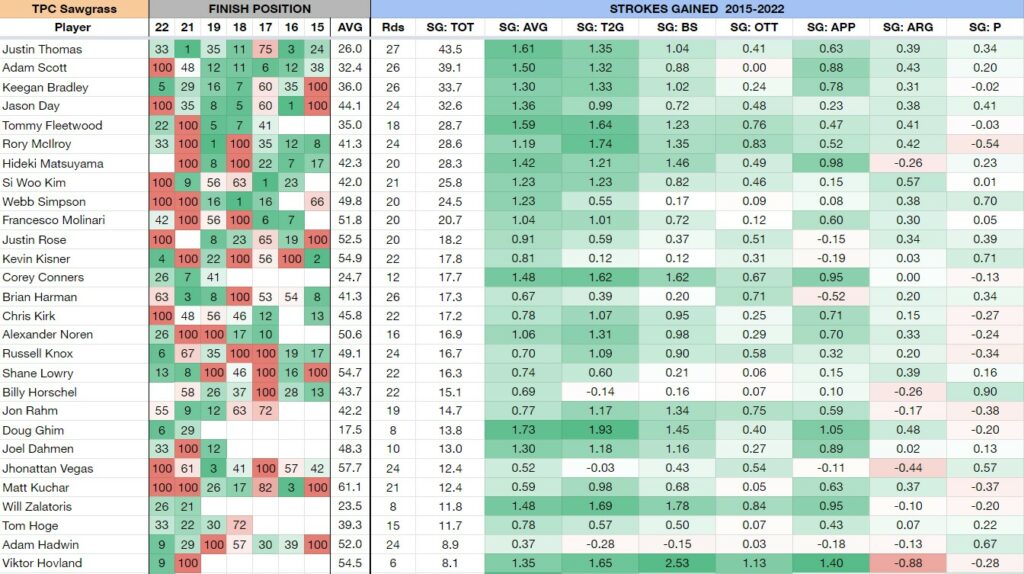
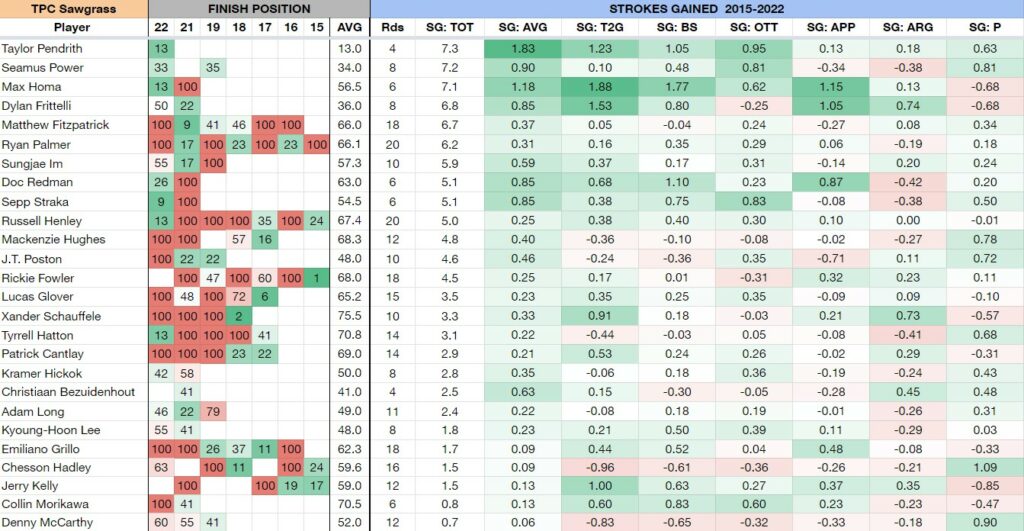
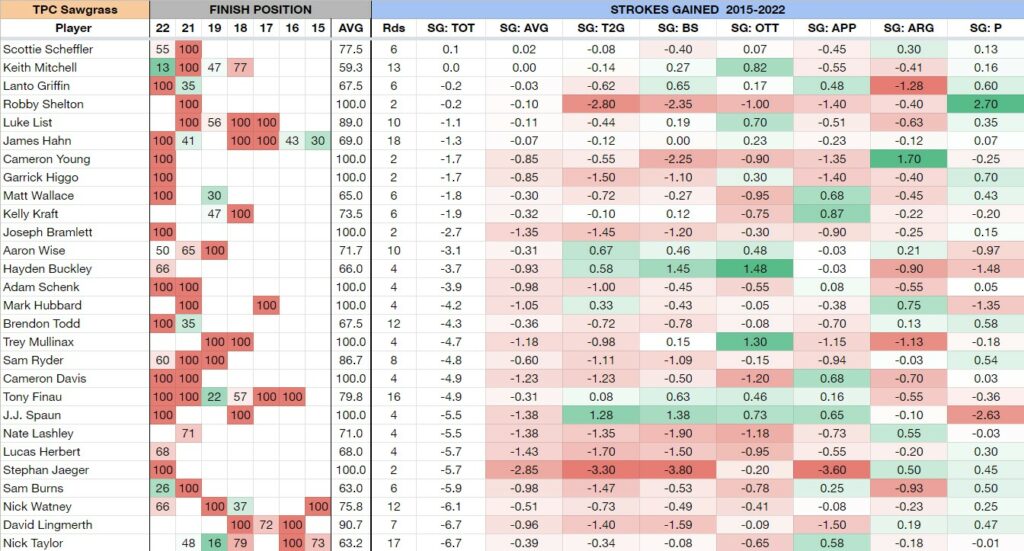
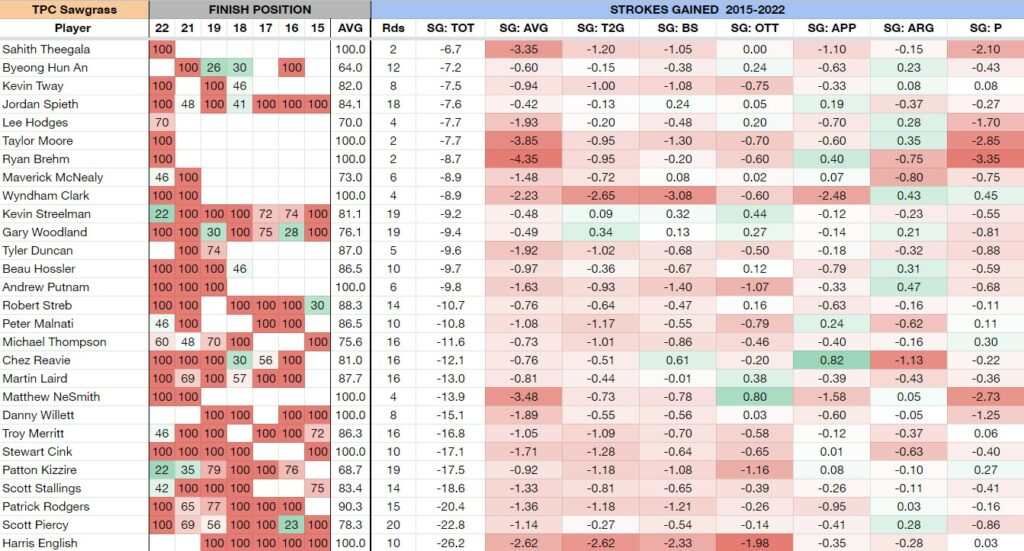
Finish Position and Strokes Gained Course History (2015-2022)
According to DataGolf, course history at TPC Sawgrass is the 7th most predictive on Tour.
Course Features
Located about a mile west of the Atlantic Ocean on the site of the PGA Tour’s official headquarters, TPC Sawgrass contains numerous challenging features. These include narrow fairways lined with marshes and elongated waste bunkers; mounds, hollows, and pot bunkers that are strategically placed to catch even the slightest misplaced shot; water hazards on almost every hole; tall trees (palm, pine and oak) that obstruct shots in many areas on the course; and firm lightning-fast greens.
All of the trademark characteristics of a Pete Dye course are found at TPC Sawgrass. From the railroad ties to the slithering dogleg fairways to strategically placed water and sand, Dye was one of a kind. But at Sawgrass, he took visual deception and the ability to make golfers nervous while standing over their shot to an entirely new level. Dye was a risk-taker in his younger years and a paratrooper during World War II. Similarly, he wanted golfers to feel sweaty palms and butterflies in their stomachs while standing over certain shots. Risk/reward golf was the name of his game. This course, for example, has numerous tee shots where it is highly beneficial for players to hit toward the hazards because it allows for the least obstructed approach into the green. In Dye’s mind, either you take on the risk and hit the correct shot, or you suffer the consequence.
Patrick Cantlay encapsulated Dye’s approach perfectly when he stated, “Dye fools you and challenges you at the same time. I feel like he will show you one side with trouble and you almost have to ignore the big flashy trouble but still hug it, because the worst side will be the bailout side, and once you bail out to that side, then the troubles start mounting. Pete Dye kind of does that all day, and if you have enough guts to hit quality shots all the way around, you can shoot good numbers.”
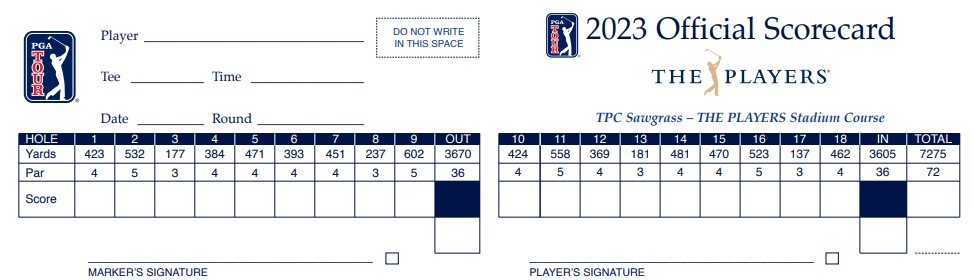
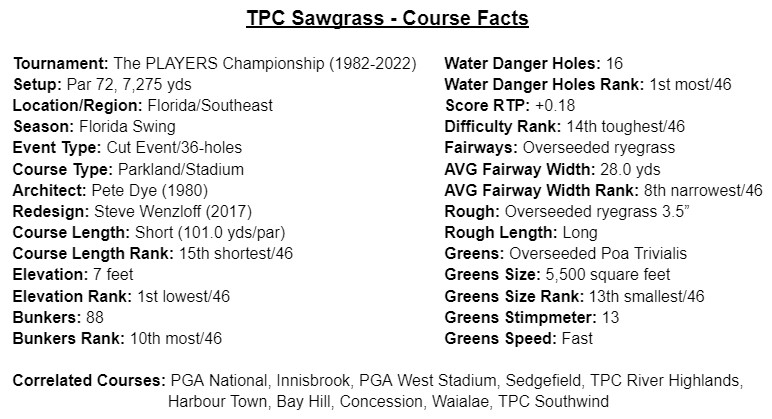
Measuring out at 7,275 yards, TPC Sawgrass is a shorter, positional, “less than driver” course. Beman instructed designer Pete Dye to build a true test that would not favor one type of player. So Dye did what he does best. He crafted a balanced course that forces strategic positional tee shots and approaches around complex bunkers and numerous water hazards. There are dog-leg holes that turn both ways and overall, the course is routed so that no two consecutive holes play in the same direction. On some holes, players must hit their targets on fairways and greens by shaping the ball in both directions on the very same hole. The course is so equitable and yet full of variance that every single hole has at least an 8% Birdie or Better rate and an 8% Bogey rate.
Even with such a balanced layout, TPC Sawgrass is one of the most unpredictable courses on Tour. With so much trouble lurking, the line separating success from complete failure is minuscule. This is a big reason why there is such little correlation to past leaderboards. Overall, many of the top-ranked players have just as many missed cuts over the years as top-10 finishes. As Dye himself said, “The mark of a good golf course is when one player can be going for 63 while six others are struggling for 78.” Those that strategize and think their way around the course, combined with pure ball-striking, will be rewarded with the best chances to score. According to Adam Scott, the course doesn’t play favorites. “We have so many different styles of game, so I think the course is open to so many different guys to have a chance to win,” he said. “There’s more guys in the mix which leaves it open for anyone.”
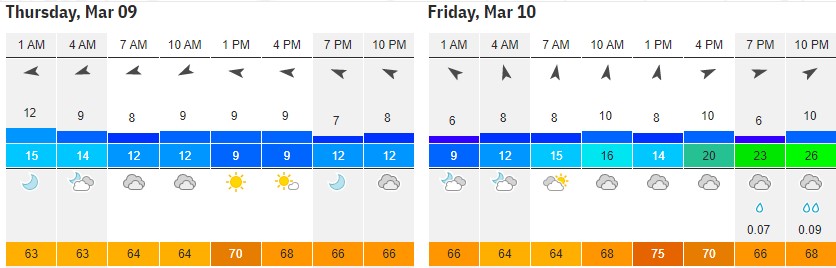
Since the event moved from May to March back in 2019, the scoring average at TPC Sawgrass has been 0.18 shots over par. It ranks as the 14th-toughest scoring course on Tour. The two-month date change has had such a dramatic effect on how the course has played that it does not make sense to take much of the pre-2019 results into account. With coastal winds gustier in March, scoring is more random and the course plays longer thanks to the softer fairways.
The course also plays softer due to more precipitation. With it so early in the growing season, the Bermuda grass is still dormant. Thus, the course is overseeded with rye on the fairways and rough. This typically makes the 2.5” rough much easier to hit out of, especially around the greens, where Bermuda rough can be quite tricky. But this year, according to Plotts, the rough will be longer than it has ever been at a lush, thick 3.5″. More penal rough will only add to the difficulty of the course and put even more pressure on fairway accuracy. Instead of the pre-2019 Bermuda surfaces, greens are 100% Poa trivialis and run a very fast 13 on the stimpmeter.
With the ninth most bunkers and the highest amount of holes with water danger on Tour, there are plenty of means for wayward shots to be penalized. These, along with coastal winds and fast greens are the course’s main defense. Limiting any damage and scrambling for pars and bogeys are the best ways to stay afloat and keep one’s chances alive. To score low here, players need to either have elite ball-striking rounds or catch fire with their short game.
Hole Preview
With water and the other challenging features of the course being used in abundance, TPC Sawgrass was clearly built for the world’s best players. While the drama seems artificially manufactured at times thanks to Dye and his style, the course does have excellent routing with a good mix of short and long par 4s, a good variety of par 3s, and three reachable par 5s.
Three of the par-3s are under 185 yards, including the infamous 17th-hole island green. Though they average among the shortest length on Tour, each plays over par with water in the equation on every single one. Along with difficult pin positions, their greens are also surrounded by tricky pot bunkers and mounds that make scrambling an adventure. The 17th hole has one of the highest double-bogey or worse rates on Tour at 7.9%.
The par-4s are a mix of challenging holes that include a lot of risks and some rewards. They have tremendous variety and force golfers to play the correct angle into the green. Three of them play under 400 yards and three more are over 470 yards. The toughest five are also the longest. Almost all of the par-4s are “S-shaped” as Dye wanted both the draw and fade to be in play.
Combined, the par 5s at TPC Sawgrass average only 545 yards in length. It is here where scoring becomes crucial as three of them are reachable in two shots. Water is present on holes 9, 11, and 16 which requires players to find the fairway with the driver to have any chance of successfully going for the green. Overall, the four par 5s have a Birdie or Better rate of 39.4%.
While the front nine isn’t anything extraordinary, the action heats up quickly on the back nine, especially on the hair-raising closing stretch. The 16th is the final par 5 and it doglegs to the left with a green that is surrounded on the right side by a huge pond. The “sink or survive” 17th is obviously one of the most famous holes in the entire world. It was the inspiration of Dye’s wife, Alice. Few holes can match the adrenaline rush and trepidation of simply trying to land your ball on the putting surface. When winds kick up, as they did in 2022, it may also be the most unfair hole in golf as there is no place to bail out. The closing 18th doglegs to the left and is lined on its entire left side by a huge lake. If you drive the ball too far right your approach has to deal with oak trees off the fairway and then needs to carry over the numerous mounds and hollows that protect the right front of the green.
Strokes Gained Analysis
Off the Tee
With positional shots off the tee (OTT) the norm, it is to a player’s advantage to scale back and use less-than-driver on many of the par-4s. Since 2019, TPC Sawgrass has averaged the third-fewest number of drives over 300 yards at only 23.1% to go along with an average driving distance that is well below Tour average at 281.7 yards. Dye’s setup mitigates the advantage of longer hitters and provides few opportunities for players to overpower the course. The move to March does bring cooler air and fairways with less bounce. This has allowed driving distance to inch upward a bit from prior events, but it is still one of the shortest driving courses on Tour.
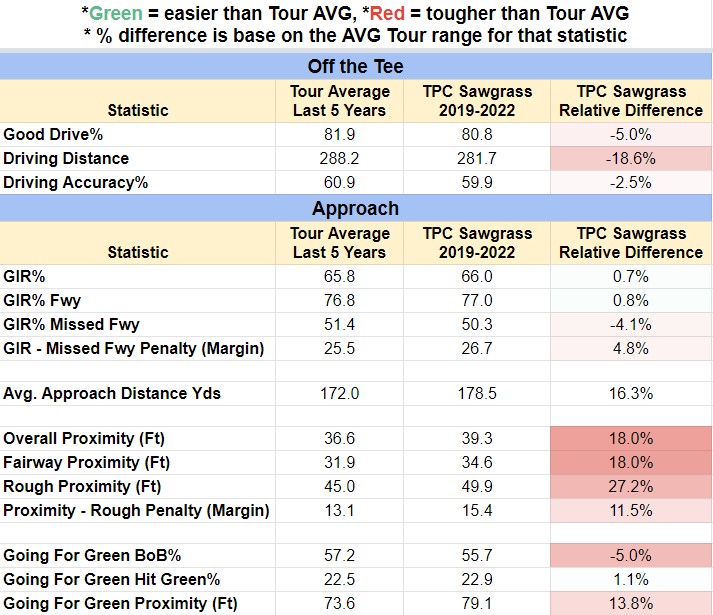
One of the biggest themes on PLAYERS leaderboards is driving accuracy. Keeping the ball in play and avoiding the bunkers, tree lines, and water hazards is crucial. TPC Sawgrass had the fourth-most penalty strokes on Tour off the tee last year. Wayward misses that find one of these trouble areas cost players more than 0.25 strokes. Dye devilishly positioned many of the hazards in conformity with the angle of the green to encourage players to hit towards the trouble areas. This requires players to have an actual game plan on each hole where they must choose a side of the fairway to either attack or play conservatively. Even with so many golfers clubbing down off the tee, driving accuracy is still below the Tour average at only 60%. We will have to wait and see how much the 3.5-inch rough penalizes players this year compared to the 2.5-inch in years past.
Overall, TPC Sawgrass is the fifth toughest course in which to gain OTT. With distance a non-factor and players being forced to club down, the main stat I will be using to measure OTT performance for this week is Good Drives Gained. This stat combines OTT and APP and finds the players who are best at positioning themselves to hit the green because they stayed out of trouble with their first shot. It also shows which players have the skill to reach the green even in difficult situations like playing from the rough or from a fairway waste bunker.
Approach
To win at TPC Sawgrass it is absolutely vital to have a great week with your irons. Though the GIR rate of 66% is right at Tour average, the ability to actually gain strokes on approach is the fifth most difficult on Tour. More specifically, approaches from inside 150 yards are the toughest anywhere.
Greens are the 13th-smallest on Tour and are protected by false-fronts and run-offs that funnel balls into pot bunkers and hollows off the green. Their firmness and the strength of the wind will be one of the determining factors in how tough the course will play. With proximities to the hole being so challenging, the best iron players and those in positive “approach” form have an advantage on the field. In seven of the last eight events, the winner here was gaining an average of 0.52 strokes on approach in their last 36 rounds before the Players Championship. 16 of the last 18 winners ranked in the top-35 for SG: Approach in the year leading up to their victory.
With fairways only averaging 28 yards wide in the landing zones, the 3.5-inch rough this year could create a major decline in the GIR rate. Early reports have balls being half-buried in the lush rough which will prevent players from being able to hit the high-spinning irons that are necessary to get the ball anywhere near the hole. This lack of precision caused by errant tee shots will bring the penal bunkering, the severe contours of the greens, and the water hazards into play on approach.
Around the Greens and Putting
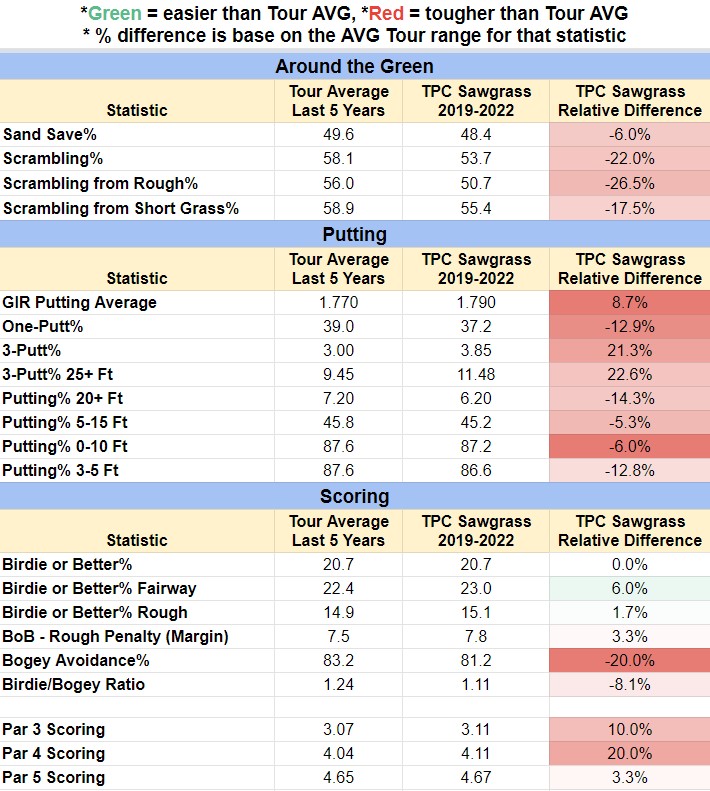
With grinding for par or bogey being a common theme for the week (especially if weather affects the tournament), players will have to scramble on numerous occasions. As previously mentioned, even near misses on approach shots end up in all sorts of unpredictable lies around the many bunkers, mounds, and hollows that surround the green complexes. Touch and creativity will be a necessity when it comes to chipping from either the rough or short grass areas. Once again, TPC Sawgrass ranks inside the top 10 for toughest courses to gain strokes around the green. Both scrambling and sand saves are below average.
With the Bermudagrass on the greens still dormant, surfaces are 100% Poa trivialis. These greens run smooth and pure and are much different than the bumpy west coast Poa annua. The overseeding with Poa trivialis removes the graininess of the Bermuda which is dormant below the surface. There are only five other courses with similar greens to TPC Sawgrass, which would include TPC Scottsdale, PGA West Stadium, Innisbrook, Harbour Town, and TPC San Antonio. While putting on these greens is overall tougher than average, results show that one does not need to have a “great” putting week to win here. Justin Thomas, Rory McIlroy, and Si Woo Kim each won while gaining 1.6 strokes or less putting.
The greens at Sawgrass are most known for their speed and undulations. Running at a 13 to start the week on the stimpmeter, players often struggle with the speed of downhill putts if they end up on the wrong side of the pin. It is these slopes and tiers which make it paramount for players to aim for the proper quadrant even if it is away from the flagstick. Having to putt around the numerous ridges and slopes leads to one of the highest 3-putt rates on Tour at 3.85 %. TPC Sawgrass ranks as the sixth toughest course in which to gain strokes when putting from more than 15 feet.
Most Important Stats For Success at the PLAYERS Championship
*In order of importance
- SG: APP
- Good Drive %
- Bogey Avoidance
- Scrambling
- SG: ARG
- Par 5 Scoring
- SG: Putting (overall)
- Par 4 Scoring
- Birdie or Better%
- SG: Total in Difficult Fields
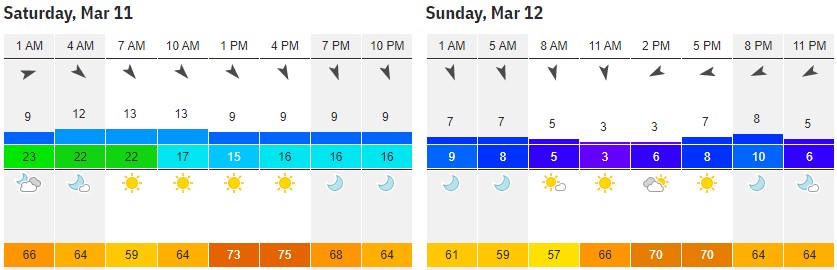
Early Weather Forecast – Ponte Vedra Beach, Florida