2023 BMW Championship at Olympia Fields Country Club (North) – Preview

Ron Klos

3 years ago
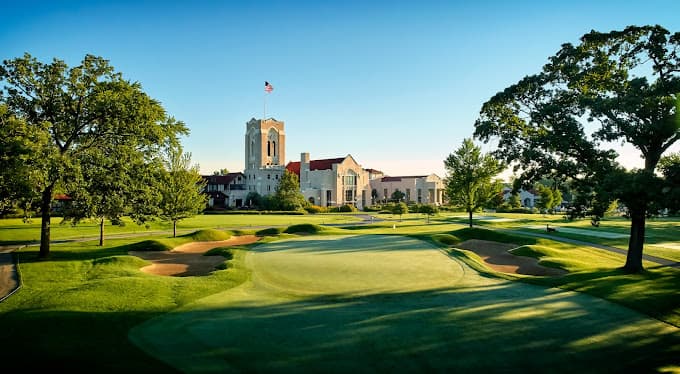
With a field of only 50 golfers, the atmosphere shifts from Memphis, where amongst the best players in the world Lucas Glover amazingly managed to win his second consecutive event, to the Chicago suburb of Olympia Fields for the BMW Championship. The North Course at Olympia Fields Country Club is considered one of the best courses in Illinois and is generally ranked in the top 50 courses in the United States.
Olympia Fields is a classical, tree-lined parkland layout, designed in 1923 by Willie Park Jr. during the “Golden Age” of golf course architecture. Over the years, the course has been lengthened, but nearly all of Park’s design and strategy remain intact. The North Course is routed over naturally rolling terrain and features narrow fairways lined by hundreds of native oak trees along with Butterfield Creek which meanders its way through numerous holes.
Over the past decade, the BMW Championship has mostly been played on easier courses with a winning score of 14-under last year at Wilmington Country Club which was preceded by a 27-under winning score in 2021 at Caves Valley. In fact, seven of the last 11 champions of this event had a winning score of 20-under or better.
Olympia Fields will provide no such continuation of that trend. It will present one of the sternest tests of golf that players have faced over the past five years. When it was last played as a PGA Tour event for this same BMW Championship back in 2020, Jon Rahm sank a 66-foot birdie putt on the 18th hole to win at only -4 as only five players finished under par. Overall, it played 1.82 strokes over par and ranks as the fifth toughest course in that same period.
With thick rough, strategic bunkering, and treacherous greens, players who don’t bring their best will get beat up in all sorts of ways. Similar to a U.S. Open test, it will examine all aspects of the game. Poor shots will face challenging consequences. While it was expected to play firm and fast with rough approaching six inches by the weekend, nine inches of rain in July along with another two-plus inches that is forecast through Tuesday should cause the course to play softer and longer than it already does.
The Field
With the PGA Tour’s new playoff structure, only 50 players are competing in this year’s no-cut, BMW Championship as opposed to the 70 that were in last year’s field. And with FedExCup points more than tripled for these playoff events, the winner will receive 2,000, giving the 50th-ranked player, Patrick Rodgers, ample opportunity to crack the top-30 by the end of the week and move on to East Lake for next week’s Tour Championship. It is also important to note that each player in the field this week has already punched their ticket for every signature event in next year’s season.
Every single eligible top-20 player in the OWGR will be teeing up this week. Jon Rahm remains in the top sport in the FedExCup standings, but world No. 1, Scottie Scheffler is right on his heels only 148 points behind. Coming off his playoff loss to Glover at last week’s St. Jude Championship, Patrick Cantlay will go for the three-peat this week as he has won the last two BMW Championships.
Olympia Fields Country Club – Course History
Olympia Fields Country Club was founded in 1915 and encompassed an astounding 674 acres of land with the hope of becoming the largest and most premier golf club in the world. After three other courses were already built on the property, the club’s No. 4 Course (the North Course) was designed in 1923 by Scotland native Willie Park Jr. who was a two-time Open champion (1887 and 1889) and was known as the grandfather of inland golf design.
Although Park’s work includes more than 100 courses worldwide, the North Course at Olympia Fields is often regarded as Park’s greatest achievement – not just by contemporary critics, but by Park himself, who concluded, “I have examined thousands of places adaptable for the ideal golf course, both in Europe and America, but I have never seen a more natural setting for a championship course. I am satisfied now that your number IV course is the equal of any golf course I have ever seen and I know of none that is superior, either in beauty or natural terrain.”
After the club descended toward financial ruin during the Great Depression and then again at the start of World War II, it was forced to sell off half of its land. Park’s “Course No. 4” simply became the “North Course” and the remaining holes from the other three courses were reconfigured to make the South Course.
As time has marched on, the North Course has remained steadfastly faithful to Park’s original design, with precious few changes over the decades other than deepened bunkers and additional length. These changes were completed by designer Mark Mungeam starting in the 1990s. In fact, Mungeam has spent nearly a quarter of a century renovating, restoring and defending this classical course from equipment enhancements. Said Mungeam, “The only real deterrents to Bryson and other bombers these days is the rough and the wonderfully sloped Willie Park Jr. putting surfaces. In the end, the greens make this course what it is.”
Olympia Fields has hosted four major championships: two U.S. Opens (1928, 2003) and two PGA Championships (1925, 1961). It has also been the site of the U.S. Senior Open (1997) the U.S. Amateur (2015), and the 2017 KPMG Women’s PGA Championship. In addition, the Western Open on the PGA Tour was played at the club five times.
Course Features
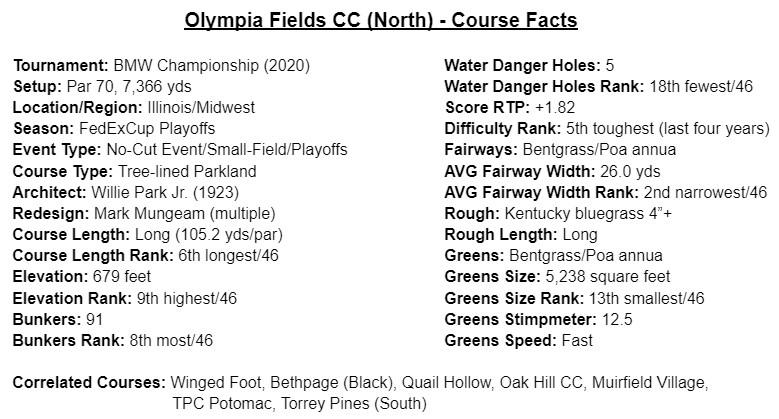
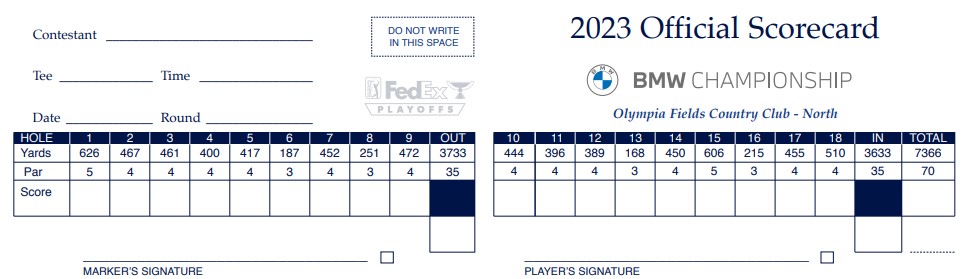
Located just 30 miles south of Chicago, the North Course at Olympia Fields is a par-70 that measures 7,366 yards. At 105.2 yards per par, it would be the sixth-longest course in the Tour rotation. It features the standard par-70 mix of 12 par 4s, four par 3s and two par 5s.
While there is only one par-4 longer than 475 yards, eight of them play at 445 yards or longer. Remarkably, in 2020, not a single par 4 played under par. Led by the mammoth 251-yard 8th hole, the par 3s are among the most challenging on Tour averaging 3.12 strokes. Both par 5s measure over 600 yards and – you guessed it – are among the toughest group of par 5s averaging 4.87 with a Birdie or Better rate of only 29%.
Olympia Fields is a very straightforward course. Other than a couple of blind tee shots (No. 3 and 12), everything is right in front of you. There are also no weak holes to be found. Each one offers a full test of ability. While there is a great variety to the layout along with tons of history, the course lacks overall character and any distinctive features as it appears just like any other northern parkland course.
The main reason Olympia Fields plays so tough is that there are so many areas where the course defends itself and is just waiting to penalize golfers for the slightest mistake. And on top of that, other than the first hole which has the highest birdie rate on the course, there is simply no let-up.
To start with, fairways are pinched in at the landing zones and have strategically placed bunkers that are much deeper than normal and often cause players to pitch out due to having no other options. The Kentucky bluegrass rough is listed at four-plus inches and will definitely be longer by the first tee-time on Thursday. The undulated, sloping green complexes present their own set of problems for each golfer. “Death by a million paper cuts” is a great way to describe the toll Olympia Fields will take on most golfers.
There are also more elevation changes than many expect with a good deal of steep up and downs as the land rolls back and forth. Trees overhang the fairway on numerous holes providing just another obstacle for players to face when approaching the green. From an agronomy standpoint, along with the aforementioned rough, the course features both fairways and greens with a combination of bentgrass and Poa annua. Greens run a speedy 12.5 on the stimpmeter.
Strokes Gained Analysis
Off the Tee
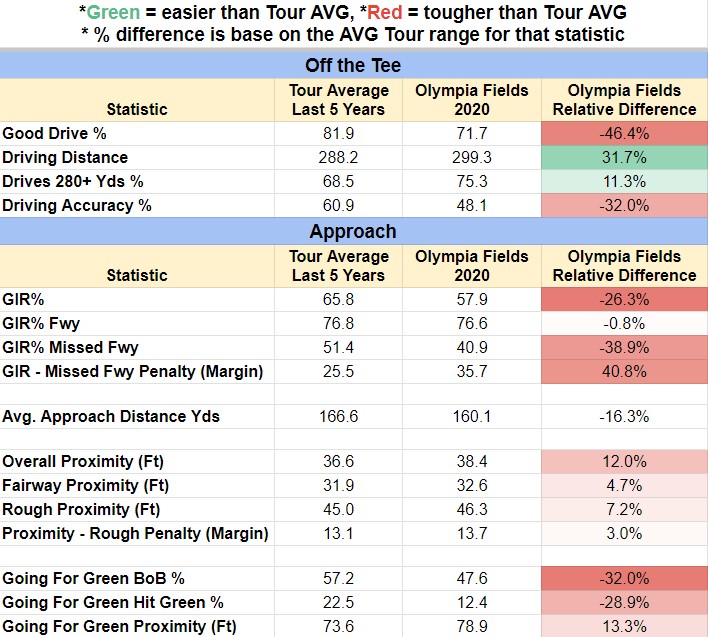
While the North Course most assuredly places a premium of accuracy off the tee thanks to the tight tree-lined corridors, penal fairway bunkers, and thick rough, its length and advantage presented to “total drivers” of the ball is one that allows the longer hitters to find an edge. Throughout the round, players are forced to make tough decisions off the tee.
It starts on the very first hole where you are asked to thread the bunkers with your drive. It continues throughout the course on numerous holes that beg you to challenge the fairway hazards to create the best angles into greens. In fact, challenging the bunkers is something that Park often demands of the longer hitters. Golfers that bailout will run out of fairway and find their ball in the rough or amongst the trees.
According to Jim Furyk, “It gives you some options off the tee. There are three shorter par 4s where you can lay back with an iron or with a short fairway wood and maybe hit an 8-iron to the green, or you can actually try to drive it up into the neck and get yourself a wedge into the green.”
The top of the leaderboard from 2020 reads like a “Who’s Who” of elite total drivers with names like Rahm, Dustin Johnson, Joaquin Niemann, Hideki Matsuyama, Tony Finau, Jason Kokrak and Matt Fitzpatrick. That being said, the bouncy fairways are typically firm enough to provide plenty of roll-out which allows shorter hitters to still compete. That may not be the case this week with all of the recent rainfall.
The bottom line is that with a driving accuracy rate of 48%, everyone will be missing fairways. Whenever that is the case, typically distance takes priority over accuracy since longer players will be able to take shorter clubs out of the rough when approaching these smaller greens. In 2020, 75.3% of all tee shots were hit with driver.
Approach
The average approach shot distance here at the 2020 BMW Championship was 160 yards. 42% of approaches came from the 125-175 yard range which is well above Tour average. Interestingly, on a longer course such as this, only 24% of second-shots came from the 200+ yard range.
One of Willie Park Jr’s signature features was his tabletop greens. “The greens here, for example, are for the most part raised up on plateaus and drop off sharply at the edges. That’s the way Park designed them, and that’s the way they play today.” said Mungeam.
Not only do they have sharp run-off areas but they are one of the toughest greens to hit as evidenced by a GIR rate of only 58%. In 2020, players that found the rough off the tee had little chance of hacking it onto the green with only a 40% GIR rate. The deep fairway bunkers were only slightly easier with a 46% clip. Tiger Woods found five fairway bunkers in 2020 and didn’t find the green on any of his approach shots. At an average square footage of 5,238 yards, they rank as the 13th smallest on Tour. They are also known for their sharp undulations and tough pin placements. Players will need to be highly accurate on approach in order to find the correct quadrant so they are not left above the hole or putting across ridges.
Around the Green and Putting
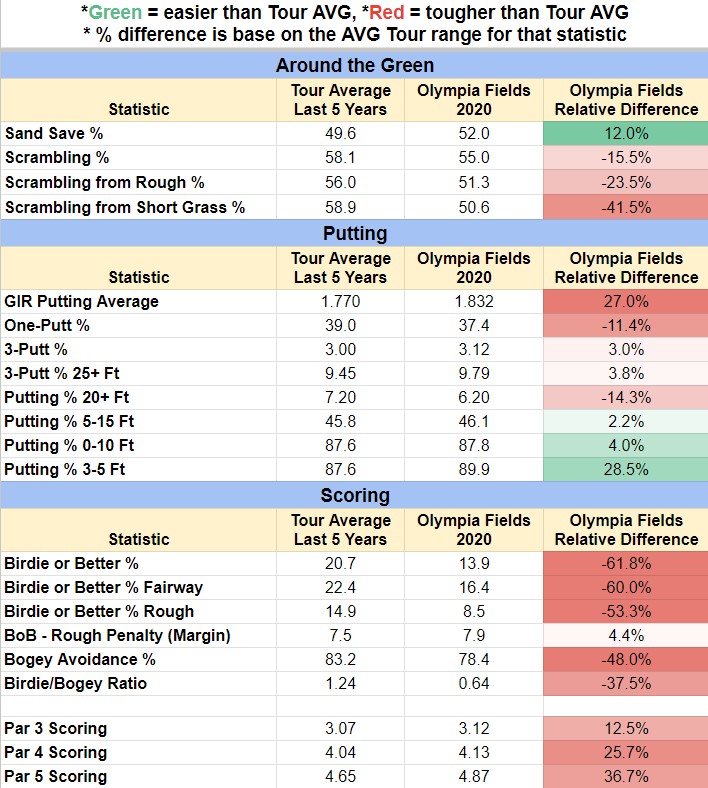
With such a low GIR%, short-game skill are an important tool in the bag this week. Players with elite scrambling skills and creativity on these treacherous green complexes should be able to gain some separation on the field. Scrambling from the rough as well as from short grass areas below these tabletop greens were much tougher than average back in 2020.
As seen in the chart above, the GIR putting average here in 2020 was relatively 27% tougher than the average PGA Tour course. The greens typically play quite firm and fast. They will run at a speedy 12.5 on the stimpmeter to start the week and will likely be close to 14 by Sunday.
While they don’t have any huge slopes, they are deceptively steep with numerous subtle undulations. While most modern greens are built with surface slopes ranging from 1.5-3%, older greens such as those at Olympia Fields often have slopes between 3-5% near the hole placements. Older greens are also typically “hand-finished” which leave smaller undulations in many areas that are difficult to see. This is a main reason these greens can play so unpredictable and will leave many a golfer frustrated when missing putts after getting the incorrect read on the line.
Most Important Stats For Success at Olympia Fields Country Club
*In order of importance
- Total Driving
- SG: Approach
- Scrambling (Tough Greens)
- Proximity: 125-175
- SG: Par 4
- Bogey Avoidance
- Good Drive % (Long Rough)
- SG: Difficult Scoring Courses
- SG: Putting
- Driving Distance
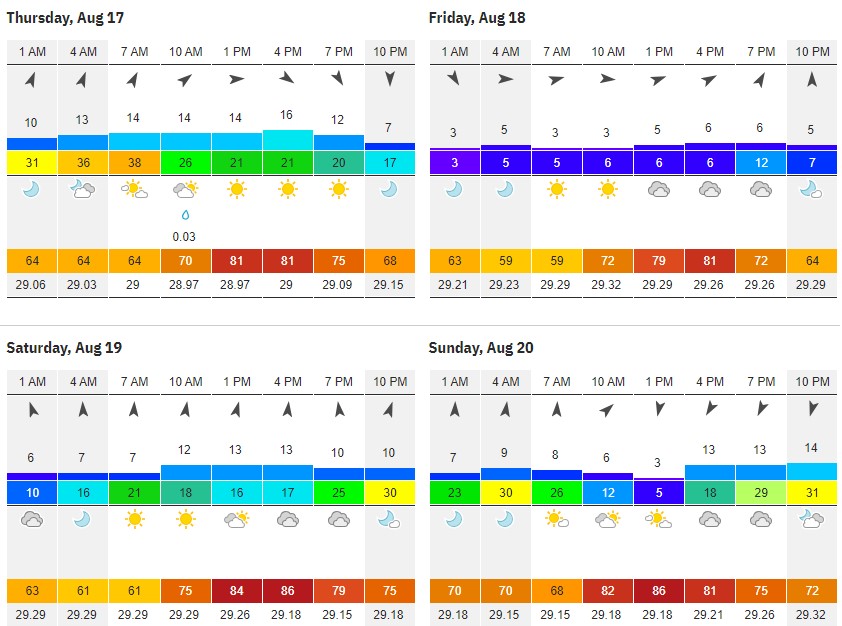
Weather Forecast – Olympia Fields, Illinois